
Ressources
Explorez une large gamme de ressources sur le GCED afin d’approfondir votre compréhension et de renforcer vos activités de recherche, de plaidoyer, d’enseignement et d’apprentissage.
3,790 résultats trouvés
 Discussion Papers Journal (Vol 3) Volume III presents a diverse group of authors writing on a wide range of topics. Among the contributors are academics, researchers, and sociologists, the chairman of a world-renowned Holocaust museum, the Special Advisers to the Secretary-General on the Prevention of Genocide and the Responsibility to Protect, a Hollywood filmmaker, and a former United Nations intern. They are from Canada, Denmark, Israel, Morocco, Senegal, Serbia, the United Kingdom and the United States. Their articles deal with a fascinating wide range of issues including Holocaust education in Denmark, and in Morocco; the International Holocaust Remembrance Alliance; music and the Holocaust; rescue; the preservation of former Nazi concentration and death camps; crimes committed against the Roma and Sinti during the Second World War; the post-Holocaust memory of German-Jewish achievements; and the prevention of atrocity crimes. (By the publisher) Discussion Papers Journal (Vol 3) Volume III présente un groupe diversifié d'auteurs écrivant sur un large éventail de sujets. Parmi les contributeurs sont des universitaires, des chercheurs et des sociologues, le président d'un musée de l'Holocauste de renommée mondiale, les Conseillers spéciaux du Secrétaire général sur la prévention du génocide et la responsabilité de protéger, un cinéaste d'Hollywood, et un ancien stagiaire des Nations Unies . Ils sont du Canada, le Danemark, Israël, le Maroc, le Sénégal, la Serbie, le Royaume-Uni et aux États-Unis. Leurs articles traitent d'un large éventail fascinant de questions, y compris l'Holocauste au Danemark et au Maroc; l'Alliance internationale Holocauste; la musique et l'Holocauste; porter secours; la préservation des anciens camps de concentration et d'extermination nazis; les crimes commis contre les Roms et les Sintis pendant la Seconde Guerre mondiale; la mémoire post-Holocauste des réalisations juifs allemands; et la prévention des crimes atroces. (Par l'éditeur)
  L'enseignement de la Shoah dans les écoles juives In this article, Katy Hazan studies the teaching of the Holocaust in Jewish schools. First, she portrays the educational systems of these specific schools and second, she establishes all the ethical, philosophical issues this theme entails. In the third part, she takes inventory of alternative ways of teaching the Holocaust, to conclude on the danger of emotional approaches. Teaching the Holocaust at a distance : reflections from the field As technology continues to improve and online learning programs continue to proliferate each year throughout the United States, it is necessary for teachers to establish a sound understanding of proper pedagogical techniques for a digital environment. This phenomenon has ushered in a new era of education, thus bringing forth a myriad of new questions and issues that must be addressed. For instance, how should online instructors properly transfer and teach traditional core subjects in an online milieu? Social studies educators are faced with additional quandaries, such as teaching democratic processes for effective citizenship and the teaching of controversial issues/topics like the Holocaust. Undeniably, controversial topics elicit strong emotions and come with a plethora of concerns that seem only possible to address in a face-to-face classroom. This current exploration draws upon the scholarship and experience of experts in the field of social studies education, distance learning, and Holocaust Studies to provide suggestions as to how teachers should approach controversial topics in a digital learning environment. An example lesson plan is also provided to showcase a successful integration of controversial issues into an online high school social studies classroom. (By the author)
  Seeing the world from today from a different viewpoint: The impact of the lessons from Auschwitz project on schools in Scotland Auschwitz remains the epitome of inhumanity and barbarism. In 2007, the Holocaust Educational Trust organised the first Lessons from Auschwitz (LFA) project for Scottish schools. Its participants were two plane-loads of Scottish pupils and teachers from 31 local authorities – typically two pupils from a school accompanied by a teacher. This research, funded by the Holocaust Educational Trust and the Pears Foundation, involved these participants being invited to complete an online questionnaire with selected follow-up interviews. The aims were to evaluate the LFA project and provide insight into the impact this project had on individuals, schools and communities. This paper will report on: Student evaluation of the LFA project ; The impact of the LFA project on individuals, schools and local communities. Conclusions as to the value of the LFA project in Scotland. (By the author)
  [Vidéo] Citoyenneté mondiale: citoyens du monde au 21e siècle Année de publication: 2016 Auteur institutionnel: Canadian Commission for UNESCO Des participants de la Conférence nationale des écoles UNESCO se sont exprimés sur la définition de la citoyenneté mondiale et sur les qualités d'un citoyen du monde. L’événement avait lieu dans le cadre de la 56e Assemblée générale annuelle de la Commission canadienne pour l’UNESCO et avait pour but de promouvoir le rôle de chef de file de l'UNESCO dans l'Agenda 2030 pour l'éducation. Cette vidéo a été produite au Musée canadien pour les droits de la personne, à Winnipeg, au Manitoba.
  [Vidéo] L'éducation à la citoyenneté mondiale et solidaire Année de publication: 2015 Auteur institutionnel: Îles de Paix Iles de Paix a produit ce petit film pour présenter ce qu’est l’éducation à la citoyenneté mondiale et solidaire aux futurs enseignants. Ceux-ci n’ont toutefois pas le monopole de l’action en cette matière. Chacun – qu’il soit enseignant ou non – peut en prendre connaissance avant d’agir, agir, et encore agir, sans relâche.
  Learning from genocide: a study in the failure of Holocaust education The importance of learning lessons from the Holocaust and from the mass slaughter in Rwanda was recognised in the theme underpinning Britain’s Holocaust Memorial Day in 2004. This article is principally concerned with the lessons learnt from the Holocaust by a culturally diverse group of students aged 14 to 16. They all attended schools in an outer London borough and were interviewed after taking part in a local event held to mark the 2004 commemoration. The article concludes with a discussion of the main findings of the investigation. (By the author)
 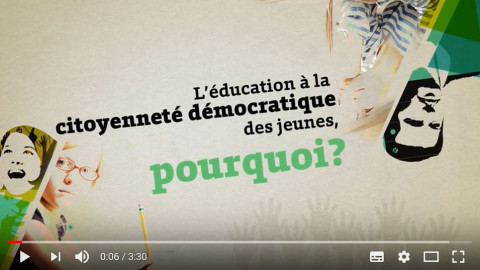 [Vidéo] L'éducation à la citoyenneté, pourquoi ? Année de publication: 2016 Auteur institutionnel: Le Centre interdisciplinaire de recherche sur la citoyenneté et les minorités (CIRCEM) Symposium Éducation et Démocratie « Former les citoyens de demain » Mémoire et pédagogie. Autour de la transmission de la destruction des Juifs d'Europe Based on qualitative interviews, "Memory and pedagogy" takes inventory of the representations and fears teachers can encounter when they broach the Holocaust, especially if their personal background echoes that part of history. The author then describes different postures they can adopt ‒ centred victim empathy, genocide as a general theme or focused on "lessons" from the past. This book, one of the first research projects on this topic in Switzerland, is a contribution to a collective reflection on the current and future transmission of the history and memory of the destruction of European Jews. (By the author - Translation)