
Ressources
Explorez une large gamme de ressources sur le GCED afin d’approfondir votre compréhension et de renforcer vos activités de recherche, de plaidoyer, d’enseignement et d’apprentissage.
3,790 résultats trouvés
 Holocaust Education and English Language Learner Students - Reflections on Teaching the Shoah Teaching the Holocaust involves confronting many challenges regardless of the setting involved. The complex nature of Holocaust history demands that students and teachers function at high intellectual levels as they study that history, and the need to determine how sensitive topics should be approached challenges educators in ways that are not present when teaching most other topics. Thus, any teaching of the Shoah places significant demands on teachers‘ content knowledge and pedagogical expertise. These demands increase when educators teach students whose backgrounds differ from those of the general population. Specifically, students whose language skills limit their understanding of texts and classroom dialogue face multiple challenges as they seek to learn within new school environments. Moreover, the distinctive cultural milieu and life experiences that form the frames of references from which these students approach the study of all social studies topics make it imperative that teachers build curricula that include culturally relevant perspectives in order to ensure that students are provided an opportunity to learn material at sophisticated levels. This paper considers how these factors influence the teaching of the Shoah in a Roman Catholic high school located in a major city in the western United States. More than 80% of the school’s students are either immigrants to the United States or members of the first generation of their families to be born in this country; thus, most students have been identified as English Language Learners (ELLs), a category used to determine if special language services should be provided to them. This paper overviews English language learning in the United States and teaching social studies to ELL students before discussing teaching the Holocaust in a parochial school whose primary focus is on teaching ELL students. (By the author - Introduction)
  Dialogue and Living Together: From Québec’s Ethics and Religious Culture Program to Democratic Deliberation Année de publication: 2013 Auteur: André Duhamel | Mireille Estivalèzes Auteur institutionnel: McGill University. Faculty of Education The idea of “living together” is a recurring concept in Quebec’s Ethics and Religious Culture program. It structures, through the promotion of dialog, the whole pedagogical and political project of the program, and so means much more than mere “coexistence.” This concept also extends outside the school system, in the political realm of democratic deliberation, which the program ultimately hopes to improve. We intend to examine this concept, using the disciplines of philosophy and education research, in order to show its educative meaning and political implications. Our hypothesis is that both dimensions refer to a common pedagogical paradigm that transcends the supposed dichotomy between ethics and politics.
  Le rôle des enseignants dans l’éducation et la démocratie : impacts d’un projet de recherche sur la perception de futurs enseignants Année de publication: 2015 Auteur: Gina Thésée | Paul R. Carr | Franck Potwora Auteur institutionnel: McGill University. Faculty of Education Cet article étudie les réflexions suscitées par un questionnaire d’enquête portant sur les liens entre l’éducation et la démocratie. Un échantillon de 157 étudiants d’un programme de formation initiale des enseignants à Montréal a répondu à un questionnaire de suivi (seconde étude) après avoir rempli un questionnaire d’enquête (première étude) portant sur leurs perceptions et leurs expériences des liens entre l’éducation et la démocratie. La première étude révèle une expérience démocratique faible et un parcours éducatif pratiquement sans lien avec la démocratie, ce qui concorde avec les résultats d’études antérieures. Cependant, les résultats du questionnaire de suivi indiquent que la participation à l’enquête a suscité des réflexions d’ordre socioéducatif, épistémologique, pédagogique et méthodologique, qui pourraient avoir des retombées significatives sur leur perception du rôle de l’enseignant. Challenging stereotypes and avoiding the superficial: A suggested approach to teaching the Holocaust Alison Kitson provides a rationale for a scheme of work for Year 9 (13-14 year olds). She argues that teachers should analyse the kind of historical learning that is taking place when the Holocaust is studied. Critical of the assumption that learning will take place as a result of exposure, she argues that teachers need to think about learning outcomes and to explore how these connect and support each other. She draws upon the types of historical thinking specified by the National Curriculum in England and shows how these can link up with areas of knowledge that pupils need if they are to understand the context of the Holocaust. Like Kate Hammond, she argues that emotional, human response and moral learning can and should be involved in teaching the Holocaust and that this can support ‒ rather than detract from ‒ rigorous historical analysis of sources and causes. (By the publisher)
 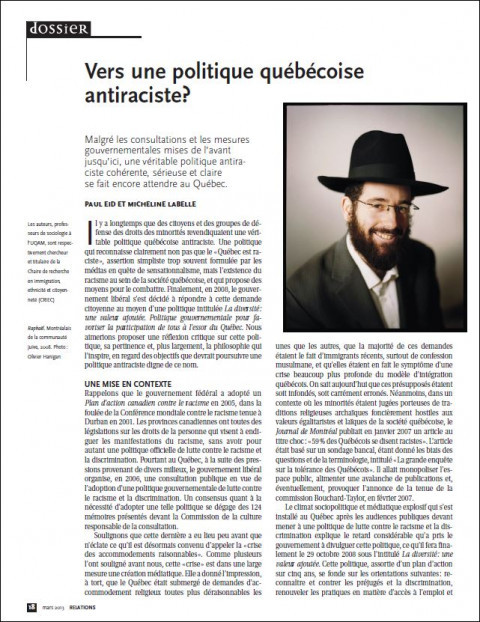 Vers une politique québécoise antiraciste? Année de publication: 2013 Auteur: Paul Eid | Micheline Labelle Auteur institutionnel: Relations Malgré les consultations et les mesures gouvernementales mises de l’avant jusqu’ici, une véritable politique antiraciste cohérente, sérieuse et claire se fait encore attendre au Québec.
  Citizen Participation, a Keystone of Social Change for the Public Library Année de publication: 2013 Auteur: Marie Désilets Auteur institutionnel: Revue Documentation et bibliothèques The concepts of "citizen participation" and "empowerment" are, at present, widely discussed. The authors begin this article by defining these concepts in order to link them to the social development of libraries. Thus, Montréal's public libraries, a knowledge city, adhere to the values associated with citizen participation such as openness, equality, inclusion, and innovation. Their activities help foster the citizen's autonomy and his or her participation in society. Examples of different types of clients will be put forward and the conditions necessary for citizen participation will be outlined. The authors will attempt to assess the impact of citizen participation from a sustainable development point of view. How can public libraries relate and contribute to the cultural component of Agenda 21 from a sustainable development perspective? Why is it relevant to invest and encourage citizen participation in libraries? What gains can be made in the long-term? Examples of social and urban development help further the analysis.
 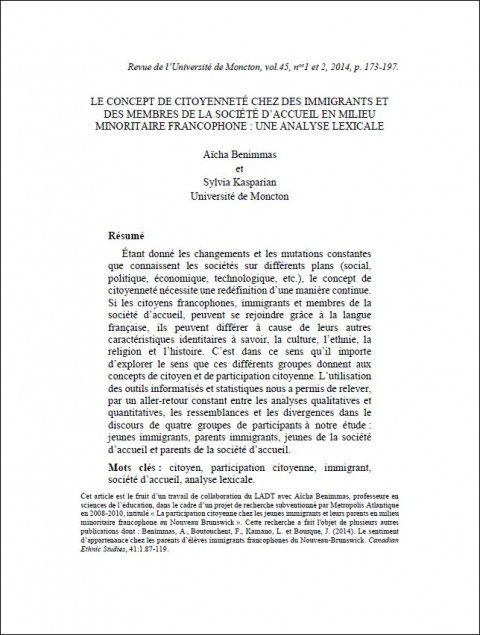 The Concept of Citizenship for Immigrants and Members of the Host Society within the Minority Francophone Context: A Lexical Analyse Année de publication: 2014 Auteur: Aïcha Benimmas | Sylvia Kasparian Auteur institutionnel: Revue de l’Université de Moncton Given the changes and constant mutations which occur in societies at the social, political, economic, technological, and educational levels, the concept of citizenship must be continually redefined. While French-speaking citizens, immigrants and members of the host society can find common ground thanks to the French language, they can also find differences because of other characteristics linked to their identity, such as culture, ethnic background, religion, and history. This is why we must analyze the meaning that these groups give to the concepts of citizenship and citizen participation, interpreting the differences and similarities that surface in their discourse regarding these two concepts. The use of computerized tools and statistics has enabled us to find through a constant comparison between qualitative and quantitative analyses-the perceptions, similarities, and divergences in the discourse of four groups of participants involved in our study: immigrant youth, immigrant parents, host society youth, and host society parents. Le concept de citoyenneté chez des immigrants et des membres de la société d’accueil en milieu minoritaire francophone : une analyse lexicale Année de publication: 2014 Auteur: Aïcha Benimmas | Sylvia Kasparian Auteur institutionnel: Revue de l’Université de Moncton Étant donné les changements et les mutations constantes que connaissent les sociétés sur différents plans (social, politique, économique, technologique, etc.), le concept de citoyenneté nécessite une redéfinition d’une manière continue. Si les citoyens francophones, immigrants et membres de la société d’accueil, peuvent se rejoindre grâce à la langue française, ils peuvent différer à cause de leurs autres caractéristiques identitaires à savoir, la culture, l’ethnie, la religion et l’histoire. C’est dans ce sens qu’il importe d’explorer le sens que ces différents groupes donnent aux concepts de citoyen et de participation citoyenne. L’utilisation des outils informatisés et statistiques nous a permis de relever, par un aller-retour constant entre les analyses qualitatives et quantitatives, les ressemblances et les divergences dans le discours de quatre groupes de participants à notre étude : jeunes immigrants, parents immigrants, jeunes de la société d’accueil et parents de la société d’accueil. The Role of Teachers in Education and Democracy: The Impact of a Research Project on Preservice Teacher Perceptions Année de publication: 2015 Auteur: Gina Thésée | Paul R. Carr | Franck Potwora Auteur institutionnel: McGill University. Faculty of Education This article presents reflections on a survey questionnaire related to the connection between education and democracy. A sample of 157 teacher-education students in Montreal completed a follow-up questionnaire after having participated in a research questionnaire (first study) concerning their perception and experience of the linkage between education and democracy. The first study underscored a weak democratic experience as well as an educational journey without a strong linkage to democracy, which concurs with our previous findings. However, the results of the follow-up survey indicate that participation in this inquiry generated socio-educational, epistemological, pedagogical, and methodological reflections, which could have significant implications for the perception of the role of educators. La participación ciudadana como pilar de un cambio social en la biblioteca pública Année de publication: 2013 Auteur: Marie Désilets Auteur institutionnel: Revue Documentation et bibliothèques Los conceptos de "participación ciudadana" y de "empoderamiento" se utilizan sin reserva en nuestras sociedades. En primer lugar, nos detendremos en la definición de estos conceptos para luego determinar la estrecha relación que existe entre estos términos y la función de desarrollo social de las bibliotecas. De hecho, las bibliotecas públicas de Montreal, ciudad culta, abrazan los valores inherentes a la participación ciudadana: apertura, igualdad, inclusión, innovación, etc. Asimismo, a través de sus actos, favorecen la autonomía del ciudadano y su participación activa en la vida en sociedad. Ofreceremos ejemplos concretos sobre los diferentes tipos de clientes y determinaremos cuales son las condiciones que favorecen la participación ciudadana. Por último, intentaremos evaluar los impactos que provocan estas acciones en una perspectiva de desarrollo sostenible: ¿Qué hacer para que las bibliotecas públicas se posicionen y colaboren con la Agenda 21 de la cultura en una perspectiva de desarrollo sostenible? ¿Por qué invertir en nuestras bibliotecas y alentar a nuestros ciudadanos a participar en ellas? ¿Cuál sería el resultado a largo plazo? La descripción de algunas experiencias, especialmente en el ámbito del desarrollo social y urbano, nos permitirá reflexionar sobre este tema.