
Ressources
Explorez une large gamme de ressources sur le GCED afin d’approfondir votre compréhension et de renforcer vos activités de recherche, de plaidoyer, d’enseignement et d’apprentissage.
2,162 résultats trouvés
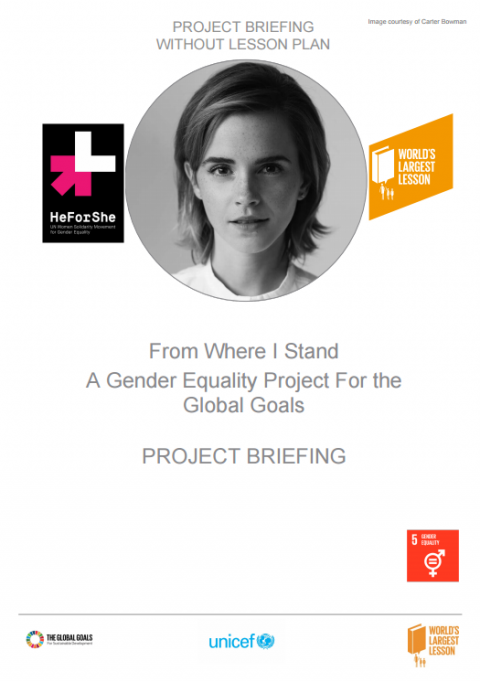 From Where I Stand: A Gender Equality Project for the Global Goals; Project Briefing Auteur institutionnel: United Nations Children's Fund (UNICEF) This project enables you to think about and contribute to encouraging women and girls to have equal opportunities to be heard and to have real opportunities to participate in all political, economic and public spheres.
 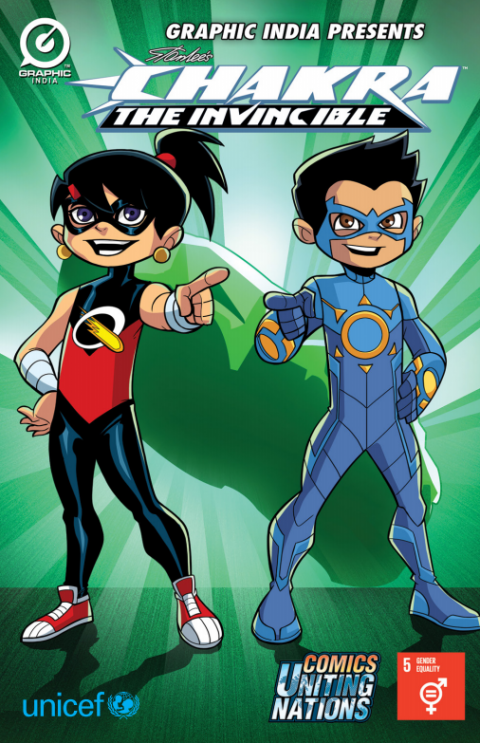 Chakra the Invincible; Gender Equality Année de publication: 2015 Auteur: Stan Lee | Sharad Devarajan | Gotham Chopra | Ashwin Pande | Jeevan J. Kang | Sesha Sainan Devarajan | Aditya Bidikar | Nilesh S. Mahadik Auteur institutionnel: Graphic India Pte. ltd | POW Entertainment The legendary Stan Lee and Sharad Devarajan bring their character Chakra the Invincible to teach children about the global goals! Chakra takes to the streets of Mumbai to teach children a lesson on gender equality and girls' empowerment.
 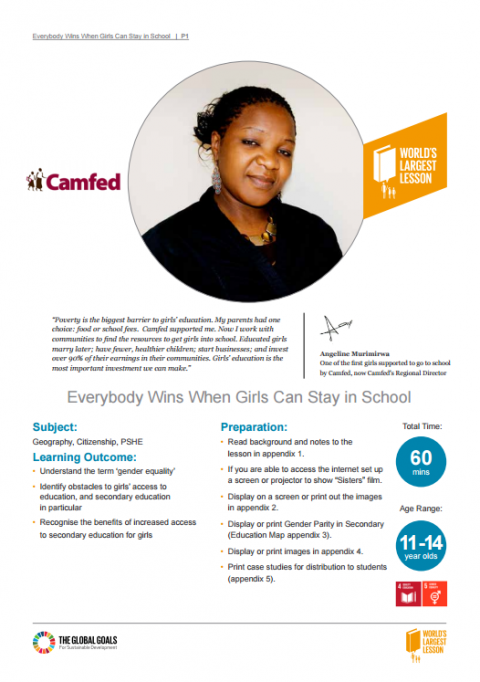 Everybody Wins When Girls Can Stay in School Auteur institutionnel: United Nations Children's Fund (UNICEF) World’s Largest Lesson is a collaborative education project to support the announcement of the United Nations Global Goals for Sustainable Development.Learning outcomes of the project: • Understand the term ‘gender equality’ • Identify obstacles to girls’ access to education, and secondary education in particular • Recognise the benefits of increased access to secondary education for girls
 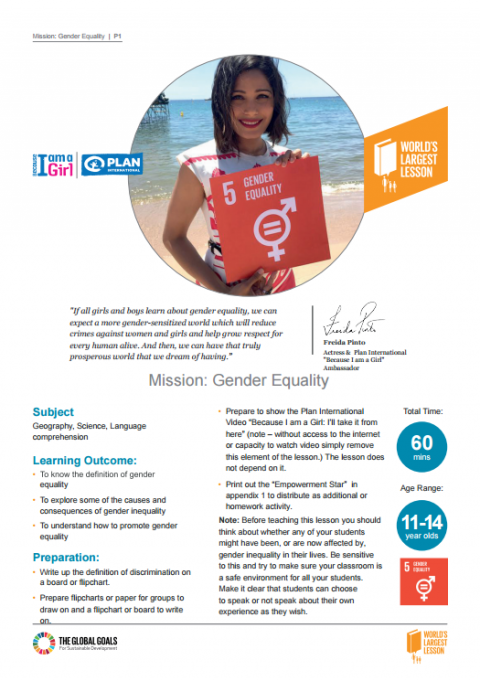 Mission: Gender Equality Auteur institutionnel: United Nations Children's Fund (UNICEF) World’s Largest Lesson is a collaborative education project to support the announcement of the United Nations Global Goals for Sustainable Development. Learning outcomes of the project: • To know the definition of gender equality • To explore some of the causes and consequences of gender inequality • To understand how to promote gender equality
 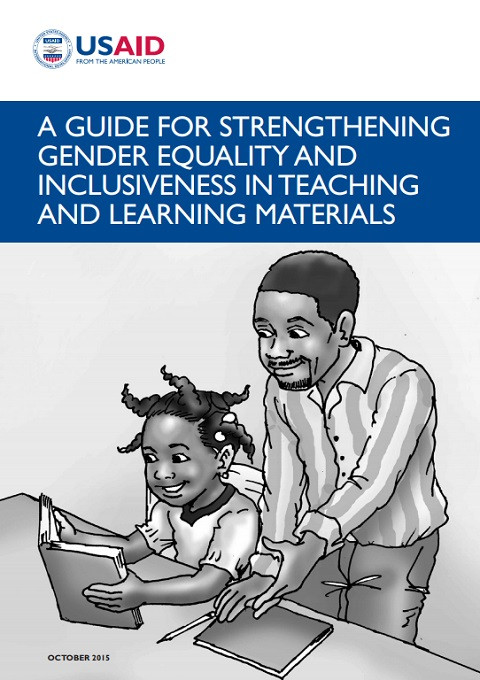 A Guide for Strengthening Gender Equality and Inclusiveness in Teaching and Learning Materials Année de publication: 2015 Auteur institutionnel: RTI International | United States Agency for International Development (USAID) The purpose of this guide is to provide guidance on how to represent members of all subgroups of a society in teaching and learning materials in equitable and non-stereotypical ways. Reviewers can use the strategies proposed in this guide to evaluate existing teaching and learning materials across primary and secondary levels. Authors or developers can employ the strategies to inform the development of new materials. This guide is organized according to themes that emerged from the review of relevant literature. Each theme reflects a particular type of bias that should be considered when evaluating or developing teaching and learning materials.
 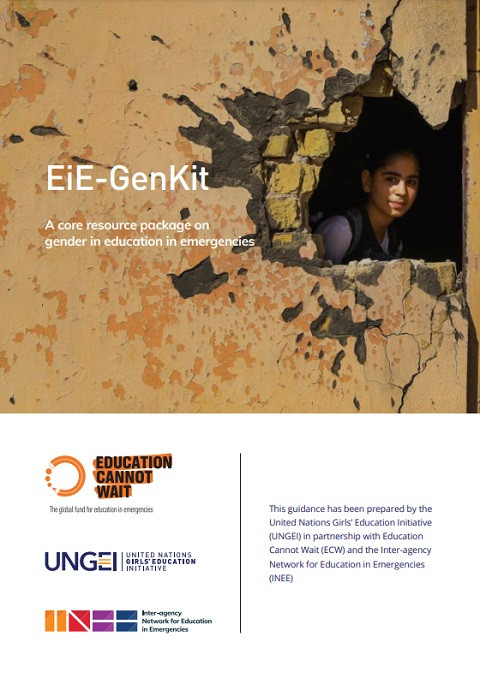 EiE-GenKit: A Core Resource Package on Gender in Education in Emergencies Année de publication: 2021 Auteur institutionnel: Education Cannot Wait (ECW) | Inter-agency Network for Education in Emergencies (INEE) | United Nations Girls' Education Initiative (UNGEI) When gender-responsive, quality education is available to all it has the potential to transform societies and build sustainable peace. A joint initiative from the Inter-agency Network for Education in Emergencies (INEE), Education Cannot Wait (ECW) and the UN Girls’ Education Initiative (UNGEI), the EiE-GenKit is a core resource package for gender in education in emergencies. The EiE-GenKit is the first resource of its kind, providing education practitioners with practical tools to promote gender-responsive programming from crisis to peace and sustainable development.The EiE-GenKit is based on extensive research and consultation with the latest resources, evidence, new tools and good practice available in one easy-to-use package. The EiE-GenKit builds on existing humanitarian processes for a streamlined approach to gender-responsive EiE. The EiE-GenKit offers tools for practical and immediate use including checklists, tipsheets and assessment templates supporting practitioners to ensure that each phase of an EiE intervention is gender-responsive. Bridging the gap between what we know about gender-responsive EiE and the tools we need to make it happen, the EiE-GenKit aims to promote improved gender and education outcomes of learners living in crises.
 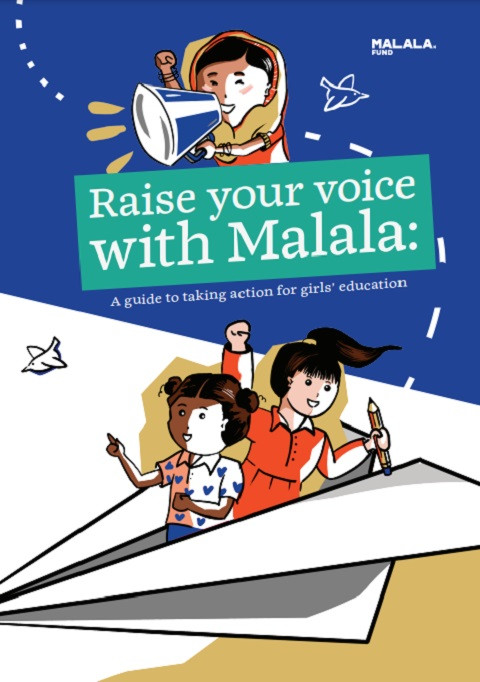 Raise Your Voice With Malala: A Guide to Taking Action for Girls’ Education Année de publication: 2018 Auteur: Emily Laurie | Eleanor Gall Auteur institutionnel: Malala Fund This guide gives young activists the tools to raise their voices and make change happen. Girls around the world are standing up in support of their out-of-school sisters and fighting to see every girl complete 12 years of free, safe, quality education. By taking action in their communities, girls can contribute to the peace and prosperity of our entire world. The guide includes real stories about girls around the world working to make sure all girls have the opportunity to go to school.
  Key Concepts: A Feminist Approach to Human Rights Education (Chapter 4) Année de publication: 2014 Auteur: Julie Maia Auteur institutionnel: Stanford Human Rights Education Initiative (SHREI) Developed for the Stanford Human Rights Education Initiative (SHREI), this curriculum project examines connections among Gender Studies, feminist theory, and human rights movements around the world. This SHREI project presents its four key concepts through four curricular units, or chapters, each with a series of activities that can easily be adapted for use in courses in many disciplines. Each chapter contains these elements: A definition of the key concept An example of the use of the concept in a human rights document A brief essay on the value of the concept for human rights education A series of activities that guide students in using gender, race/ethnicity/nation, and class as lenses for analyzing social justice issues include transnational and multicultural perspectives on gender and human rights issues use "best practices" pedagogies for teaching human rights topics in community colleges. Within each chapter, activities are orgaized from simple to complex. Most activities, however, have self-contained objectives and can be used independently of the others. Sections on “Extending the Learning” offer longer readings or in-depth material for advanced courses. The GCED Clearinghouse introduces only chapter 4, "global citizenship" of this SHERI project.
  Education for sustainable development country guidelines for changing the climate of teacher education to address sustainability: putting transformative education into practice Année de publication: 2011 Auteur institutionnel: UNESCO Jakarta This document on ESD Country Guidelines for TEIs is the result of the Regional Training Workshop Programme, titled “Developing Capacities of Teacher Education Institutions (TEIs) of Brunei Darussalam, Indonesia, Malaysia, Philippines and Timor-Leste in Reorienting Teacher Education to Address Sustainability” and has been developed by the five cluster countries of the UNESCO Office, Jakarta. The developed guidelines ultimately aim to reorient each country's curriculum, policies, standard practices and programmes to address sustainability and implement it in a tangible way. Although many idealistic descriptions of sustainability and sustainability education exist, faculties of education must decide which themes should receive particular focus and create their own guidelines and design criteria on this specific area. Therefore, these ESD Country Guidelines are significant initial steps to ensuring teacher education programmes fit the environmental, social, cultural and economic conditions and goals of each country's communities, regions and nations. Lignes directrices pour l'éducation au service du développement durable pour changer le climat de la formation des enseignants pour aborder la durabilité: mettre en pratique l'éducation transformatrice Année de publication: 2011 Auteur institutionnel: UNESCO Jakarta Le présent document sur EDD pour les Institutions de Formations des Enseignants (IFE) est le résultat du Programme régional d'ateliers de formation intitulé «Développer les capacités des établissements d'enseignement de Brunei Darussalam, de l'Indonésie, de la Malaisie, des Philippines et du Timor-Leste pour réorienter la formation des enseignants pour la durabilité» et a été développé par les cinq pays du Bureau de l'UNESCO à Jakarta. Les lignes directrices élaborées visent en fin de compte à réorienter les programmes, les politiques, les pratiques et les programmes standard de chaque pays en vue d'aborder la durabilité et de la mettre en œuvre de façon tangible. Bien que de nombreuses descriptions idéalistes de la durabilité et de l'éducation en matière de durabilité existent, les facultés d'éducation doivent décider quels thèmes devraient recevoir une attention particulière et créer leurs propres lignes directrices et critères de conception dans ce domaine spécifique. Par conséquent, ces EDD directrices sont des étapes importantes pour assurer que les programmes de formation des enseignants correspondent aux conditions et aux objectifs environnementaux, sociaux, culturels et économiques des communautés, des régions et des nations de chaque pays.