
Ressources
Explorez une large gamme de ressources sur le GCED afin d’approfondir votre compréhension et de renforcer vos activités de recherche, de plaidoyer, d’enseignement et d’apprentissage.
1,322 résultats trouvés
 Центральная Азия и Монголия. Субрегиональная экспертная встреча ОБСЕ по вопросам недопущения насилия в отношении женщин и девочек Année de publication: 2021 Auteur institutionnel: Organization for Security and Co-operation in Europe (OSCE) В 2020 году Отдел Секретариата ОБСЕ по гендерным вопросам организовал серию субрегиональных экспертных встреч с целью оценки прогресса осуществления обязательств ОБСЕ по предотвращению и борьбе с насилием в отношении женщин и девочек.Отчет содержит данные о результатах встреч, которые были направлены на обмен информацией и определение сфер прогресса, а также сохраняющиеся проблемы по вопросам гендерного насилия.
  Uzbekistan: Failure to Protect Women from Domestic Violence (CEDAW submission) Année de publication: 2022 Auteur institutionnel: International Partnership for Human Rights (IPHR) This piece focuses on the problem of domestic violence against women in Uzbekistan. It identifies protection gaps in both domestic law as well as in practice, and makes recommendations to the government of Uzbekistan in anticipation of the Committee on the Elimination of Discrimination against Women (CEDAW Discrimination against Women (CEDAW) periodic report of Uzbekistan on the implementation of Convention on the Elimination of All Forms of Discrimination against Women. Узбекистан: неспособность защитить женщин от домашнего насилия (представление CEDAW) Année de publication: 2022 Auteur institutionnel: International Partnership for Human Rights (IPHR) В этом материале основное внимание уделяется проблеме домашнего насилия в отношении женщин в Узбекистане. В нем выявляются пробелы в защите как во внутреннем законодательстве, так и на практике, и даются рекомендации правительству Узбекистана в преддверии рассмотрения Комитетом по Ликвидации Дискриминации Женщин (КЛДЖ) (Committee on the Elimination of Discrimination against Women (CEDAW)) периодического доклада Узбекистана о выполнении Конвенции о ликвидации всех форм дискриминации в отношении женщин.
  Prospects for Ensuring Human Rights and Freedom in Uzbekistan Année de publication: 2022 Auteur: F.F. Khatamov This scientific article analyzes the trends in ensuring human rights and freedoms in Uzbekistan. It is emphasized that the category of human rights is not only a universal human value, but also has national and mental characteristics. The National Strategy of the Republic of Uzbekistan on Human Rights has also been studied and analyzed. Перспективы обеспечения прав и свобод человека в Узбекистане Année de publication: 2022 Auteur: F.F. Khatamov В данной научной статье анализируются тенденции обеспечения прав и свобод человека в Узбекистане. Подчеркивается, что категория прав человека является не только общечеловеческой ценностью, но и имеет национальные и ментальные характеристики. Также изучена и анализирована Национальная стратегия Республики Узбекистан по правам человека.
  Tajikistan 2016-2021 3rd Cycle Universal Periodic Review on Human Rights Prepared by Civil Society Organizations of the Republic of Tajikistan Année de publication: 2021 Auteur institutionnel: Bureau of Human Rights and Rule of Law (BHR) The review was prepared by civil society organizations of the Republic of Tajikistan and covers the period 2016-2021. In preparing the review were used: open statistical data, national and international reports, media materials, international standards, national legislation and other open sources. Таджикистан 2016-2021 3-й цикл Универсальный периодический обзор по правам человека, подготовленный организациями гражданского общества Республики Таджикистан Année de publication: 2021 Auteur institutionnel: Bureau of Human Rights and Rule of Law (BHR) Обзор подготовлен организациями гражданского общества Республики Таджикистан и охватывает период 2016-2021 годы. При подготовке обзора были использованы: открытые статистические данные, национальные и международные отчеты, материалы средств массовой информации, международные стандарты, национальное законодательство и другие открытые источники.
  What Do We Work for? Année de publication: 2022 Auteur institutionnel: CuriosaMente In this video he presents us the objective of working and how it humanizes or dehumanizes us. It shows how the perspective on work has been changing as time goes by and its meaning for our lives and for the world. ¿Para que trabajamos? Année de publication: 2022 Auteur institutionnel: CuriosaMente En este video nos presenta el objetivo de trabajar y como nos humaniza o deshumaniza. Muestra como la perspectiva sobre el trabajo ha venido cambiando a medida que avanzan los tiempos y su sentido para nuestras vidas y para el mundo.
 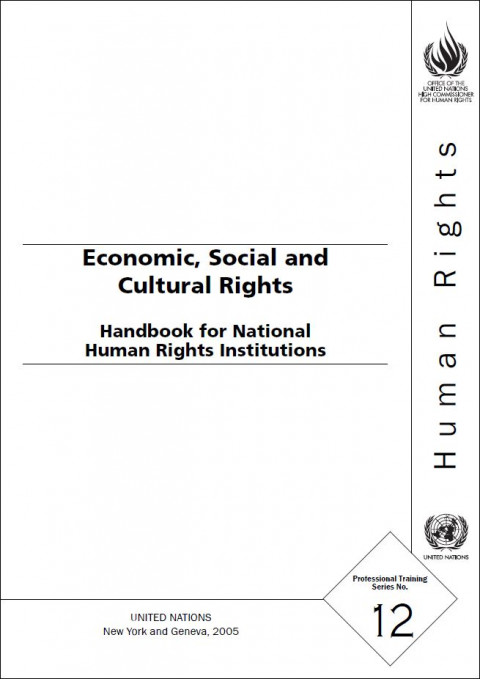 Economic, Social and Cultural Rights: Handbook for National Human Rights Institutions (Professional Training Series No.12) Année de publication: 2005 Auteur institutionnel: UN. Office of the United Nations High Commissioner for Human Rights (UN. OHCHR) This publication reviews economic, social and cultural human rights. It is a guide to national institutions produced by the United Nations. The guide is a reference in all matters related to human rights to create a decent life for people, and to clarify the role that governments should play in this regard.This handbook is intended to help national human rights institutions maximize the effectiveness of their functions and powers in addressing economic, social and cultural rights. Its aim is to assist national human rights institutions in the development of policies, processes and skills to integrate economic, social and cultural rights further into their work, thereby enabling them to address poverty and development, for example, through an economic, social and cultural rights framework.This handbook will discuss ways in which national human rights institutions can become more effective in protecting and promoting economic, social and cultural rights. It will examine how national institutions’ legal mandates can be interpreted to incorporate economic, social and cultural rights within their jurisdictions, how their functions and powers can be exercised more appropriately in regard to these rights, how they can use their resources most efficiently and effectively and how they can implement economic, social and cultural rights in the political and social contexts in which they operate.