
Ressources
Explorez une large gamme de ressources sur le GCED afin d’approfondir votre compréhension et de renforcer vos activités de recherche, de plaidoyer, d’enseignement et d’apprentissage.
3,790 résultats trouvés
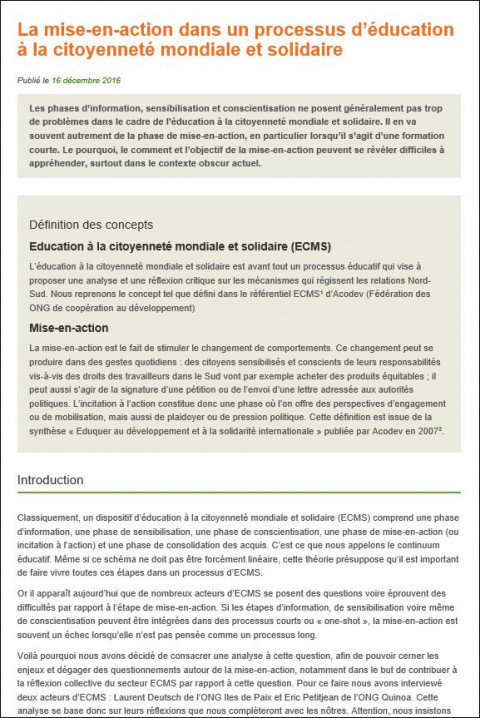 La mise-en-action dans un processus d’éducation à la citoyenneté mondiale et solidaire Année de publication: 2016 Auteur: Hugo Roegiers Auteur institutionnel: OXFAM-Magasins du monde Les phases d’information, sensibilisation et conscientisation ne posent généralement pas trop de problèmes dans le cadre de l’éducation à la citoyenneté mondiale et solidaire. Il en va souvent autrement de la phase de mise-en-action, en particulier lorsqu’il s’agit d’une formation courte. Le pourquoi, le comment et l’objectif de la mise-en-action peuvent se révéler difficiles à appréhender, surtout dans le contexte obscur actuel.
 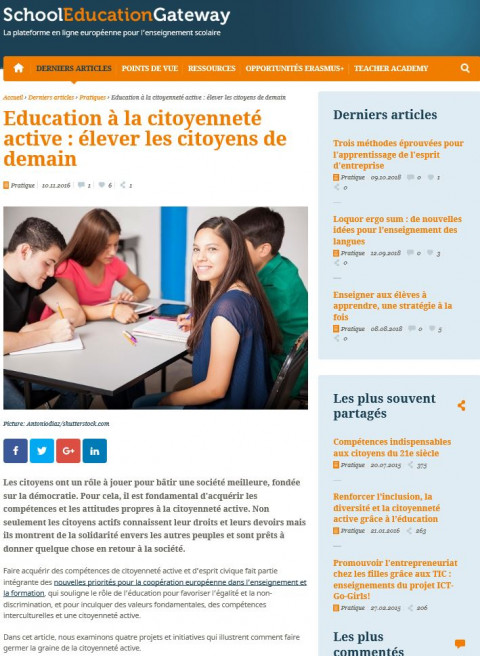 Éducation à la citoyenneté active: élever les citoyens de demain Année de publication: 2016 Auteur institutionnel: Centre européen Wergeland Les citoyens ont un rôle à jouer pour bâtir une société meilleure, fondée sur la démocratie. Pour cela, il est fondamental d'acquérir les compétences et les attitudes propres à la citoyenneté active. Non seulement les citoyens actifs connaissent leur droits et leurs devoirs mais ils montrent de la solidarité envers les autres peuples et sont prêts à donner quelque chose en retour à la société.Faire acquérir des compétences de citoyenneté active et d’esprit civique fait partie intégrante des nouvelles priorités pour la coopération européenne dans l’enseignement et la formation, qui souligne le rôle de l’éducation pour favoriser l’égalité et la non-discrimination, et pour inculquer des valeurs fondamentales, des compétences interculturelles et une citoyenneté active. Dans cet article, nous examinons quatre projets et initiatives qui illustrent comment faire germer la graine de la citoyenneté active.
 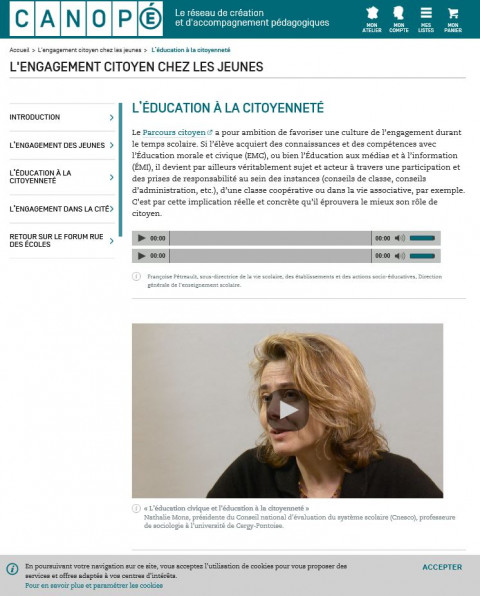 L’ÉDUCATION À LA CITOYENNETÉ Auteur: Nathalie Mons | Éric Favey | Jean-Michel Zakhartchouk Auteur institutionnel: CANOPé Le Parcours citoyen a pour ambition de favoriser une culture de l’engagement durant le temps scolaire. Si l’élève acquiert des connaissances et des compétences avec l’Éducation morale et civique (EMC), ou bien l’Éducation aux médias et à l’information (ÉMI), il devient par ailleurs véritablement sujet et acteur à travers une participation et des prises de responsabilité au sein des instances (conseils de classe, conseils d’administration, etc.), d’une classe coopérative ou dans la vie associative, par exemple. C’est par cette implication réelle et concrète qu’il éprouvera le mieux son rôle de citoyen.
  Les chemins de l'éducation à la citoyenneté Année de publication: 2017 Auteur: Franziska Flucke Auteur institutionnel: La Clé des Langues Personne ne naît « bon démocrate », c’est un processus d’apprentissage durant lequel l’école joue un rôle extrêmement important. Chaque démocratie a besoin d’une éducation à la citoyenneté afin que les futures générations apprennent à exercer de manière compétente et autonome leurs droits démocratiques. Dans cet article seront présentées les différentes variantes de l'enseignement de l'éducation civique dans les Länder de la République fédérale d’Allemagne, avant d’aborder le système scolaire allemand en général afin de pouvoir montrer dans une troisième partie quelques exemples plus concrets qui illustrent l’éducation à la citoyenneté plus en détail. Ainsi, nous étudierons les chemins que les jeunes Allemands doivent suivre afin de devenir de bons démocrates, des citoyens de leur pays, mais aussi des habitants de leur Land comme le Bade-Wurtemberg.
 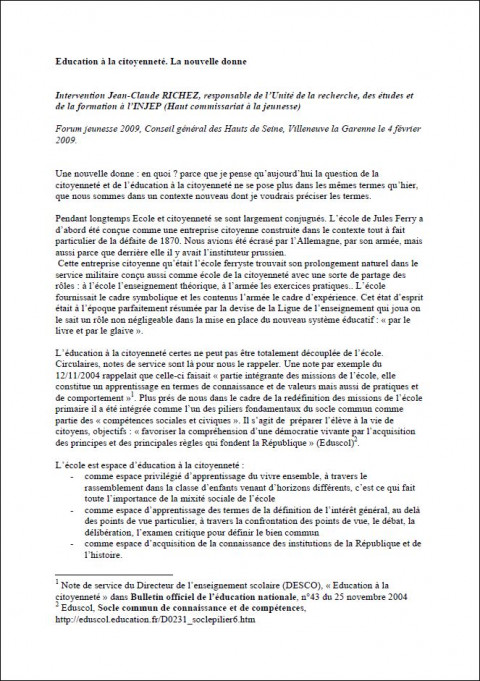 Éducation à la citoyenneté. La nouvelle donne Année de publication: 2009 Auteur: Jean-Claude Richez Auteur institutionnel: Haut commissariat à la jeunesse «Je pense qu'aujourd'hui, la question de la citoyenneté et de l'éducation à la citoyenneté ne se pose plus dans les mêmes termes qu'hier. (...) Nous sommes dans un contexte nouveau dont je voudais préciser les termes.»Selon Jean-Claude Richez1, la prise en compte de la dimension non formelle de l'éducation à la citoyenneté est un enjeu fondamenal dans la société d'aujourd'hui. Il a précisé pourquoi lors d'une intervention au forum jeunesse organisé par le conseil général des Hauts-de-Seine.
  Les établissements d’enseignement supérieur et l’éducation à la citoyenneté mondiale Année de publication: 2013 Auteur: Vera Jelinek Auteur institutionnel: Chronique ONU Bien que l’expression « citoyen du monde » soit très ancienne, elle n’a trouvé écho que depuis ces dernières décennies dans les cercles universitaires. C’est un objectif de nombreuses déclarations de mission et également une manière de vivre, une conscience de soi non pas comme personne isolée, mais comme personne liée étroitement aux autres. De crainte que l’usage commun de cette expression ne devienne un cliché, je pense qu’il nous incombe en premier lieu de définir, bien que de manière générale, ce que nous entendons par citoyen du monde. Est-ce un sentiment partagé d’une identité mondiale, même si les êtres humains ne se reconnaissent pas encore comme des membres d’une communauté mondiale ? Est-ce un engagement à certaines valeurs universelles communes ? Ou est-ce une façon d’aborder, d’accepter et d’essayer de résoudre les défis mondiaux en s’inscrivant dans une perspective plus large et plus inclusive que celle qui, jusqu’à récemment, plaçait les États souverains au cœur du discours mondial ? En ce qui concerne les établissements d’enseignement supérieur et ce qu’ils proposent, nous nous concentrerons sur la dernière définition que nous avons appliquée dans notre université.
 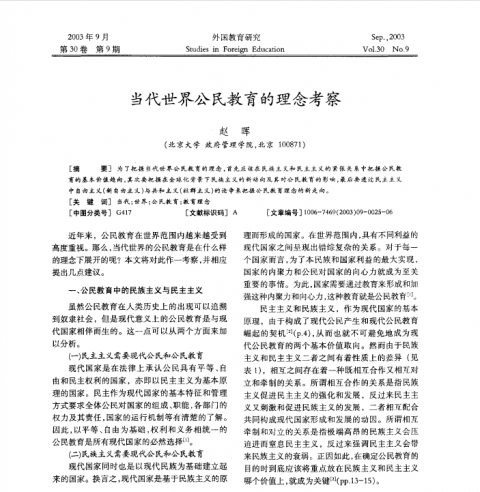 当代世界公民教育的理念考察 Année de publication: 2003 Auteur: Zhao Hui 为了把握当代世界公民教育的理念,首先应该在民族主义和民主主义的紧张关系中把握公民教育的基本价值趋向,其次要把握在全球化背景下民族主义的新动向及其对公民教育的影响,最后要透过民主主义中自由主义(新自由主义)与共和主义(社群主义)的论争来把握公民教育理念的新走向。
 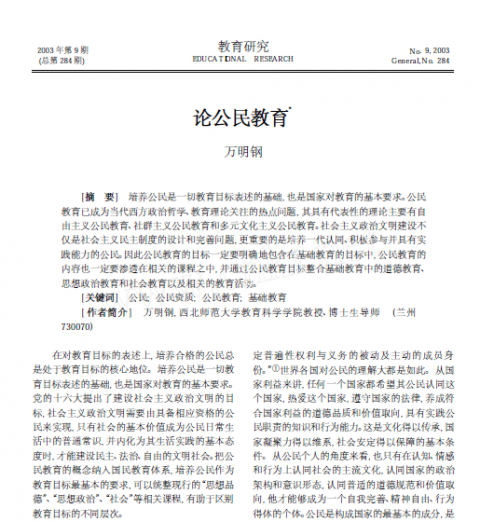 On Citizenship Education Année de publication: 2003 Auteur: Wan Minggang Cultivation of citizens is the basis of all educational objectives and the State's basic requirement for eductaion. Citizenship education has become a hot issue at tracting the solicitude of modern Western political philosophy and educational theories. The citizenship education is characterized by its representative theories of liberalist citizenship education, corporatist citizenship education and muticulturalist citizenship eduction. The construction of socialist politics and civilization not only involves the designing and optimization of socialist democratic system, but also concerns the cultivation of citizens with strong sense of participation and practical ability. Therefore, the aim of citizenship eduction must be clearly included in the objectives of basic education and the content of citizenship education must be reflected in relevant courses. The objectives of citizenship education should be used to integrate moral education, ideological and political education, social education and relevant educational activities in basic education. 论公民教育 Année de publication: 2003 Auteur: Wan Minggang 培养公民是一切教育目标表述的基础,也是国家对教育的基本要求。公民教育已成为当代西方政治哲学、教育理论关注的热点问题,其具有代表性的理论主要有自由主义公民教育、社群主义公民教育和多元文化主义公民教育。社会主义政治文明建设不仅是社会主义民主制度的设计和完善问题,更重要的是培养一代认同、积极参与并具有实践能力的公民。因此公民教育的目标一定要明确地包含在基础教育的目标中,公民教育的内容也一定要渗透在相关的课程之中,并通过公民教育目标整合基础教育中的道德教育、思想政治教育和社会教育以及相关的教育活动。
  World Development Report 2018 and Its Policy Implications for Education Development in China Année de publication: 2018 Auteur: Liu Ji 2018 comprehensively describes a crisis that is looming worldwide: Schooling does not equalize learning. Drawing on key insights from the report, this study provides a high—level summary and relates the findings to common and critical issues that China is today. Specifically, this study highlights five important policy implications for education development in China: Education quality monitoring, adaptive policies, evidence-based decision, expanding human capital investments, and building stronger ties with international organizations.