
Ressources
Explorez une large gamme de ressources sur le GCED afin d’approfondir votre compréhension et de renforcer vos activités de recherche, de plaidoyer, d’enseignement et d’apprentissage.
2,781 résultats trouvés
 全球公民社会与全球公民教育 Année de publication: 2014 Auteur: Feng Jianjun 全球化时代产生全球公民社会,全球公民社会需要全球公民。全球公民不仅生活在全球化时代,更要具有全球意识和人类关怀,并愿意为世界的和平与人类的发展、全球的公平与正义、人与自然的可持续发展采取积极的行动。培养负责任的全球公民,是全球化时代赋予公民教育的新使命。全球公民教育,就是培养具有全球意识并愿意为全球和人类的发展而积极行动的负责任的公民的教育,包括人权和人道主义教育、全球意识和全球责任教育、环境和可持续发展教育、国际理解教育与多元文化教育。
  The Concept, Values and Implementation Models of GCED Année de publication: 2013 Auteur: Lu Lihua, Jiang Junhe “Global Citizenship education” aims to cultivate global citizens with an international perspective and global awareness. At present, there are more and more countries focusing on developing the core education value including” equity and justice”, “survival and development” and “democracy and rationality” and builds the global citizenship education network. “全球公民”教育基本内涵、价值诉求与实践模式 Année de publication: 2013 Auteur: Lu Lihua, Jiang Junhe “全球公民”教育旨在培养具有国际视野和全球意识的世界公民。当前,世界各国逐渐确立了以“公平与正义”、“生存与发展”、“民主与理性”为核心的“全球公民”教育价值诉求,实施“全球公民”教育的立体化教育网络也正在一些国家和地区悄然形成。
 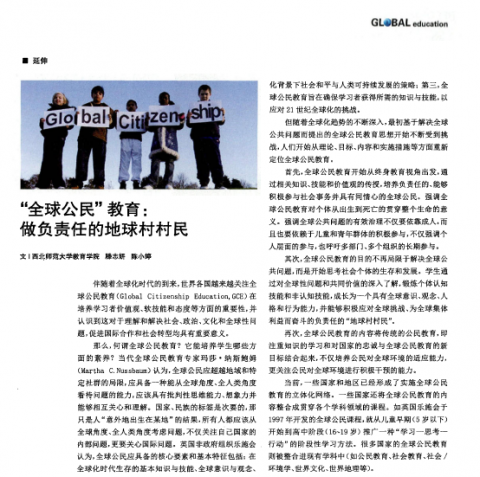 GCED towards Responsible villagers of the Global Village Année de publication: 2015 Auteur: Teng Zhiyan, Chen Xiaoting Global citizenship education has attracted an increasing attention in global era. This essay briefly introduce the definition of global citizenship education and how to develop it in today's society. This article believe that cultivating global citizens not only is a trend, but also is an important result of globalization. “全球公民”教育做负责任的地球村村民 Année de publication: 2015 Auteur: Teng Zhiyan, Chen Xiaoting 在全球化时代,全球公民教育得到了越来越多的关注。本文简单介绍了全球公民教育的定义以及当今社会如何发展全球公民教育。文章认为培养全球公民不仅是一种趋势,更是全球化的重要产物。
  The National Youth White Paper on Global Citizenship Année de publication: 2015 Auteur institutionnel: Centre for Global Citizenship Education and Research (CGCER) On March 20, 2015, over 400 students from five high schools across Canada, in partnership with the Centre for Global Citizenship Education, The Centre for Global Education and TakingITGlobal, came together to collaborate, through the use of technology, in a Virtual Town Hall to discuss the youth’s vision for Global Citizenship Education. From Alberta to Ontario, downtown Toronto to Yellowknife, the youth of Canada exchanged ideas, debated alternatives, and ultimately created a document that represents their voice on the relationship Canadians should have with the rest of the world. The Virtual Town Hall, an “archetype of grassroots democracy,” (Senator Grant Mitchell) was the culmination of over a month of online teamwork, 2000 hours of student collaboration, over 100 hours of teacher facilitation, and the passion of over 1000 youth to engage in a national conversation and have their voices heard.In the month prior to the Virtual Town Hall, student leaders, systematically chosen from each school to represent Canada’s diverse geographic and demographic population, met on a weekly basis to exchange ideas, work with and listen to experts, and create a common framework. Concurrently, the students were trained to use an arsenal of Web 2.0 tools (YouTube, Twitter, cell phone voting, Google Docs, H.323 Video Conference, discussion boards, blogs, etc.) to collaborate, build consensus, and create community regardless of time or location.Equipped with this knowledge and empowered through online technology, the student leaders facilitated a full-day virtual town hall. In the morning, 400 youth peers engaged in a dialogue with local and international experts. Following this session, the youth participated in breakout groups to address three critical questions: What are our obligations as global citizens? What are the rights and responsibilities that we have? To what extent can well-intentioned global citizenship initiatives reinforce or resist power inequities? What types of policies/practices will enable/facilitate global citizenship? The National Youth White Paper on Global Citizenship, written collaboratively by Canadian students, is the direct result of this full-day, interactive event. The evolution of the document involved equipping leaders with knowledge and technology, having those leaders facilitate a larger conversation among their peers, taking the data generated to their community at large for feedback and direction, and then synthesizing the results in the student white paper. It represents the voices of over one thousand youth, introduced to the complexities of global citizenship education, unified through the power of 21st century technology, and sharing a passion to contribute to the dialogue taking place on the future of Canada and its relationship to the rest of the world. Le Livre blanc de la jeunesse nationale sur la citoyenneté mondiale Année de publication: 2015 Auteur institutionnel: Centre for Global Citizenship Education and Research (CGCER) Le 20 Mars, 2015, plus de 400 élèves de cinq écoles secondaires à travers le Canada, en partenariat avec le Centre d'éducation à la citoyenneté mondiale, le Centre for Éducation globaleet TakingITGlobal, se sont réunis pour collaborer, par l'utilisation de la technologie, dans une salle virtuelle ville pour discuter de la vision de la jeunesse pour l'éducation sur la citoyenneté mondiale. De l'Alberta à l'Ontario, le centre-ville de Toronto à Yellowknife, la jeunesse du Canada a échangé des idées, débattre des solutions de rechange, et, finalement, a créé un document qui représente leur voix sur les relations Canadiens devraient avoir avec le reste du monde. Le Virtual Town Hall, un «archétype de la démocratie de base» (le sénateur Grant Mitchell) est l'aboutissement de plus d'un mois de travail d'équipe en ligne, 2000 heures de la collaboration des élèves, plus de 100 heures de facilitation des enseignants, et la passion de plus de 1000 jeunes engager dans une conversation nationale et faire entendre leurs voix dans le mois précédant l'Hôtel virtuel Ville, les leaders étudiants, systématiquement choisis parmi chaque école pour représenter la diversité population géographique et démographique du Canada, se sont réunis sur une base hebdomadaire pour échanger des idées, travailler avec et écouter les experts, et de créer un cadre commun. En même temps, les étudiants ont été formés à l'utilisation d'un arsenal d'outils Web 2.0 (YouTube, Twitter, téléphone cellulaire vote, Google Docs, H.323 Vidéo Conférence, forums de discussion, les journaux, etc.) pour collaborer, établir un consensus et créer une communauté quelle que soit de temps ou de lieu. Equipé de cette connaissance et le pouvoir grâce à la technologie en ligne, les leaders étudiants ont facilité une mairie virtuelle d'une journée complète. Dans la matinée, 400 pairs de jeunes engagés dans un dialogue avec des experts locaux et internationaux. Suite à cette session, les jeunes ont participé à des groupes de petits groupes pour répondre à trois questions essentielles: 1. Quelles sont nos obligations en tant que citoyens du monde? Quels sont les droits et les responsabilités que nous avons? 2. Pour les initiatives de citoyenneté mondiale dans quelle mesure peut bien intentionnés renforcer ou résister à des inégalités de pouvoir? 3. Quels types de politiques / pratiques permettront / faciliter la citoyenneté mondiale. Le Livre blanc de la jeunesse nationale sur la citoyenneté mondiale, écrite en collaboration par les étudiants canadiens, est le résultat direct de cette journée complète, événement interactif. L'évolution du document impliqué équipant les dirigeants ayant des connaissances et de la technologie, ayant ces dirigeants facilitent une plus grande conversation entre leurs pairs, en prenant les données générées à leur communauté dans son ensemble pour la rétroaction et la direction, et ensuite la synthèse des résultats dans le livre blanc de l'étudiant. Elle représente les voix de plus de mille jeunes, présenter à la complexité de l'éducation à la citoyenneté mondiale, unifiée par la puissance de la technologie du 21e siècle, et le partage de la passion de contribuer au dialogue qui se déroule sur l'avenir du Canada et de sa relation avec le reste du monde.
  Global citizenship education: the school as a foundation for a fair world Année de publication: 2009 Auteur institutionnel: Conectando Mundos Consortium (Cidac, inizjamed, Intermon Oxfam, Ucodep) This publication is based on an initiative about the development education, intercultural education, popular education, the education of values, human rights education, education for sustainability, education for peace, education for gender equality, etc. The pedagogical proposal of Global Citizenship Education aspires to integrate in a coherent and challenging vision all these themes, keeping them in a close relationship with one another and taking into consideration the (increasing) interdependence of human beings living in a planet whose sustainability is under threat. This book is the fruit of a process that was triggered off by the joint effort of four European development NGOs, namely Cidac, Inizjamed, Intermón Oxfam and Ucodep within the frame of a project co-financed by the European Commission. These organisations set for themselves the objective to promote the acknowledgment and the inclusion of the contents and the methodology of Global Citizenship Education in the formal educational contexts in their respective countries, in order to kick-start a process of change in attitudes, values, and the beliefs of the pupils. Thanks to the initiative and efforts of the above-mentioned four organisations, and through various meetings and seminars carried out over the last three years in Spain, Italy, Portugal and Malta, groups of educators have been able to come face-to-face with each other, exchange experiences and reflect on the role of formal education with respect to the challenges of our times. Among the other experiences, the publication contains that of a key moment in the process. This took place in July 2008 in Cortona, a small and beautiful Tuscan city close to the border with Umbria, and in which many educators shared the benefit of what was the first international encounter of educators for global citizenship. The Cortona experience, in which around ninety teachers coming from Spain, Portugal, Malta, Italy, the Dominican Republic and Costa Rica have participated, was one of the stages – the starting point, in fact – of a process and a relationship that it is our aim to develop at the regional, national and international levels. In this publication, therefore, one can find theoretical cues put forward at Cortona that encourage educators to share their experiences and to compare the work done by different groups.This publication has two parts. The first part contains contributions of a theoretical type, whereas the second part concentrates on the educational experiences of the participants in the Cortona meeting. Global citizenship education: the school as a foundation for a fair world Année de publication: 2009 Auteur institutionnel: Conectando Mundos Consortium (Cidac, inizjamed, Intermon Oxfam, Ucodep) Cette publication est basée sur une initiative sur l'éducation au développement, l'éducation interculturelle, l'éducation populaire, l'éducation des valeurs, l'éducation des droits de l'homme, l'éducation pour le développement durable, l'éducation pour la paix, l'éducation pour l'égalité des sexes, etc. La proposition pédagogique de l’éducation à la citoyenneté mondiale aspire d'intégrer dans une vision cohérente et stimulante, tous ces thèmes, les maintenir dans une relation étroite avec l'autre et en tenant compte de la (augmentation) interdépendance des êtres humains vivant dans une planète dont la pérennité est menacée. Ce livre est le fruit d'un processus qui a été déclenché par l'effort conjoint de quatre ONG européennes de développement, à savoir Cidac, Inizjamed, Intermon Oxfam et Ucodep dans le cadre d'un projet cofinancé par la Commission européenne. Ces organisations se sont données pour objectif de promouvoir la reconnaissance et la prise en compte du contenu et de la méthodologie de l’Éducation à la Citoyenneté Mondiale dans les contextes éducatifs formels dans leurs pays respectifs, afin de démarrer un processus de changement dans les attitudes, les valeurs et les croyances des élèves. Merci à l'initiative et les efforts des quatre organisations mentionnées ci-dessus, et par le biais de diverses réunions et séminaires réalisés au cours des trois dernières années en Espagne, Italie, Portugal et Malte, des groupes d'éducateurs ont été en mesure de venir en face-à-face avec les uns des autres, d'échanger des expériences et réfléchir sur le rôle de l'éducation formelle par rapport aux défis de notre temps. Parmi les autres expériences, la publication contient celle d'un moment clé dans le processus. Cela a eu lieu en Juillet 2008 à Cortona, une petite et belle ville Toscane près de la frontière avec l'Ombrie, et dans lequel de nombreux éducateurs partagent le bénéfice de ce qui était la première rencontre internationale des éducateurs pour la citoyenneté mondiale. L'expérience Cortona, dans lequel près de quatre-vingt dix enseignants venant d'Espagne, le Portugal, Malte, l'Italie, la République dominicaine et le Costa Rica ont participé, a été l'une des étapes - le point de départ, en fait - d'un processus et d'une relation avec pour objectif de développer aux niveaux régional, national et international. Dans cette publication, par conséquent, on peut trouver des indices théoriques mis en avant à Cortona qui encouragent les éducateurs à partager leurs expériences et de comparer le travail accompli par les différents groupes. Cette publication comporte deux parties. La première partie contient des contributions d'un type théorique, alors que la deuxième partie se concentre sur les expériences éducatives des participants à la réunion Cortona.
  A Review of Neo-liberal Global Citizenship Education in Western Societies Année de publication: 2016 Auteur: Zhou Xiaoyong Global citizenship education has become an increasingly dominant discourse among western societies. However, practices of global citizenship education assume plural forms, among which neo-liberal global citizenship education is an important one. Neo-liberalism competitiveness emphasizes personal choice based on cometition and access to global competitiveness and global cultural capital guided by competence. If this marked-oriented competition continues to ignore question of power and access, global citizens of this kind will take it for granted that the privilege they enjoyed is a natural result and a symbol of personal success. For people in developing countries, this is an obviously unfair situation.