
Ressources
Explorez une large gamme de ressources sur le GCED afin d’approfondir votre compréhension et de renforcer vos activités de recherche, de plaidoyer, d’enseignement et d’apprentissage.
2,781 résultats trouvés
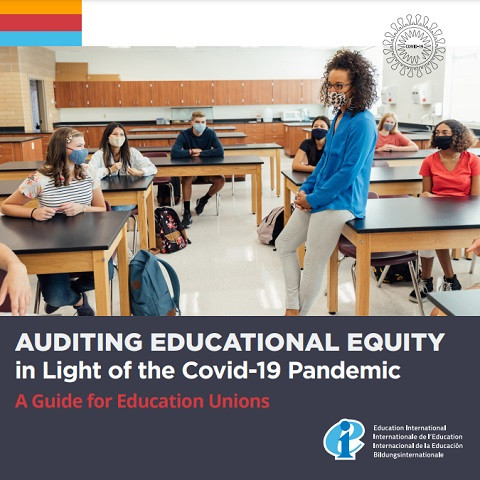 Auditing Educational Equity in Light of the COVID-19 Pandemic: A Guide for Education Unions Année de publication: 2020 Auteur institutionnel: Education International (EI) The COVID-19 pandemic has led to unprecedented school closures that have affected over 1.5 billion students worldwide. However, the impact of the pandemic has not been equal, with vulnerable and disadvantaged students disproportionately affected by the resulting global crisis in teaching and learning."Auditing Educational Equity in Light of the COVID-19 Pandemic" is a guide to support education unions as they advocate for equity audits to be conducted at both education institution and systems levels.The guide stresses the importance of equity audits in enabling education institutions and systems to adapt more effectively to a COVID-19 ‘new normal’ and also address entrenched structures of inequality that have long prevented countries from realising the universal right to education.
 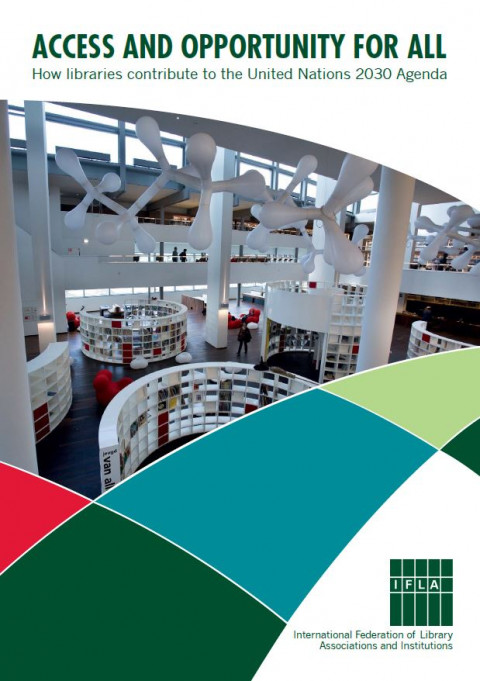 Access and Opportunity for All: How Libraries Contribute to the United Nations 2030 Agenda Année de publication: 2020 Auteur institutionnel: International Federation of Library Associations and Institutions (IFLA) The inclusion of libraries and access to information in national and regional development plans will contribute to meeting the global United Nations 2030 Agenda for Sustainable Development.In support of this goal, IFLA has published a booklet of examples and recommendations for policymakers demonstrating the contribution of libraries to the UN Sustainable Development Goals (SDGs).The booklet includes stories from all types of libraries in many countries around the world.
 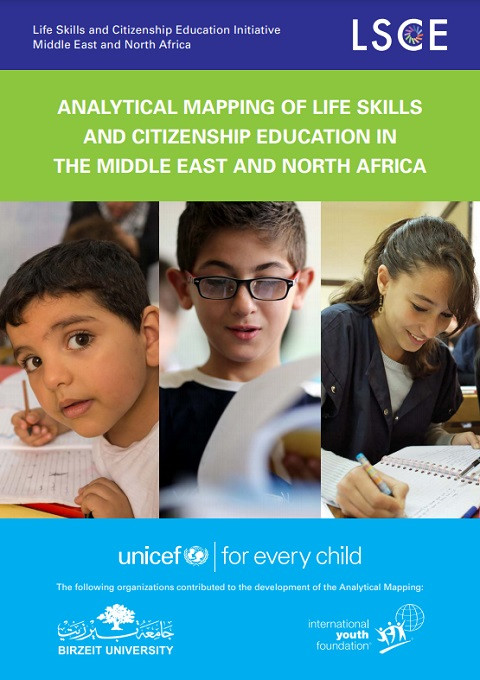 Analytical Mapping of Life Skills and Citizenship Education in the Middle East and North Africa Année de publication: 2017 Auteur institutionnel: UNICEF Middle East and North Africa The Analytical Mapping of the Life Skills and Citizenship Education in MENA, published in October 2017, provides a multi-stakeholder view of the status of life skills and citizenship education in MENA and the corresponding vision for the region. It does not evaluate existing interventions, nor is it meant to generate an exhaustive list of all existing life skills programmes in MENA. It rather aims to provide an analytical overview of Life Skills and Citizenship Education (LSCE) related intervention in the region. Through analyzation, it also attempts to highlight general challenges encountered in the programming of LSCE, as well as focus on opportunities for LSCE in MENA national education systems.
  The Idea and Innovation of Digitized Public Participation Année de publication: 2016 Auteur: Ji Yuanyuan This paper analyses the existing problems of public participation in public affairs through digitial tools and provides suggestions for improvement. 数字化公众参与的理念与创新 Année de publication: 2016 Auteur: Ji Yuanyuan 本文分析了当前中国民众通过数字方式参与政务的现状,探讨了现存为题,并为民主型政府转型提出了相关改善建议。
 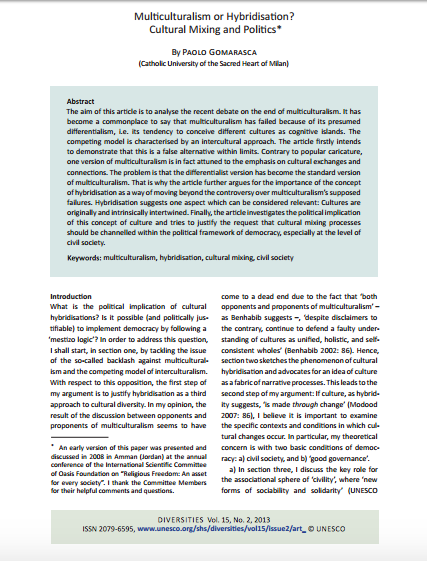 Multiculturalism or Hybridisation?: Cultural Mixing and Politics Année de publication: 2013 Auteur: Paolo Gomarasca The aim of this article is to analyse the recent debate on the end of multiculturalism. It has become a commonplace to say that multiculturalism has failed because of its presumed differentialism, i.e. its tendency to conceive different cultures as cognitive islands. The competing model is characterised by an intercultural approach. The article firstly intends to demonstrate that this is a false alternative within limits. Contrary to popular caricature, one version of multiculturalism is in fact attuned to the emphasis on cultural exchanges and connections. The problem is that the differentialist version has become the standard version of multiculturalism. That is why the article further argues for the importance of the concept of hybridisation as a way of moving beyond the controversy over multiculturalism’s supposed failures. Hybridisation suggests one aspect which can be considered relevant: Cultures are originally and intrinsically intertwined. Finally, the article investigates the political implication of this concept of culture and tries to justify the request that cultural mixing processes should be channelled within the political framework of democracy, especially at the level of civil society.
 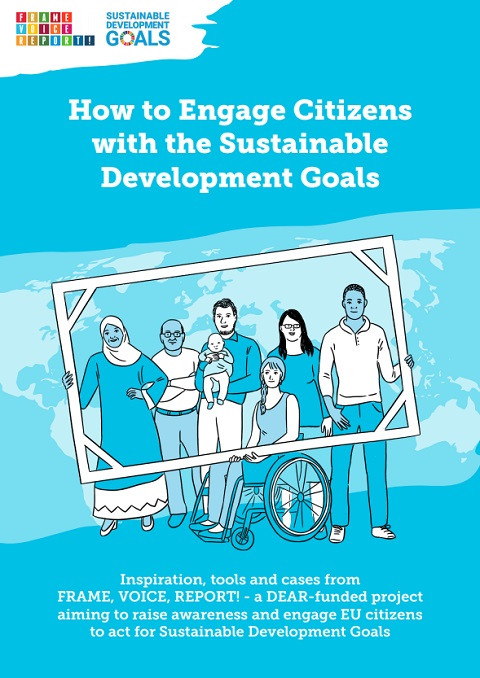 How to Engage Citizens with the Sustainable Development Goals Année de publication: 2020 Auteur institutionnel: Finnish Development NGOs Fingo The purpose of this booklet is to share reflections, successes and learning outcomes from the FRAME, VOICE, REPORT! (FVR) project.It can be used to find inspiration from other civil society organisations (CSOs) working on the same topics and themes you do, but also as a source for ideas for new ways of looking at old issues.This booklet covers both the more theoretical approaches and concrete cases from CSOs across Europe. These cases are examples of the many projects funded by the FVR.The project had its roots in the previous successes and tried and tested approaches of the partner organisations. The aim of FVR! was to secure resources and develop the value-based, high quality work of civil society organisations. The second aim was to enable smaller organisations to learn about EU project funding and to build capacity on how to conduct high quality global citizenship education and development communications. Finally, the overarching aim of the project was to engage EU citizens with the SDGs.
  Intégrer le genre pour les organisations de la société civile: Réponses pratiques à des questions essentielles Année de publication: 2023 Auteur: Alice Neyret | Melya Allalou | Souâd Belhaddad | Christine Talabard Auteur institutionnel: Fondation Friedrich-Ebert Ce manuel tente d’apporter des réponses aux organisations de la société civiles dans leurs questionnements les plus fondamentaux en proposant des pistes de réflexions concrètes sur : Qu'est-ce que l'approche genre? Comment l'intégrer dans les projets? Comment l'intégrer dans sa gouvernance et sa communication? Ce guide a été élaboré par l'association Citoyenneté Possible en collaboration avec la Fondation Friedrich Ebert.
 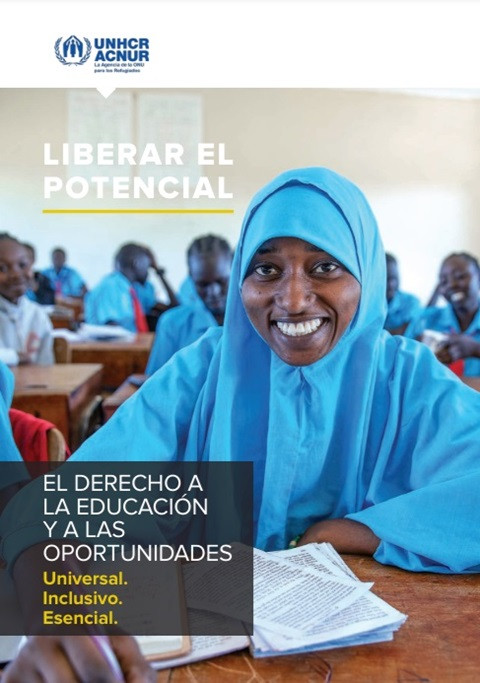 Unleashing Potential: The Right to Education and Opportunity Année de publication: 2023 Auteur institutionnel: UN. Office of the United Nations High Commissioner for Refugees (UNHCR) The UNHCR Refugee Education Report 2023 presents the challenges faced by almost 15 million school-aged refugee girls and boys under UNHCR mandate, including others in need of international protection. It also highlights the achievements and aspirations of young refugees who, with the right support, achieved the highest educational goals through perseverance, resilience, determination and enormous effort. Liberar el potencial: El derecho a la educación y a las oportunidades Année de publication: 2023 Auteur institutionnel: UN. Office of the United Nations High Commissioner for Refugees (UNHCR) El Informe de Educación de Personas Refugiadas de ACNUR de 2023 presenta los desafíos que enfrentan casi 15 millones de niñas y niños refugiados en edad escolar bajo el mandato de ACNUR, que incluyen a otras personas que necesitan protección internacional. También destaca los logros y las aspiraciones de personas jóvenes refugiadas que, con el apoyo adecuado, lograron los objetivos educativos más altos gracias a la perseverancia, la resiliencia, la determinación y un enorme esfuerzo.