
Ressources
Explorez une large gamme de ressources sur le GCED afin d’approfondir votre compréhension et de renforcer vos activités de recherche, de plaidoyer, d’enseignement et d’apprentissage.
2,162 résultats trouvés
 Guidelines and Recommendations for Reorienting Teacher Education to Address Sustainability Année de publication: 2005 Auteur institutionnel: UNESCO Members of the International Network made recommendations related to reorienting teacher education to address sustainability. The recommendations are pieces of wisdom garnered through the experimentation and hard work of teacher educators.The recommendations concern ministerial and national levels to the local level. The recommendations involve curriculum, pedagogy, policy, practice, programs, rewards, research, information and computer technology, partnerships, networking, communications, etc.Members of the International Network repeatedly mentioned the urgency to act and the need for profound change. While many spoke of the enormity of the task at hand, all who participated were able to make signifi cant and positive inroads. Interested individuals operating within their own spheres of control (e.g., weaving sustainability themes into their own classroom curricula) made great headway reorienting their programs. Also, many institutions were able to develop new courses at both the undergraduate and graduate levels. Problems arose, however, when the Network members advocated for change beyond the sphere of direct control. ESD within teacher-education institutions is currently endorsed by early-adopters. However, it will take concerted effort and resources to establish ESD in curricula, programs, practices, and policies across teacher-education institutions.
  UNESCO Associated Schools Network: guide for national coordinators Année de publication: 2018 Auteur institutionnel: UNESCO This document describes in detail the history of the UNESCO Associated Schools Network, its mission, goals, management, membership, and other information. It is a guide for National Coordinators who are the link between the schools in their country, their National Commission and other national authorities, and the International Coordinator at UNESCO. Сеть ассоциированных школ ЮНЕСКО: Руководство для национальных координаторов Année de publication: 2018 Auteur institutionnel: Организация Объединенных Наций по вопросам образования, науки и культуры (UNESCO) В данной работе подробно описывается история Сети ассоциированных школ ЮНЕСКО (Сеть ПАШ), ее миссия, цели, управление, членство и др. информация. Она является руководством для национальных координаторов, которые осуществляют взаимосвязь между школами своей страны, ее национальной комиссией по делам ЮНЕСКО и другими национальными властями18, а также международным координатором в Штаб-квартире ЮНЕСКО.
 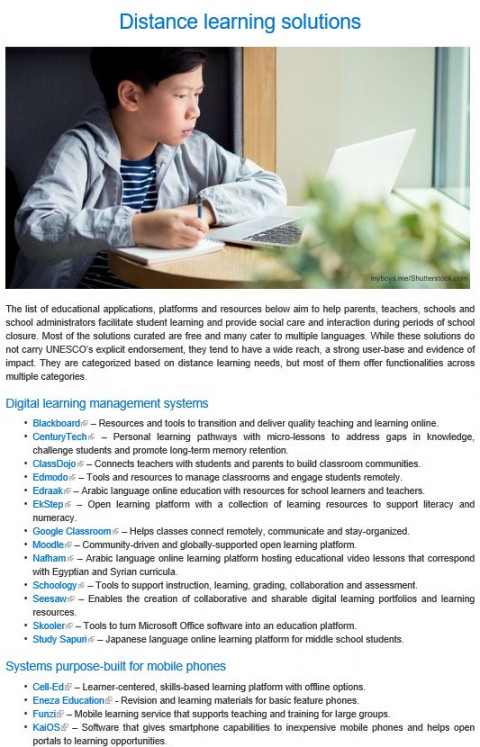 Soluciones para un aprendizaje a distancia Année de publication: 2020 Auteur institutionnel: Organización de las Naciones Unidas para la Educación, la Ciencia y la Cultura (UNESCO) A continuación, ofrecemos una lista de aplicaciones y plataformas educativas para ayudar a los padres, docentes, centros educativos y sistemas escolares a facilitar el aprendizaje de los alumnos y garantizar las interacciones y los servicios sociales durante el periodo de cierre de las escuelas. Aunque no han sido explícitamente respaldadas por la UNESCO, estas soluciones tienen un amplio alcance, numerosos usuarios y una eficacia probada. La mayor parte de las soluciones son gratuitas y muchas se encuentran en varios idiomas.Si usted es un proveedor de servicios de aprendizaje digital y posee un producto sólido que cree merece figurar en la siguiente lista de recursos, favor envíenos un correo electrónico a la dirección: COVID19taskforce@unesco.org Инструменты дистанционного обучения Année de publication: 2020 Auteur institutionnel: Организация Объединенных Наций по вопросам образования, науки и культуры (UNESCO) Приведенный ниже список образовательных приложений, платформ и ресурсов призван помочь родителям, учителям, школам и школьным администраторам облегчить процесс обучения учащихся и обеспечить социальную помощь и взаимодействие в периоды закрытия школ. Большинство предложений доступны бесплатно и многие поддерживаются на нескольких языках. Хотя эти предложения не имеют непосредственной поддержки ЮНЕСКО, они, как правило, имеют широкий охват, мощную базу пользователей и подтверждения достигнутых результатов. Они распределены исходя из потребностей дистанционного обучения, но большинство из них предлагают функциональные возможности по нескольким категориям. حلول للتعلّم عن بعد Année de publication: 2020 Auteur institutionnel: منظمة الأمم المتحدة للتربية والعلم والثقافة (UNESCO) الغرض من قائمة التطبيقات والمنصات والموارد التعليمية الواردة أدناه، مساعدة الأهل والمعلمين والمدارس ومديريها على تيسير عملية تعلّم الطلاب وتقديم الرعاية الاجتماعية والتفاعل الاجتماعي لهم في أثناء فترة إغلاق المدارس. ومعظم الحلول المختارة مجانية، ويقدم العديد منها محتوى متاحاً بعدة لغات. ولا تحظى هذه الحلول بدعم صريح من اليونسكو، بيد أنها تصل إلى عدد كبير من الأشخاص، ولها قاعدة مستخدمين واسعة، وتأثيرها مثبت. وتُصنّف هذه الحلول في فئات تبعاً لاحتياجات الدارسين، ولكن معظمها يحتوي على خصائص مأخوذة من فئات مختلفة.
  Teacher’s Guide for Culture and Arts Activities in Schools Année de publication: 2019 Auteur: Beatrice Polato | Xavier Verhoest Auteur institutionnel: Comitato Internazionale per lo Sviluppo dei Popoli (CISP) | European Union (EU) | UNESCO | UK aid This guide was designed as a curriculum to be used by teachers and mentors who facilitate modules and sessions aiming at involving school children in the study of cultural heritage, peace, inclusion and gender equity through artistic expressions. It has been tested and used by teachers in 24 schools in Somalia between 2018 and 2019, involving a total of 48 teachers and about 700 children. It contains text in Somali for activities.
 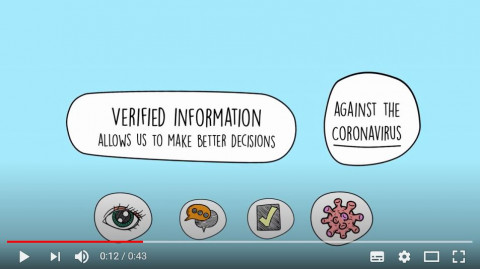 How to Stop Misinformation in Times of Coronavirus? Année de publication: 2020 Auteur institutionnel: United Nations Development Programme (UNDP) | UNESCO Learn how to identify unverified content you receive on your cell phone and avoid spreading information on social media that has not been checked by credible sources. Caring for reliable information is everyone's responsibility, and helps us make better decisions.Learn more about this campaign by UNESCO and UNDP at:https://en.unesco.org/news/disinformation-silent-weapon-times-pandemic
 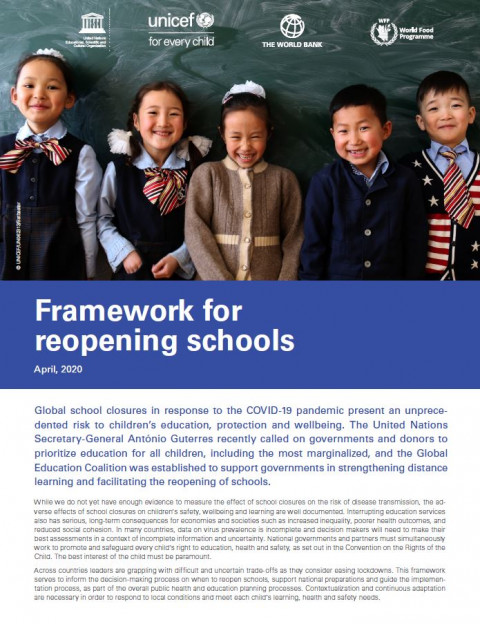 Framework for Reopening Schools; April, 2020 Année de publication: 2020 Auteur institutionnel: UNESCO | United Nations Children's Fund (UNICEF) | World Bank | World Food Programme By late April, nationwide school closures were still disrupting the learning of more than 73 per cent of students, or more than 1.2 billion children and youth. When deciding whether to reopen schools, authorities should look at the benefits and risks across education, public health and socio-economic factors, in the local context, using the best available evidence. The best interest of every child should be paramount.The guidelines aim to inform the decision-making process regarding school reopening, support national preparations and guide the implementation process, as part of overall public health and education planning processes. It is designed to be a flexible tool that can be adapted to each context and updated as the situation changes. The guidelines outline six key priorities to assess the readiness of those schools and inform planning.
 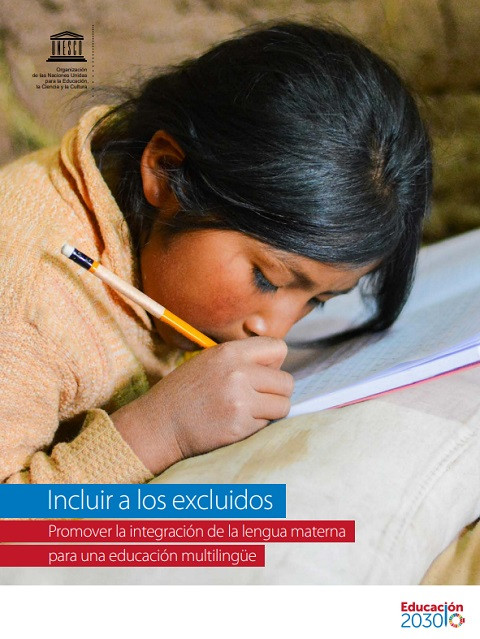 Including the Excluded: Promoting the Integration of the Mother Tongue for a Multilingual Education Année de publication: 2020 Auteur institutionnel: UNESCO This publication presents the advantages of including the mother tongue and promoting multilingual education, as well as guidelines for achieving it.