
Ressources
Explorez une large gamme de ressources sur le GCED afin d’approfondir votre compréhension et de renforcer vos activités de recherche, de plaidoyer, d’enseignement et d’apprentissage.
2,781 résultats trouvés
 Repositionnement et reconceptualiser le programme d'études pour l'utilisation Efficace du Développement Durable Objectif Quatre, pour le développement holistique et modes de vie durables Année de publication: 2015 Auteur institutionnel: UNESCO International Bureau of Education (IBE) Le but de ce document de travail est double, il est de repositionner curriculum au centre national et le dialogue mondial du développement et de mettre en évidence son pouvoir pour donner effet aux nationaux et aux états ambitieux mondiaux sur le rôle de l'éducation dans le développement holistique . Quand bien conçu et efficacement adopté, le curriculum détermine la qualité, l'inclusion et le développement-pertinence de l'éducation. Deuxièmement, il faut reconceptualiser programme comme une force fondamentale de l'intégration des systèmes d'éducation et comme un outil opérationnel pour donner effet aux politiques sur l'apprentissage continu. Curriculum conduit tous les aspects essentiels de l'éducation qui sont connus pour déterminer la qualité, l'inclusion et la pertinence tels que le contenu, l'apprentissage, l'enseignement, l'évaluation et l'enseignement et des environnements d'apprentissage entre autres. Son articulation horizontale et verticale, ainsi que son articulation dans tous les milieux d'apprentissage est ce qui donne effet aux politiques d'apprentissage continu. Ce document vise donc à repositionner programme comme un outil indispensable pour donner effet à ODD Objectif 4. Global citizenship: abstraction or framework for action Année de publication: 2006 Auteur: Lynn Davies Auteur institutionnel: Educational Review This paper explores whether the notion of ‘global citizenship’ is too abstract to be valuable in driving curriculum policy and active citizenship for students. The paper looks firstly at three of the key aspects of an active role: a concern for social justice; rights; and culture and cultural conflict. It then examines actual curricula and programmes of study for global citizenship, and compares the conceptual frameworks, progression routes and emphases within these curricula. It moves on to review the research on teachers’ practices and orientations in teaching global citizenship, finding some variation and problems, particularly in areas such as teaching controversial issues. Factors in successful impact of global citizenship education are outlined, such as various forms of democratic decision-making and community service. Constraints are nonetheless identified of curriculum overload, resources, time and confidence. The paper then describes existing research on the needs and wishes of learners within global citizenship. The conclusion confirms the consensus on the importance of global citizenship and argues that it can be turned into a more radical and politicised curriculum area; however, more research is needed on impact of the learning, including research by students themselves. Global citizenship: abstraction or framework for action Année de publication: 2006 Auteur: Lynn Davies Auteur institutionnel: Educational Review Cet article examine si la notion de ‘citoyenneté mondiale’ est trop abstraite pour être utile dans la conduite de la politique des programmes et la citoyenneté active pour les étudiants. Le document examine tout d'abord à trois des aspects clés d'un rôle actif: un souci de justice sociale; droits; et de la culture et de conflits culturels. Il examine ensuite les programmes et les programmes d'études à la citoyenneté mondiale réelle, et compare les cadres conceptuels, des voies de progression et emphases au sein de ces programmes. Il se déplace en revue les recherches sur les pratiques et les orientations des enseignants dans l'enseignement de la citoyenneté mondiale, de trouver une certaine variation et des problèmes, en particulier dans des domaines tels que l'enseignement des questions controversées. Facteurs de succès de l 'éducation à la citoyenneté mondiale sont exposés, tels que les diverses formes de prise de décision démocratique et le service communautaire. Les contraintes sont néanmoins identifiées de la surcharge des programmes, les ressources, le temps et la confiance. Le document décrit ensuite les recherches existantes sur les besoins et les souhaits des apprenants au sein de la citoyenneté mondiale. La conclusion confirme le consensus sur l'importance de la citoyenneté mondiale et fait valoir qu'il peut être transformé en une zone de curriculum plus radicale et politisée; cependant, plus de recherche est nécessaire sur l'impact de l'apprentissage, y compris la recherche par les étudiants eux-mêmes. How can you embed global citizenship in your curriculum? Année de publication: 2012 Auteur institutionnel: National Committee for International Cooperation and Sustainable Development (NCDO) This handbook offers tips, guidelines and inspiration for embedding global citizenship in your curriculum. It also helps your school answer the following questions: 1. What do you want to achieve? 2. Where is your school today? 3. What needs to be done? 4. Where to start? This publication is not a blueprint for embedding global citizenship in secondary education, but hopefully it will help you on your way to achieving that goal. Comment pouvez-vous intégrer la citoyenneté mondiale dans votre curriculum? Année de publication: 2012 Auteur institutionnel: National Committee for International Cooperation and Sustainable Development (NCDO) Ce guide propose des conseils, des orientations et des idées pour intégrer la citoyenneté mondiale dans votre curriculum. Il aide également votre école de répondre aux questions suivantes: 1. Que voulez-vous atteindre? 2. Où est votre école aujourd'hui? 3. Que faut-il faire? 4. Où commencer? Cette publication ne constitue pas un plan pour intégrer la citoyenneté mondiale dans l'enseignement secondaire, mais nous espérons qu'il vous aidera sur votre chemin pour atteindre cet objectif.
 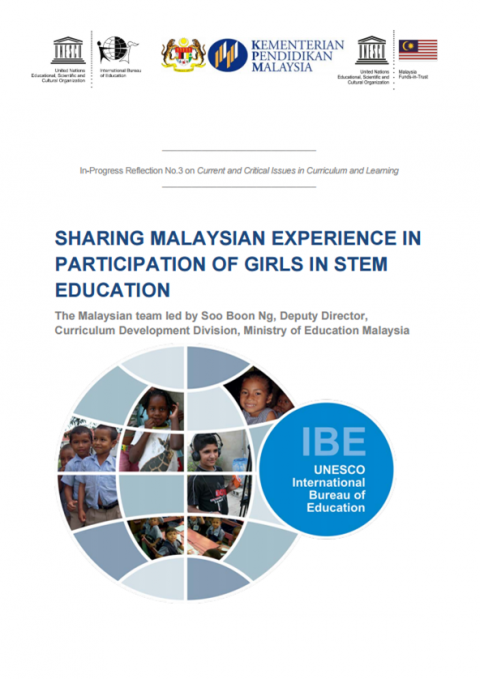 Sharing Malaysian experience in participation of girls in STEM education Année de publication: 2016 Auteur institutionnel: UNESCO International Bureau of Education (IBE) The Malaysia government has placed STEM as a focus in developing the country towards achieving the status of a developed nation. The government acknowledges the role of women as equal partners in nation building. Thus, various policies ranging from economy, education, women’s welfare and human resources have been formulated through the years. These policies have resulted in among others, the increase in women researchers from 35.8% in 2004 to 49.9% in 2012 as well as more women’s participation in selected STEM courses at the tertiary level. A total of 84 girls’ day schools with 6 of them as residential STEM Girls’ schools have been built since 1939. There are many female role models in STEM for the girls to emulate. This has been made possible by the successful implementation of the various policies related to women in STEM as well as innovative measures in facing the continuing challenges in STEM education.
  School knowlegde and curriculum standard Année de publication: 2000 Auteur: Zhong Qiquan Based on curriculum sociology, criticism towards school knowledge has been expanded. This article first discusses the problems of education in both Japan and China and then emphasizes the important relationship between quality value and curriculum standard. The four elements of school curriculum: curriculum objectives, curriculum content, curriculum implementation and curriculum evaluation are also clarified with regard to design curriculum standard. 学校知识与课程标准 Année de publication: 2000 Auteur: Zhong Qiquan 基于课程社会学,对于学校知识的批判增加。文章首先讨论了中国和日本的教育问题,并强调了“素质价值”与课程标准间的重要关系。文章讨论了课程构成的四要素:课程目标、课程内容、课程实施和课程评价,及其与课程标准编制的关系。
  Research on National Curriculum Standards and Framework Année de publication: 2001 Auteur: Cui Yunkuo This article is devoted to explaining the nature and framework of the national curriculum standards and the presentation techniques of the curriculum objectives. First, this article discusses the nature of the curriculum standard, describing the prescriptiveness of the curriculum standards, and then discussed the normative presentation of the curriculum standard framework. It also provides the framework of the first national curriculum standards in China and finally explains the presentation techniques of the course objectives, as well as the level of learning and behavioral verbs. 国家课程标准与框架的解读 Année de publication: 2001 Auteur: Cui Yunkuo 本文致力于阐释国家课程标准的性质、框架和课程目标的陈述技术。首先,探讨了课程标准的性质,对于课程标准的规定性作了描述。然后讨论了课程标准框架的规范性陈述方式,并提供了我国第一个国家课程标准的框架。最后阐述了课程目标的陈述技术,以及学习水平与行为动词等问题。