
Ressources
Explorez une large gamme de ressources sur le GCED afin d’approfondir votre compréhension et de renforcer vos activités de recherche, de plaidoyer, d’enseignement et d’apprentissage.
1,405 résultats trouvés
 Enseigner Témoigner Année de publication: 2024 Auteur institutionnel: Ligue de l'enseignement, Fédération de Paris & Ibuka France En 1994, environ 1 million de Tutsi ont été tués au Rwanda. Le génocide perpétré contre les Tutsi au Rwanda constitue l’une des principales tueries du XXème siècle. Elle a été rendue possible par l’action d’extrémistes qui ont, pendant des années, attisé la haine anti-tutsi au sein de la population rwandaise à coup de préjugés, de fausses informations, d’accusations en miroir, de stratégie de manipulation et de conditionnement des esprits à la peur, à la haine et à la violence meurtrière.Avec l’inscription récente de son enseignement dans les programmes scolaires, de plus en plus d’enseignants travaillent avec leurs élèves sur cet événement majeur de l’histoire du XXème siècle. Parallèlement, des rescapés ressentent le besoin de témoigner pour partager leur histoire avec la jeune génération et prévenir ainsi les mécanismes qui ont rendu ce drame possible. Dans ce contexte, l’association Ibuka France et la Ligue de l’enseignement engagent une action commune pour proposer un accompagnement dans l’organisation et la gestion pédagogique d’une rencontre avec un témoin-rescapé en classe. Cet accompagnement vise à créer un cadre à la fois utile et sécurisant pour l’ensemble des acteurs engagés et impactés par le témoignage en classe. In 1994, around 1 million Tutsis were killed in Rwanda. The genocide perpetrated against the Tutsis in Rwanda is one of the major killings of the twentieth century. It was made possible by the actions of extremists who, for years, stirred up anti-Tutsi hatred among the Rwandan population by means of prejudice, false informations, mirror-image accusations, a strategy of manipulation and the conditioning of minds to fear, hatred and murderous violence.With the recent inclusion of the subject in school curricula, more and more teachers are working with their pupils on this major event in the history of the 20th century. At the same time, survivors are feeling the need to share their stories with the younger generation and prevent the mechanisms that made this tragedy possible. Against this backdrop, Ibuka France and the Ligue de l'enseignement have joined forces to offer support in organising and managing a meeting with a survivor-witness in the classroom. The aim of this support is to create a framework that is both useful and reassuring for all those involved and affected by the testimonial in the classroom.
  Inclusive Education Année de publication: 2008 Auteur institutionnel: UNESCO International Bureau of Education (IBE) Inclusive education: the road to the future is the subject of the forty-eighth meeting of the International Conference on Education (CIE) to be held in Geneva from November 25 to 28, 2008. I believe that a genuine dialogue and a frank debate between Ministers and other education actors on this central theme and on the four related sub-themes: approaches, scope and content; public politics; systems, interfaces and transitions, and students and teachers, will be both timely and appropriate. Educación Inclusiva Année de publication: 2008 Auteur institutionnel: UNESCO International Bureau of Education (IBE) La educación inclusiva: el camino hacia el futuro es el tema de la cuadragésimo octava reunión de la Conferencia Internacional de Educación (CIE) que tendrá lugar en Ginebra del 25 al 28 de noviembre de 2008. Creo que un genuino diálogo y un franco debate entre los ministros y otros actores de la educación sobre este tema central y sobre los cuatro subtemas relacionados: enfoques, alcance y contenido; políticas públicas; sistemas, interfaces y transiciones, y alumnos y docentes, resultarán a la vez oportunos y apropiados. Education pour l'inclusion Année de publication: 2008 Auteur institutionnel: UNESCO International Bureau of Education (IBE) L’auteur présente ce numéro spécial qui offre une sélection d’articles alliant recherche théorique et pratique sur la notion de l’éducation pour l’inclusion et sur les problèmes rencontrés dans l’élaboration de politiques et leur application pratique. Ces articles reflètent les approches diversifiées et à volets multiples de l’inclusion, eu égard aux aspects théoriques, disciplinaires et méthodologiques. Tout au long de ce numéro, l’inclusion est le principe de base qui oriente l’Éducation pour tous (EPT) de qualité —- c’est-à-dire, l’établissement de systèmes éducatifs tirant profit de la diversité et visant à édifier une société plus juste et plus démocratique.Ce numéro spécial est consacré au thème de la quarante-huitième session de la Conférence internationale de l’éducation (CIE) « L’éducation pour l’inclusion : la voie de l’avenir » (Genève, 25-28 novembre 2008).
  Address by Audrey Azoulay, Director-General of UNESCO, on the occasion of ceremony launching UNESCO's contribution to the 70th anniversary of the UDHR Année de publication: 2017 Auteur institutionnel: UNESCO. Director-General, 2009-2017 (Bokova, I.G.) This address was delivered by Audrey Azoulay, Director-General of UNESCO, on the occasion of ceremony launching UNESCO's contribution to the 70th anniversary of the UDHR; UNESCO, 11 December 2017.
  Éducation à la citoyenneté à l'école : Politiques, pratiques scolaires et effets sur les élèves (Rapport scientifique avril 2016) Année de publication: 2016 Auteur: Géraldine Bozec Auteur institutionnel: Conseil natiional d'évaluation du système scolaire (CNESCO) Ce rapport de recherche, commandé par le CNESCO, constitue une revue de la littérature à la fois française et internationale portant sur l’éducation à la citoyenneté. Il vise à avancer dans la compréhension d’un objet de recherche encore délaissé à ce jour dans les études françaises et à identifier des pistes de recherche qui pourraient s’avérer fécondes à l’avenir. Il privilégie les travaux mobilisant des données empiriques. Le rapport dresse d’abord un état de lieux de l’apprentissage de la citoyenneté à l’école française, à partir d’une analyse des politiques, des programmes et des pratiques scolaires (Partie I). Il met ensuite en perspective le cas français en resituant ses spécificités et les points communs qu’il partage avec d’autres cas nationaux en matière d’éducation à la citoyenneté (Partie II). Enfin, il présente un bilan des recherches visant à évaluer les effets de l’éducation à la citoyenneté sur les représentations, les attitudes et les pratiques des élèves (Partie III). En conclusion, des orientations de recherche qui apparaissent, à l’issue de cet état des lieux, comme encore peu explorées et potentiellement fructueuses, sont identifiée.
 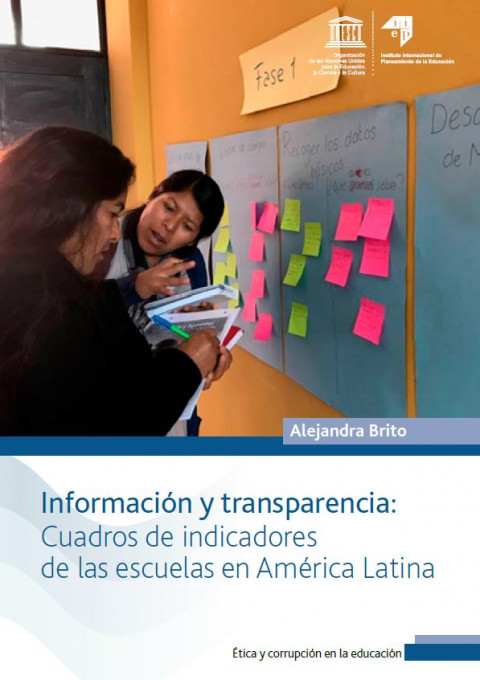 Información y transparencia: cuadros de indicadores de las escuelas en América Latina Année de publication: 2019 Auteur: Alejandra Brito Auteur institutionnel: UNESCO International Institute for Educational Planning (IIEP) ¿La publicación de indicadores sobre cada escuela y compartirlos con los actores escolares mejoran la transparencia y la rendición de cuentas y ayudan a combatir la corrupción de manera eficaz? Mientras que los cuadros de indicadores de las escuelas se están desarrollando en un número creciente de países de América Latina, esta pregunta aparece particularmente aguda; la información y las evaluaciones disponibles sobre el tema siguen siendo parcelarias.Este estudio muestra un panorama de la situación a nivel regional, revisando los sistemas de información e indicadores escolares de acceso público de 15 países de América Latina. Además, examina en profundidad siete cuadros de indicadores de información escolar en cuanto a su contenido, periodicidad, mecanismos de relevamiento y difusión de la información, diseño, uso e impacto en temas de transparencia, rendición de cuentas y lucha contra la corrupción.En conclusión, formula recomendaciones detalladas para los encargados de la toma de decisiones, entre las que se incluyen: considerar la utilidad, claridad y accesibilidad de los cuadros; mejorar la validez y vigencia de los datos; fomentar la comprensión y uso de la información; vincular los cuadros con los sistemas de rendición de cuentas actuales; incluirlos en los canales de comunicación en uso; proporcionar consecuencias o sanciones en caso de corrupción; asegurar la comprensión y difusión de los resultados por los padres de familias, así como su participación en los planes de mejora.
  Right to Education Handbook Année de publication: 2019 Auteur institutionnel: Right to Education Initiative (UK) The ultimate aim of this handbook is to facilitate the realization and universal enjoyment of the right to education. Its objective is not to present the right to education as an abstract, conceptual, or purely legal concept, but rather to be action-oriented. Where possible, practical guidance is given on how to implement and monitor the right to education along with recommendations to overcome persistent barriers. It seeks to do this by: Increasing awareness and knowledge of the right to education. This includes the normative content of the right to education, states’ legal obligations, the various sources of law regarding the right to education, what states must do to domestically implement the right to education, how to monitor the right to education, and how to increase accountability of the right to education. Providing a summary of current debates and issues regarding education and what human rights law says about them, including on forced migration, education in emergencies, the privatization of education, and the challenge of reaching the most marginalized. Providing an overview of the UN landscape and its mechanisms, including a clear understanding of the role of UNESCO and more generally the UN, as well as all relevant stakeholders in education, particularly civil society. UNESCO’s Strategy on standard-setting instruments in the field of education (2016-2021) encourages Member States of the Organization to use normative action in relation with the right to education as a strategic tool to implement and achieve SDG4. In line with this, this handbook – specifically foreseen by the Strategy– will also serve as a reference tool for the design and organization of training modules and workshops in the field of right to education. Finally, the handbook will also be an important reference for those working towards the achievement of SDG4, by offering guidance on how to leverage legal commitment to the right to education as a strategic way to achieve this goal.
  Migration: la solidarité internationale contre le nationalisme xénophobe Année de publication: 2018 Auteur: Tina Robiolle Moul Le sommet qui vient de se tenir à Bruxelles les 28 et 29 juin, confirme l’entêtement des dirigeant·e·s européen·ne·s dans une politique du pire qui, loin d’être le fruit de maladresses face à l’idée d’une invasion imaginaire de personnes étrangères, s’apparente à une stratégie explicite de coercition des populations en adoptant sans réserve les positions de l’extrême droite. La politique migratoire européenne, à l’image de celle des pays membres, reste aveugle à une compréhension plus globale des migrations qui est celle de la solidarité internationale.
  Accountability from a Human Rights Perspective: The Incorporation and Enforcement of the Right to Education in the Domestic Legal Order Année de publication: 2017 Auteur institutionnel: ActionAid International | Right to Education Initiative (UK) The aim of this paper is to reframe States’ political commitment to education under Education 2030 as a legal commitment the vast majority of States have already made under international human rights law. By recasting the content of SDG Four as part of the right to education, the legal obligations owed to that content can be invoked. This renders various elements of SDG Four, ifthe State in question has legally committed to the right to education and incorporated the right to education in their domestic legal orders, amenable to adjudication by competent mechanisms, offering the possibility of legal accountability through legal enforcement.