
Ressources
Explorez une large gamme de ressources sur le GCED afin d’approfondir votre compréhension et de renforcer vos activités de recherche, de plaidoyer, d’enseignement et d’apprentissage.
3,433 résultats trouvés
 Citoyenneté, identité et de l'éducation: l'examen des fins publiques des écoles à l'ère de la mondialisation Année de publication: 2006 Auteur: Fernando Reimers Auteur institutionnel: UNESCO International Bureau of Education (IBE) Les établissements d'enseignement existent pour parvenir à des fins publiques. L'un de ces objectifs est de développer la citoyenneté. Au 21e siècle, la citoyenneté comprend la citoyenneté mondiale. Dans une ère de mondialisation citoyenneté effective comprend les connaissances, la capacité et la disposition à engager pacifique et constructive entre les différences culturelles aux fins de répondre aux besoins personnels et collectifs et de réaliser des interactions humaines-environnementales durables, ce qui nécessite l'intériorisation des valeurs globales. Pour relever ces défis de la mondialisation, il faudra faire de l'éducation à la citoyenneté et le développement des valeurs mondiales un objectif explicite des efforts pour améliorer la qualité dans le monde entier, l'examen critique des théories et des preuves sur l'efficacité des différentes approches pour développer la citoyenneté et la citoyenneté mondiale et soutenir les activités alignées cet effet public. Cet objectif public devrait soutenir le développement d'une culture politique qui favorise la primauté du droit national et international et le respect des droits de l'homme, le développement de la compréhension pour soutenir le commerce et la diplomatie bilatérale et internationale économique et pacifique comme le moyen privilégié pour résoudre les conflits internationaux, le développement de la capacité à comprendre et à relever les défis environnementaux humanité face à de graves et de collaborer à travers les frontières nationales dans la création de formes durables d'interactions homme-environnement et dans le développement des compétences pour promouvoir la rationalité dans la délibération et de l'action, et de faire avancer la science et la technologie comme moyen d'améliorer la santé humaine et le bien-être. À l'heure actuelle, cependant, de nombreux systèmes d'éducation et les réformes ne sont pas suffisamment axées sur la qualité, ou se concentrent plutôt sur une définition très étroite et auto-référencé de la qualité. Il est possible d'éduquer les gens à comprendre et à apprécier les différences culturelles et à comprendre et à acept droits de l'homme dans un cadre de valeurs globales qui comprend la compassion et la compassion, le souci des autres, le respect et la réciprocité. Ces valeurs, les dispositions, les connaissances et les compétences peuvent être développées dans un éventail d'institutions que les sociétés doivent passer sur ce qu'ils apprécient le jeune, et de recréer la culture: les familles, les institutions religieuses, les médias, les milieux de travail, les institutions politiques et aussi écoles. Bien qu'il n'y ait aucune raison de supposer que les écoles peuvent être plus efficaces dans cette tâche que l'une de ces autres institutions, ils ont un plus grand potentiel pour être aligné avec les efforts transnationaux visant à promouvoir la civilité mondiale. Ils sont un espace public, et par conséquent aussi un espace public à l'échelle mondiale, dans les façons dont les familles et les institutions religieuses ne sont pas. Si les écoles participent activement à l'enseignement à la haine ou l'intolérance, ou si elles ne parviennent pas à préparer les étudiants de manière adéquate pour la civilité mondiale, ces échecs peuvent être notées par les institutions internationales qui peuvent potentiellement mobiliser des ressources pour soutenir les efforts nationaux et locaux pour préparer les élèves à la citoyenneté mondiale. Il n'y a pas un réseau similaire reliant les institutions nationales et transnationales, publiques et privées, gouvernementales et non-gouvernementales, qui assiste à la dynamique des familles et d'autres «espaces» «privés».
 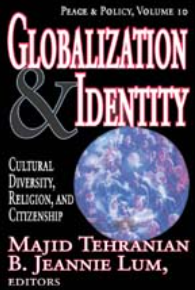 Globalization and Identity: Cultural Diversity, Religion and Citizenship Année de publication: 2006 Auteur: Majid Tehranian | B. Jeannie Lum Auteur institutionnel: Transaction Publishers In the first decade of the twenty-first century, globalization and identity have emerged as the most critical challenges to world peace. This volume of Peace & Policy addresses the overarching question, "What are the effects of globalization in the areas of culture, ethnic diversity, religion, and citizenship, and how does terrorism help groups attain a sense of global identity?"Part I, "Citizenship in a Globalizing World," reexamines globalization in light of the traditions from which human civilizations have evolved. Linda Groff focuses on Samuel R. Huntington's thesis that the Cold War would be followed by a clash of civilizations. Joseph A. Camilleri traces the history of the concept of citizenship and its transformation through the ages to modern times. Kamran Mofid argues that the marketplace is not just an economic sphere but one where economic and business interests must embrace the spiritual assets of the community. Majid Tehranian raises the problem of identity and advocates the assumption of global identity, responsibility, and citizenship. Part II, "Convergence in Global Cultures," explores the complex issues of diversity in religions. Christopher Leeds, Vladimir Korobov, and Bharapt Gupt show how the reconceptualization of the world both geographically and regionally can recreate new sensibilities needed to overcome differences. Part III, "Divergence in Global Conflicts," discusses the multiple dimensions of the globalizing effects of economic expansion and political strife experienced by different cultures at local and regional levels. Audrey Kitigawa and Ade Ogunrinade use Nigeria as an example of political manipulation of religious and ethnic groups to divert attention from the real problems of social and economic marginalization. Fred Riggs looks at how the Web has become a medium in the globalization of religious movements.The authors maintain that continuing efforts for dialogue across cultural and religious boundaries in today's interreligious and interfaith organizations can become a force for healing.
 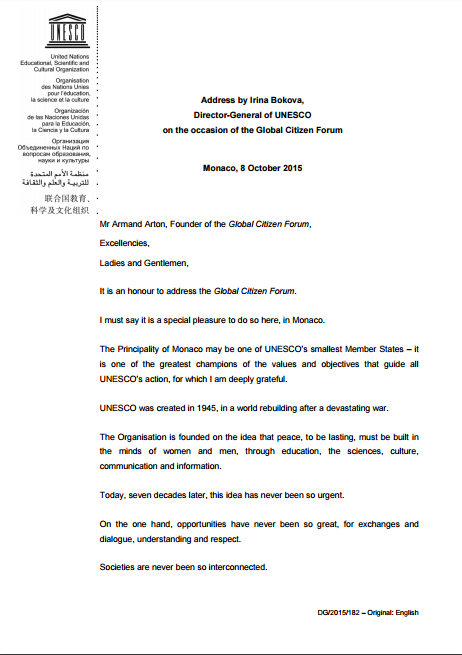 Address by Irina Bokova, Director-General of UNESCO, on the occasion of the Global Citizen Forum; Monaco, 8 October 2015 Auteur institutionnel: UNESCO. Director-General, 2009-2017 (Bokova, I.G.) This address was delivered by Irina Bokova, Director-General of UNESCO, on the occasion of the Global Citizen Forum.
  Education for global citizenship Année de publication: 2004 Auteur: Audrey Osler Cosmopolitan Citizenship is described as a concept of Global learning based on international agreements of UNESCO and the Council of Europe. To live in a global world people would need – besides basic education – different social skills as competencies of political literacy.
  The Elusive and Exclusive Global Citizen Année de publication: 2015 Auteur: Jill Koyama Auteur institutionnel: Mahatma Gandhi Institute of Education for Peace and Sustainable Development (MGIEP) In this paper, the author interrogate the notion of global citizenship, both as an aspiration and an improbable practice, by situating it within contemporary understandings of citizenship and globalization.It is a conceptualization that suffers from the dangers inherent in the term “citizenship” and misconceptions of the terms “global,” and it is rooted in the West’s long engagement in normative undertakings in non-Western countries. The writer refute ideas of the autonomous and agentic global citizen. he encourage a rethinking of global citizenship and global citizenship education (GCE) and offer recommendations for redirecting attention to contemporary global stratifications and issues of human rights to address the issues of social justice and inequality that, due to the problematic definition of global citizenship, are currently inadequately covered in existing GCE curricula.
 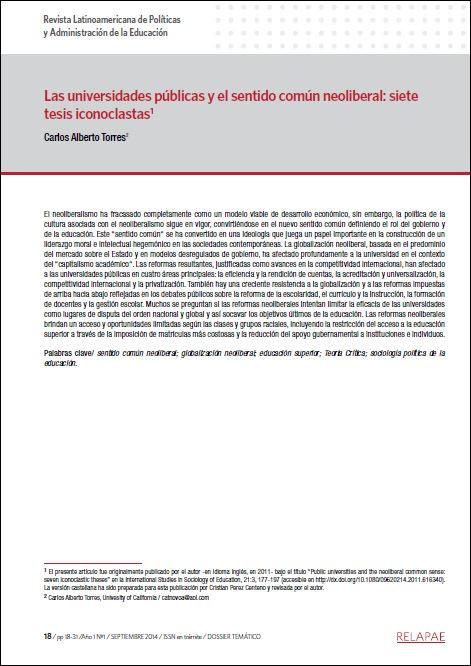 Public Universities and Neoliberal Common Sense: Seven Iconoclastic Thesis Année de publication: 2014 Auteur: Carlos Alberto Torres Auteur institutionnel: Universidad Nacional de Tres de Febrero (UNTREF) Neoliberalism has utterly failed as a viable model of economic development, yet the politics of culture associated with neoliberalism is still in force, becoming the new common sense shaping the role of government and education. This ‘common sense’ has become an ideology playing a major role in constructing hegemony as moral and intellectual leadership in contemporary societies. Neoliberal globalisation, predicated on the dominance of the market over the state and on deregulatory models of governance, has deeply affected the university in the context of ‘academic capitalism’. The resulting reforms, rationalised as advancing international competitiveness, have affected public universities in four primary areas: efficiency and accountability, accreditation and universalisation, international competitiveness and privatisation. There is also growing resistance to globalisation as top-down-imposed reforms reflected in the public debates about schooling reform, curriculum and instruction, teacher training and school governance. Many question whether neoliberal reforms attempt to limit the effectiveness of universities as sites of contestation of the national and global order and thus undermine the broader goals of education. Neoliberal reforms have limited access and opportunity along class and racial lines, including limiting access to higher education through the imposition of higher tuition and reduced government support to institutions and individuals. Las universidades públicas y el sentido común neoliberal: siete tesis iconoclastas Année de publication: 2014 Auteur: Carlos Alberto Torres Auteur institutionnel: Universidad Nacional de Tres de Febrero (UNTREF) El neoliberalismo ha fracasado completamente como un modelo viable de desarrollo económico, sin embargo, la política de la cultura asociada con el neoliberalismo sigue en vigor, convirtiéndose en el nuevo sentido común definiendo el rol del gobierno y de la educación. Este “sentido común“ se ha convertido en una ideología que juega un papel importante en la construcción de un liderazgo moral e intelectual hegemónico en las sociedades contemporáneas. La globalización neoliberal, basada en el predominio del mercado sobre el Estado y en modelos desregulados de gobierno, ha afectado profundamente a la universidad en el contexto del “capitalismo académico“. Las reformas resultantes, justificadas como avances en la competitividad internacional, han afectado a las universidades públicas en cuatro áreas principales: la eficiencia y la rendición de cuentas, la acreditación y universalización, la competitividad internacional y la privatización. También hay una creciente resistencia a la globalización y a las reformas impuestas de arriba hacia abajo reflejadas en los debates públicos sobre la reforma de la escolaridad, el currículo y la instrucción, la formación de docentes y la gestión escolar. Muchos se preguntan si las reformas neoliberales intentan limitar la eficacia de las universidades como lugares de disputa del orden nacional y global y así socavar los objetivos últimos de la educación. Las reformas neoliberales brindan un acceso y oportunidades limitadas según las clases y grupos raciales, incluyendo la restricción del acceso a la educación superior a través de la imposición de matrículas más costosas y la reducción del apoyo gubernamental a instituciones e individuos.
 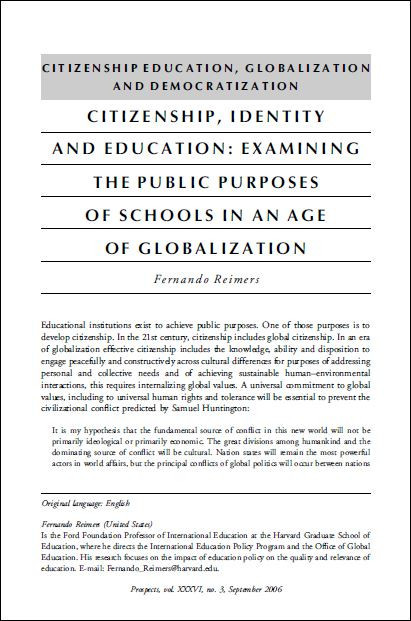 Citizenship, Identity, and Education: Examining the Public Purposes of Schools in an Age of Globalization Année de publication: 2006 Auteur: Fernando Reimers Auteur institutionnel: UNESCO International Bureau of Education (IBE) One of the purposes of educational institutions is to develop citizenship. In the 21st century, citizenship includes global citizenship. Addressing the challenges of globalization will require making citizenship education and the development of global values an explicit objective of efforts to improve quality throughout the world, critically examining theories and evidence about the effectiveness of various approaches to developing citizenship and global citizenship and supporting activities aligned with this public purpose. In this article, the author does not argue for an exclusive effort to focus schools on civic education, but rather for a balanced effort to elevate educational quality making it more relevant to address global challenges and opportunities, of which civic education and global education are components, much neglected at present. The author also does not suggest making civic education the only purpose of the curriculum or making it a priority to the expense of science, math, arts or physical and health education, but he thinks that helping students develop a sense of purpose, situated within broader civic and global purposes, would also facilitate high level engagement with science, mathematical and artistic pursuits.
 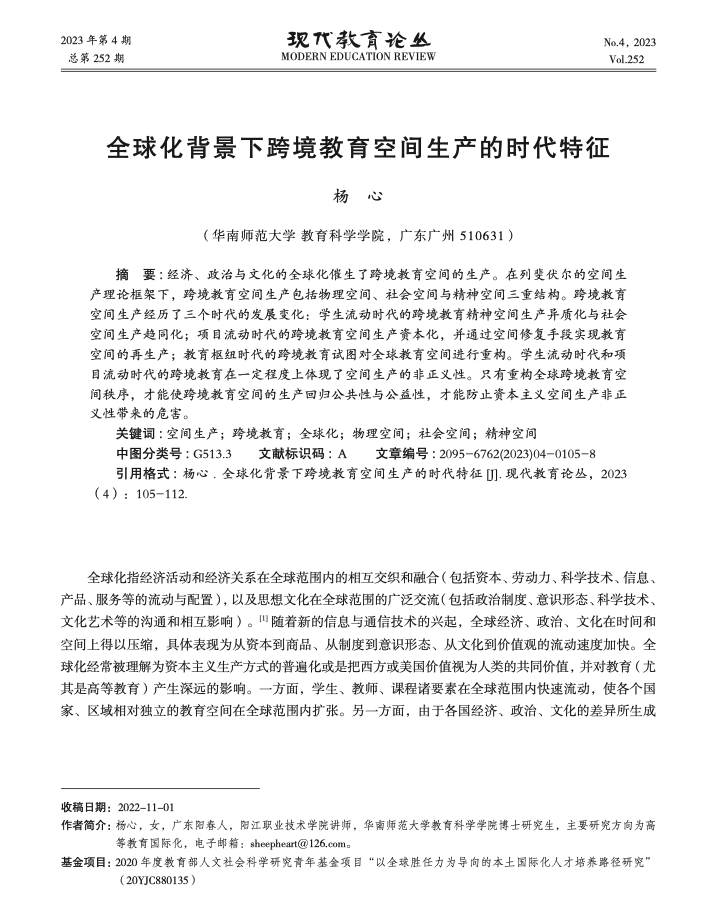 全球化背景下跨境教育空间生产的时代特征 Année de publication: 2023 Auteur: 杨心 经济、政治与文化的全球化催生了跨境教育空间的生产。在列斐伏尔的空间生产理论框架下,跨境教育空间生产包括物理空间、社会空间与精神空间三重结构。跨境教育空间生产经历了三个时代的发展变化:学生流动时代的跨境教育精神空间生产异质化与社会空间生产趋同化;项目流动时代的跨境教育空间生产资本化,并通过空间修复手段实现教育空间的再生产;教育枢纽时代的跨境教育试图对全球教育空间进行重构。学生流动时代和项目流动时代的跨境教育在一定程度上体现了空间生产的非正义性。只有重构全球跨境教育空间秩序,才能使跨境教育空间的生产回归公共性与公益性,才能防止资本主义空间生产非正义性带来的危害。
 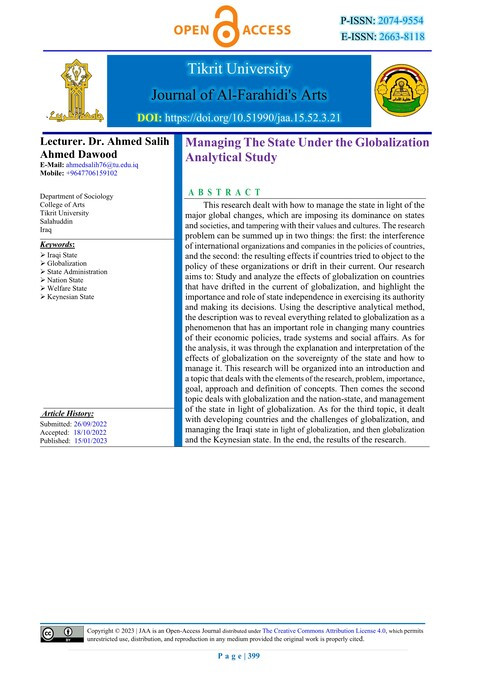 Managing the State Under the Globalization Analytical Study (Journal of Al Farahidi's Arts; Vol.15, Issue 52-3) Année de publication: 2023 Auteur: Ahmed Saleh Ahmed Dawood Auteur institutionnel: Tikrit University This research dealt with how to manage the state in light of the major global changes, which are imposing its dominance on states and societies, and tampering with their values and cultures. The research problem can be summed up in two things: the first: the interference of international organizations and companies in the policies of countries, and the second: the resulting effects if countries tried to object to the policy of these organizations or drift in their current. Our research aims to: Study and analyze the effects of globalization on countries that have drifted in the current of globalization, and highlight the importance and role of state independence in exercising its authority and making its decisions. Using the descriptive analytical method, the description was to reveal everything related to globalization as a phenomenon that has an important role in changing many countries of their economic policies, trade systems and social affairs. As for the analysis, it was through the explanation and interpretation of the effects of globalization on the sovereignty of the state and how to manage it. This research will be organized into an introduction and a topic that deals with the elements of the research, problem, importance, goal, approach and definition of concepts. Then comes the second topic deals with globalization and the nation-state, and management of the state in light of globalization. As for the third topic, it dealt with developing countries and the challenges of globalization, and managing the Iraqi state in light of globalization, and then globalization and the Keynesian state. In the end of the research, resuls will be presented and recommendations will be made.