
Ressources
Explorez une large gamme de ressources sur le GCED afin d’approfondir votre compréhension et de renforcer vos activités de recherche, de plaidoyer, d’enseignement et d’apprentissage.
2,781 résultats trouvés
 L'identité nationale et la xénophobie dans une société ethniquement divisée Année de publication: 2005 Auteur: Noah Lewin Epstein | Asaf Levanon Auteur institutionnel: Organisation des Nations Unies pour l'éducation, la science et la culture (UNESCO) Des études récentes ont suggéré que l'identité nationale est empiriquement associée à des sentiments négatifs des individus envers les étrangers. Ce type d'analyse a été jusqu'ici fondée sur la notion que la xénophobie est façonnée par la nature spécifique de l'identité nationale dans une société donnée. Représenter une perception plus forte et plus exclusive de l'identité nationale, l'identité nationale ethnique (par rapport à l'identité nationale civique) est attendue dans cette ligne de recherche pour aboutir à la perception moins favorable des immigrants. Dans cet article, nous étendre cette approche en faisant valoir que, dans les sociétés profondément divisées, l'identité nationale elle-même peut avoir des significations différentes entre les différents groupes sociaux. Education, diversité et cohésion sociale en Méditerranée occidentale Année de publication: 2010 Auteur: Sobhi Tawil | Abdeljalil Akkari | Bouthaïna Azami Auteur institutionnel: Organisation des Nations Unies pour l'éducation, la science et la culture (UNESCO) La diversité culturelle constitue une caractéristique essentielle des différentes sociétés de la région de la Méditerranée occidentale où une multitude de traditions religieuses et culturelles se sont côtoyées et réciproquement influencées, créant ainsi une mosaïque sociale particulièrement intéressante. Or, la diversité, source de créativité et d'enrichissement culturel, peut aussi amener à renforcer les tensions sociales et creuser les divisions, menaçant ainsi la cohésion sociale à l'intérieur des sociétés comme entre les pays de la région. En effet, des événements récents ont attiré l'attention sur des tensions sociales et politiques liées à l'identité et à la cohésion sociale dans un contexte de mondialisation, d’accroissement des disparités des niveaux de développement économique entre les deux rives de la Méditerranée occidentale et de diversification grandissante des flux migratoires, contexte trop souvent marqué, par ailleurs, par une exacerbation du phénomène de l’exclusion sociale, de la montée de la xénophobie et de l’extrémisme religieux. Conscients de l’importance de la contribution essentielle de l’éducation pour promouvoir un dialogue interculturel axé sur les principes d’équité, de justice, et de respect de la dignité et de la diversité culturelle, la Chaire UNESCO Droits de l’homme et éthique de la coopération internationale de l’Université de Bergame, le Bureau multipays de l’UNESCO à Rabat, et l’ISESCO ont conjointement lancé, en 2007, le projet Education, diversité et cohésion sociale en Méditerranée occidentale. Le projet s’inscrit dans une dynamique de recherche, de dialogue et d’action, renforçant ainsi les efforts de chacun des trois partenaires visant à promouvoir la culture de la justice et de la paix. Cette recherche propose de nouveaux éclairages sur le rôle des systèmes éducatifs nationaux dans la promotion du respect de la diversité et le renforcement de la cohésion sociale, et esquisse des pistes d’action et de coopération. Nous formons le vœu que cet ouvrage commun, fruit des travaux de recherche se rapportant au projet, puisse contribuer à la promotion du respect de la diversité et de la cohésion sociale en Méditerranée occidentale.
 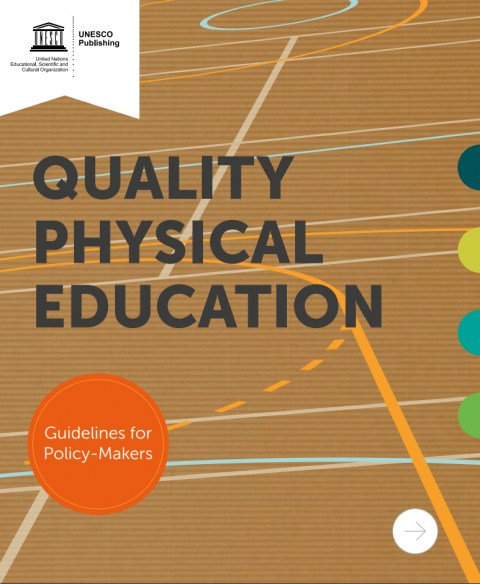 Quality Physical Education (QPE): guidelines for policy makers Année de publication: 2015 Auteur: Nancy, McLennan | Jannine, Thompson Auteur institutionnel: UNESCO A key feature of the Post-2015 Development Agenda is sustainable development. Sustainable development starts with safe, healthy, well-educated children. Participation in quality physical education (QPE), as part of a rounded syllabus, enhances young peoples’ civic engagement, decreases violence and negative patterns of behaviour, and improves health awareness. The UNESCO QPE Policy Package is an original piece of work, which draws upon results from extensive global research (including the Worldwide Survey of School Physical Education). These guidelines, designed for global application and local adaptation, provide a means of analysing current policy through practical guidance and a ‘how-to’ approach. The materials have been developed in consultation with key partners including the European Commission, the International Council for Sport Science and Physical Education (ICSSPE), UNDP, UNICEF, UNOSDP and WHO. L'Education physique de qualité (EPQ): directives à l'intention des décideurs Année de publication: 2015 Auteur: Nancy, McLennan | Jannine, Thompson Auteur institutionnel: Organisation des Nations Unies pour l'éducation, la science et la culture (UNESCO) A key feature of the Post-2015 Development Agenda is sustainable development. Sustainable development starts with safe, healthy, well-educated children. Participation in quality physical education (QPE), as part of a rounded syllabus, enhances young peoples’ civic engagement, decreases violence and negative patterns of behaviour, and improves health awareness. The UNESCO QPE Policy Package is an original piece of work, which draws upon results from extensive global research (including the Worldwide Survey of School Physical Education). These guidelines, designed for global application and local adaptation, provide a means of analysing current policy through practical guidance and a ‘how-to’ approach. The materials have been developed in consultation with key partners including the European Commission, the International Council for Sport Science and Physical Education (ICSSPE), UNDP, UNICEF, UNOSDP and WHO. Educación física de calidad (EFC): guía para los responsables políticos Année de publication: 2015 Auteur: Nancy, McLennan | Jannine, Thompson Auteur institutionnel: Organización de las Naciones Unidas para la Educación, la Ciencia y la Cultura (UNESCO) A key feature of the Post-2015 Development Agenda is sustainable development. Sustainable development starts with safe, healthy, well-educated children. Participation in quality physical education (QPE), as part of a rounded syllabus, enhances young peoples’ civic engagement, decreases violence and negative patterns of behaviour, and improves health awareness. The UNESCO QPE Policy Package is an original piece of work, which draws upon results from extensive global research (including the Worldwide Survey of School Physical Education). These guidelines, designed for global application and local adaptation, provide a means of analysing current policy through practical guidance and a ‘how-to’ approach. The materials have been developed in consultation with key partners including the European Commission, the International Council for Sport Science and Physical Education (ICSSPE), UNDP, UNICEF, UNOSDP and WHO.
  From words to action; Des paroles aux actes Année de publication: 2014 Auteur institutionnel: UNESCO Since its creation in 1945, UNESCO has been working to enhance mutual understanding between peoples, founded on an ever more subtle knowledge of cultures in their rich diversity in order to promote the dignity of all through the affirmation of the principles, rights and values of our common humanity. The era of globalization characterizes our societies, in a cultural landscape which, more than ever, is permeated with diversity because of the mutual influences of peoples, communities, and of their cultural and religious practices. A major issue remains: the need to demonstrate the benefits of promoting both respect for human rights and cultural diversity, recognizing the importance of genuine intercultural dialogue in order to fight against new forms of racism, discrimination, intolerance, extremism and radicalization. UNESCO, with lengthy practical experience as an international laboratory of ideas, monitors respect for universal values, in particular by initiating research and producing various kinds of teaching tools designed for the acquisition of intercultural skills. Which skills should be mobilized or acquired in order to be able not only to respect but also to appreciate the Other in all his or her diversity. How many of these skills can be useful on both a collective level and an individual one in order to protect cultural rights, protect oneself from, or to transcend prejudice? Intercultural sensibility and aptitudes have to be explored since they refer to the willingness and capacity of people to step outside of their own logic and systems of thought in order to engage with others, and appreciate different cultural narratives especially if they are not equally valorized or recognized in a given societal context. This portfolio proposes a basic tool for capacity building in support of exchange, communication and cooperation beyond cultural, religious and national borders, allowing the emergence of a global citizenship in a safer world for all. In this perspective, this set of key resources consists of papers by international experts exploring the linkage between respect for cultural diversity and human rights, with all that that implies. It brings together other publications such asIntercultural Competences, Conceptual and Operational Framework, published by UNESCO in 2013, and documents such as Dire la Tolérance (Defining Tolerance), published in 1997 and translated into English and into Arabic, and, finally, UNESCO’s Programme of Action for a Culture of Peace and Non-Violence, A Vision in Action, published in English in 2012 and in French in 2013. Symbolically released on 10 December 2014, Human Rights Day, this multilingual and evolving publication is designed primarly to be an Open Access tool, a flagship project of the International Decade for the Rapprochement of Cultures (2013-2022). In the same spirit, its content will be enriched and developed in an e-learning format, throughout the Decade.
 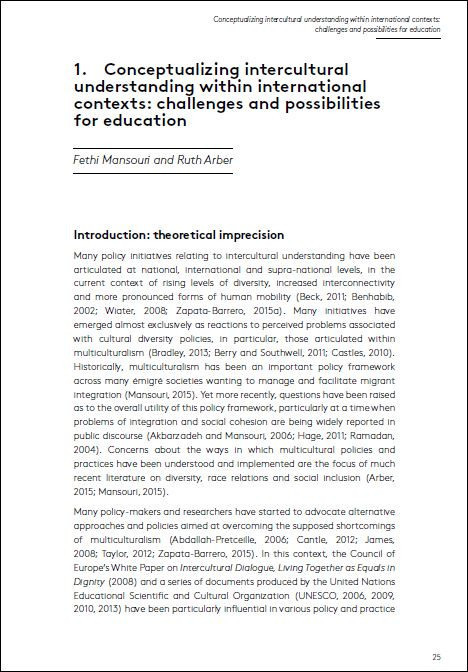 Conceptualizing Intercultural Understanding within International Contexts: Challenges and Possibilities for Education Année de publication: 2017 Auteur: Fethi Mansouri, Ruth Arber Auteur institutionnel: UNESCO This chapter interrogates the ways in which intercultural conception has been defined in diverse contexts, providing the framing context for policy and curriculum measures to work with the manifestations of global population movement, diversity and change. It asks questions the ways in which conversations about intercultural understanding can be broadened to consider how entrenched systemic inequalities, the underlying notional and institutional frameworks that support them, and the mono-cultural and specific privileges and oppression, which are so often their enduring outcome, can be dismantled. To that end, it examines how policy and notional and practical work, in relation to intercultural understanding, can better encompass structural and cultural change regarding the ways in which cross cultural encounters and intercultural relations are shaped and take place. Educação 2030 Declaração de Incheon Rumo a uma educação de qualidade inclusiva e equitativa e à educação ao longo da vida para todos Année de publication: 2016 Auteur institutionnel: UNESCO | United Nations Development Programme (UNDP) | UN. Office of the United Nations High Commissioner for Refugees (UNHCR) | United Nations Children's Fund (UNICEF) | United Nations Entity for Gender Equality and the Empowerment of Women (UN Women) | United Nations Population Fund (UNFPA) This framework — painstakingly drafted over many months with input from governments, international agencies, civil society and experts — provides guidance for implementing the education commitments made in the 2030 Agenda for Sustainable Development at a national, regional and global level. In particular: it aims at mobilizing all countries and partners around Sustainable Education Goal 4 and its targets; it proposes ways of implementing, coordinating, financing and monitoring the new commitments; and it proposes indicative strategies which countries may wish to draw upon in developing their plans, taking into account different national realities, capacities and levels of development and respecting national policies and priorities. UNESCO GCED eNewsletter Issue 3 Année de publication: 2016 Auteur institutionnel: UNESCO Feature: Expanding partenrships around Global Citizenship EducationUNESCO – IEA partnershipPresident Park Geun-hye announces initiatives to widen prtnership with UNESCOUNESCO and the United States promote education to prevent violent extremismUNESCO signs partnership with Asia Society to advance Global Citizenship EducationInternational Mother Language DayUNESCO Category 2 Institute on mother languages established in BangladeshUCLA establishes new UNESCO Chair in Global Learning and Global Citizenship EducationWorkshop in Abidjan focuses on learning to live together through history educationLeading French network of rural vocational institutions puts Global Citizenship Education firstSub-regional Workshop on Global Citizenship Education in Central AsiaRabat Conference on Democratic Citizenship and Human Rights Education: Trends and Innovation from CSOsConference on Global Citizenship Education in SudanConference on Global Citizenship Education in SharjahFocus on: ongoing UNESCO school initiative: the Happy Schools ProjectCurriculum development and review for democratic citizenship and human rights educationKey TweetsUpcoming Events
 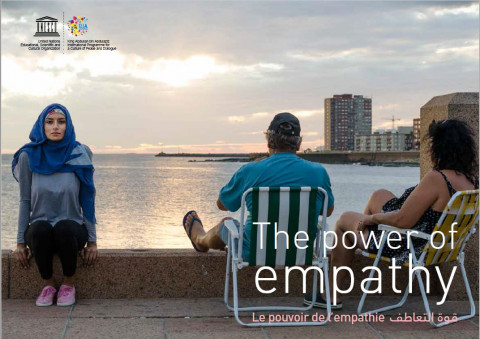 The Power of Empathy Année de publication: 2017 Auteur institutionnel: UNESCO This photobook is a tribute to the power of empathy and solidarity felt and expressed by young people. Its photographs and stories were selected from the response to the global youth contest “If I were…”, launched by UNESCO on social media in Arabic, English, French and Spanish in early 2017. UNESCO received some 837 submissions, from 117 countries, covering a wide variety of issues and experiences.Despite the gravity of the themes addressed in these beautiful pictures, hope emerges from the testaments of the young photographers which demonstrate not only a sensitivity to the situations of “others”, but, moreover, a resolve to help people recover and protect their rights and dignity.