
Ressources
Explorez une large gamme de ressources sur le GCED afin d’approfondir votre compréhension et de renforcer vos activités de recherche, de plaidoyer, d’enseignement et d’apprentissage.
518 résultats trouvés
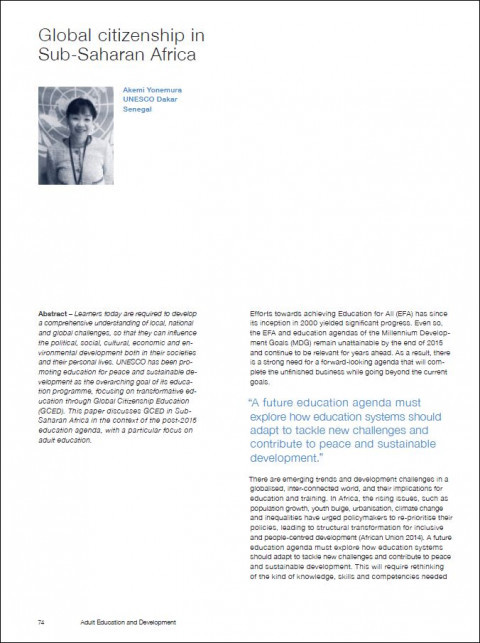 Global Citizenship in Sub-Saharan Africa Année de publication: 2015 Auteur: Akemi Yonemura Auteur institutionnel: Éducation des Adultes et Développement Learners today are required to develop a comprehensive understanding of local, national and global challenges, so that they can influence the political, social, cultural, economic and environmental development both in their societies and their personal lives. UNESCO has been promoting education for peace and sustainable development as the overarching goal of its education programme, focusing on transformative education through Global Citizenship Education (GCED). This paper discusses GCED in Sub-Saharan Africa in the context of the post-2015 education agenda, with a particular focus on adult education. Ciudadanía mundial en el África Subsahariana Année de publication: 2015 Auteur: Akemi Yonemura Auteur institutionnel: Éducation des Adultes et Développement En la actualidad, a los alumnos se les exige desarrollar una concepción global de los problemas locales, nacionales y mundiales, para que sean capaces de influir en el desarrollo político, social, cultural y económico, tanto en su sociedad como en su vida personal. La UNESCO ha estado promoviendo la educación para la paz y el desarrollo sostenible como objetivo integral de su programa de educación, concentrándose en la educación transformativa por medio de la educación para la ciudadanía mundial (ECM). En este trabajo se analiza la ECM en el África Subsahariana (ASS), en el contexto de la agenda educativa posterior a 2015, con especial énfasis en la educación de adultos.
  The Failure of Living-Together in Rwanda: What is the Responsibility of History Textbooks? Année de publication: 2013 Auteur: Éric Mutabazi Auteur institutionnel: McGill University. Faculty of Education Rwanda, landlocked in the Great Lakes region in Central Africa, has known war and massacres resulting in the 1994 genocide. Many critics and researchers have attempted to explain the reasons behind the inhuman and monstrous massacres that ravaged this country. While political, historical and economical factors are more often invoked to justify these horrible events, this article seeks to draw attention to the responsibility of history textbooks in the failure of living-together in pre-genocide Rwanda. Our analysis of textbook content reveals that certain values transmitted through the teaching of Rwanda’s history has generated injustice, inequality, victimisation, suffering, etc., at school and in society. We attempt to demonstrate how textbook content contributed to the failure of living-together in Rwanda and we propose alternative perspectives to guide the development of content that can contribute to peace, unity and living-together in post-genocide Rwanda. Échec du vivre-ensemble au Rwanda : quelle est la responsabilité des manuels scolaires d’histoire ? Année de publication: 2013 Auteur: Éric Mutabazi Auteur institutionnel: McGill University. Faculty of Education Le Rwanda, enclavé dans la région des Grands Lacs en Afrique centrale, a connu la guerre et les massacres aboutissant au génocide de 1994. Plusieurs penseurs et chercheurs ont tenté d’expliquer les raisons de ces massacres inhumains et monstrueux qui ont ravagé ce pays. Alors que les facteurs politiques, historiques et économiques sont plus souvent évoqués pour justifier ces horribles événements, cette contribution consiste à dégager la responsabilité des manuels scolaires d’histoire dans l’échec du vivre-ensemble au Rwanda avant le génocide. Notre analyse des contenus des manuels scolaires révèle que certaines valeurs transmises à travers l’enseignement de l’histoire du Rwanda ont généré toutes sortes d’injustices, d’inégalités, de victimisation, de souffrances, etc., à l’école et dans la société. Nous essaierons de montrer en quoi le contenu des manuels a contribué à l’échec du vivre-ensemble au Rwanda et nous proposerons des perspectives qui pourraient guider l’élaboration du nouveau contenu contribuant à la paix, à l’unité et au vivre-ensemble au Rwanda après le génocide.
  Global Citizenship in a Digital World (The MILID Yearbook, 2014) Année de publication: 2014 Auteur: Sherri Hope Culver | Paulette Kerr Auteur institutionnel: International Clearinghouse on Children, Youth and Media (Sweden) | NORDICOM | University of Gothenburg The theme of the 2014 Yearbook is Global Citizenship in a Digital World. Global citizenship assumes ease of participation in global spaces in which persons are media and information literate and are equipped with competencies and attitudes to deal with the multi-faceted nature of a mediated world in which information is no longer bound by space or time. The unprecedented access to and use of media and Internet technologies for communication and collaboration especially among youth, suggest that effective strategies must be found to enable active critical inquiry and effective media production. The proliferation of mediated spaces throughout education environments, as well as personal and professional environments, does not in itself guarantee that citizens will consider their role as global citizens as they create and consume media. This awareness must be cultivated, encouraged and taught.The 2014 MILID Yearbook brings together a range of reviewed articles, which articulate the theme of global citizenship from varied perspectives and regions of the world. The articles represent different expressions on media and information literacy from researchers and practitioners who offer bold new strategies, share research findings and best practices, and share musings and reflections.
  Media and Information Literacy for the Sustainable Development Goals (The MILID Yearbook 2015) Année de publication: 2015 Auteur: Jagtar Singh | Alton Grizzle | Sin Joan Yee | Sherri Hope Culver Auteur institutionnel: International Clearinghouse on Children, Youth and Media (Sweden) In the year 2000, governments and development partners all over the world agreed on eight global development targets called the Millennium Development Goals (MDGs). The year 2015 is a pivotal year as it marks the end of the period during which the MDGs were to be reached and the year in which new global development targets are to be set. These new targets are referred to as the Post-2015 Sustainable Development Goals (SDGs). This process is in its highest gear with ongoing debates and consultative meetings/initiatives globally both online and offline. While much progress has been made, achievement of the MDGs has been mixed across countries. The centrality of information and communication to development is irrefutable. The MILID Yearbook provides a case for media and information literacy (MIL) as a tool for open and inclusive sustainable development.The 2015 edition of the MILID Yearbook displays how media and information literacy can be helpful in facilitating progress and achievement of the sustainable development goals. It is sincerely hoped that the articles in this yearbook will go a long way to sensitize the stakeholders about the role and value of MIL in sustainable development of one and all across frontiers.
 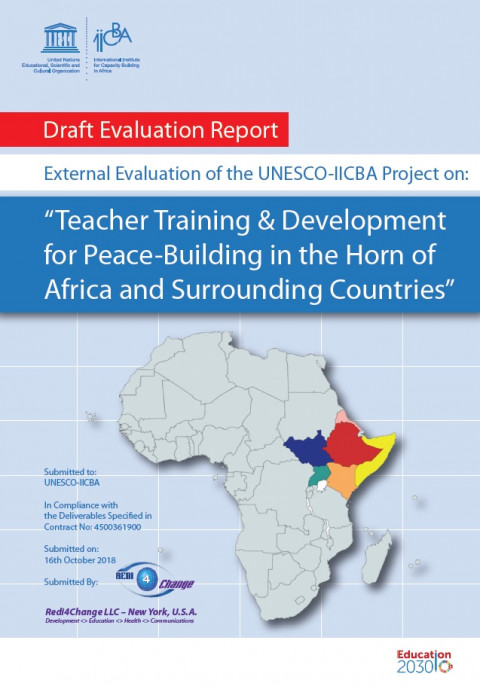 [Draft Evaluation Report] External Evaluation of the UNESCO-IICBA Project on: “Teacher Training & Development for Peace-Building in the Horn of Africa and Surrounding Countries” Année de publication: 2018 Auteur institutionnel: UNESCO International Institute for Capacity-Building in Africa (IICBA) The project on “Teacher Training and Development for Peace-Building in the Horn of Africa and Surrounding Countries” was designed by UNESCO-IICBA and financed by the Government of Japan. The project benefitted six conflict-affected countries; Ethiopia, Eritrea, Somalia, Kenya, Uganda, and South Sudan by building on the mandate and niche expertise of UNESCO-IICBA in teacher education, as well as benefiting from the empathetic insights and financing of the Government of Japan.This evaluation report analyses the design, implementation, and consolidation of the project to assess the likelihood that it can facilitate peace education as an effective and integral part of the national education systems. The project’s short timeframe and modest financing mean that the evaluation could not credibly deal with its outcomes and impact; but efforts are made to gauge the uptake and sustainability of this project as a vehicle for promoting peace education and so help to prevent violent conflict and cultivate a culture of peace in the countries concerned.
  [Summary] SDG 4 Data Digest 2018: Data to Nurture Learning; Executive Summary Année de publication: 2018 Auteur institutionnel: UNESCO Institute for Statistics (UIS) The 2018 edition of the SDG 4 Data Digest: Data to Nurture Learning builds on last year’s report, which proposed a conceptual framework and tools to help countries improve the quality of their data and fulfil their reporting requirements. In this report, we present the wide range of national and cross-national learning assessments currently underway and the assessment experiences of practitioners in the field. The report draws on these experiences to present pragmatic approaches that can help countries monitor progress and make the best possible use of data for policymaking purposes. [Resumen] Compendio 2018 de Datos sobre el ODS 4: Estadísticas para Fomentar el Aprendizaje; resumen Année de publication: 2018 Auteur institutionnel: UNESCO Institute for Statistics (UIS) La edición del Compendio 2018 de Datos sobre el ODS 4: Estadísticas para Fomentar el Aprendizaje apoya y expande el contenido del informe del año precedente, que proponía a los países un marco conceptual y un conjunto de herramientas para mejorar la calidad de sus estadísticas y cumplir con las obligaciones en materia de informes. En este documento, presentamos una amplia gama de evaluaciones de aprendizaje nacionales e internacionales que se realizan actualmente, así como las experiencias en evaluaciones de expertos en la materia. En el informe se elabora sobre esas experiencias para ofrecer soluciones pragmáticas que ayuden a monitorear el progreso y a lograr el mejor uso posible de los datos con miras a la formulación de políticas.
  Disinformation and Peacebuilding in Sub-Saharan Africa : Security Implications of AI-Altered Information Environments : Research Report Année de publication: 2024 Auteur: Eduardo Albrecht | Eleonore Fournier-Tombs | Rebecca Brubake Auteur institutionnel: United Nations University This report aims to further explore the way in which AI technologies as they currently stand impact peace and conflict, and what methods might be used to mitigate their adverse effects - through the development of better tools and the inclusion of peace and conflict considerations in AI governance frameworks. The report proposes the following recommendations: 1. More funding and support should be provided to civil society organization efforts to expand media literacy and fact-checking initiatives using AI tools to enhance capabilities. 2. Governments need to work with civil society to develop and implement comprehensive, transparent legal frameworks combating disinformation. These legislative measures need to support digital and media literacy campaigns and fact-checking organizations. 3. Social media companies need to expand investment and research into understanding local information environments, so they can better identify and respond to instances of disinformation in all contexts in which they operate and enhance transparency. 4. Peacebuilding organizations need to carefully consider local media ecosystems and information environments when conducting conflict analyses, and factor these dynamics into their projects' frameworks.