
Ressources
Explorez une large gamme de ressources sur le GCED afin d’approfondir votre compréhension et de renforcer vos activités de recherche, de plaidoyer, d’enseignement et d’apprentissage.
3,790 résultats trouvés
 Citizenship education and coexistence: teaching modules for citizenship and coexistence based on the collective construction of meaning and networks; unit 1; coexisting citizens and comunities Année de publication: 2014 Auteur institutionnel: Centro de Investigación y Educación Popular (CINEP) | Secretaría de Educación del Distrito (SED) These modules and guides are directed to the Facilitators Network Citizenship and Coexistence to help them through a process of training and reflection that allows them to be aware of their capabilities, and the tools we have, providing a bank of learning activities, as well as a general guide for development, according to the needs of the processes with their educational communities .Therefore, the processes of dialogue and exchange that have been developed with the same Network facilitators, and the interaction and reflection with all educational stakeholders in Bogota, have been taken into account in the conceptual, methodological and didactic guidelines of the modules and guides. Educación para la ciudadanía y la convivencia: módulo de ciudadanía y convivencia desde la construcción colectiva de sentidos y redes;unidad 1; sujetos ciudadanos y comunidades en convivencia Année de publication: 2014 Auteur institutionnel: Centro de Investigación y Educación Popular (CINEP) | Secretaría de Educación del Distrito (SED) These modules and guides are directed to the Facilitators Network Citizenship and Coexistence to help them through a process of training and reflection that allows them to be aware of their capabilities, and the tools we have, providing a bank of learning activities, as well as a general guide for development, according to the needs of the processes with their educational communities .Therefore, the processes of dialogue and exchange that have been developed with the same Network facilitators, and the interaction and reflection with all educational stakeholders in Bogota, have been taken into account in the conceptual, methodological and didactic guidelines of the modules and guides.
 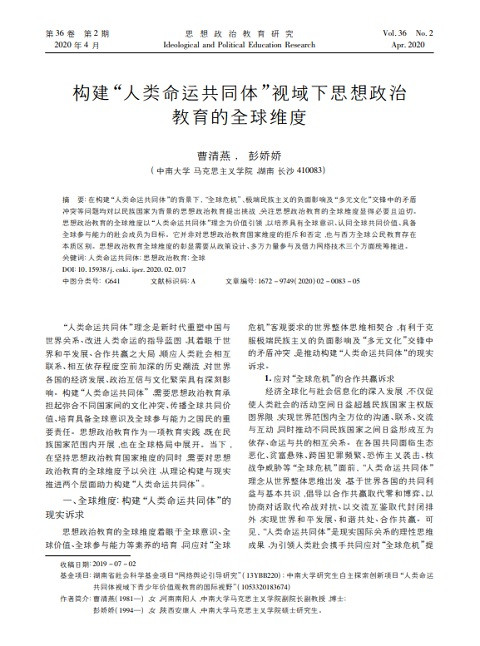 构建“人类命运共同体”视域下思想政治 教育的全球维度 (思想政治教育研究; Vol. 36, No. 2) Année de publication: 2020 Auteur: Cao Qingyan | Peng Jiaojiao Auteur institutionnel: Harbin University of Science and Technology 在构建“人类命运共同体”的背景下,“全球危机”、极端民族主义的负面影响及“多元文化”交锋中的矛盾 冲突等问题均对以民族国家为背景的思想政治教育提出挑战,关注思想政治教育的全球维度显得必要且迫切。 思想政治教育的全球维度以“人类命运共同体”理念为价值引领,以培养具有全球意识、认同全球共同价值、具备 全球参与能力的社会成员为目标。它并非对思想政治教育国家维度的拒斥和否定,也与西方全球公民教育存在 本质区别。思想政治教育全球维度的彰显需要从政策设计、多方力量参与及借力网络技术三个方面统筹推进。
 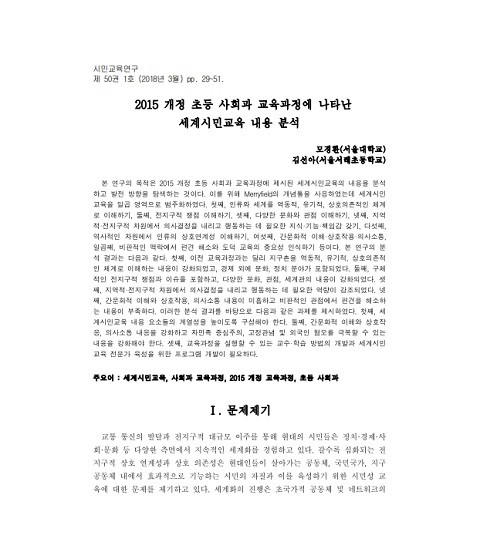 A Critical Analysis of Global Citizenship in 2015 Revised Elementary Social Studies Curriculum (Theory and Research in Citizenship Education; Vol. 50, No. 1) Année de publication: 2018 Auteur: Kyunghwan Mo | Sunah Kim Auteur institutionnel: Korea Association of Social Education The purpose of this study was to examine how global citizenship is reflected in the 2015 revised social studies curriculum. The study used the conceptual framework of Merryfield(1998) to analyze the national curriculum. The results of the analysis are as follows. First, in terms of understanding of the world as interdependent systems, contents on politics and culture as well as economy increased. Second, more global issues and problems were included. Third, contents on sustainable development increased. Fourth, the scope of diversity expanded. Fifth, interconnectedness of humans through time was inadequately reflected in the current social studies curriculum. Sixth, contents on values and attitudes, and actions were strengtened. Sixth, contents of cross-cultural understanding, interaction, and communication are not adequately included. The elementary social studies curriculum should strengthen cross-cultural understanding and interaction and prejudice reduction. Also, more instructional methods for global citizenship education should be developed and teacher education programs should be overhauled. 2015 개정 초등 사회과 교육과정에 나타난 세계시민교육 내용 분석 (시민교육연구; Vol. 50, No. 1) Année de publication: 2018 Auteur: 모경환 | 김선아 Auteur institutionnel: 한국사회과교육학회 본 연구의 목적은 2015 개정 초등 사회과 교육과정에 제시된 세계시민교육의 내용을 분석하고 발전 방향을 탐색하는 것이다. 이를 위해 Merryfield의 개념틀을 사용하였는데 세계시민교육을 일곱 영역으로 범주화하였다. 첫째, 인류와 세계를 역동적, 유기적, 상호의존적인 체계로 이해하기, 둘째, 전지구적 쟁점 이해하기, 셋째, 다양한 문화와 관점 이해하기, 넷째, 지역적·전지구적 차원에서 의사결정을 내리고 행동하는 데 필요한 지식·기능·책임감 갖기, 다섯째, 역사적인 차원에서 인류의 상호연계성 이해하기, 여섯째, 간문화적 이해·상호작용·의사소통, 일곱째, 비판적인 맥락에서 편견 해소와 도덕 교육의 중요성 인식하기 등이다. 본 연구의 분석 결과는 다음과 같다. 첫째, 이전 교육과정과는 달리 지구촌을 역동적, 유기적, 상호의존적인 체계로 이해하는 내용이 강화되었고, 경제 외에 문화, 정치 분야가 포함되었다. 둘째, 구체적인 전지구적 쟁점과 이슈를 포함하고, 다양한 문화, 관점, 세계관의 내용이 강화되었다. 셋째, 지역적·전지구적 차원에서 의사결정을 내리고 행동하는 데 필요한 역량이 강조되었다. 넷째, 간문화적 이해와 상호작용, 의사소통 내용이 미흡하고 비판적인 관점에서 편견을 해소하는 내용이 부족하다. 이러한 분석 결과를 바탕으로 다음과 같은 과제를 제시하였다. 첫째, 세계시민교육 내용 요소들의 계열성을 높이도록 구성해야 한다. 둘째, 간문화적 이해와 상호작용, 의사소통 내용을 강화하고 자민족 중심주의, 고정관념 및 외국인 혐오를 극복할 수 있는 내용을 강화해야 한다. 셋째, 교육과정을 실행할 수 있는 교수·학습 방법의 개발과 세계시민교육 전문가 육성을 위한 프로그램 개발이 필요하다. Citizenship education and coexistence: guides for citizenship and coexistence based on the collective construction of meaning and networks; unit 3; planetary citizenship and a society without territory Année de publication: 2014 Auteur institutionnel: Centro de Investigación y Educación Popular (CINEP) | Secretaría de Educación del Distrito (SED) These modules and guides are directed to Facilitators Network Citizenship and Coexistence to help them through a process of training and reflection that allows them to be aware of their capabilities, and the tools we have, providing a bank of learning activities, as well as a general guide for development, according to the needs of the processes with their educational communities .Therefore, the processes of dialogue and exchange that have been developed with the same Network facilitators, and the interaction and reflection with all educational stakeholders in Bogota, have been taken into account in the conceptual, methodological and didactic guidelines of the modules and guides. Educación para la ciudadanía y la convivencia: manual de ciudadanía y convivencia desde la construcción colectiva de sentidos y redes;unidad 3; ciudadanía planetaria y sociedad desterritorializada Année de publication: 2014 Auteur institutionnel: Centro de Investigación y Educación Popular (CINEP) | Secretaría de Educación del Distrito (SED) These modules and guides are directed to Facilitators Network Citizenship and Coexistence to help them through a process of training and reflection that allows them to be aware of their capabilities, and the tools we have, providing a bank of learning activities, as well as a general guide for development, according to the needs of the processes with their educational communities .Therefore, the processes of dialogue and exchange that have been developed with the same Network facilitators, and the interaction and reflection with all educational stakeholders in Bogota, have been taken into account in the conceptual, methodological and didactic guidelines of the modules and guides. Education à la citoyenneté et de la coexistence: la citoyenneté et le module de coexistence de la construction collective des significations et des réseaux; Unité 3; la citoyenneté mondiale et de la société déracinée Année de publication: 2014 Auteur institutionnel: Centro de Investigación y Educación Popular (CINEP) | Secretaría de Educación del Distrito (SED) Ces modules et guides sont dirigés vers Facilitateurs Réseau Citoyenneté et Coexistence pour les aider dans un processus de formation et de réflexion qui leur permet d'être au courant de leurs capacités, et les outils dont nous disposons, en fournissant une banque d'activités d'apprentissage, ainsi qu'un général guide pour le développement, en fonction des besoins des processus avec leurs communautés éducatives. Par conséquent, les processus de dialogue et d'échange qui ont été développés avec les mêmes animateurs de réseau, et l'interaction et de réflexion avec tous les acteurs de l'éducation à Bogota, ont été prises en compte dans les orientations conceptuelles, méthodologiques et didactiques des modules et des guides.
  Sustainable Foundations: A Guide for Teaching the Sustainable Development Goals Année de publication: 2018 Auteur: Keana Rellinger | Grace Van Mil Auteur institutionnel: Manitoba Council for International Cooperation (MCIC) This guide is designed for educators or anyone who would like to teach young people about the United Nations Sustainable Development Goals. The Sustainable Development Goals — also known as the SDGs or the Global Goals —cover a wide range of sustainability issues; highlighting local, national and international priority areas to end poverty and hunger, improve health and education, make cities more sustainable and combat climate change. This guide will provide you with clear information, educational resources and other supports to help you in your efforts to educate and engage young people so that they support the Sustainable Development Goals and are inspired to turn their support into action. This guide will also explore how you can incorporate the different topics covered by each goal into your lessons across multiple subjects. Fondations durables: Un Guide d’enseignement des objectifs de développement durable Année de publication: 2018 Auteur: Keana Rellinger | Grace Van Mil Auteur institutionnel: Manitoba Council for International Cooperation (MCIC) Ce guide est conçu pour les éducateurs ou toute personne qui aimerait enseigner aux jeunes les objectifs de développement durable des Nations Unies. Les objectifs de développement durable – également connus sous l’acronyme ODD ou les objectifs mondiaux – couvrent un large éventail de questions relatives à la durabilité, et mettent en lumière les zones de priorité internationale pour mettre fin à la pauvreté et à la faim, améliorer la santé et l’éducation, rendre les villes plus durables et combattre le changement climatique. Ce guide vous donne des informations claires, des ressources pédagogiques et d’autres soutiens pour appuyer vos efforts d’éducation et de motivation des jeunes pour qu’ils appuient les objectifs de développement durable et se sentent inspirés à transformer leur appui en action. Ce guide explore aussi comment vous pouvez incorporer à vos cours les divers sujets couverts par chaque objectif dans de multiples matières.