
Ressources
Explorez une large gamme de ressources sur le GCED afin d’approfondir votre compréhension et de renforcer vos activités de recherche, de plaidoyer, d’enseignement et d’apprentissage.
2,162 résultats trouvés
 Asia-Pacific Living Heritage Lesson Plan 2023 Année de publication: 2023 Auteur institutionnel: APCEIU | UNESCO Bangkok | International Information and Networking Centre for Intangible Cultural Heritage in the Asia-Pacific Region (ICHCAP) In partnership with UNESCO Bangkok and ICHCAP (International Information and Networking Centre for Intangible Cultural Heritage in the Asia-Pacific Region), APCEIU (Asia-Pacific Centre of Education for International Understanding) carried out “Bringing Living Heritage to the Classroom in the Asia-Pacific” since 2020. As a part of this multi-year project, the UNESCO Asia-Pacific Living Heritage Lesson Plan Contest 2023, co-organized by UNESCO Bangkok, APCEIU, and ICHCAP was launched and 18 lesson plans from 10 countries – Bhutan, China, India, Indonesia, the Republic of Korea, Malaysia, Nepal, The Philippines, Singapore, and Viet Nam - were selected as follows. - Saykha Offering (Subject: English), Tsirangtoe Central School, Bhutan- Setting Up a Herbarium, Learning about Medicinal Herbs and their Cultural and Traditional Uses in the Community (Subject: Science/Grades 7–9), Zilukha Middle Secondary School, Bhutan- Shamanistic Worship and Propitiation to the Spirits (Subject: Bhutan History and Civics and Citizenship Education/Grade 8), Bajothang Higher Secondary School, Bhutan- Beauty of Intangible Cultural Heritage (Subject: Foundations of College Art Education/ Freshman Year), Anhui Medical University, China- The Folk Custom of Building the Peace Kiln for the Mid-Autumn Festival in Jingdezhen (Subject: Mathematics/Grade 7), Jingdezhen No.13 Secondary School, China - When Xiabu Meets Batik (Subject: Art/Grade 5–6), ChongQing Shuren Primary School, China- Agricultural Practices (Subject: Biology/Grade 8), Paramita Heritage School, India- Living Heritage – Quilting in the Kalbelia Community of Rajasthan (Subject: Social Science/Grade 9), St. Stephen's Senior Secondary School, India- My City: Varanasi (Subject: Environmental Studies/Grade 2), Sunbeam School Lahartara, India - Bringing Back the Javanese Saka Calendar through Ethnomathematics (Subject: Mathematics/Grade 7–12), Binus School Bekasi, Indonesia- Song, Play, and Dance (Subject: Interdisciplinary for Indonesian Language, Balinese Culture, Music and Physical Education/Grade 3), Green School Bali, Indonesia- Teaching Sound Wave with Sundanese Traditional Instruments (Subject: Physics/Grade 8), Binus School Bekasi, Indonesia- Wau – The Malays Traditional Kite: Introduction, Wau Bulan Appreciation, Wau Making and Flying Workshop and Wau Corner (Subject: Traditional Games/Grades 4–5), SMU (A) Tarbiah Islamiah (SABK), Malaysia- Himalayan Aromatic Incense-Making and Meditation Workshop (Subject: Economics and Social Studies/ Grades 8–9, 11–12), Pragati Pathshala, Nepal- Influence of Biodiversity on the Stability of Ecosystems (Subject: Science/Grade 10), Philippine Normal University Mindanao, The Philippines- Understanding the Nature of Religion: From the Perspective of the Tripeople (Christians, Muslims, & Lumads) of Kidapawan City, North Cotabato (Subject: Humanities and Social Sciences/Grade 12), Kidapawan City National High School, The Philippines- Bongsan Talchum that Helps the Community Become More Sustainable (Subject: Korean Language and Literature, Social Studies, P.E., Arts/Grade 6), Kimje Buk Elementary School, Republic of Korea- Exploring Community Gardens – How and why are they so precious to humans? (Subject: Geography/Grade 9), Admiralty Secondary School, Singapore 무형유산을 통해 키우는 세계시민성: 2023 아태지역 무형유산 교수학습계획안 Année de publication: 2023 Auteur institutionnel: 유네스코 아시아태평양 국제이해교육원 | UNESCO Bangkok | 유네스코아태무형유산센터 유네스코 아태교육원은 2020년부터 유네스코 방콕사무소와 유네스코아태무형유산센터(ICHCAP)와 협력하여 「아시아태평양 교실에서 만나는 무형유산 사업」을 수행하였다. 이 사업의 일환으로, <2023 아태지역 무형유산 교수학습계획안 공모전 >을 개최하였으며, 총 10개국(네팔, 말레이시아, 베트남, 부탄, 싱가포르, 인도, 인도네시아, 중국, 필리핀, 한국)의 18개 교수학습계획안을 모범사례로 최종 선정하였다. 다음은 수상작 목록이다. - Saykha Offering (Subject: English), Tsirangtoe Central School, Bhutan- Setting Up a Herbarium, Learning about Medicinal Herbs and their Cultural and Traditional Uses in the Community (Subject: Science/Grades 7–9), Zilukha Middle Secondary School, Bhutan- Shamanistic Worship and Propitiation to the Spirits (Subject: Bhutan History and Civics and Citizenship Education/Grade 8), Bajothang Higher Secondary School, Bhutan- Beauty of Intangible Cultural Heritage (Subject: Foundations of College Art Education/ Freshman Year), Anhui Medical University, China- The Folk Custom of Building the Peace Kiln for the Mid-Autumn Festival in Jingdezhen (Subject: Mathematics/Grade 7), Jingdezhen No.13 Secondary School, China - When Xiabu Meets Batik (Subject: Art/Grade 5–6), ChongQing Shuren Primary School, China- Agricultural Practices (Subject: Biology/Grade 8), Paramita Heritage School, India- Living Heritage – Quilting in the Kalbelia Community of Rajasthan (Subject: Social Science/Grade 9), St. Stephen's Senior Secondary School, India- My City: Varanasi (Subject: Environmental Studies/Grade 2), Sunbeam School Lahartara, India - Bringing Back the Javanese Saka Calendar through Ethnomathematics (Subject: Mathematics/Grade 7–12), Binus School Bekasi, Indonesia- Song, Play, and Dance (Subject: Interdisciplinary for Indonesian Language, Balinese Culture, Music and Physical Education/Grade 3), Green School Bali, Indonesia- Teaching Sound Wave with Sundanese Traditional Instruments (Subject: Physics/Grade 8), Binus School Bekasi, Indonesia- Wau – The Malays Traditional Kite: Introduction, Wau Bulan Appreciation, Wau Making and Flying Workshop and Wau Corner (Subject: Traditional Games/Grades 4–5), SMU (A) Tarbiah Islamiah (SABK), Malaysia- Himalayan Aromatic Incense-Making and Meditation Workshop (Subject: Economics and Social Studies/ Grades 8–9, 11–12), Pragati Pathshala, Nepal- Influence of Biodiversity on the Stability of Ecosystems (Subject: Science/Grade 10), Philippine Normal University Mindanao, The Philippines- Understanding the Nature of Religion: From the Perspective of the Tripeople (Christians, Muslims, & Lumads) of Kidapawan City, North Cotabato (Subject: Humanities and Social Sciences/Grade 12), Kidapawan City National High School, The Philippines- Bongsan Talchum that Helps the Community Become More Sustainable (Subject: Korean Language and Literature, Social Studies, P.E., Arts/Grade 6), Kimje Buk Elementary School, Republic of Korea- Exploring Community Gardens – How and why are they so precious to humans? (Subject: Geography/Grade 9), Admiralty Secondary School, Singapore
  ACER-APCEIU Global Citizenship Education Monitoring Toolkit: For Teachers, Schools and System Leaders Année de publication: 2024 Auteur: Rachel Parker | Amy Berry | Payal Goundar | Karena Menzie-Ballantyne Auteur institutionnel: Australian Council for Educational Research (ACER) | APCEIU The APCEIU-ACER GCED Monitoring Toolkit was developed and informed by research conducted from 2022-2024 in collaboration with partners in Australia, Lao PDR, Philippines, and South Korea. The toolkit aims to assist education stakeholders to embed GCED within policy and practice in alignment with local, regional, and international frameworks. Target users of this toolkit include policy makers, education department and ministry personnel, leaders, and educators at all levels in both formal and non-formal education sectors.The toolkit explores effective GCED including how to conceptualise and define, plan, enact and monitor implementation, and how to measure success. By guiding educators and leaders to align their enactment and monitoring efforts to international guidance, research, theory and practice, this toolkit supports a robust and evidence-informed process for enacting GCED in ways that nurture learners as proactive and empowered global citizens.Phase I Report (Link): https://www.unescoapceiu.org/post/4995Phase II Report (Link): https://www.unescoapceiu.org/post/5184
  Common Curriculum Guide for Peace Education in Northeast Asia Année de publication: 2023 Auteur: Sicong Chen | Kevin Kester | Jeongmin Eom Auteur institutionnel: APCEIU Inspired by the recommendations from the study, Peace Education in Northeast Asia: A Situational Analysis (APCEIU, 2021), APCEIU coordinated a project to develop a common curriculum for peace education in Northeast Asia. This initiative was undertaken in partnership with UNESCO Multisectoral Regional Office for East Asia, UNESCO Chair on Peace Studies at Nanjing University, UNESCO Chair on Education for Peace, Social Justice and Global Citizenship at Kyushu University, Peace Education Commission of the Peace Studies Association of Japan, Japan Association for International Education, and Korean Society of Education for International Understanding. This guide serves as a framework for supporting peace education in diverse communities across Northeast Asia. Its primary function is to aid in the design and development of peace education programs tailored to various contexts within the region. It is our sincere hope that this guide will serve as a catalyst, encouraging and assisting more teachers and practitioners in the region to actively participate in our collective efforts to foster peace in and through education.
 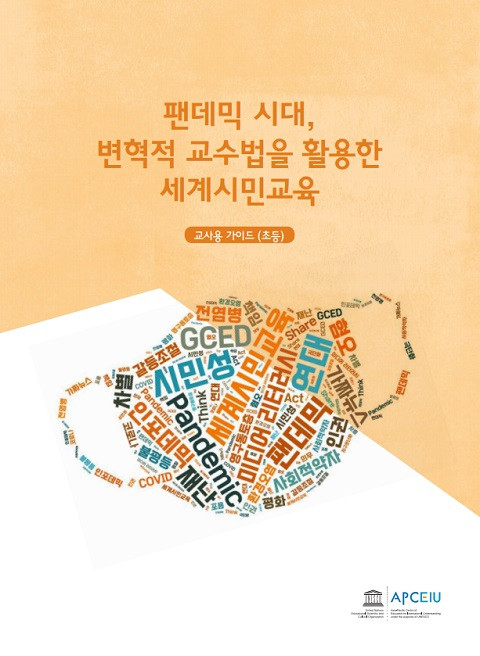 팬데믹 시대, 변혁적 교수법을 활용한 세계시민교육: 교사용 가이드 (초등·중등) Année de publication: 2020 Auteur: 김화선 | 박재준 | 하승천 [초등 편] | 양철진 | 최인선 | 최윤경 [중등 편] Auteur institutionnel: 유네스코 아시아태평양 국제이해교육원 본 교사용 가이드는 팬데믹과 관련된 다양한 세계시민교육 주제를 선정하여, 유네스코가 권장하는 변혁적 교수학습법(Transformative pedagogy)을 수업에 적용하여 실천해볼 수 있도록 구성하였다. 초등과 중등 수준에 맞춰 다양한 주제의 수업활동을 위한 교사용 팁과 교수학습자료도 포함하였다.
 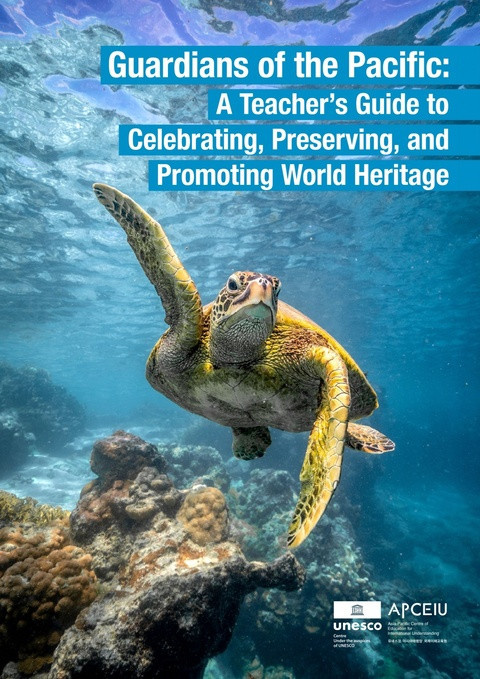 Guardians of the Pacific: A Teacher’s Guide to Celebrating, Preserving, and Promoting World Heritage Année de publication: 2024 Auteur: Karena Menzie-Ballantyne | Nanise J. Young Okotai | Adi Meretui Tuvou Ratunabuabua Auteur institutionnel: APCEIU Guardians of the Pacific: A Teacher’s Guide to Celebrating, Preserving, and Promoting World Heritage is an APCEIU initiative dedicated to advancing Global Citizenship Education (GCED) worldwide. Anchored in the principles of the Sustainable Development Goals (SDGs) and UNESCO World Heritage, the guide places a special emphasis on the rich and diverse heritage of the Pacific region. This Guide reflects GCED’s integrative approach, which encompasses three interconnected dimensions of learning: cognitive, socio-emotional, and behavioral. It encourages critical thinking about heritage and sustainability, fosters empathy by deepening understanding of the Pacific's unique cultural and natural environments, and inspires meaningful actions to protect and preserve local heritage. Tailored for educators working with students in upper primary (grades 4–6) and lower secondary (grades 7–9), the Guide provides step-by-step instructions and practical resources for incorporating Pacific World Heritage into classroom lessons and extracurricular activities. It is a valuable tool for nurturing awareness, appreciation, and stewardship of the Pacific region’s irreplaceable heritage in schools worldwide. <Table of Contents>ForewordHow to Use This GuideSection 1. Learning Framework Rationale Section 2. What Makes a Place Special?Section 3. The 2030 Agenda, Five Pillars and SDGsSection 4. Protecting People: Levuka Historical Port Town (Cultural Site)Section 5. Preserving the Planet: Phoenix Islands Protected Area (Natural Site)Section 6. Ensuring Prosperity: Rock Islands Southern Lagoon (Mixed Site)Section 7. Promoting Peace: Bikini Atoll Nuclear Test Site (Cultural Site)Section 8. Partnerships to Protect the Environment: East Rennell (Natural Site)Section 9. Taking Action to Promote and Protect a Special PlaceReferences WorksheetsPhoto Cards
  지리적 상상력으로 세계시민 되기 Année de publication: 2024 Auteur: 이경한 | 김다원 | 조대훈 | 이용훈 | 황태성 | 김하나 | 박정연 Auteur institutionnel: 유네스코 아시아태평양 국제이해교육원 유네스코 아시아태평양 국제이해교육원에서 기획한 『지리적 상상력으로 세계시민 되기: 세계시민과 지리 수업 안내서』가 출간되었다. 본 도서는 2022 개정 교육과정 (고등학교)에 신설된 <세계시민과 지리> 교과 및 세계시민교육 관련 수업을 구성하고 진행하는 데 활용할 수 있도록 개발되었다. GIS, 지정학, 인구, 음식, 초국적기업, 에너지, 기후위기, 국제개발협력과 같은 세계시민교육과 밀접한 여덟 가지 주제를 통해 학습자의 지리적 상상력을 자극하고 세계시민성을 함양하는 데 기여할 것으로 기대된다. 주제별로 구체적인 핵심활동과 활동지, 다채로운 참고자료를 제시하여 본 도서의 활용도를 높였다. * 본 단행본과 관련된 활동지는 유네스코 아시아태평양 국제이해교육원 홈페이지(https://www.unescoapceiu.org/post/5210)에서 다운 받으실 수 있습니다.
  Empowering Students for Just Societies: A Handbook for Secondary School Teachers Année de publication: 2019 Auteur institutionnel: UNESCO | UN. Office on Drugs and Crime (UNODC) The purpose of the handbook is to: Provide teachers with a selection of relevant and accessible in-classroom and out-of-classroom educational resources (summaries of short activities, lessons, units) that aim to instil the principles of the RoL among secondary school students. Assist teachers in applying the teaching resources to their local educational settings by providing ideas for adaptation for a variety of learning environments. This handbook provides: Summaries of existing teaching resources selected from UN agencies, INGOs, NGOs, and ministries that work to meet the learning outcomes on GCED for the RoL. Links to the original resource that offers additional learning opportunities. Tips and suggestions for adaptation, extension and cross-references of teaching resources; and Suggestions for learning assessment. This handbook can be useful for: Teachers and teacher trainers in formal school settings at the secondary school level. It encourages teachers to strengthen the RoL through education by integrating it into their lessons and planning. Professionals working in non-formal education or engaging with young people, for example, in sports associations, community organizations, social work and the justice sector. Parents seeking to raise empowered young citizens who actively contribute to peace and justice. Empoderar a los alumnos para crear sociedades justas: manual para docentes de educación secundaria Année de publication: 2019 Auteur institutionnel: Organización de las Naciones Unidas para la Educación, la Ciencia y la Cultura (UNESCO) | UN. Office on Drugs and Crime (UNODC) Cuál es el objetivo de este manual? Su finalidad es: Proporcionar a los docentes diversos materiales didácticos relevantes y accesibles que pueden usarse tanto dentro como fuera del aula (resúmenes de actividades breves, unidades didácticas) dirigidos a transmitir los principios del estado de derecho a los alumnos de educación secundaria. Ayudar a los docentes en la aplicación de los materiales didácticos a su contexto educativo local ofreciendo ideas de adaptación para diversos entornos de prendizaje. El presente manual ofrece: Resúmenes de materiales didácticos procedentes de organismos de las Naciones Unidas, ONG, ONGI y ministerios encargados de lograr resultados educativos en materia de promoción del estado de derecho para la educación para la ciudadanía mundial; Enlaces a los recursos originales, donde pueden consultarse opciones de aprendizaje adicionales; Consejos y sugerencias para la adaptación y ampliación de los recursos didácticos, así como su cotejo con otros materiales; y Sugerencias para evaluar el aprendizaje. Puede resultar de utilidad a: Docentes y formadores de docentes en entornos educativos formales de educación secundaria. Anima a los docentes a fortalecer el estado de derecho a través de la educación intergrandolo en sus clases y planificaciones; Profesionales que trabajan en contextos educativos no formales o que están implicados con los jóvenes, por ejemplo, asociaciones deportivas, en organizaciones comunitarias, que hacen trabajo social y en el sector de justicia; Padres que desean criar a ciudadanos empoderados que contribuyan de forma activa a la paz y la justicia. 为学生赋能,建设公正社会: 中学教师手册 Année de publication: 2019 Auteur institutionnel: 联合国教科文组织 (UNESCO) | UN. Office on Drugs and Crime (UNODC) 该文件为中学阶段的教师提供一个公民教育指导手册,包含众多易于获取的教育资源,用于进行青少年公民教育。