
Ressources
Explorez une large gamme de ressources sur le GCED afin d’approfondir votre compréhension et de renforcer vos activités de recherche, de plaidoyer, d’enseignement et d’apprentissage.
2,781 résultats trouvés
 Global Citizenship Education: Topics and Learning Objectives Année de publication: 2015 Auteur institutionnel: UNESCO This publication, titled Global Citizenship Education: Topics and learning objectives, is the first pedagogical guidance from UNESCO on global citizenship education. It is the result of an extensive research and consultation process with experts from different parts of the world. This guidance draws on the UNESCO publication Global Citizenship Education: Preparing learners for the challenges of the 21st century and the outcomes of three key UNESCO events on global citizenship education: the Technical Consultation on Global Citizenship Education (September 2013), as well as the First and Second UNESCO Fora on Global Citizenship Education, organized in December 2013 and January 2015 respectively. Before it was finalized, the guidance was field-tested by education stakeholders in selected countries in all regions to ensure its relevance in different geographical and socio-cultural contexts. Following the foundational work of UNESCO to clarify the conceptual underpinnings of global citizenship education and provide policy and programmatic directions, this document has been developed in response to the needs of Member States for overall guidance on integrating global citizenship education in their education systems. It presents suggestions for translating global citizenship education concepts into practical and age-specific topics and learning objectives in a way that allows for adaptation to local contexts. It is intended as a resource for educators, curriculum developers, trainers as well as policy-makers, but it will also be useful for other education stakeholders working in non-formal and informal settings.
  Éducation à la citoyenneté mondiale: thèmes et objectifs d'apprentissage Année de publication: 2015 Auteur institutionnel: Organisation des Nations Unies pour l'éducation, la science et la culture (UNESCO) Le présent ouvrage, intitulé Éducation à la citoyenneté mondiale : Thèmes et objectifs d’apprentissage, est le premier guide pédagogique de l’UNESCO sur l’éducation à la citoyenneté mondiale. Il est le fruit d’un processus approfondi de recherche et de consultation avec des spécialistes de différentes régions du monde. Ce guide s’inspire de la publication de l’UNESCO intitulée Éducation à la citoyenneté mondiale : Préparer les apprenants aux défis du XXIe siècle ainsi que des résultats de trois événements clés de l’UNESCO sur l’éducation à la citoyenneté mondiale : la Consultation technique sur l’éducation à la citoyenneté mondiale (septembre 2013) et les premier et deuxième Forums de l’UNESCO sur l’éducation à la citoyenneté mondiale, organisés en décembre 2013 et en janvier 2015. Avant sa finalisation, le guide a été expérimenté sur le terrain par des acteurs de l’éducation dans différents pays de chaque région, afin de veiller à ce qu’il soit adapté à des contextes géographiques et socioculturels divers. Inspirée des travaux de base de l’UNESCO visant à clarifier les fondements conceptuels de l’éducation à la citoyenneté mondiale, et à fournir des orientations politiques et programmatiques, cette publication a été élaborée pour répondre aux besoins des États membres, en leur donnant des indications générales sur l’intégration de l’éducation à la citoyenneté mondiale dans leurs systèmes éducatifs. Elle propose des moyens de transposer l’éducation à la citoyenneté mondiale dans des thèmes et des objectifs d’apprentissage pratiques et tenant compte de l’âge de l’apprenant, qui puissent être adaptés aux contextes locaux. Cette publication a été conçue pour servir de document de référence aux éducateurs, aux concepteurs de programmes éducatifs, aux formateurs et aux décideurs, mais elle sera également utile à d’autres acteurs de l’éducation travaillant dans des contextes non formels et informels.
  Educación para la ciudadanía mundial: temas y objetivos de aprendizaje Année de publication: 2015 Auteur institutionnel: Organización de las Naciones Unidas para la Educación, la Ciencia y la Cultura (UNESCO) La educación para la ciudadanía mundial aspira a ser un factor de transformación, inculcando los conocimientos, las habilidades, los valores y las actitudes que los educandos necesitan para poder contribuir a un mundo más inclusivo, justo y pacífico.La presente publicación, titulada Educación para la ciudadanía mundial: Temas y objetivos de aprendizaje, es la primera guía de la UNESCO al respecto. Se presentan sugerencias para plasmar los conceptos de la educación para la ciudadanía mundial en temas y objetivos de aprendizaje específicos para cada grupo de edad de un modo que facilita su adaptación a las circunstancias locales. Es un recurso para los educadores, los responsables de la elaboración de programas de estudios, los instructores y los encargados de la formulación de políticas, pero también será de utilidad para otros copartícipes en la educación que trabajan en contextos no formales e informales.
 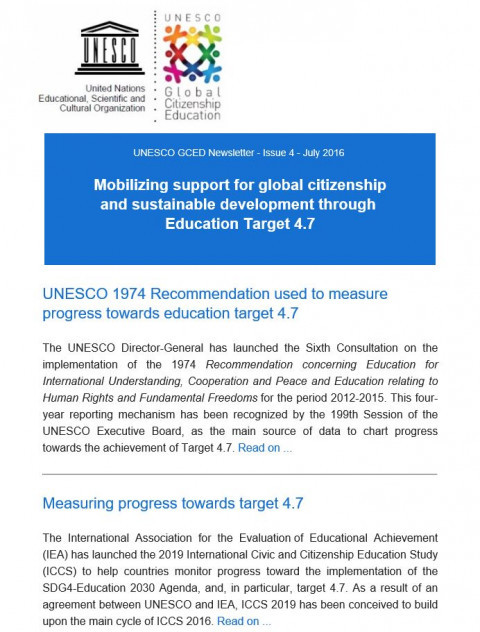 UNESCO GCED eNewsletter Issue 4 Année de publication: 2016 Auteur institutionnel: UNESCO Feature: Mobilizing support for global citizenship and sustainable development through Education Target 4.7 UNESCO 1974 Recommendation used to measure progress towards education target 4.7 Measuring progress towards 4.7 Gyeongju Action Plan: NGOs join UNESCO Global capacity-building workshop on GCED organized by APCEIU Southern Africa Regional Meeting on GCED convened in Johannesburg, South Africa UNESCO launches Teacher's Guide on the Prevention of Violent Extremism Expert meeting on the Prevention of Violent Extremism through Education European ministers back education for democracy to counter extremism and racaism UN discusses innovative solutions to prevent violent extremism through education UNESCO's YESPeace Network taps the power of youth worldwide to change the future GCED Topics and Learning Objectives available in seven languages.
 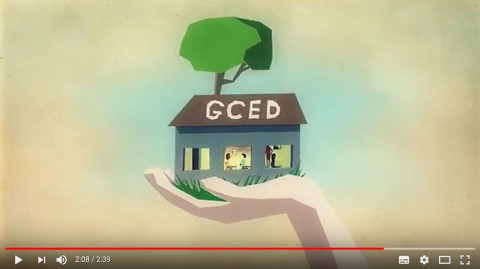 [Video] Learning to live together in peace through Global Citizenship Education Année de publication: 2016 Auteur institutionnel: UNESCO The UNESCO video on “Learning to live together in peace through Global Citizenship Education” explains the importance of Global Citizenship Education (GCED) in a globalized and increasingly interconnected and interdependent world. GCED is key to understand the interconnections between the local and the global and nurture a sense of belonging to a common humanity. It builds motivation to assume active roles to contribute to a more just, peaceful, tolerant and sustainable world. The video also illustrates how GCED can be delivered in and outside of schools. [Vidéo] Apprendre à vivre ensemble dans la paix par l’éducation à la citoyenneté mondiale Année de publication: 2016 Auteur institutionnel: Organisation des Nations Unies pour l'éducation, la science et la culture (UNESCO) La vidéo de l'UNESCO sur le thème "Apprendre à vivre ensemble dans la paix par l’Éducation à la Citoyenneté Mondiale", explique l'importance de l'Éducation à la Citoyenneté Mondiale (ECM) dans un monde globalisé et de plus en plus interconnecté et interdépendant. ECM est essentiel de comprendre les interconnexions entre le local et le global et à favoriser un sentiment d'appartenance à une humanité commune. Il construit la motivation à assumer un rôle actif pour contribuer à un monde plus juste, pacifique, tolérante et durable. La vidéo montre également comment ECM peut être livré dans et à l'extérieur des écoles.
  Interculturalism at the Crossroads: Comparative Perspectives on Concepts, Policies and Practices Année de publication: 2017 Auteur: Fethi Mansouri Auteur institutionnel: UNESCO Today most societies across the world are witnessing rising levels of social and cultural diversity brought about by globalisation and in particular increased human mobility and significant advances in information and communications technologies. The dilemma, therefore, has been how best to manage the resultant diversity and what optimal social policy paradigms to adopt towards this end.Assimilation, multiculturalism and presently interculturalism have all been proposed as possible policy conduits for managing socio-cultural diversity.This book, in focusing on the latter concept, and in particular in its intercultural dialogue manifestation, offers at once theoretical examinations, policy discussion and practical explorations of its uptake across the world. The core argument connecting the book’s three distinct sections is that whilst assimilation in its racist manifestation is no longer a viable option in today’s world, intercultural dialogue within existing multicultural settings has much to offer.
  Historical efforts to implement the UNESCO 1974 Recommendation on Education in light of 3 SDGs Targets Année de publication: 2017 Auteur institutionnel: UNESCO This paper presents an analytical overview of historical efforts by Member States of the United Nations Educational, Scientific and Cultural Organization (UNESCO) to implement the 1974 Recommendation concerning education for international understanding, cooperation and peace education relating to human rights and fundamental freedoms. The author of the review was hired in April 2016 to undertake an analysis of Member States’ progress reports submitted for the fourth (2008) and fifth (2012) consultations on implementation of the 1974 Recommendation. The main purpose of the review was to provide a historical overview of efforts to achieve Sustainable Development Goal (SDG) Targets 4.7, 12.8 and 13.3 and their proposed measurement indicators, based on states’ historical reporting on the Recommendation. A total of 94 country reports were reviewed for the exercise: 37 from the 4th Consultation (2008); and 57 from the 5th Consultation (2012). The coding involved retrofitting the content of reportsto conceptsthat may have been developed at a later date for the Sustainable Development Agenda and coding for data that was not explicitly requested in the Consultations. Following the coding, a quantitative and qualitative analysis was undertaken and is presented in the following report.
  Unpacking Sustainable Development Goal 4 Education 2030: Guide Année de publication: 2017 Auteur institutionnel: UNESCO This guide, organized around a set of questions and answers to “unpack” SDG4, provides overall guidance for a deeper understanding of SDG4 within the 2030 Agenda for Sustainable Development, in order to support its effective implementation. The guide outlines the key features of SDG4-Education 2030 and the global commitments expressed in the SDG4 targets as articulated in the Incheon Declaration and the Education 2030 Framework for Action. The guide also examines the implications of translating these global commitments within, and through, national education development efforts. This guide supplements the UNESCO technical guidelines (2016) for Mainstreaming SDG4-Education 2030 into sector-wide policy and planning. It was developed by Sobhi Tawil, Margarete Sachs-Israel, Huong Le Thu, and Matthias Eck of the UNESCO Section of Partnerships, Cooperation and Research (PCR) within the Division for Education 2030 Support and Coordination. Comprendre l'Objectif de développement durable 4: Education 2030, guide Année de publication: 2017 Auteur institutionnel: Organisation des Nations Unies pour l'éducation, la science et la culture (UNESCO) Le présent guide, qui s’articule autour d’une série de questions et de réponses pour « décoder » l’ODD4, contient des indications générales permettant de mieux comprendre sa place dans le Programme pour le développement durable à l’horizon 2030 et d’assurer sa mise en œuvre efficace. Il met en avant les principales caractéristiques de l’ODD4-Education 2030 et les engagements pris au niveau mondial, manifestés dans les cibles de l’ODD4 telles que formulées par la Déclaration d’Incheon et le Cadre d’action Education 2030.Ce guide complète les principes directeurs techniques de l’UNESCO (2016) pour l’intégration de l’ODD4-Education 2030 au sein de la politique et de la planification sectorielles. Il a été élaboré par Sobhi Tawil, Margarete Sachs-Israel, Huong Le Thu et Matthias Eck de la Section Partenariats, Coopération et Recherche (PCR) de l’UNESCO au sein de la Division d’appui et de coordination d’Éducation 2030.Qu’est-ce que le Programme de développement durable à l’horizon 2030 ?Le Programme de développement durable à l’horizon 2030 est un engagement intergouvernemental et un « plan d’action pour l’humanité, la planète et la prospérité ». Il se compose de 17 Objectifs de développement durable (ODD) « intégrés et indissociables qui concilient les trois dimensions du développement durable : économique, sociale et environnementale », démontrant par ailleurs l’ampleur et l’ambition de ce nouveau Programme universel. Ils ressortent de ce qui a été sans nul doute le processus de consultation le plus inclusif de toute l’histoire des Nations Unies, le fruit de la contribution substantielle de tous les secteurs de la société, de tous les acteurs de la communauté internationale et de toutes les régions du monde. Tous les États membres, l’ensemble du système des Nations Unies, les experts et les représentants de la société civile, du monde des entreprises et, le plus important, des millions de personnes du monde entier, ont pris l’engagement de concrétiser ce large programme qui s’attaque aux préoccupations communes de la planète toute entière et de promouvoir le bien public.