
Ressources
Explorez une large gamme de ressources sur le GCED afin d’approfondir votre compréhension et de renforcer vos activités de recherche, de plaidoyer, d’enseignement et d’apprentissage.
91 résultats trouvés
 Rapport préparatoire du BIE-UNESCO pour la 48e CIE sur l'éducation inclusive Année de publication: 2007 Auteur institutionnel: UNESCO International Bureau of Education (IBE) La Conférence Internationale sur l'Éducation (CIE) est un important forum international pour le dialogue sur les politiques éducatives entre les Ministres de l'Éducation et d'autres parties prenantes (chercheurs, praticiens, représentants d'organisations intergouvernementales et ONG). CIE est organisé par le Bureau International d'Éducation (BIE), l'Institut de l'UNESCO spécialisé pour aider les États membres dans l'élaboration des programmes pour atteindre une éducation de qualité pour tous. Le Conseil du BIE, composé de 28 États membres de l'UNESCO, a proposé en Janvier 2007 que la session de la CIE 48e, qui se tiendra à Genève en Novembre 2008, devrait se concentrer sur le thème «Education pour l'inclusion: la voie de l'avenir». La 48e CIE mettra l'aCECnt sur l'élargissement de la compréhension de la théorie et la pratique de l'éducation inclusive, tout en discutant comment les gouvernements peuvent élaborer et mettre en œuvre des politiques sur l'éducation inclusive. Le BIE organise une série d'ateliers préparatoires régionaux dédiés à l'exploration et de faire progresser l'éducation inclusive dans la préparation de la CIE 2008. L'Atelier régional préparatoire "Atelier international sur l'éducation inclusive, des Andes et les régions du Cône Sud» a eu lieu à Buenos Aires, Argentine sur la 11-14 Septembre 2007. Cet événement a été organisé par le Bureau International d'Éducation (BIE / UNESCO), la Division de la promotion de l'Éducation de Base (ED / BAS, UNESCO Paris), le Bureau Régional de l'Éducation pour l'Amérique latine et les Caraïbes (OREALC / UNESCO); Université de de San Andrés, Ministère de la Science, de la Technologie et de l'Éducation, en collaboration avec la Communauté de Pratique - Cône Sud et les régions andines;. il y avait la participation de dix pays du Cône Sud et les régions andines Cette rapport est basé sur les rapports et les présentations des pays de l'atelier sur la conception et le statut de l'éducation inclusive dans les pays participants, ainsi que sur les idées proposées par les participants sur les prochaines étapes devraient être sur la façon de faire progresser la politique de l'éducation inclusive et la mise en œuvre dans la région.
  The New educational pact: education, competitiveness and citizenship in modern society Année de publication: 1997 Auteur: Juan Carlos Tedesco Auteur institutionnel: UNESCO International Bureau of Education (IBE) As things are, individuals are just not sure where exactly they stand. The identity of the progressive educational movement and thought is in a state of crisis, and the simple answers of the past are no longer sufficient to define an educational policy which responds to the objectives of democracy and equity in the distribution of knowledge.This book is therefore a response to a personal need, which may be shared by others, namely the need to reflect on the role of education in this new social scenario laden with uncertainty and to try and find an alternative, both to the social disintegration derived from neo-liberal tendencies and to the totalitarian unity advocated in fundamentalist, anti-modern theories. The following script therefore moves between the past and the future. The look back at the past does not claim to be a historical analysis. It does try, on the other hand, to provide a useful instrument for a better understanding of what is changing. The glimpse into the future is not intended either to forecast what will happen, but to indicate which way we should be trying to guide our actions. As a result, the book is eclectic in more than one sense. From a theoretical point of view, it combines different disciplinary approaches : history, sociology, pedagogy, psychology and philosophy. From a political point of view, it adopts positions, but also allows for doubts and queries. Excluding doubt is a way of encouraging the predominance of dichotomous views, which promise us either a glorious destiny or total disaster. In this sense, the book tries not to fall into the trap of having to choose between pessimism and optimism and, perhaps excessively, assumes a conscious voluntarism based on a trust in the learning ability of human beings. Le Nouveau pacte éducatif: l'éducation, la compétitivité et la citoyenneté dans la société moderne Année de publication: 1997 Auteur: Juan Carlos Tedesco Auteur institutionnel: UNESCO International Bureau of Education (IBE) Comme les choses sont, les individus sont tout simplement pas sûr où ils se situent exactement. L'identité du mouvement éducatif progressive et de la pensée est dans un état de crise, et les réponses simples du passé ne sont plus suffisants pour définir une politique éducative qui répond aux objectifs de la démocratie et de l'équité dans la répartition des connaissances.Ce livre est donc une réponse à un besoin personnel, qui peut être partagé par d'autres, à savoir la nécessité de réfléchir sur le rôle de l'éducation dans ce nouveau scénario social chargé d'incertitude et d'essayer de trouver une solution de rechange, à la fois à la désintégration sociale dérivée des tendances néo-libérales et à l'unité totalitaire préconisée dans les théories fondamentalistes, anti-modernes. Le script suivant se déplace donc entre le passé et l'avenir. Le regard rétrospectif sur le passé ne prétend pas être une analyse historique. Il ne cherche, d'autre part, de fournir un instrument utile pour une meilleure compréhension de ce qui change. L'aperçu de l'avenir ne vise pas non plus de prévoir ce qui se passera, mais pour indiquer de quelle manière nous devrions essayer de guider nos actions. En conséquence, le livre est éclectique dans plus d'un sens. D'un point de vue théorique, il combine différentes approches disciplinaires: l'histoire, la sociologie, la pédagogie, la psychologie et la philosophie. D'un point de vue politique, il adopte des positions, mais permet également des doutes et des requêtes. Hors doute est un moyen d'encourager la prédominance des vues dichotomiques, qui nous promettent soit un destin glorieux ou d'une catastrophe totale. En ce sens, le livre essaie de ne pas tomber dans le piège d'avoir à choisir entre le pessimisme et l'optimisme et, peut-être trop, suppose un volontarisme conscient basée sur une confiance dans la capacité d'apprentissage des êtres humains. Address by Irina Bokova, Director-General of UNESCO on the occasion of the Geneva Conference on Preventing Violent Extremism – The Way Forward Année de publication: 2016 Auteur institutionnel: UNESCO. Director-General, 2009-2017 (Bokova, I.G.) This address presented by Irina Bokova, Director-General of UNESCO, on the occasion of the Geneva Conference on Preventing Violent Extremism - The Way Forward. Discours de Mme Irina Bokova, Directrice générale de l'UNESCO à l'occasion de l'Genevaconférenceon Prévenir l'extrémisme violent - Aller de l'avant Année de publication: 2016 Auteur institutionnel: UNESCO. Director-General, 2009-2017 (Bokova, I.G.) Cette adresse présentée par Irina Bokova, Directrice générale de l'UNESCO, à l'occasion de la conférence de Genève sur la prévention extrémisme violent - La voie à suivre
 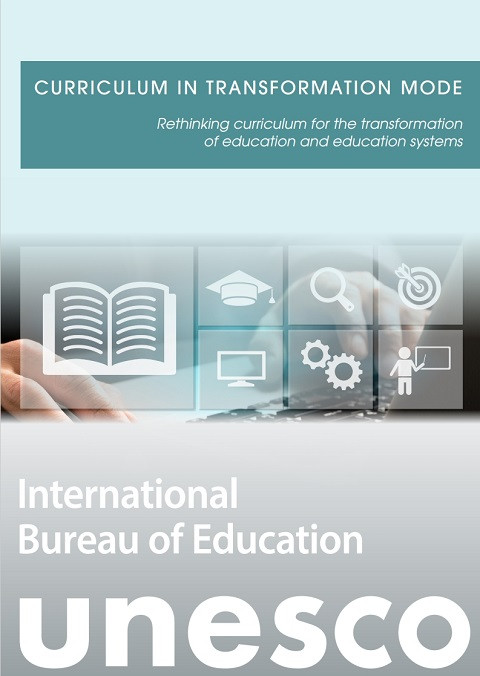 Curriculum in Transformation Mode: Rethinking Curriculum for the Transformation of Education and Education Systems Année de publication: 2023 Auteur: Renato Opertti Auteur institutionnel: UNESCO International Bureau of Education (IBE) Through these pages, Renato Opertti shares a series of reflections that invite us to revisit the curriculum as an opportunity and lever for societies to express their visions and aspirations. Curriculum can serve to position education as the pillar of a renewed social contract grounded on the welfare of all learners as persons and supporting societies and communities give effect to sustainable and better futures for the younger generations. To do so, we need to re-conceptualize curriculum at large: from a mere specification of frequently fragmented learning contents to its understanding as both a process and product of public policy developments in which diversity of stakeholders own and take responsibility for education as a global common good. Curriculum and pedagogy, by going hand-inhand, and supported by effective teaching, learning and assessment processes, can play a key role in fulfilling the right to education for every learner equally, according to their own individual needs. Key ideas in this book help us to rethink curriculum with future-oriented approaches, entailing a stronger involvement of younger generations in the decision-making process and a careful attention to vulnerability and disadvantaged groups. A curriculum that embraces individuality and diversity within collaborative and caring learning settings, nurtures freedom and autonomous thinking, connects meaningfully the global and the local, and assumes the hybridization of education. The book also delves into perspectives for educational transformation prioritizing the development of learners’ foundational and transformative competencies as the barometer of a progressive curriculum. Crucially, this entails rethinking the mindsets and practices of education systems in light of the interconnected challenges posed by the Fourth Industrial Revolution, post COVID-19, generative AI and the sustainability of the planet and the world.
  Guidelines for Contributing to the United Nations Sustainable Development Goals Année de publication: 2024 Auteur institutionnel: International Organization for Standardization (ISO) | United Nations Development Programme (UNDP) The International Organization for Standardization (ISO) and United Nations Development Programme (UNDP) Guidelines for contributing to the Sustainable Development Goals (SDGs) offer a practical guidance on how organizations and businesses can manage and enhance their contributions to the SDGs. The guidelines draw on global expertise and best practices, complementing existing sustainability standards for aligning organizational strategies and operations with the SDGs as a whole. While other standards may address specific aspects of sustainable development, these guidelines emphasize a holistic approach and provide practical tools to enhance business performance, while at the same time optimizing the impact of all organizational activities on both people and the planet.
  A New Era of Social Justice: International Labour Conference, 100th Session, 2011 Année de publication: 2011 Auteur institutionnel: International Labour Organization (ILO) This report specifically presents to the conference what the Director believes are the fundamental problems the ILO faces as it oversees a century of its inception in 2019. These problems are the remnants of an ineffective growth pattern that has increased inequality around the world over the past 30 years. The mission of the organization is to continue to work together to develop effective responses to these challenges - within the ILO itself, with national bodies such as governments, employers and workers, and through ILO cooperation with others. حقبـة جديـدة من العدالـة الاجتماعيـة: مؤتمر العمل الدولي، الدورة المائة ٢٠١١ Année de publication: 2011 Auteur institutionnel: International Labour Organization (ILO) يعرض هذا التقرير بالتحديد على المؤتمر ما يعتقد المدير أنها مشاكل جوهرية تواجهها منظمة العمل الدولية وهي تشرف على بلوغ قرن من إنشائها في عام ٢٠١٩. وتتجسد هذه المشاكل في مخلفات نمط نمو غير مجد أدى إلى زيادة انعدام المساواة في جميع أنحاء العالم خلال السنوات الثلاثين الماضية. وتتمثل مهمة المنظمة في مواصلة العمل معاً لبلورة استجابات فعالة حيال هذه التحديات - داخل منظمة العمل الدولية نفسها، ومع الهيئات الوطنية من حكومات وأصحاب عمل وعمال، ومن خلال تعاون منظمة العمل الدولية مع جهات أخرى. Aprender a vivir juntos: un programa intercultural e interreligioso para la educacion ética Année de publication: 2008 Auteur institutionnel: Arigatou Foundation (Switzerland) | Interfaith Council on Ethics Education for Children Learning to Live Together has been developed for use in different religious and secular contexts as a resource for everyone concerned with promoting ethics and values. The objective has been to develop a resource that is relevant on a global level and yet flexible enough to be interpreted within different cultural and social contexts. The resource has been tested in many different regions and cultural contexts to assure that it is relevant in regional and local contexts (see ‘We did it like this’, p.187). Test workshops have been held in 10 different countries, where the GNRC was able to bring together various religious and secular organisations working with children. During the test workshops, this resource manual was used to the benefit of more than 300 children and youth, representing African Traditional Religions, Bahá’í Faith, Buddhism, Christianity, Hinduism, Islam, Judaism, members of Brahma Kumaris and a number of people of secular thinking. Test workshops as well as input and comments from experts in the area of education, ethics, spirituality, intercultural and interfaith learning and child rights have contributed important experiences and opportunities for learning for the development of this resource. Learning to Live Together is already having an impact. In a GNRC programme in Israel, the resource material was used during a six-day journey made by a group of Jewish, Christian, and Muslim youth to the historical sites of Israel and Palestine, all of which have symbolic relevance to the conflict in their region. At each stop, youth participants discussed their values and their differing perceptions of their shared history. Learning to Live Together is an adaptable resource that can be used with children from many different cultural, religious and social contexts to nurture common values and a mutual respect for different backgrounds and traditions. The resource provides space for enhancing children’s innate potential for spirituality and hope for a better world, as a contribution to changing the situation for children worldwide. The Users Guide provides all necessary information for its use. UNESCO and UNICEF have been closely involved in developing Learning to Live Together and have endorsed the material as an important contribution to a quality education, which takes a multicultural and multi-religious society into consideration. UNESCO’s Guidelines for Intercultural Education underpin the philosophy and the approach of the resource: “Religious education can be described as learning about one’s own religion or spiritual practices, or learning about other religions or beliefs. Interfaith education, in contrast, aims to actively shape the relations between people from different religions”.