
Ressources
Explorez une large gamme de ressources sur le GCED afin d’approfondir votre compréhension et de renforcer vos activités de recherche, de plaidoyer, d’enseignement et d’apprentissage.
306 résultats trouvés
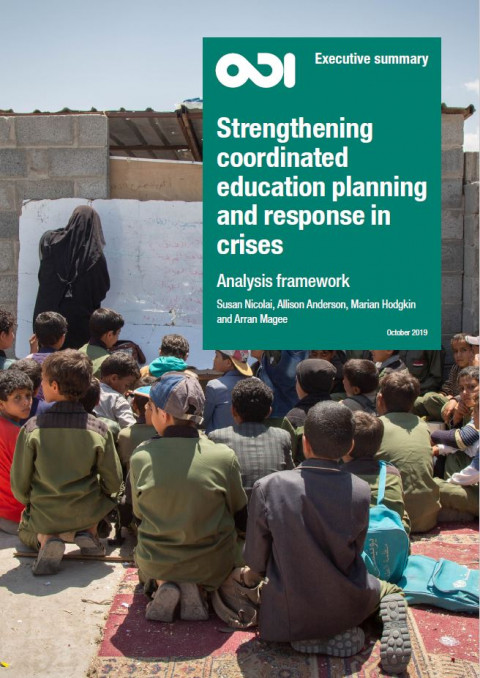 [Summary] Strengthening Coordinated Education Planning and Response in Crises: Analysis Framework; Executive Summary Année de publication: 2019 Auteur: Susan Nicolai | Allison Anderson | Marian Hodgkin | Arran Magee Auteur institutionnel: Overseas Development Institute (ODI) This report presents a framework for analysis of formal coordination approaches for education planning and response in emergencies and protracted crises. It reviews concepts and definitions of coordination, approaches and structures for coordinated planning and response, and expected outcomes of these processes, with a focus on humanitarian structures across the humanitarian–development nexus. The main types of formal education coordination groups include Education Clusters, Refugee Education Working Groups and Local Education Groups (LEGs). These often have different purposes and organisations associated with them, sometimes resulting in overlaps and gaps in coordination efforts.
  The Lazy Person’s Guide to Saving the World Auteur institutionnel: United Nations (UN) End extreme poverty. Fight inequality and injustice. Fix climate change. Whoa. The Sustainable Development Goals are important, world-changing objectives that will require cooperation among governments, international organizations and world leaders. It seems impossible that the average person can make an impact. Should you just give up?No! Change starts with you. Seriously. Every human on earth—even the most indifferent, laziest person among us—is part of the solution. Fortunately, there are some super easy things we can adopt into our routines that, if we all do it, will make a big difference.Have a look at just a few of the many things you can do to make an impact!For more information: https://www.un.org/sustainabledevelopment/takeaction/
 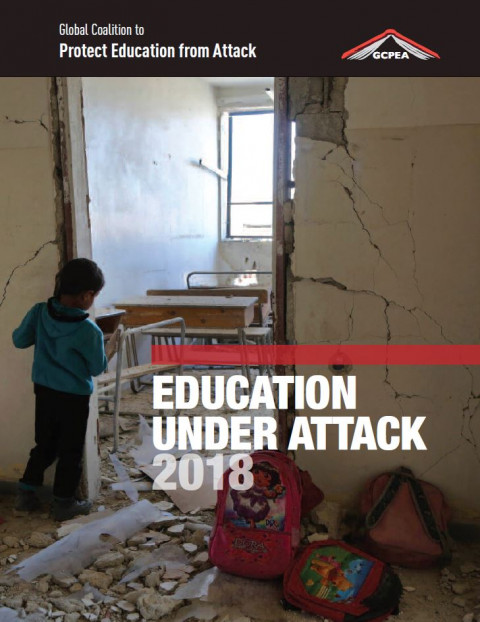 Education Under Attack 2018 Année de publication: 2018 Auteur institutionnel: Global Coalition to Protect Education from Attack (GCPEA) This report is the fourth edition of Education under Attack. It builds on the 2014 study published by the Global Coalition to Protect Education from Attack and the 2007 and 2010 publications by the United Nations Educational, Scientific and Cultural Organization (UNESCO). The present edition covers the five-year period from January 2013 to December 2017. The previous edition included profiles of 30 countries that had experienced at least five incidents of attacks on education in which students or education personnel were harmed, including at least one direct attack or one person killed, between 2009 and mid-2013. The current study includes profiles of 28 countries that experienced at least 20 attacks on education during the 2013-2017 reporting period, regardless of the severity of the incidents. Although significant data gaps remain and data quality varies, reporting of attacks on education has become more comprehensive and systematic over the last five years.Each country profile includes information on six categories of attacks on education, as relevant: Physical attacks or threats of attacks on schools Physical attacks or threats directed at students, teachers, and other education personnel Military use of schools and universities Child recruitment at, or en route to or from, school or university Sexual violence by armed parties at, or en route to or from, school or university Attacks on higher education
 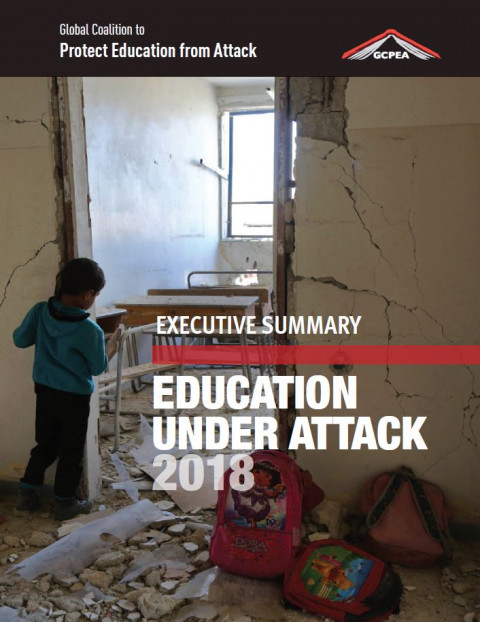 [Summary] Education Under Attack 2018; Executive Summary Année de publication: 2018 Auteur institutionnel: Global Coalition to Protect Education from Attack (GCPEA) A global study of threats or use of force, either deliberate or indiscriminate, against students, teachers, academics, education support and transport staff or education officials, and against schools, universities and other education institutions carried out for political military, ideological, sectarian, ethnic or religious reasons from 2013 to 2017. [Resumen] Ataques a la Educación 2018; Resumen Ejecutivo Année de publication: 2018 Auteur institutionnel: Global Coalition to Protect Education from Attack (GCPEA) Estudio global de las amenazas o instancias de uso deliberado o indiscriminado de la fuerza contra estudiantes, docentes, académicos, personal auxiliar educativo y de transporte o funcionarios de educación, y contra escuelas, universidades y otras instituciones educativas, perpetradas con fines políticos, militares, ideológicos, sectarios, étnicos o religiosos entre 2013 y 2017. [Résumé] L’education prise pour cible 2018; Un résumé de Année de publication: 2018 Auteur institutionnel: Global Coalition to Protect Education from Attack (GCPEA) Une étude globale des menaces ou de l'usage de la force, délibérée ou non, contre les élèves, les enseignants, les universitaires, le personnel scolaire et des transports ou les agents de l'éducation; et contre les écoles, les universités et autres institutions éducatives, menées pour des raisons politiques, militaires, idéologiques, sectaires, ethniques ou religieuses de 2013 à 2017.
 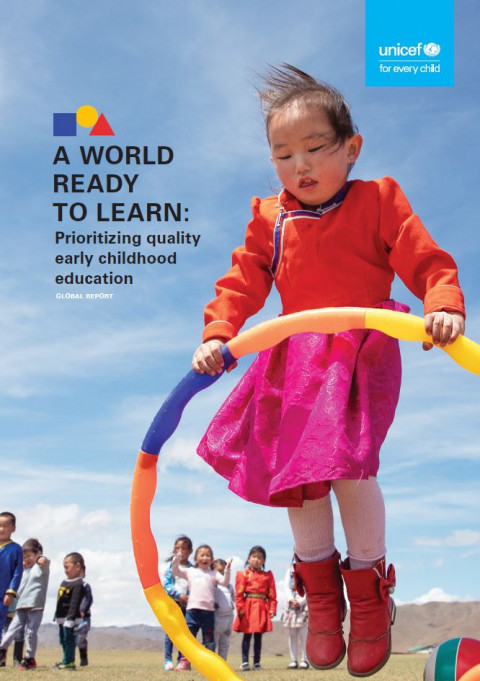 A World Ready to Learn: Prioritizing Quality Early Childhood Education Année de publication: 2019 Auteur institutionnel: United Nations Children's Fund (UNICEF) The Sustainable Development Goals (SDGs), and target 4.2 specifically, convey a clear objective that all girls and boys have access to quality early childhood development, care and pre-primary education so that they are ready for primary education. This global report confirms the importance of early childhood education in achieving SDG 4 and supports a bold challenge: Provide all children with at least one year of quality pre-primary education by 2030.The reasons for this aspiration are clear, as a solid body of evidence shows that the foundations for learning are largely built in the early years of life, before a child ever crosses the threshold of a primary school.In recent proposals on how to achieve universal education at all levels, the International Commission on Financing Global Education Opportunity (the Education Commission), the World Development Report and the Global Education Monitoring Reports3,4,5 have all emphasized that investments in early childhood education have positive returns not only for individual children but also for building more efficient and effective education systems.Yet, currently, both domestic financing and international aid invested in pre-primary education are poorly targeted and grossly inadequate. This represents one of the greatest missed opportunities to nurture the world’s human capital and help children reach their fullest potential.Based on comprehensive, data-driven analysis, this report examines the current status of pre-primary education and offers a practical vision for expanding equitable access and improving quality. Recognizing that many countries, especially low- and lower-middle-income countries, are at the beginning of this journey, providing universal access to pre-primary education in all countries by 2030 requires a realistic yet bold approach.
  Perceptions of the Holocaust in Europe and Muslim communities : Sources, Comparisons and Educational challenges Année de publication: 2012 Auteur: Gunther Jikeli | Joëlle Allouche-Benayoun The way people think about the Holocaust is changing. The particular nature of the transformation depends on people’s historical perspectives and how they position themselves and their nation or community vis-à-vis the tragedy. Understandably, European Muslims perceive the Holocaust as less central to their history than do other Europeans. Yet while the acknowledgement and commemoration of the horrors of the Holocaust are increasingly important in Europe, Holocaust denial and biased views on the Holocaust are widespread in European Muslims’ countries of origin. In this book, a number of distinguished scholars and educators of various backgrounds discuss views of the Holocaust. Problematic views are often influenced by a persistent attitude of Holocaust denial, which is derived, in part, from discourses in the Muslim communities in their countries of origin. The essays collected here explore the backgrounds of these perceptions and highlight positive approaches and developments. Many of the contributions were written by people working in the field and reflecting on their experiences. This collection also reveals that problematic views of the Holocaust are not limited to Muslim communities. (By the publisher)
 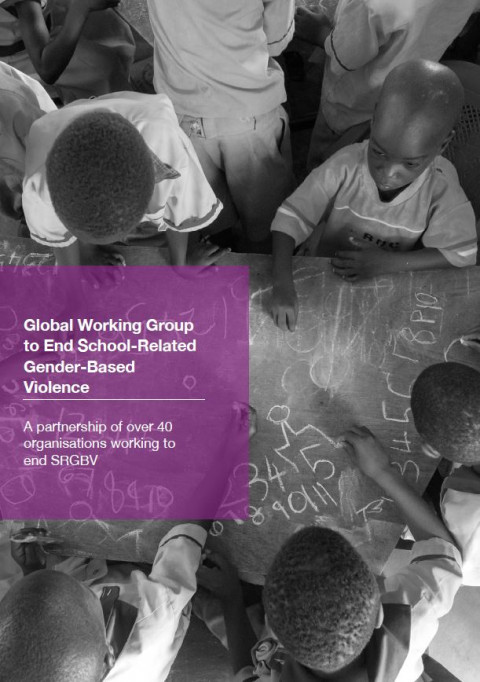 Global Working Group to End School-Related Gender-Based Violence Année de publication: 2017 Auteur institutionnel: United Nations Girls' Education Initiative (UNGEI) In August 2014, a coalition of governments, development organizations, civil society activists, UN agencies and research institutions came together to collaborate on ending gender-based violence in and around schools.The Global Working Group to End SRGBV has been a strong advocate to ensure that schools remain safe places for learning and that girls and boys have the opportunity to acquire the knowledge, skills and resources they need to reach their potential.To learn more about the group and its members, please go here:www.ungei.org/srgbv
  Realization of the Sustainable Development Goals by, for and with Persons with Disabilities (UN Flagship Report on Disability and Development 2018) Année de publication: 2018 Auteur institutionnel: United Nations (UN) Realization of the Sustainable Development Goals by, for and with persons with disabilities 'Disability and the 2030 Agenda for Sustainable Development' this report represents the first UN systemwide effort to examine disability and the Sustainable Development Goals (SDGs) of the 2030 Agenda for Sustainable Development at the global level. The report reviews data, policies and programmes and identifies good practices; and uses the evidence it reviewed to outline recommended actions to promote the realization of the SDGs for persons with disabilities. The report shows that despite the progress made in recent years, persons with disabilities continue to face numerous barriers to their full inclusion and participation in the life of their communities. It sheds light on their disproportionate levels of poverty, their lack of access to education, health services, employment, their under-representation in decision-making and political participation. This is particularly the case for women and girls with disabilities. Main barriers to inclusion entail discrimination and stigma on the ground of disability, lack of accessibility to physical and virtual environments, lack of access to assistive technology, essential services, rehabilitation and support for independent living that are critical for the full and equal participation of persons with disabilities as agents of change and beneficiaries of development. Data and statistics compiled and analysed in the present report indicate that persons with disabilities are not yet sufficiently included in the implementation, monitoring and evaluation of the SDGs.