
Ressources
Explorez une large gamme de ressources sur le GCED afin d’approfondir votre compréhension et de renforcer vos activités de recherche, de plaidoyer, d’enseignement et d’apprentissage.
2,668 résultats trouvés
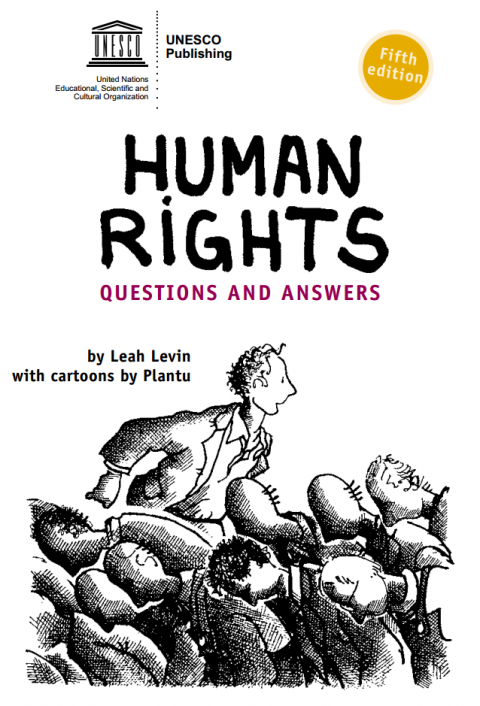 حقوق الإنسان ـ أسئلة و إجابات Année de publication: 2009 Auteur: Leah Levin Auteur institutionnel: منظمة الأمم المتحدة للتربية والعلم والثقافة (UNESCO) This 5th edition presents an overview of the scope and content of international human rights law, procedures to monitor its implementation, organizations and institutions working for human rights, major international events, as well as new developments and challenges. It also offers a brief commentary on the articles of the Universal Declaration of Human Rights explaining their meaning and providing examples on their practical implications. A permanent feature of this publication, and one of the reasons of its success, are the cartoons of Plantu, a well-known French political cartoonist and a devoted human rights activist.
  Global guidance on addressing school related gender based violence Année de publication: 2016 Auteur institutionnel: UNESCO | United Nations Entity for Gender Equality and the Empowerment of Women (UN Women) More than 246 million children are subjected to gender-based violence in or around schools every year. This is a violation of their human rights, and a form of gender-discrimination that has far-reaching physical, psychological and educational consequences. Ending schoolrelated gender-based violence (SRGBV) is a priority for countries wishing to achieve ambitious global goals on inclusive and quality education for all and gender equality.WHAT IS THE AIM OF THIS GUIDANCE? This guidance aims to provide a comprehensive, one-stop resource on school-related gender-based violence (SRGBV), including clear, knowledge-based operational guidance, diverse case studies drawn from examples of promising practice and recommended tools for the education sector and its partners working to eliminate gender-based violence. It distils programme knowledge based on existing global literature, promising practices, expert recommendations and practitioner consensus.WHO IS THIS GUIDANCE FOR? The primary audience for this global guidance is the national education sector, including government policy-makers, education ministries, school administrators, educators and other school staff. The guidance may also have wider interest for other national and international stakeholders that are interested in addressing SRGBV, including NGOs, bilateral and multilateral agencies, teachers’ trade unions and policy-makers in other domestic sectors. The guidance is intended primarily for use in low- and middle-income settings, but is based on norms and principles that are universally applicable.WHAT IS COVERED IN THIS GUIDANCE? Promising practice case studies and recommended tools are embedded throughout the relevant sub-sections of the guidance. These provide readers with illustrative examples of implementation in real-life contexts and can serve as resources that have been successfully used – and can be adapted – for application in different contexts.This guidance complements other existing tools and materials for specific bilateral, multilateral and NGO audiences on violence against women and girls, and violence in schools. An expanded online version, which will be regularly updated, is available at www.endvawnow.org Lutte contre la violence de genre en milieu scolaire: orientations mondiales: Année de publication: 2016 Auteur institutionnel: Organisation des Nations Unies pour l'éducation, la science et la culture (UNESCO) | United Nations Entity for Gender Equality and the Empowerment of Women (UN Women) More than 246 million children are subjected to gender-based violence in or around schools every year. This is a violation of their human rights, and a form of gender-discrimination that has far-reaching physical, psychological and educational consequences. Ending schoolrelated gender-based violence (SRGBV) is a priority for countries wishing to achieve ambitious global goals on inclusive and quality education for all and gender equality.WHAT IS THE AIM OF THIS GUIDANCE? This guidance aims to provide a comprehensive, one-stop resource on school-related gender-based violence (SRGBV), including clear, knowledge-based operational guidance, diverse case studies drawn from examples of promising practice and recommended tools for the education sector and its partners working to eliminate gender-based violence. It distils programme knowledge based on existing global literature, promising practices, expert recommendations and practitioner consensus.WHO IS THIS GUIDANCE FOR? The primary audience for this global guidance is the national education sector, including government policy-makers, education ministries, school administrators, educators and other school staff. The guidance may also have wider interest for other national and international stakeholders that are interested in addressing SRGBV, including NGOs, bilateral and multilateral agencies, teachers’ trade unions and policy-makers in other domestic sectors. The guidance is intended primarily for use in low- and middle-income settings, but is based on norms and principles that are universally applicable.WHAT IS COVERED IN THIS GUIDANCE? Promising practice case studies and recommended tools are embedded throughout the relevant sub-sections of the guidance. These provide readers with illustrative examples of implementation in real-life contexts and can serve as resources that have been successfully used – and can be adapted – for application in different contexts.This guidance complements other existing tools and materials for specific bilateral, multilateral and NGO audiences on violence against women and girls, and violence in schools. An expanded online version, which will be regularly updated, is available at www.endvawnow.org
  2017 CCNGO, Education 2030: implementing SDG4-Education 2030; Global meeting declaration Année de publication: 2017 Auteur institutionnel: Organización de las Naciones Unidas para la Educación, la Ciencia y la Cultura (UNESCO) | Collective Consultation of NGOs on Education for All We, the representatives of national, regional and international non-governmental and civil society organisations and members of the Collective Consultation of NGOs (CCNGO) for Education 2030 from different parts of the world have gathered in Siem Reap, Cambodia on 8 and 9 May 2017.We re-affirm that education is a fundamental human right and a public good that is key to promoting social, economic and environmental justice. States have the duty to provide free quality equitable public education at all levels and lifelong learning for all, and to ensure the right to education is enshrined in law and enforceable.We have met to take stock and discuss the implementation of SDG4-Education 2030 since its adoption and make recommendations. Participants discussed initiatives undertaken, key challenges encountered, opportunities identified and ways forward, as well as debated the role of civil society organizations in supporting the implementation of SDG4-Education 2030 at national, regional and global levels, and the contributions of the CCNGO in this regard. We furthermore agreed upon the revised working procedures of the CCNGO in light of SDG4-Education 2030 and elected a new CCNGO Coordination Group for 2017- 2019. In this context, we reaffirm:· Our endorsement of the vision, principles, goals and targets laid out under SDG 4 within ‘The 2030 Agenda for Sustainable Development’; the Incheon Declaration; the ‘Education 2030 Framework for Action’; and the 2015 Incheon Final Declaration of the NGO Forum;· The important role of civil society organisations in the implementation of SDG4-Education 2030, and their engagement and involvement at all stages, from policy formulation and planning through to monitoring and evaluation with their participation institutionalized and guaranteed, as stated in the Education 2030 Framework for Action.
 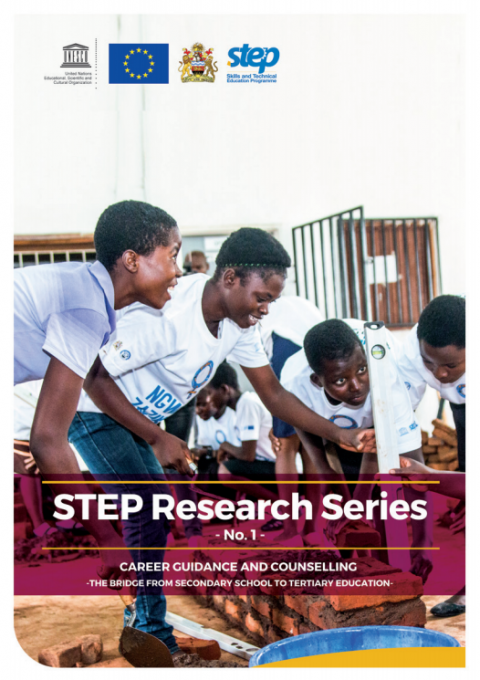 Career guidance and counselling: the bridge from secondary school to tertiary education; a review of current guidance and counselling programmes and practices in Malawi and their support in promoting technical and vocational training for girls Année de publication: 2017 Auteur institutionnel: UNESCO The objective of this report is to identify and review existing career G&C programmes and practices in secondary schools in Malawi. The review assesses to what extent such programmes and practices create an awareness of the importance of technical careers and how graduates from the secondary schools can access TEVET. Additionally, it assesses whether any affirmative action measures or approaches are used to increase girls’ interest in and applications to enter technical colleges.
  School-related gender-based violence: global guidance (Infographic) Année de publication: 2016 Auteur institutionnel: UNESCO | United Nations Entity for Gender Equality and the Empowerment of Women (UN Women) School-related gender-based violence: global guidance (Infographic) Lutte contre la violence de genre en milieu scolaire: orientations mondiales (Infographique) Année de publication: 2016 Auteur institutionnel: Organisation des Nations Unies pour l'éducation, la science et la culture (UNESCO) | United Nations Entity for Gender Equality and the Empowerment of Women (UN Women) Lutte contre la violence de genre en milieu scolaire: orientations mondiales (Infographique)
 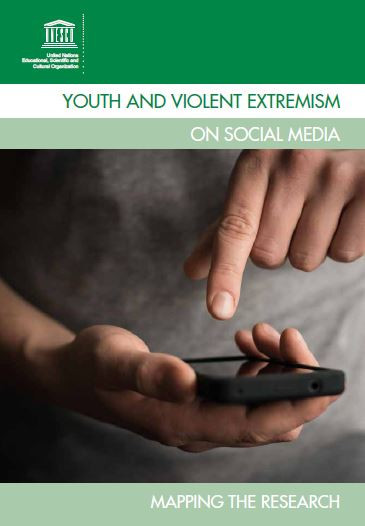 Youth and Violent Extremism on Social Media: Mapping the Research Année de publication: 2017 Auteur: Séraphin Alava | Divina Frau-Meigs | Ghayda Hassan Auteur institutionnel: UNESCO Does social media lead vulnerable individuals to resort to violence? Many people believe it does. And they respond with online censorship, surveillance and counter-speech. But what do we really know about the Internet as a cause, and what do we know about the impact of these reactions? All over the world, governments and Internet companies are making decisions on the basis of assumptions about the causes and remedies to violent attacks. The challenge is to have analysis and responses firmly grounded. The need is for a policy that is constructed on the basis of facts and evidence, and not founded on hunches or driven by panic and fearmongering. It is in this context that UNESCO has commissioned the study titled Youth and Violent Extremism on Social Media: Mapping the Research. This work provides a global mapping of research (mainly during 2012-16) about the assumed roles played by social media in violent radicalization processes, especially when they affect youth and women. The research responds to the belief that the Internet at large is an active vector for violent radicalization that facilitates the proliferation of violent extremist ideologies. Les jeunes et l’extrémisme violent dans les médias sociaux inventaire des recherches: Inventaire des recherches Année de publication: 2017 Auteur: Séraphin Alava | Divina Frau-Meigs | Ghayda Hassan Auteur institutionnel: Organisation des Nations Unies pour l'éducation, la science et la culture (UNESCO) Les médias sociaux incitent-ils des personnes vulnérables à recourir à la violence? Beaucoup le pensent et cherchent à y remédier par la censure, la surveillance des échanges en ligne et la diffusion de contre-discours. Mais que savons-nous réellement des effets de l’Internet et de l’impact de ces contre-mesures ? Partout dans le monde, les gouvernements et les opérateurs d’Internet prennent des décisions en s’appuyant sur de simples hypothèses en ce qui concerne les causes des actes de violence et les remèdes possibles. La question est de savoir si ces analyses et ces réponses reposent bien sur des bases solides. Il est essentiel que les politiques soient ancrées dans les faits et les données d’observation, et non fondées sur des intuitions ou dictées par la panique ou les efforts pour semer la peur. C’est dans ce contexte que l’UNESCO a commandé la présente étude intitulée Les jeunes et l’extrémisme violent dans les médias sociaux – Inventaire des recherches, qui propose un tour d’horizon mondial des recherches menées (principalement entre 2012 et 2016) sur les rôles que les médias sociaux sont supposés jouer dans les processus de radicalisation violente, en particulier ceux qui touchent les jeunes et les femmes. L’étude examine d’un oeil critique l’idée selon laquelle l’Internet en général serait un vecteur actif de radicalisation violente qui faciliterait la prolifération d’idéologies extrémistes violentes.
  Rethinking Education: Towards a Global Common Good? Année de publication: 2015 Auteur institutionnel: UNESCO The changes in the world today are characterized by new levels of complexity and contradiction. These changes generate tensions for which education is expected to prepare individuals and communities by giving them the capability to adapt and to respond. This publication contributes to rethinking education and learning in this context. It builds on one of UNESCO’s main tasks as a global observatory of social transformation with the objective of stimulating public policy debate.It is a call for dialogue among all stakeholders. It is inspired by a humanistic vision of education and development, based on respect for life and human dignity, equal rights, social justice, cultural diversity, international solidarity, and shared responsibility for a sustainable future. These are the fundamentals of our common humanity. This book enhances the vision provided by the two landmark UNESCO publications: Learning to Be: The world of education today and tomorrow (1972), the ‘Faure Report’, and Learning: The treasure within (1996), the ‘Delors Report’.