
Ressources
Explorez une large gamme de ressources sur le GCED afin d’approfondir votre compréhension et de renforcer vos activités de recherche, de plaidoyer, d’enseignement et d’apprentissage.
306 résultats trouvés
 Disinformation and Peacebuilding in Sub-Saharan Africa : Security Implications of AI-Altered Information Environments : Research Report Année de publication: 2024 Auteur: Eduardo Albrecht | Eleonore Fournier-Tombs | Rebecca Brubake Auteur institutionnel: United Nations University This report aims to further explore the way in which AI technologies as they currently stand impact peace and conflict, and what methods might be used to mitigate their adverse effects - through the development of better tools and the inclusion of peace and conflict considerations in AI governance frameworks. The report proposes the following recommendations: 1. More funding and support should be provided to civil society organization efforts to expand media literacy and fact-checking initiatives using AI tools to enhance capabilities. 2. Governments need to work with civil society to develop and implement comprehensive, transparent legal frameworks combating disinformation. These legislative measures need to support digital and media literacy campaigns and fact-checking organizations. 3. Social media companies need to expand investment and research into understanding local information environments, so they can better identify and respond to instances of disinformation in all contexts in which they operate and enhance transparency. 4. Peacebuilding organizations need to carefully consider local media ecosystems and information environments when conducting conflict analyses, and factor these dynamics into their projects' frameworks.
  Teaching the Holocaust : Practical approaches for ages 11-18 Année de publication: 2015 Auteur: Michael Gray Teaching the Holocaust is an important but often challenging task for those involved in modern Holocaust education. What content should be included and what should be left out? How can film and literature be integrated into the curriculum? What is the best way to respond to students who resist the idea of learning about it? This book, drawing upon the latest research in the field, offers practical help and advice on delivering inclusive and engaging lessons along with guidance on how to navigate through the many controversies and considerations when planning, preparing and delivering Holocaust education. Whether teaching the subject in History, Religious Education, English or even in a school assembly, there is a wealth of wisdom that will make the task easier for you and make the learning experience more beneficial for the student. (By the publisher)
 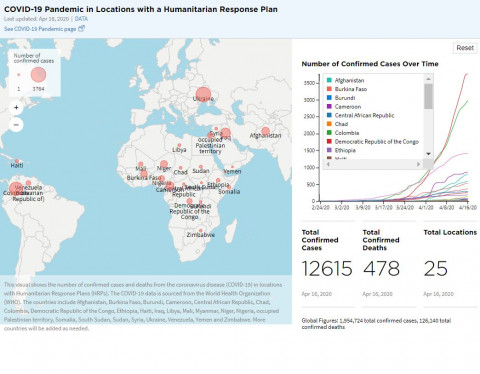 COVID-19 Pandemic in Locations with a Humanitarian Response Plans Année de publication: 2020 Auteur institutionnel: United Nations Office for the Coordination of Humanitarian Affairs (OCHA) This visual shows the number of confirmed cases and deaths from the coronavirus disease (COVID-19) in locations with Humanitarian Response Plans (HRPs). The COVID-19 data is sourced from the World Health Organization (WHO). The countries include Afghanistan, Burkina Faso, Burundi, Cameroon, Сentral African Republic, Chad, Colombia, Democratic Republic of the Congo, Ethiopia, Haiti, Iraq, Libya, Mali, Myanmar, Niger, Nigeria, occupied Palestinian territory, Somalia, South Sudan, Sudan, Syria, Ukraine, Venezuela, Yemen and Zimbabwe. More countries will be added as needed.
  Postcolonial Perspectives on Global Citizenship Education Année de publication: 2012 Auteur: Vanessa Andeotti | Lynn Mario T. Menezes de Souzz This volume bridges the gap between contemporary theoretical debates and educational policies and practices. It applies postcolonial theory as a framework of analysis that attempts to engage with and go beyond essentialism, ethno- and euro-centrisms through a critical examination of case studies and conceptual issues.
  تقدیم الدعم النفسي الاجتماعي خلال التعلیم في حالات الطوارئ Année de publication: 2019 Auteur institutionnel: Inter-agency Network for Education in Emergencies (INEE) تُلخصُ هذه الوحدة ثلاث ساعات ( 180 دقیقة) من أنشطةِ وموادِ التدریب المتصلة بالدّعم النّفسيّ الاجتماعيّ والتّعلّم الاجتماعي والعاطفيّ في حالات الطوارئ، و تشملُ أنشطةً تكمیلیة لزیادة استیعاب مفاهیم الدعم النفسي الاجتماعي والتعلیم الاجتماعي العاطفي،لفترة تمتد إلى خمس ( 5) ساعات ( 270 دقیقة).ویقدمُ دلیلُ المُیسِّر - الذي بین أیدینا - الموادَ ومذكراتِ المُیسِّرین (بما في ذلك الأفكار الرئیسة وتعلیمات الأنشطة)، ونصاً مقترحاًللعرض المرافق.یشجعُ الدلیلُ أیضًا المُیسِّرین على استعراض التعلیمات أولًا قبل التدریب، التي من شأنها تقدیم التوجیه لوضع موارد التدریب فيسیاقها الصحیح. Psychosocial Support through Education in Emergencies Année de publication: 2019 Auteur institutionnel: Inter-agency Network for Education in Emergencies (INEE) This module outlines 3 hours (180 minutes) of training activities and materials related to psychosocial support (PSS) and social and emotional learning (SEL) in emergency contexts. It includes supplementary activities to further understanding of PSS-SEL concepts, for an extended duration of 5 hours (270 minutes). This Facilitator Guide provides the materials, facilitator notes (including main ideas and activity instructions), and a suggested script for the accompanying presentation. Facilitators are encouraged to first review the Instructions prior to training, which provides guidance for contextualization of the training resources. Apoyo Psicosocial a través de la Educación en Situaciones de Emergencia Année de publication: 2019 Auteur institutionnel: Inter-agency Network for Education in Emergencies (INEE) Este módulo ofrece 3 horas (180 minutos) de actividades de formación y materiales relacionados con el apoyo psicosocial (PSS, por sus siglas en inglés) y el aprendizaje socioemocional (SEL, por sus siglas en inglés) en situaciones de emergencia. Incluye actividades complementarias para una mayor comprensión de los conceptos PSS-SEL, con una duración ampliada de 5 horas (270minutos). Esta Guía del Facilitador proporciona los materiales, las notas del facilitador (incluyendo las ideas principales y las instrucciones de las actividades), además de un guión propuesto para la presentación que se adjunta. Se recomienda a los facilitadores que primero revisen las instrucciones antes de pasar a la formación, ya que contienen directrices para la contextualización de los recursos de la formación. Le soutien psychosocial par l'éducation en situations d'urgence Année de publication: 2019 Auteur institutionnel: Inter-agency Network for Education in Emergencies (INEE) Ce module est une présentation de 3 heures (180 minutes) d'activités de formation et de matériel concernant le soutien psychosocial (SPS) et l'apprentissage social et émotionnel (ASE) en contextes d'urgence. Il comprend également des activités supplémentaires permettant d'approfondir la compréhension des concepts de SPS-ASE, et ce, pour une durée prolongée de 5 heures (270 minutes). Le présent guide du facilitateur contient le matériel, les notes de facilitation (y compris les idées principales et les instructions pour les activités) et une suggestion de script pour la présentation associée. Il est suggéré aux facilitateurs d'étudier, avant la formation, les instructions qui fournissent des repères pour la contextualisation des ressources de formation.
  All Aboard for Global Goals Année de publication: 2018 Auteur institutionnel: Thomas & Friends | United Nations (UN) This material has details on how you can teach your child to be a good global citizen. It contains an Early Learning Skills Framework for each of the Global Goals, as well as suggestions for additional children’s literature to extend these lessons.
  Frieda Makes a Difference: The Sustainable Development Goals and How You Too Can Change the World Année de publication: 2019 Auteur institutionnel: United Nations (UN) This is the story about a young girl named Frieda who embarks on a wonderful adventure to bring about positive change in the world. One day, Ana from the United Nations visits Frieda’s school to teach her class about the Sustainable Development Goals—the world’s plan to reduce poverty and protect the planet by 2030. Frieda develops a global perspective and is encouraged to take action against the biggest issues of our day: from combating climate change and protecting endangered species to ending poverty and fighting inequality. But most important, Frieda learns that “everyone must work together to make the world much better for all”. With colourful illustrations, engaging text, and tips on how to change the world, children will discover what they can do to make a difference— in their lives and the lives around them.