
Ressources
Explorez une large gamme de ressources sur le GCED afin d’approfondir votre compréhension et de renforcer vos activités de recherche, de plaidoyer, d’enseignement et d’apprentissage.
1,180 résultats trouvés
 A Coherent European Approach to SDG Target 4.7 Année de publication: 2021 Auteur: Ana Teresa Santos Auteur institutionnel: Bridge 47 This document aims to showcase why a coherent approach to Target 4.7 of the Sustainable Development Goals’ (SDG) will strengthen the European Union’s role in achieving the targets and goals set out in Agenda 2030. The report suggests some pathways to follow in order to make this coherent approach a reality.It explores: Relevance of a coherent European approach to SDG Target 4.7 and connections with other EU processes Funding lines Possible pathways to make the coherent approach a reality
  Out of the Comfort Zone?: Global Citizenship Education and Cross-Sector Partnerships for Sustainable Development Année de publication: 2021 Auteur: Kerstin Wittig-Fergeson | Harm-Jan Fricke Auteur institutionnel: Bridge 47 This publication provides examples of partnerships involving civil society and a wide range of actors in different sectors: from policy makers to academia, from media to health services, from businesses to museums. The partnerships, initiated by Bridge 47, promoted learning about and for sustainable development using a variety of Global Citizenship Education (GCE) methods. Their experiences form the basis for suggestions that aim to encourage further explorations of cross-sector collaborations.
  Why Is Transformative Education a Vital Response to the Multiple Challenges of the Future? Année de publication: 2021 Auteur: Tereza Čajková Auteur institutionnel: Bridge 47 This report explores the role of transformative education as described in SDG Target 4.7 in responding to the global challenges, risks and trends of the future, and is split into three sections: Part 1 sets the context based on several foresight reports, suggesting that the physical effects of climate change are likely to intensify during the next two decades as humanity looks unlikely to meet the goal of limiting global warming to under 2°C. The burden of climate disruption and environmental decline is already felt by everyone, but disproportionately by the most vulnerable populations. Social challenges described in foresight reports reflect increasing levels of uncertainty, precarity, fragility and complexity. The future world will likely be more connected, yet more fragmented, characterised by multiple changes taking place at an unprecedented pace.Part 2 reflects on the role of education in times of social and ecological transformation. There is currently increasing momentum for questioning established education approaches in terms of whether they are able to equip future generations to cope with the multiple crises the foresight reports warn us of. Transformative education can contribute to this process given that preparing learners to address future challenges is one of its core commitments. Part 3 provides an insight into the types of learning which may be more suited to coping with these numerous challenges. Transformative learning develops the cognitive abilities to learn from the social and historical shortcomings of the dominant world-view and to address the driving forces responsible for degradation of life on the planet. It can support development of dispositions enabling learners to relate to each other and the world in a radically different way, understanding that we cannot separate humanity from the planet and all other living beings and that humanity may need to learn how to live in, and with the world, without occupying its centre.
  Imagining Transformation Otherwise: Case Studies of Learning Practices Année de publication: 2021 Auteur: Rene Suša Auteur institutionnel: Bridge 47 This publication is written by Rene Suša, on behalf the Bridge 47 project. It features ten case studies of organizations and initiatives from around the world that are committed to bringing about positive changes in society and strive to do that in different ways. Working in diverse social, cultural and political contexts, the organizations and initiatives presented in this publication seek to address the systemic inequalities, injustices and harm they perceive as important. They strive to do that in ways that correspond to their analysis of the problems, their respective theories of change and their available means and resources. Although highly diverse in the ways they approach social change, these organizations and initiatives emphasize the importance of learning and unlearning in their work. This applies in equal measure to those initiatives with an explicitly education-oriented mission and to those that work on other approaches to social change, such as different practices of (internal) organizational transformation.
  The Impact of COVID-19 on Early Childhood Education in the Asia-Pacific and Sub-Saharan Africa: Insights From the Results of Rapid Regional Personnel Survey Année de publication: 2021 Auteur: Yoshie Kaga | Kyungah Bang Auteur institutionnel: UNESCO Bangkok Declared a global pandemic on 11 March 2020 by the World Health Organization (WHO), COVID-19 has had far-reaching impacts on every facet of life around the world, exacerbating pre-existing inequalities and negatively impacting on vulnerable and disadvantaged populations the most. Learning continuity has been disrupted by school closures, generating an unprecedented situation worldwide. According to UNESCO Institute for Statistics (UIS) data collated in July 2020, over 18.6 million children in pre-primary education in forty-eight Sub-Saharan African countries and 4.4 million pre-primary teachers – eighty- five per cent of whom were women – in twenty-four countries in the Asia-Pacific region were affected by school or centre closures. Recognizing the possible severe and detrimental impact that COVID-19 might have on ECE personnel and their practices, UNESCO Bangkok and Dakar teamed up with several partners to undertake regional surveys in the Asia-Pacific and Sub-Saharan Africa from April to July 2020. Based on the regional surveys, this report features eight key findings and three key messages to better understand ECE personnel’s needs and to identify possible responses to support them.
  التنمر الإلكتروني بين المراهقين: دراسة مطبَّقة على عينة من طلبة المرحلة المتوسطة المستخدمين للعبة الفورتنايت Année de publication: 2019 Auteur: Moudi Al-Anzi Auteur institutionnel: Qassim University استهدفت الدراسة التعرف على الأسباب الشخصية للتنمر الالكتروني ومعرفة دور المناخ الأسري والمدرسي في التنمر الالكتروني. استخدمت لعبة الفورتنايت كمثال للتعرف على التنمر الذي يحصل من خلال الألعاب الالكترونية. استخدمت الاستبانة لجمع البيانات. Cyberbullying among Adolescents: A Study Applied to a Sample of Middle School Students Who Used the Game of Fortnite Année de publication: 2019 Auteur: Moudi Al-Anzi Auteur institutionnel: Qassim University The study aimed to identify the personal causes of cyberbullying and the role of the family and school climate in cyberbullying. The study used the game Fortnite as an example to recognize bullying that occurs through electronic games. A questionnaire was used to collect data.
  Best Practices in TVET Policies Coping with COVID-19 Crisis: UNEVOC Network East and Southeast Asia Cluster Countries Année de publication: 2020 Auteur: Jihee Choi | Hanbyul Lee | Kunjoo Lim | Hyunsik Choi | Jongtaek Han Auteur institutionnel: UNESCO International Centre for Technical and Vocational Education and Training (UNEVOC) | Korea Research Institute for Vocational Education and Training (KRIVET) This book presents the best practices with regard to TVET policies to cope with COVID-19 crisis. It includes 8 cases of manuscripts from 6 countries in total. The topics covered range from the national TVET policies responding to COVID-19 crisis to open and digital learning, migrant female workers, and TVET strategies to deal with youth unemployment. UNESCO-UNEVOC 동아시아 동남아시아 클러스터: TVET 정책 우수사례집 Année de publication: 2020 Auteur: 최지희 | 이한별 | 임건주 | 최현식 | 한종택 Auteur institutionnel: UNESCO International Centre for Technical and Vocational Education and Training (UNEVOC) | 한국직업능력개발원 본 자료는 COVID-19시대에 대응하는 국가전략에 관한 동남아지역 우수사례를 소개하고 있다. 총 6개국의 8개 사례를 포함하고 있으며, COVID-19에 대한 TVET의 대응에서 원격 및 디지털 학습, 청년실업, 이주 여성 근로자 문제 등 다양한 주제에 대해 각국의 정책까지 다양한 사례를 다루고 있다. 본 저작물은 ‘한국직업능력연구원’에서 ‘2020’년 작성하여 공공누리 4유형으로 개방한 ‘ UNESCO-UNEVOC 동아시아 동남아시아 클러스터: TVET 정책 우수사례집 (작성자: 최지희; 이한별; 임건주; 최현식; 한종택) ’을 이용하였으며, 해당 저작물은 ‘한국직업능력연구원(www.krivet.re.kr)’에서 무료로 다운받으실 수 있습니다.
 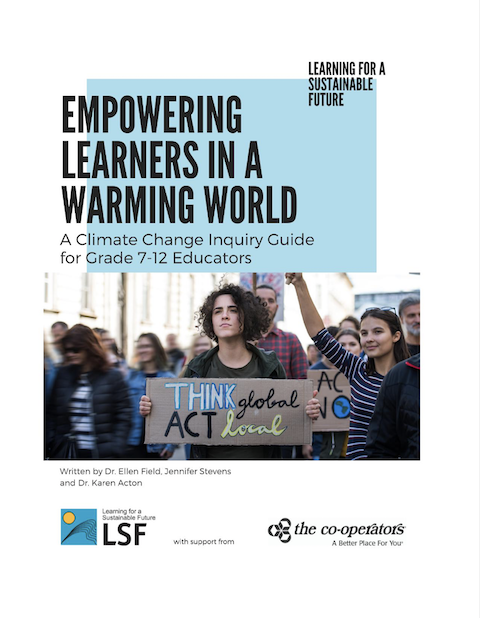 Équiper nos apprenants à un monde en réchauffement : Guide d’apprentissage par l’enquête sur le changement climatique pour les éducateurs du secondaire Année de publication: 2020 Auteur: Ellen Field | Jennifer Stevens | Karen Acton Auteur institutionnel: Learning for a Sustainable Future (LSF) Ce guide suit les principes directeurs de apprentissage par l’enquête. Il a pour but de proposer des occasions de favoriser l’évolution de la compréhension des élèves à l’égard du climat et du changement climatique, d’évaluer les risques et les occasions d’y remédier, de s’adapter au climat changeant, d’analyser les dimensions éthiques et de respecter les émotions qui découlent nécessairement du processus lié à la compréhension de la complexité et de l’urgence du problèmeLes stratégies d’enseignement transformatrices, telles que d’apprentissage par l’enquête , sont mieux adaptées à l’enseignement de problèmes complexes, comme le changement climatique. Ces stratégies utilisent souvent, comme point de départ, les connaissances et les expériences que les élèves détiennent déjà. Les éducateurs, qui eux-mêmes sont aux prises avec les enjeux liés au changement climatique, jouent le rôle de facilitateur pour guider les apprenants et aider la classe à collaborer pour apprendre, penser de façon critique et passer à l’actionEnfin et surtout, ce guide vise à mobiliser les élèves pour qu’ils contribuent aux solutions à école, dans la communauté et à la maison. Ce guide propose aux éducateurs des stratégies didactiques permettant aux élèves d’exprimer leurs perspectives et leur voix, des recherches et données scientifiques courantes sur le changement climatique, des ressources et activités, ainsi que des solutions pour agir.