
Ressources
Explorez une large gamme de ressources sur le GCED afin d’approfondir votre compréhension et de renforcer vos activités de recherche, de plaidoyer, d’enseignement et d’apprentissage.
3,790 résultats trouvés
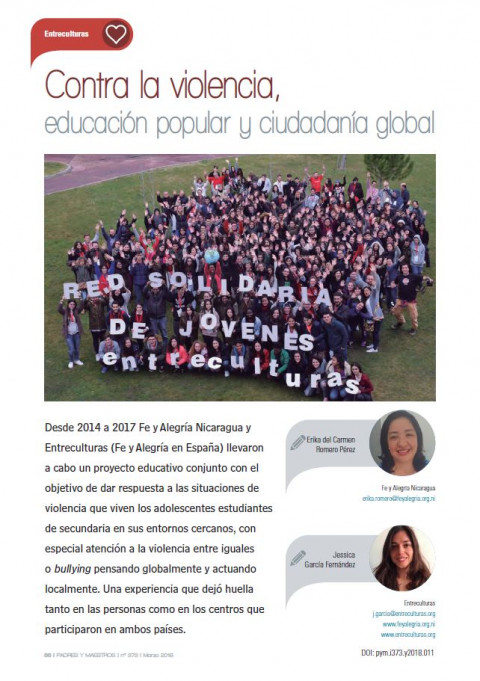 Against Violence, Popular Education and Global Citizenship Année de publication: 2018 Auteur: Erika del Carmen Romero Pérez | Jessica García Fernández The article is about a project that was carried out between 2014 and 2017 by two countries: Nicaragua and Spain, on behalf of the organizations "Fe y alegría Nicaragua" and "Entreculturas (Fe y Alegría España)". It was an educative project among both nations that had two main objectives: promoting both local and global citizenship, and to give answer to violent situations that adolescent students hae to face in secondary education contexts, with special attention to the violence among equals or bullying. Contra la violencia, educación popular y ciudadanía global Année de publication: 2018 Auteur: Erika del Carmen Romero Pérez | Jessica García Fernández El artículo habla sobre un proyecto que se llevó a cabo entre 2014 y 2017 por medio de dos países: Nicaragua y España, a través de las organizaciones "Fe y alegría Nicaragua" y "Entreculturas (Fe y Alegría España)". Fue un proyecto educativo conjunto entre los dos países, y tenía dos objetivos principales: el fomentar una ciudadanía tanto local como global, y el de dar respuesta a las situaciones de violencia que viven los adolescentes estudiantes de secundaria en sus entornos cercanos, con especial atención a la violencia entre iguales o bullying.
  Education for global and multicultural citizenship: a strategy for Victorian Government schools 2009-2013 Année de publication: 2009 Auteur institutionnel: State of Victoria (Australia) | Melbourne. Department of Education and Early Childhood Development. Office of Government School Education. Student Learning Programs Division The purpose of this strategy is to provide a renewed vision for global and multicultural education in Victorian Government schools; to align priorities to current legislative, policy and curriculum frameworks; and to guide action across schools, regions and the Department. The strategy offers a new concept for thinking about multicultural education: global and multicultural citizenship. The actions outlined will pursue the following objectives: improving educational outcomes for all students through the implementation of inclusive practices and through learning and teaching that utilises the Victorian Essential Learning Standards (VELS) domains relevant to global and multicultural citizenshipdeveloping the intercultural literacies that students, parents, educators, and leadership groups need to live and work as part of a diverse and globalised populationpromoting social cohesion and diversity as sources of educational and economic advantage for all students • enhancing the engagement, wellbeing and sense of belonging for all students in safe and secure learning environmentsbuilding the capacity of the school community to identify and address overt, subtle and institutionalised racism, stereotyping and other forms of prejudicebuilding and sustaining inclusive and participative school–community partnerships that prepare all students for global and multicultural citizenship. Education à la Citoyenneté Mondiale et Multiculturelle: une stratégie pour les écoles Victorienne Governement 2009-2013 Année de publication: 2009 Auteur institutionnel: State of Victoria (Australia) | Melbourne. Department of Education and Early Childhood Development. Office of Government School Education. Student Learning Programs Division Le but de cette stratégie est de fournir une vision renouvelée de l'éducation globale et multiculturelle dans les écoles publiques victorienne; d'aligner les priorités des cadres législatifs, politiques et programmes actuels; et pour guider l'action dans les écoles, les régions et le ministère. La stratégie offre un nouveau concept pour la réflexion sur l'éducation multiculturelle: mondiale et citoyenneté multiculturelle. Les actions décrites poursuivra les objectifs suivants:Améliorer les résultats scolaires pour tous les élèves grâce à la mise en œuvre de pratiques inclusives et par l'apprentissage et l'enseignement ont fait utliser les Normes d'Apprentissage Essentielles Victoriennes (NAEV) les domaines pertinents à la citoyenneté mondiale et multiculturelle développer les alphabétisations interculturelles ne élèves, les parents, les éducateurs et les groupes de leadership doivent vivre et travailler dans le cadre d'une diversité et globalisé promo population ting cohésion sociale et la diversité comme sources d'avantage éducatif et économique pour tous les élèves • renforcement de la participation, bien-être et le sentiment d'appartenance pour tous les élèves dans des environnements d'apprentissage sûrs et sécurisésle renforcement des capacités de la communauté scolaire pour identifier et traiter ouvertement, subtile et institutionnalisés racisme, les stéréotypes et d'autres formes de renforcement des préjugés et de maintien de partenariats inclusifs et participatifs scolaires communautaires a fait préparer tous les élèves à la citoyenneté mondiale et multiculturelle.
  Who in the World Am I?: An Activity and Enquiry Pack about Values and Identity for SMSC and British Values Année de publication: 2018 Auteur: Caroline Harmer Auteur institutionnel: European Union (EU) | Global Schools Program | Cumbria Development Education Centre(CDEC) Who in the World Am I is a resource pack for teachers and children who want to actively explore their own identity from the personal right through to being part of a family, a community, a country and becoming a global citizen. The activities develop progressively through the global learning themes of valuing diversity and skills of self-awareness and reflection.
 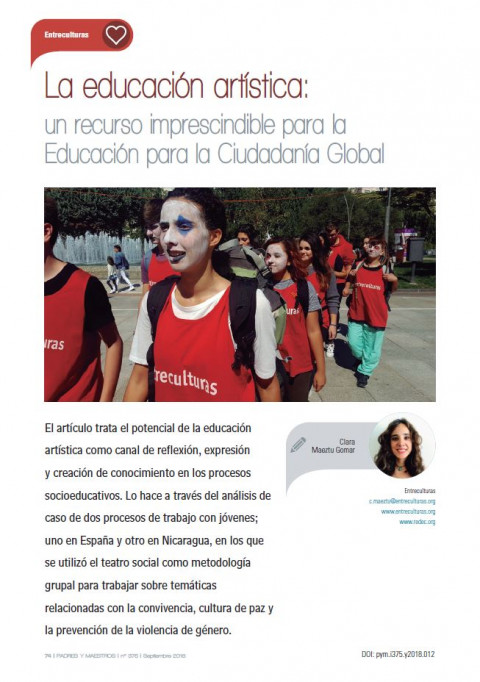 Artistic Education: An Essential Resource for Global Education Année de publication: 2018 Auteur: Clara Maeztu Gomar The article is about the potential of artistic education as a means of reflection, expression and production of knowledge in socioeducative processes. It details a case study were two working processes with youth are explained: one in Spain and the other one in Nicaragua. In both cases social theatre was used as a group methodology to work on thematics related with coexistence, culture of peace, and prevention of gender violence. La educación artística: un recurso imprescindible para la Educación para la Ciudadanía Global Année de publication: 2018 Auteur: Clara Maeztu Gomar El artículo trata el potencial de la educación artística como canal de reflexión, expresión y creación de conocimiento en los procesos socioeducativos. Lo hace a través del análisis de caso de dos procesos de trabajo con jóvenes; uno en España y otro en Nicaragua, en los que se utilizó el teatro social como metodología grupal para trabajar sobre temáticas relacionadas con la convivencia, cultura de paz y la prevención de la violencia de género.
  The Meaning of Citizenship in Social Inequality Contexts: Guidelines for a Comprehensive Education Année de publication: 2016 Auteur: Alma A Ramírez Iñiguez This article analyses the sense of citizenship education currently regarding the social inequality in the global era. For this, a conceptual framework about citizenship meaning is stablished and the need of a conceptual change is highlighted taking into account the social transformations, the increase of inequality in the worldwide and the neoliberal model hegemony in last decades. Based on this, some relevant Ibero American educational experiences in citizenship education are analyzed and their results are discussed. From this, some key elements involved in education for inclusive citizenship are pointed out as well as their contribution for social inequality decrease. El significado de la ciudadanía en contextos de desigualdad social: pautas para una educación incluyente Année de publication: 2016 Auteur: Alma A Ramírez Iñiguez El presente artículo tiene el propósito de analizar el sentido de la educación para la ciudadanía en la actualidad, tomando en cuenta la desigualdad social existente en la era global. Para ello, se realiza una revisión conceptual sobre el significado de la ciudadanía en nuestros días, destacando la necesidad de un cambio de perspectiva para entender este concepto y considerando las transformaciones sociales de las últimas décadas, así como el predominio del modelo económico neoliberal, el cual ha tenido como consecuencia el incremento de la desigualdad social a nivel mundial. Con base en dicha revisión, se realiza un análisis documental de algunas experiencias educativas iberoamericanas relevantes por su propósito de crear ciudadanía a través de propuestas inclusivas. A partir de este análisis, se discuten los resultados de dichas experiencias, los elementos clave que propician una ciudadanía incluyente desde la educación y sus implicaciones en la reducción de la desigualdad social.
  What is Education for Development? Année de publication: 2019 Auteur institutionnel: UNAQUÍ The blog of Unaquí informs that the Aragones Federation of Solidarity understands that Education for Development (ED) is a process which fosters critical and active global citizenship, that promotes more just, equal and cooperative societies. The blog also informs that the organizations that are part of the FAS believe that they are responsible of the education in order to transform societies, therefore, they created this space, called UNAQUÍ, to promote Education for Development and contribute to the promotion of citizenship.The blog provides information about different projects that are carried out.