
Ressources
Explorez une large gamme de ressources sur le GCED afin d’approfondir votre compréhension et de renforcer vos activités de recherche, de plaidoyer, d’enseignement et d’apprentissage.
875 résultats trouvés
 Derechos humanos Année de publication: 2021 Auteur institutionnel: Argentina. Ministry of Education Este material asume el desafío de abordar los Derechos Humanos como un territorio vivo, una construcción colectiva, donde acontecen disputas permanentes sobre su significado y alcance. En la escuela, la responsabilidad de la formación de las nuevas ciudadanías para la vida en democracia ubica a cada docente en el centro mismo de este desafío.
  Identities Année de publication: 2021 Auteur institutionnel: Argentina. Ministry of Education In these pages, it is invited to rethink the construction of identity and identities within the framework of the school, from a transversal perspective. This concept is traversed by multiple dimensions, genealogies and debates that give shape to a privileged and nodal notion for the formation of a new democratic citizenship in schools. The idea is that both students of different educational levels, as well as teachers and families feel challenged and challenged by the reflections that this concept raises. Identidades Année de publication: 2021 Auteur institutionnel: Argentina. Ministry of Education En estas páginas, se invita a (re)pensar la construcción de la identidad y de las identidades en el marco de la escuela, desde una perspectiva transversal. Este concepto se encuentra atravesado por múltiples dimensiones, genealogías y debates que le dan forma a una noción privilegiada y nodal para la formación de una nueva ciudadanía democrática en las escuelas. La idea es que tanto estudiantes de los distintos niveles educativos, como las y los docentes y las familias se sientan interpeladas e interpelados por las reflexiones que suscita este concepto.
  Culture of Peace Toolbox Année de publication: 2016 Auteur institutionnel: National Workshop Schools Program (Colombia) | Spanish Agency for International Development Cooperation (AECID) The Workshop Schools with the support of the Ministry of Culture and the Spanish Agency for International Development Cooperation (AECID), take the initiative to promote a Culture of Peace that arises from the ethical principles that define the Workshop School and that allows its protagonists themselves (administrators, instructors, apprentices and parents) assume positions, beliefs and attitudes that promote a Culture of Peace as a way of life. For this, a Tool Box has been designed, the objective of which is to strengthen the apprentices of the Workshop School as citizens who develop personal and social capacities to live healthily with others and generate harmonious environments, while proposing tools to serve as agents of change in society. At a general level, the Toolbox is made up of three large sections: the first contains the Implementation Manual, the second the Compendium of Activities and the third the Follow-up and Monitoring Manual. Caja de herrameintas: Cultura de paz Année de publication: 2016 Auteur institutionnel: National Workshop Schools Program (Colombia) | Spanish Agency for International Development Cooperation (AECID) Las Escuelas Taller, con el apoyo del Ministerio de Cultura y la Agencia Española de Cooperación Internacional para el Desarrollo (AECID), toman la iniciativa de promover una Cultura de Paz que surja desde los principios éticos que definen a la Escuela Taller y que permita que sus propios protagonistas (administrativos, instructores, aprendices y padres de familia) asuman posturas, creencias y actitudes que promuevan una Cultura de Paz como una forma de vida. Para ello se ha diseñado una Caja de Herramientas, cuyo objetivo es fortalecer a los aprendices de la Escuela Taller como ciudadanos que desarrollan capacidades personales y sociales para convivir sanamente con otros y generar entornos armónicos, a la vez que proponen herramientas para servir como agentes de cambio en la sociedad. A nivel general, la Caja de Herramientas se encuentra conformada por tres grandes secciones: la primera contiene el Manual de Implementación, la segunda el Compendio de Actividades y la tercera el Manual de Seguimiento y Monitoreo.
  Justicia para la paz: Crímenes atroces, derecho a la justicia y paz negociada Année de publication: 2014 Auteur: Rodrigo Uprimny Yepes | Luz maría Sánchez Duque | Nelson Camilo Sánchez León Auteur institutionnel: Centro de Estudios de Derecho, Justicia y Sociedad, Dejusticia, Reino de los Países Bajos La investigación que se presenta en este libro así como las intervenciones judiciales en las que se partició con ocasión del proceso sobre la constitucionalidad del Marco Jurídico para la Paz, fueron realizados gracias al apoyo de la embajada del Reino de los Países Bajos en Colombia. La guerra ha cambiado pues se ha degradado y se ha tornado cada vez más cruel como bien se señala en estas páginas.
  Science Education in a Cultural Diversity Context: The Migrant Student in Chile (Revista Saberes Educativos; July-Decembe, No.11) Année de publication: 2023 Auteur: Carmen Luisa Alfaro Contreras | Iskra Pavez Soto The aim of this article is to analyze teachers' conceptions of science education in contexts of cultural diversity. In recent years, the presence of migrant students in Chilean education has increased, which has generated a meeting of diverse world views that stress the paradigms of scientific education itself. The article presents a study whose methodological design was of a qualitative nature. 13 interviews were conducted with a strategic sample made up of science teachers from the school system, pedagogy students, and university professors. The results reflect dissimilar ideas about the relationship between science and culture, generating, on the one hand, a kind of invisibility or denial of diversity and, on the other, a recognition of a multiplicity of ways of building knowledge, approaching an intercultural view of science. Stereotyped ideas about the student body and the lack of training to deal with cultural diversity are recognized. The main difficulties are associated with the characteristics of the school system and the hegemonic and monocultural nature of the curriculum. It concludes with recommendations on the need for a postcolonial scientific education and to democratize knowledge, with a focus on student learning that allows the development of critical individuals. Educación científica en contextos de diversidad cultural: El estudiantado migrante en chile Année de publication: 2023 Auteur: Carmen Luisa Alfaro Contreras | Iskra Pavez Soto El objetivo de este artículo es analizar las concepciones del profesorado en torno a la educación científica en contextos de diversidad cultural. Durante los últimos años ha aumentado la presencia de estudiantado migrante en la educación chilena, lo cual ha generado un encuentro de visiones de mundo diversas que tensionan los paradigmas de la propia educación científica.
 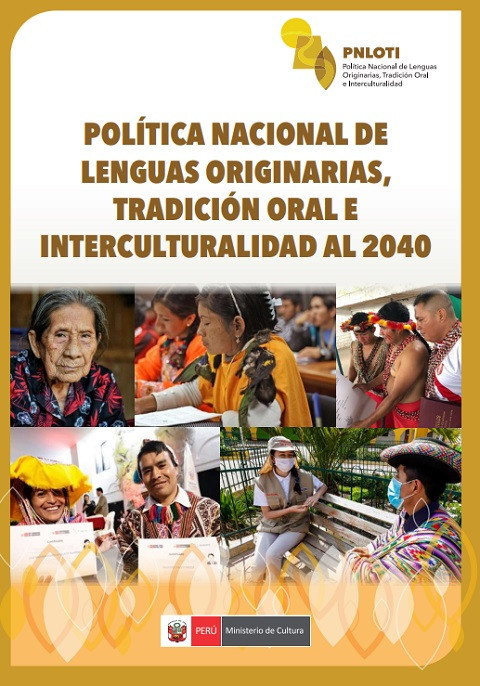 National Policy on Native Languages, Oral Tradition and Interculturality by 2040 Année de publication: 2021 Auteur institutionnel: Ministry of Culture of Peru The Ministry of Culture, in coordination with the different sectors of the State, has carried out the process of updating the National Policy on Native Languages, Oral Tradition and Interculturality by 2040 (PNLOTI), which will be the main instrument of guidance and attention in subject of indigenous languages. Seeking to guarantee the participation of citizens in public decisions, the Ministry of Culture makes the PNLOTI proposal for 2040 available to them, with the aim that they can access it and learn about the 41 services declared in charge of the different sectors. In this way, the PNLOTI ensures the full exercise of the linguistic rights of the more than 4 million citizens who speak one of the 48 indigenous or native languages of the country. Política nacional de lenguas originarias, tradición oral e interculturalidad al 2040 Année de publication: 2021 Auteur institutionnel: Ministry of Culture of Peru El Ministerio de Cultura, en coordinación con los diferentes sectores del Estado, han llevado a cabo el proceso de actualización de la Política Nacional de Lenguas Originarias, Tradición Oral e Interculturalidad al 2040 (PNLOTI), que será el principal instrumento de orientación y atención en materia de lenguas indígenas. Buscando garantizar la participación de la ciudadanía en las decisiones públicas, el Ministerio de Cultura pone a su disposición la propuesta de la PNLOTI al 2040, con el objetivo de que puedan acceder a él y conocer los 41 servicios declarados a cargo de los diferentes sectores. De esta manera, la PNLOTI asegura el ejercicio pleno de los derechos lingüísticos de los más de 4 millones de ciudadanos y ciudadanas hablantes de alguna de las 48 lenguas indígenas u originarias del país.