
Ressources
Explorez une large gamme de ressources sur le GCED afin d’approfondir votre compréhension et de renforcer vos activités de recherche, de plaidoyer, d’enseignement et d’apprentissage.
1,471 résultats trouvés
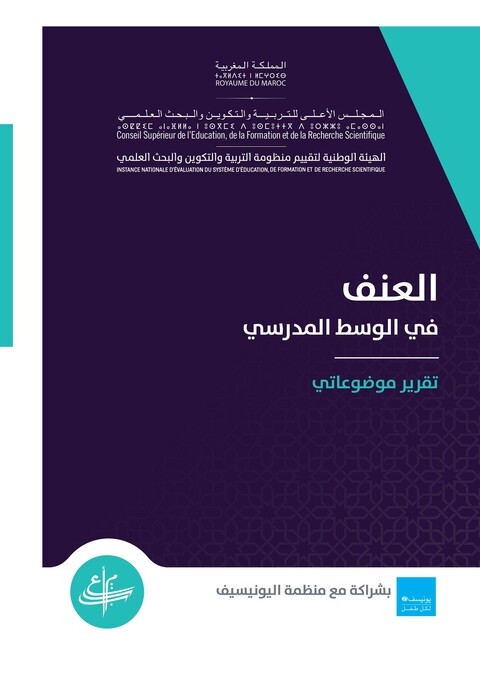 La violence en Milieu scolaire: Rapport Thématique Année de publication: 2023 Auteur institutionnel: Higher Council for Education, Training, and Scientific Research (CSEFRS) | United Nations Children's Fund (UNICEF) Ce rapport présente les résultats de l’évaluation de la violence en milieu scolaire réalisée par le Conseil Supérieur de l’Éducation, de la Formation et de la Recherche Scientifique à travers l’Instance Nationale d’Évaluation en partenariat avec l’UNICEF. Il met en évidence l’importance d’un environnement scolaire sûr et sans violence pour garantir une éducation de qualité. L’objectif principal de cette évaluation est d’apporter un diagnostic détaillé sur la situation de la violence en milieu scolaire au Maroc. Elle vise ainsi à en mesurer la prévalence et à identifier les différentes formes et manifestations de celle-ci, ainsi que les acteurs impliqués, en ciblant, non seulement les auteurs de violence, mais également les victimes parmi les élèves et le personnel éducatif. Cette évaluation repose sur les résultats d’une enquête quantitative réalisée à la fin du premier trimestre de l’année scolaire 2021-2022, auprès de 260 établissements représentatifs à l’échelle nationale, avec la participation de 13 884 élèves représentant les trois cycles de l’enseignement (primaire, secondaire collégial et qualifiant), ainsi qu’une enquête qualitative menée dans 27 établissements. العنف في الوسط المدرسي:تقرير موضوعاتي Année de publication: 2023 Auteur institutionnel: Higher Council for Education, Training, and Scientific Research (CSEFRS) | United Nations Children's Fund (UNICEF) يقدم هذا التقرير نتائج تقييم العنف في الوسط المدرسي الذي أجراه المجلس الأعلى للتربية والتكوين والبحث العلمي، من خلال الهيئة الوطنية للتقييم، بشراكة مع منظمة اليونيسيف. ويسلط هذا التقرير الضوء على أهمية وجود بيئة مدرسية آمنة وخالية من العنف لضمان تعليم ذي جودة.الهدف الرئيسي لهذا التقييم يكمن في تقديم تشخيص مفصل لوضع العنـف في الوسط المدرسي في المغرب. وعليـه، تركــز الدراســة عـلـى قيــاس مــدى انتشــار هــذه الظاهــرة وتحديــد أشــكالها وتجلياتها المختلفة في الوســط المدرسي، وكــذا الفاعلـيـن المعنين بهــا، وهــي لا تســتهدف مرتكبــي العنــف فقــط، بــل أيضــا ضحايــاه مــن تلامذة وأطر تربوية.
  Pan-African forum: sources and resources for a culture of peace Année de publication: 2013 Auteur institutionnel: African Union The Pan-African Forum “ Sources and resources for a culture of peace” was held in Luanda, Angola, from 26 to 28 March 2013, and was jointly organized by UNESCO, the African Union and the Government of Angola, under the High Patronage of H. E. Mr José Eduardo dos Santos, President of the Republic of Angola. This forum was the result of a close cooperation between UNESCO and the African Union, one of their main objectives being building peace in Africa, through the promotion of a culture of peace based on the intrinsic values of African societies. The Republic of Angola Government, through its President of the Republic H. E. Mr José Eduardo dos Santos, resolutely engaged in this process with major financial and technical support for the organization of the Forum in the Angolan capital city. As indicated in the Action Plan adopted by the participants in plenary (Annex I), recommendations made during the Forum are directed at all components of African society : political leaders, national and regional institutions, civil society, community associations, youth movements and women’s organizations, religious and traditional leaders, entrepreneurs and leaders from the private sector, etc. The implementation of the Action Plan will be continuously monitored by the two institutions that jointly organized the Luanda Forum, the African Union and UNESCO. Representatives from the 55 African countries participating in the Forum will both contribute to the proposal for action by bringing their national experience and take the lead in the follow‐up of the recommendations made at country level. In order to ensure this follow‐up it will be important to link together the participants by the creation of an African Network for the Promotion of a Culture of Peace and Non‐violence. The representatives of African countries will play the role of focal points of the awareness campaign at the national level. Finally, the agenda of the Forum includes a plan to hold a roundtable on the establishment of a multi-stakeholder partnership for action. Organized with the participation of regional institutions, public and private economic actors as well as representatives of Governments and Civil Society, this session will be the occasion to launch a continental and lasting Movement for the promotion of a culture of peace. For this round table and for the Campaign, the stakeholders can now witness the action as their Foundation / Company / Institution / Organization leads to help in building the defence of peace in the minds of men and women and ensure that peace is a reality: "Make Peace Happen". Forum panafricain: sources et ressources pour une culture de paix Année de publication: 2013 Auteur institutionnel: African Union Le Forum «Sources et ressources pour une culture de paix » panafricaines a eu lieu à Luanda, en Angola, du 26 au 28 Mars 2013, et a été organisée conjointement par l'UNESCO, l'Union africaine et le Gouvernement de l'Angola, sous le Haut Patronage de SEM José Eduardo dos Santos, Président de la République d'Angola. Ce forum a été le résultat d'une étroite collaboration entre l'UNESCO et l'Union africaine, l'un de leurs principaux objectifs étant consolidation de la paix en Afrique, à travers la promotion d'une culture de la paix fondée sur les valeurs intrinsèques des sociétés africaines. Le gouvernement de la République d'Angola, à travers son Président de la République H. E. M. José Eduardo dos Santos, résolument engagé dans ce processus avec le soutien financier et technique majeur pour l'organisation du Forum dans la capitale angolaise. Comme indiqué dans le Plan d'action adopté par les participants en séance plénière (annexe I), les recommandations formulées lors du Forum visent à toutes les composantes de la société africaine: les dirigeants politiques, les institutions nationales et régionales, la société civile, les associations communautaires, les mouvements de jeunesse et les organisations de femmes , les chefs religieux et traditionnels, les entrepreneurs et les dirigeants du secteur privé, etc. la mise en œuvre du plan d'action seront surveillés en permanence par les deux institutions qui ont organisé conjointement le Forum Luanda, l'Union africaine et l'UNESCO. Les représentants des 55 pays africains participant au Forum seront tous deux contribuer à la proposition d'action en apportant leur expérience nationale et prendre les devants dans le suivi des recommandations formulées au niveau des pays. Afin d'assurer ce suivi, il sera important de relier entre eux les participants par la création d'un Réseau africain pour la promotion d'une culture de la paix et de la non-violence. Les représentants des pays africains vont jouer le rôle des points focaux de la campagne de sensibilisation au niveau national. Enfin, l'ordre du jour du Forum comprend un plan pour tenir une table ronde sur la mise en place d'un partenariat multipartite pour l'action. Organisé avec la participation des institutions régionales, publiques et acteurs économiques privés ainsi que des représentants des gouvernements et de la société civile, cette session sera l'occasion de lancer un mouvement continental et durable pour la promotion d'une culture de la paix. Pour cette table ronde et de la campagne, les parties prenantes peuvent maintenant témoigner de l'action que leur / Société / Institution / Organisation Fondation mène pour aider à la construction de la défense de la paix dans l'esprit des hommes et des femmes et de veiller à ce que la paix est une réalité: « Agissons pour la paix ». Educación para la ciudadanía y la convivencia: manual de ciudadanía y convivencia desde la construcción colectiva de sentidos y redes; derechos humanos y paz Année de publication: 2015 Auteur institutionnel: Centro de Investigación y Educación Popular (CINEP) | Secretaría de Educación del Distrito (SED) Human rights and peace is one of the main themes related with education for citizenship and coexistence. Therefore, identifies three areas of reflection: 1) Human rights as an ongoing and unfinished process, 2) Recognizing the diversities, 3) The generations of peace. Each one of these areas is accompanied by didactic tools that allow to deepen into the contents that are based on fundamental theoretical and practical elements, which could be useful in the pedagogical process leaded by the participants of the project. National meeting on peace education: working papers; report Année de publication: 2015 Auteur institutionnel: Encuentro de Educacion para la Paz y los Derechos Humanos This document presents the most relevant reflections and commitments made up from the First National Encounter of Education for Peace and Human Rights, which took place on July 29th of 2014, with the participation of the Mayors, Secretaries of Education from the different territories of Colombia, governmental organizations, NGO's and multilateral agencies. Réunion nationale de l'éducation pour la paix: document de travail; mémoires Année de publication: 2015 Auteur institutionnel: Encuentro de Educacion para la Paz y los Derechos Humanos Ce document présente les réflexions les plus pertinentes et les engagements pris à partir de la première rencontre nationale de l'éducation pour la paix et les droits de l'homme, qui a eu lieu le 29 Juillet 2014, avec la participation des maires, secrétaires d'éducation des différents territoires de la Colombie, gouvernementales organisations, les ONG et les agences multilatérales. Encuentro nacional de educación para la paz: documento de trabajo; memorias Année de publication: 2015 Auteur institutionnel: Encuentro de Educacion para la Paz y los Derechos Humanos This document presents the most relevant reflections and commitments made up from the First National Encounter of Education for Peace and Human Rights, which took place on July 29th of 2014, with the participation of the Mayors, Secretaries of Education from the different territories of Colombia, governmental organizations, NGO's and multilateral agencies. Memorias del Segundo encuentro nacional sobre educación para la paz y los derechos humanos en los territorios Année de publication: 2015 Auteur institutionnel: Encuentro de Educacion para la Paz y los Derechos Humanos The discussions and reflections of the Second National Encounter of Education for Peace and Human Rights were focused on the reality of schools, their dynamics and the territorial problems, taking into account those territories were the armed Colombian conflict has been deeply developed and the politic and administrative relations between the local-national dynamics present important challenges. These memories gather those discussions that lead to actions, new challenges and commitments, specially focused on the construction of public policy for education for peace and human rights. Education for a culture of peace, human rights, citizenship, democracy and regional integration: ECOWAS reference manual, for use by trainer of trainers Année de publication: 2013 Auteur institutionnel: UNESCO Dakar | Economic Community of West African States (ECOWAS) The manual comprises seven modules dealing with the Culture of Peace and Conflict Management; Human Rights; Civism and Citizenship; Democracy and Good Governance; Gender and Development; Public Health, Environment and Sustainable Development; and Regional Integration. Each module has sub-themes with introductions, reference materials, general objectives to guide the trainer and generic pedagogical tables that are flexible enough to be adapted to available teaching resources in the different ECOWAS countries. It is also suitable and adaptable to the training of teachers involved in both formal and non-formal education delivery at different levels of teaching and learning. The ultimate goal of the Manual is to build a critical mass of ECOWAS citizens equipped with competent skills, not only for cognitive and psycho-motor domains of education, but also affective skills for positive values, attitudes and behaviors that promote peace, tolerance and peaceful co-existence of community citizens.