
Ressources
Explorez une large gamme de ressources sur le GCED afin d’approfondir votre compréhension et de renforcer vos activités de recherche, de plaidoyer, d’enseignement et d’apprentissage.
3,451 résultats trouvés
 Report of the 2019 Arab Forum for Sustainable Development "Empowering people and ensuring inclusion and equality in the Arab region" Année de publication: 2019 Auteur: United Nations (UN) Auteur institutionnel: United Nations (UN) The Economic and Social Commission for Western Asia (ESCWA), in partnership with the League of Arab States and the United Nations system working in the Arab region, organized the 2019 Arab Forum on Sustainable Development under the theme 'Empowering People and Ensuring Inclusion and Equality in the Arab Region', in Beirut, from 9 to 11 April 2019. تقرير المنتدى العربيللتنمية المستدامة لعام 2019تمكين الناس وضمان الشمول والمساواة في المنطقة العربية" بيت الأمم المتحدة،بيروت، Année de publication: 2019 Auteur institutionnel: United Nations (UN) نظمت اللجنة الاقتصادية والاجتماعية لغربي آسيا (الإسكوا)، وبالشراكة مع جامعة الدول العربية ومنظومة الأمم المتحدة العاملة في المنطقة العربية، المنتدى العربي للتنمية المستدامة لعام 2019 تحت عنوان "تمكين الناس وضمان الشمول والمساواة في المنطقة العربية"، في بيروت، في الفترة من 9 إلى 11 نيسان/أبريل 2019 برئاسة جمهورية العراق.
 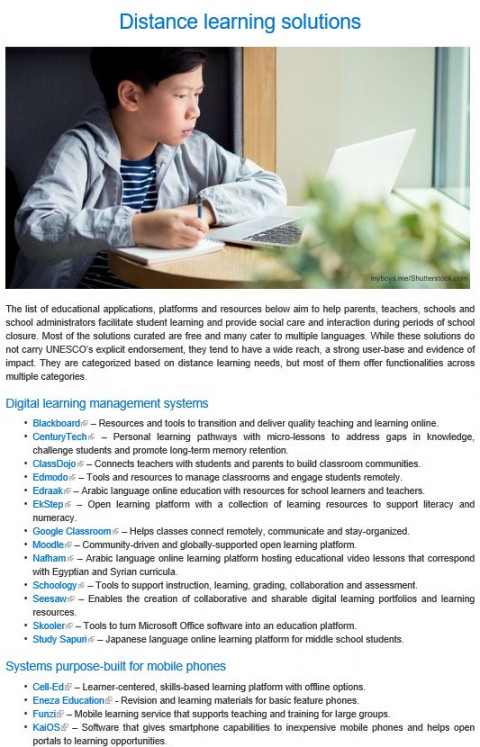 Soluciones para un aprendizaje a distancia Année de publication: 2020 Auteur institutionnel: Organización de las Naciones Unidas para la Educación, la Ciencia y la Cultura (UNESCO) A continuación, ofrecemos una lista de aplicaciones y plataformas educativas para ayudar a los padres, docentes, centros educativos y sistemas escolares a facilitar el aprendizaje de los alumnos y garantizar las interacciones y los servicios sociales durante el periodo de cierre de las escuelas. Aunque no han sido explícitamente respaldadas por la UNESCO, estas soluciones tienen un amplio alcance, numerosos usuarios y una eficacia probada. La mayor parte de las soluciones son gratuitas y muchas se encuentran en varios idiomas.Si usted es un proveedor de servicios de aprendizaje digital y posee un producto sólido que cree merece figurar en la siguiente lista de recursos, favor envíenos un correo electrónico a la dirección: COVID19taskforce@unesco.org Инструменты дистанционного обучения Année de publication: 2020 Auteur institutionnel: Организация Объединенных Наций по вопросам образования, науки и культуры (UNESCO) Приведенный ниже список образовательных приложений, платформ и ресурсов призван помочь родителям, учителям, школам и школьным администраторам облегчить процесс обучения учащихся и обеспечить социальную помощь и взаимодействие в периоды закрытия школ. Большинство предложений доступны бесплатно и многие поддерживаются на нескольких языках. Хотя эти предложения не имеют непосредственной поддержки ЮНЕСКО, они, как правило, имеют широкий охват, мощную базу пользователей и подтверждения достигнутых результатов. Они распределены исходя из потребностей дистанционного обучения, но большинство из них предлагают функциональные возможности по нескольким категориям. حلول للتعلّم عن بعد Année de publication: 2020 Auteur institutionnel: منظمة الأمم المتحدة للتربية والعلم والثقافة (UNESCO) الغرض من قائمة التطبيقات والمنصات والموارد التعليمية الواردة أدناه، مساعدة الأهل والمعلمين والمدارس ومديريها على تيسير عملية تعلّم الطلاب وتقديم الرعاية الاجتماعية والتفاعل الاجتماعي لهم في أثناء فترة إغلاق المدارس. ومعظم الحلول المختارة مجانية، ويقدم العديد منها محتوى متاحاً بعدة لغات. ولا تحظى هذه الحلول بدعم صريح من اليونسكو، بيد أنها تصل إلى عدد كبير من الأشخاص، ولها قاعدة مستخدمين واسعة، وتأثيرها مثبت. وتُصنّف هذه الحلول في فئات تبعاً لاحتياجات الدارسين، ولكن معظمها يحتوي على خصائص مأخوذة من فئات مختلفة.
  UNESCO: Promise of Gender Equality; Key Actions of 2018 and 2019 Année de publication: 2020 Auteur institutionnel: UNESCO This is the first UNESCO Annual Report on Gender Equality that highlights the key initiatives implemented in 2018-2019. The advancement of gender equality through education, the sciences, culture, information and communication, at the heart of UNESCO’s mandate, aims to equip both women and men to address the challenges of sustainable development in a fast-changing world. UNESCO: La Promesse de l’Egalité des genres; Actions clés de 2018 - 2019 Année de publication: 2020 Auteur institutionnel: Organisation des Nations Unies pour l'éducation, la science et la culture (UNESCO) Ceci est le premier rapport annuel de l’UNESCO sur l’égalité des genres qui met en lumière quelques-unes des initiatives clés mises en place en 2018 - 2019. Les progrès en matière d’égalité des genres par l’éducation, les sciences, la culture, l’information et la communication, au cœur des activités de l’UNESCO, visent à donner aux femmes et aux hommes les moyens de relever les défis du développement durable dans un monde en perpétuelle mutation.
  Visioning and Framing the Futures of Education: February 2020 Année de publication: 2020 Auteur institutionnel: UNESCO This statement is the outcome from first meeting of the International Commission on the Futures of Education held in Paris, 28-29 January 2020. Established by UNESCO, the Commission is charged with looking at 2050 and beyond to issue a report in 2021 to rethink how knowledge, learning and education may address the challenges and opportunities, both those foreseen for the future and those with us in the present. Note de cadrage sur les Futurs de l'éducation: Février 2020 Année de publication: 2020 Auteur institutionnel: Organisation des Nations Unies pour l'éducation, la science et la culture (UNESCO) Cette note est le fruit de la première réunion de la Commission internationale sur les futurs de l’éducation qui s’est tenue à Paris les 28 et 29 janvier 2020. Etablie par l’UNESCO, la Commission est chargée de repenser lessavoirs, l’apprentissage et l’éducationface aux défis et auxopportunités, tant ceux envisagés à l’horizon2050 et au-delà, que ceux duprésent. Visióny marco de los futuros de la educación: Febrero de 2020 Année de publication: 2020 Auteur institutionnel: Organización de las Naciones Unidas para la Educación, la Ciencia y la Cultura (UNESCO) La declaración es el resultado de la primera reunión de la Comisión Internacional sobre los Futuros de la Educación, celebrada en París los días 28 y 29 de enero de 2020. La Comisión, establecida por la UNESCO, se encarga de mirarhacia 2050 y más allá para publicar en 2021 un informe con el fin de repensar el modo en que el conocimiento, el aprendizaje y la educación pueden ayudar a abordar los desafíos y las oportunidades, tanto los previstos para el futuro como los que nos acompañan en el presente.