
Ressources
Explorez une large gamme de ressources sur le GCED afin d’approfondir votre compréhension et de renforcer vos activités de recherche, de plaidoyer, d’enseignement et d’apprentissage.
2,781 résultats trouvés
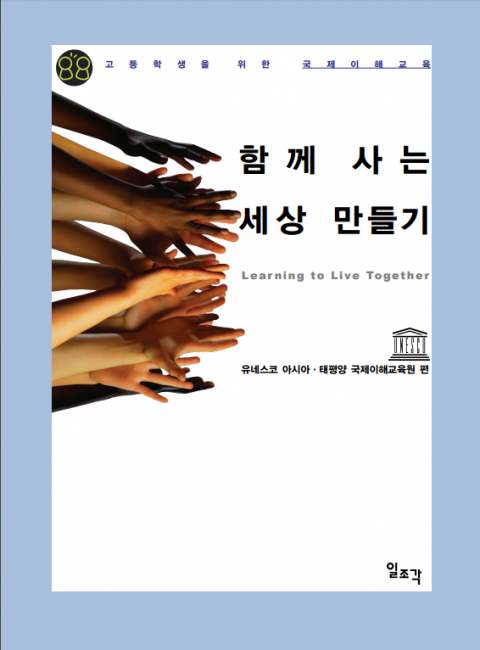 함께 사는 세상 만들기 Année de publication: 2004 Auteur institutionnel: APCEIU This book, in essence, aims to introduce Education for International Understanding (EIU) to high school students, college students and teachers at all levels as well as the general public. The growing interconnectedness and interdependence compels all of us to understand the world beyond our immediate living space, to critically reflect on issues affecting us and others, and to work together to make our world a more peaceful and sustainable one. It requires values education that is transformative and participatory in nature to arouse genuine interests and passions to learn more and eventually to make positive changes. The book is comprised of five parts, organized by five thematic areas of EIU, namely, intercultural understanding, globalization, human rights, peace and Education for Sustainable Development (ESD). It introduces carefully chosen topics and discussions which may pique readers’ interest in some of the issues at stake, thus, encourage them to critically reflect on the complexities surrounding the issues and motivate them to engage further. Using an interdisciplinary lens, the book also borrows some ideas and approaches commonly practiced in critical anthropology. 함께 사는 세상 만들기 Année de publication: 2004 Auteur institutionnel: 유네스코 아시아태평양 국제이해교육원 유네스코 아시아태평양 국제이해교육원에서는 국제이해교육을 가르치는 교사와 배우고자 하는 고등학생들에게 도움을 주기 위하여 고등학생을 위한 국제이해교육 교재를 출간하게 되었습니다우리 교육원은 아시아·태평양 지역의 45개 나라들과 함께 국제이해교육을 학교와 시민사회에서 강화하고 발전시킬 책임을 부여받았기 때문에, 여러가지 국제 회의와 연수과정, 전문가 협의회 등을 통해 이 과목의 교육 내용과 교과 과정에 대한 그림을 그려보는 노력을 부단히 전개하고 있습니다. 우리 교육원은 국내·외 여러 전문가들과 함께 많은 토론을 거쳐 국제이해교육의 기본 골격을 ① 문화 간 이해, ② 세계화, ③ 인권, ④ 평화, ⑤ 지속가능발전의 다섯 가지로 정했으며, 이를 바탕으로 초·중·고 국제이해교육 교육과정을 개발했습니다.우리 교육원은 앞으로 수년간 이러한 토대 위에서 교육자료나 수업 모형 등을 개발해보려고 합니다. 이번에 발간되는 교재 『함께 사는 세상 만들기』도 이러한 노력의 한 결실입니다. 이 책이 세계화 시대의 사회구조와 문제들을 파악하고, 함께 살 수 있는 가치관과 태도를 길러주는 데 크게 도움이 될 수 있기를 바랍니다.
 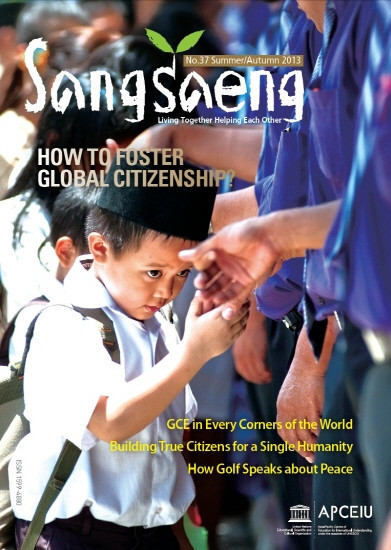 Building a global community out of the ashes of poverty (SangSaeng no. 37 summer autumn 2013) Année de publication: 2013 Auteur institutionnel: APCEIU SangSaeng No. 37- How to Foster Global Citizenship? has been published. In order to help our readers better grasp the concept of global citizenship and provide useful information and new ideas, this issue deals with various aspects of global citizenship education.3 Director’s Message4 Special ColumnBuilding True Citizens for a Single Humanity8 Focus: How to Foster Global Citizenship?8 Eliminating World Challenges through Global Citizenship Education 13 Developing Global Citizens with a Global Perspective18 Living in a New World Starts with Education23 GCE in Every Corners of the World28 Best Practices28 Hands-on Hand Print for Environmental Sustainability32 Bhutan Teachers Learn New Models of Education35 Comic Relief: Song of the City36 Special ReportPaving the Way Together for Global Citizenship Education40 InterviewBuilding a Global Community out of the Ashes of Poverty42 LetterCapturing Moments of Living in Harmony44 Peace in My MemoryHow Golf Speaks about Peace47 Understanding the Asia-Pacific RegionDiscovering Locks beyond the Function of Opening and Closing50 APCEIU in Action
 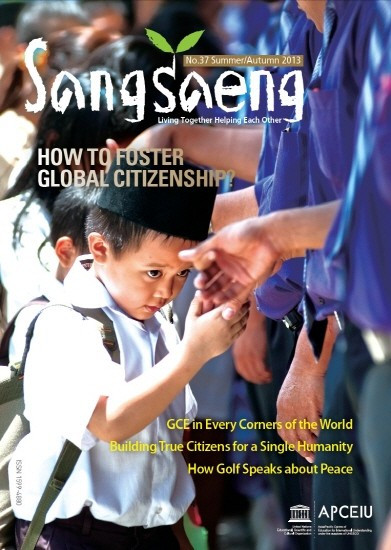 Paving the way together for global citizenship education (SangSaeng no. 37 summer autumn 2013) Année de publication: 2013 Auteur institutionnel: APCEIU SangSaeng No. 37- How to Foster Global Citizenship? has been published. In order to help our readers better grasp the concept of global citizenship and provide useful information and new ideas, this issue deals with various aspects of global citizenship education.3 Director’s Message4 Special ColumnBuilding True Citizens for a Single Humanity8 Focus: How to Foster Global Citizenship?8 Eliminating World Challenges through Global Citizenship Education 13 Developing Global Citizens with a Global Perspective18 Living in a New World Starts with Education23 GCE in Every Corners of the World28 Best Practices28 Hands-on Hand Print for Environmental Sustainability32 Bhutan Teachers Learn New Models of Education35 Comic Relief: Song of the City36 Special ReportPaving the Way Together for Global Citizenship Education40 InterviewBuilding a Global Community out of the Ashes of Poverty42 LetterCapturing Moments of Living in Harmony44 Peace in My MemoryHow Golf Speaks about Peace47 Understanding the Asia-Pacific RegionDiscovering Locks beyond the Function of Opening and Closing50 APCEIU in Action
 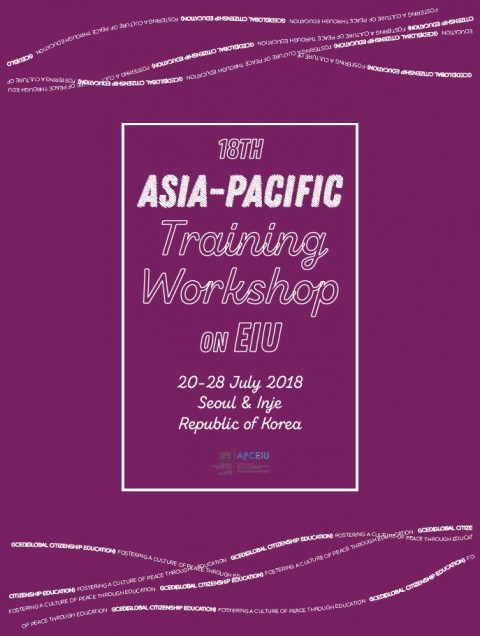 Final Report: 18th Asia-Pacific Training Workshop on EIU Année de publication: 2018 Auteur institutionnel: APCEIU This report is the summary of the 18th Asia-Pacific Workshop on EIU (APTW) held in the Republic of Korea from 20 to 28 July 2018. Designed as TOT (Training of Trainers), the Workshop has invited 31 teacher educators/trainers from the Asia-Pacific region, strengthening their capacities to carry out Global Citizenship Education in their respective institutions and countries.
 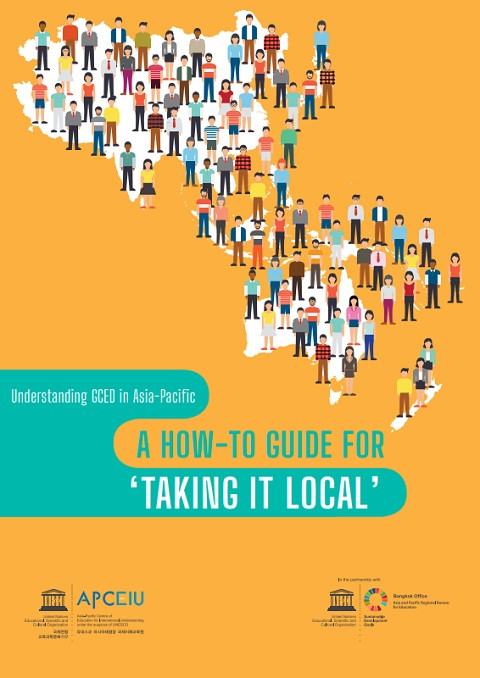 Understanding GCED in Asia-Pacific: A How-to Guide for ‘Taking It Local’ Année de publication: 2020 Auteur institutionnel: APCEIU | UNESCO Bangkok The Asia-Pacific Centre of Education for International Understanding (APCEIU), in partnership with UNESCO Bangkok, has published “Understanding GCED in Asia-Pacific: A How-To Guide for ‘Taking It Local’”, a guidebook for GCED-themed workshop organizations in the region. The publication is developed by UNESCO Asia-Pacific Regional Bureau for Education under the framework of the Asia-Pacific Regional GCED Network that is coordinated by UNESCO Bangkok and APCEIU. Taking stock of the key data from the 2019 publication titled “GCED: Taking it Local in Asia-Pacific”, the guidebook presents full-detailed guidelines on preparing and conducting a ‘Taking it Local’ workshop on GCED with particular focuses on the three core notions of GCED – respect for diversity, solidarity and a shared sense of humanity. The purpose of the publication is to promote GCED in local contexts and support active GCED practitioners on the ground to design and carry out GCED workshops that are translated and designed fully within the local context of the Asia-Pacific region. <Contents>Chapter 1: Introduction1.1 What is GCED?1.2 Purpose of the Guidebook1.3 Pedagogical ApproachChapter 2: Preparing a ‘Taking it Local’ Workshop on GCED2.1 Workshop Objectives2.2 Target Audiences2.3 Workshop Preparation2.4 Tips for a Successful Workshop2.5 Sample Agenda for the WorkshopChapter 3: Conducting a ‘Taking it Local’ Workshop on GCED3.1 Welcome, Overview, and Agreements3.2 Introduction Exercise: Story Circles3.3 GCED in AsiaPacific Exercise3.4 Optional Activities for the Workshop 3.5 Application Exercise 3.6 Closing 3.7 Final Reflection and Workshop Evaluation 3.8 Sharing Reflections 3.9 FollowUp of the WorkshopReferences
  International Understanding and Cooperation in Education in the Post-Corona World Année de publication: 2020 Auteur: Dongjoon Jo | Edward Vickers | Dina Kiwan | Fei Yan | Kyujoo Seol | Kyoko Nakayama Auteur institutionnel: APCEIU Research Report of International Understanding and Cooperation in Education in the Post-Corona World APCEIU has published a report, including research studies from 6 experts in order to figure out the role of education in promoting international understanding and cooperation in the education sector in the post-pandemic world. Through this research project, APCEIU mainly sought to answer the following questions; ▲What will be the implications of COVID-19 for international exchange and cooperation especially in education?▲What should we as educators, researchers, and practitioners do to counter the rise of populist nationalism?▲What should be the focus and direction of international cooperation in education during and after the pandemic in order to promote international understanding and GCED? This research project is expected to provide insightful views on the desirable direction for international understanding and cooperation in the education sector. Table of Contents 1. The development of UNESCO’s exchange programmes and their possible rearrangements in the post-pandemic years (Dong-Joon Jo, Professor at Department of Political Science and International Relations, Seoul National University, Korea) 2. ‘Rethinking Schooling’ once again: Post-corona challenges for education for peace and sustainability in Asia (Edward Vickers, Professor of Comparative Education at Kyushu University, Japan) 3. Race, gender, disability, and their intersections under the impact of COVID-19 (Dina Kiwan, Professor in Comparative Education, University of Birmingham, United Kingdom) 4. Competition or cooperation: Configuring ‘International’ in Chinese school textbooks (Fei Yan, Post-Doctoral Research Fellow, South China University, China) 5. The implications of democratic citizenship education and global citizenship education in South Korea for the post-corona era (Kyujoo Seol, Professor of Social Studies Education, Kyeongin National University of Education, Korea) 6. What can we learn from the pandemic of COVID-19?: An attempt to develop teaching materials for international understanding and cooperation based on Japanese educational issues (Kyoko Nakayama, Professor of Social Studies Education and Multicultural Education, Teikyo University, Japan)
 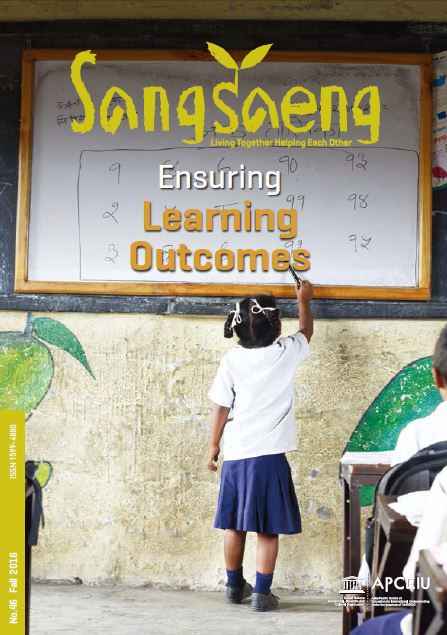 학습 성과의 강화 (상생 제46호 2016년 가을호) Année de publication: 2016 Auteur institutionnel: 유네스코 아시아태평양 국제이해교육원 46호 <상생>이 “학습 성과의 강화 (Ensuring Learning Outcomes)”라는 주제로 발간되었다. 교육 2030 실행계획에서 양질의 교육을 확보하고 평가하는 업적에 집중함에 따라, 이번 <상생> 가을호는 현재의 교육 평가 시스템을 재검토하고 더 나은 평가 체계를 개발하기 위한 다양한 연구와 노력을 소개하고자 한다. 3 발간사4 스페셜 칼럼상생하기: 교육의 기둥은 ‘학습’에서 시작한다8 포커스: 학습 성과의 강화8 새로운 미래에 대비하기: 신교육시대의 지속가능개발과 세계시민의식을 위한 모니터링14 학습 성과물 개선을 위한 지식의 모니터링: ‘동남아시아권 기초교육 학습지표’의 세계시민의식 지수 측정18 민주적 문화의 역량강화: 민주적 역량의 교육과 측정을 위한 유럽의회 프로젝트24 21세기 역량, 그리고 세계시민의식과 글로벌 역량 28 스페셜 리포트키르기스스탄 학생들의 사회문화적 역량 강화하기34 국제이해교육 모범사례34 지속가능성 받아들이기: 여러분도 변화를 만들 수 있다39 가치의 실천을 통한 학생 역량강화 (SEVA): 학교에서 의견 표출, 비판적 사고, 관용의 정신 가르치기44 APCEIU에 보내는 편지따뜻한 마음으로 세계시민이 되어요46 내 기억 속의 평화21세기 평화를 위한 식생활50 교육원 활동
 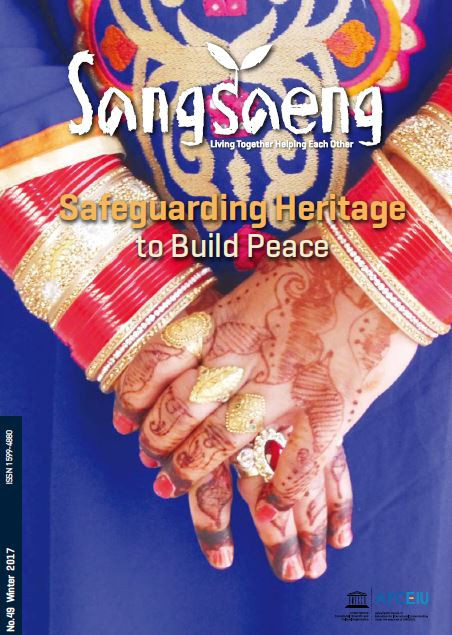 Safeguarding Heritage to Build Peace (SangSaeng no. 49 Winter 2017) Année de publication: 2017 Auteur institutionnel: APCEIU The 49h issue of SangSaeng, “Safeguarding Heritage to Build Peace,” has been published. All ancient civilizations have contributed in some way to the development of modern society. Therefore, all are equally deserving of study. This edition of SangSaeng aims to examine heritage in its different contexts and to help identify our responsibilities as a global community to understand and tolerate other people’s heritages. 3 Director’s Message4 Special Column4 Taking Stewardship of Our Planet8 Focus: Heritage8 Heritage for Peace and Prosperity12 Heritage Education: Opportunity to Enhance Cultural Literacy17 Photo Essay: World Heritage Sites of 2017 21 Special ReportUNAI Impacts Scholarship, Research for Greater Good24 Best Practices24 Frontier Education on the Frontier for Life29 Encouraging the Heart of the Matter33 InterviewGCED Challenge Issued36 Youth NetworkYouth Building Peace 40 LetterJourney to the Heart of Peace42 Peace in My MemoryPeace in a World of Violence46 Understanding the Asia-Pacific RegionEgg, Tambourine and Commemoration49 APCEIU in Action Sauvegarder le patrimoine pour consolider la paix (SangSaeng no. 49 Hiver 2017) Année de publication: 2017 Auteur institutionnel: Centre Asie-Pacifique d'éducation pour la compréhension internationale (APCEIU) 03 MESSAGE DU DIRECTEUR04 RUBRIQUE SPECIALEPrendresoin de notreplanète08 LE PATRIMOINE POUR LA PAIX ET LA PROSPÉRITÉApporter de la valeurajoutée avec uneéducationappropriéeet des services d’interprétation sur les sites de tourisme patrimonial12 EDUCATION AU PATRIMOINE: UNE OPPORTUNITÉ POUR ACCROITRE L'ALPHABÉTISATION CULTURELLEReconnaître la valeur de la communautécommeespaced’apprentissage17 REPORTAGE PHOTOSites du patrimoinemondial 2017 21 REPORTAGE SPÉCIALL’UNAI influence l’enseignementet la recherche pour le biencommun24 BONNES PRATIQUES24 Éducationen zone frontalière: à la frontière de la vie29 Encourager le coeur du sujet33 ENTRETIENLe défi de l’ECMestlancé !36 RÉSEAU DE JEUNESLes jeunes édifient la paix 40 LETTRE42 LA PAIX DANS MA MÉMOIRELa paixdansun monde de violence46 COMPRENDRE LA REGION ASIE-PACIFIQUEOEuf, tambourinetcélébration49 APCEIU EN ACTION