
Ressources
Explorez une large gamme de ressources sur le GCED afin d’approfondir votre compréhension et de renforcer vos activités de recherche, de plaidoyer, d’enseignement et d’apprentissage.
2,781 résultats trouvés
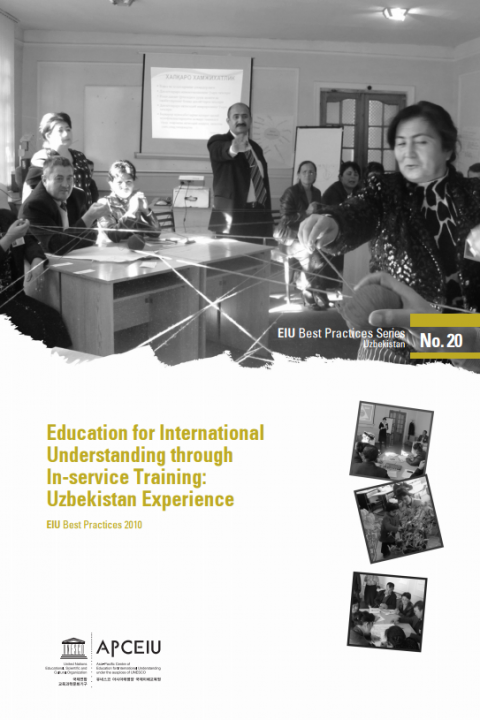 EIU Best Practices Series No. 20: Education for International Understanding through In-service Training: Uzbekistan Experience Année de publication: 2010 Auteur: Mukhamadjon Aliyev Auteur institutionnel: APCEIU This monograph is one of APCEIU's EIU Best Practices Series, which aims to encourage educators, scholars, and activists to implement and share local initiatives on EIU. The Series No.20 introduces EIU projects undertaken by the Avloni In-Service Teacher Training Institute in Uzbekistan. The programme integrates EIU concepts into the public education through in-service training programs, promotes EIU concepts in different subjects and projects, and broadcasts good practices in the field of global citizenship education nationwide. Although it is still in the process of improvement, the programme is expected to raise awareness of EIU and empower education managers, principals and teachers in Uzbekistan.
 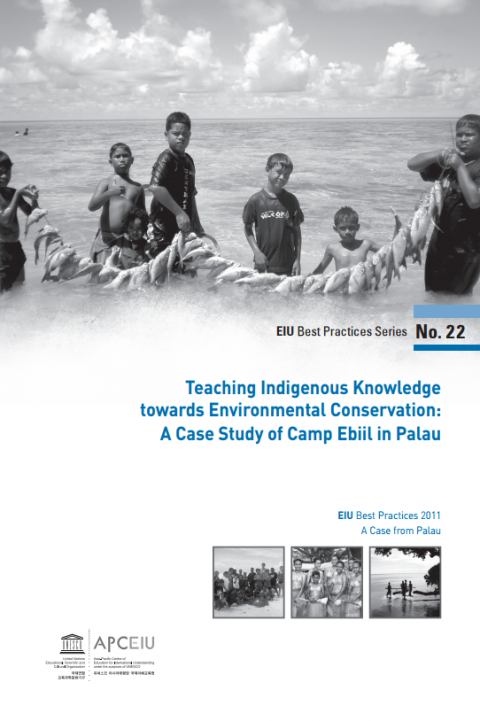 EIU Best Practices Series No. 22: Teaching Indigenous Knowledge towards Environmental Conservation: A Case Study of Camp Ebiil in Palau Année de publication: 2011 Auteur: Ann Kloulechad Singeo Auteur institutionnel: APCEIU This monograph is one of APCEIU's EIU Best Practices Series, which aims to encourage educators, scholars, and activists to implement and share local initiatives on EIU. The Series No.22 introduces a case study of community-based education program from Camp Emiil in Palau that promote protection of one's identity and heritage by teaching the youth with the traditional knowledge. The camp allows young participants to take direct part in fun activities and learning opportunities to immerse in culture and nature. Through such experiential learning, participants become more knowledgeable about ethnic practices and acquire important character building skills and conservation knowledge.
 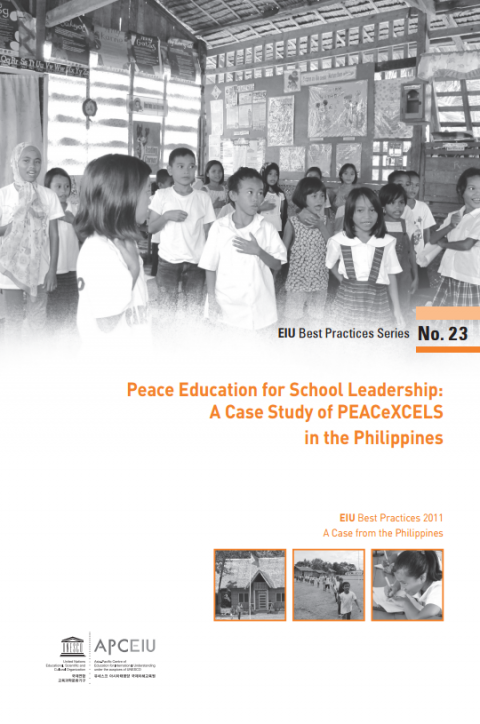 EIU Best Practices Series No. 23: Peace Education for School Leadership: A Case Study of PEACeXCELS in the Philippines Année de publication: 2011 Auteur: Ethel Agnes Pascua-Valenzuela | Elaissa Marina Mendoza | Cristina Villanueva-Moreno Auteur institutionnel: APCEIU This report is one of APCEIU's EIU Best Practices Series, which aims to encourage educators, scholars, and activists to implement and share local initiatives on EIU. The Series No.23 showcases Peace Education Excellence in School Leadership for Southeast Asia (PEACeXCELS) in the Philippines, a competency building program for educators on EIU. Through comprehensive training, principals and educators undertook reforms in respective schools, implementing various activities to include concept of peace and multiculturalism within school policies and lesson plans.
 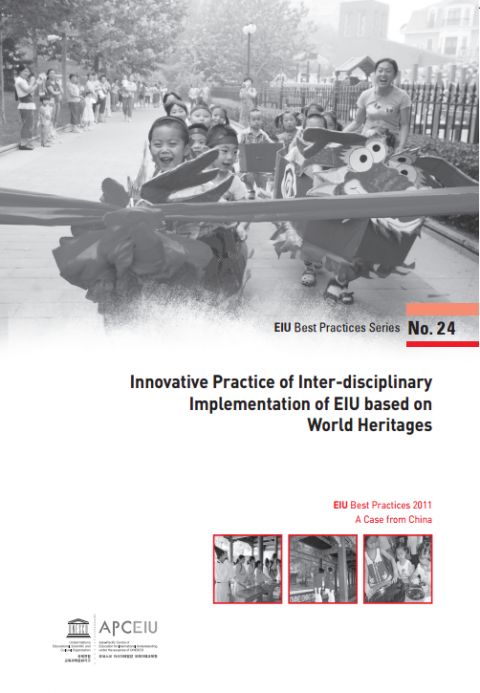 EIU Best Practices Series No. 24: Innovative Practice of Inter-disciplinary Implementation of EIU based on World Heritages Année de publication: 2011 Auteur: QIAN Lixia Auteur institutionnel: APCEIU This monograph is one of APCEIU's EIU Best Practices Series, which aims to encourage educators, scholars, and activists to implement and share local initiatives on EIU. The Series No.24 introduces a research undertaken by the Research Center for ESD, which outline projects that can be implemented to explore and promote education for international understanding and world heritage. To test the effectiveness, the Center carried out activities such as role-playing discussions and hands-on festival experiences at four kindergartens of the Huijia Education Organization and the High School Affiliated to the Renmin University of China. Overall, such initiative increased multicultural awareness of students and teachers alike, and affirmed commitment for further research and development.
  2016 한-유네스코 펠로우십 프로그램 최종보고서 Année de publication: 2016 Auteur institutionnel: 유네스코 아시아태평양 국제이해교육원 본 보고서는 2016년 9월 1일부터 10월 31일까지 열린 ‘2016 한-유네스코 펠로우십 프로그램’에서이루어진 활동 내용과 성과물에 대한 요약을 담고 있다. 올해 10회를 맞이하는 본 프로그램에는 아시아태평양 및 아프리카 17개국 25명의 교육자들이 참가하였으며, 두 달간 기초교육, ICT교육(e-러닝), 세계시민교육 및 소녀교육의 4가지 주제영역에 대한 참가자들의 이해 증진과 역량강화를 위한 연수로 진행되었다. 이 보고서를 통해, 다양한 주제관련 강의, 워크숍, 현장학습활동, 교육자료 개발 프로젝트 등으로 이루어진 이 프로그램의 내용과 참가자들의 교육현장에서 의미 있게 적용될 수 있는 결과물과 실행계획 등 성과에 대한 내용을 살펴볼 수 있다. 문의: 유네스코 아태교육원 교육연수실(ent@unescoapceiu.org)
 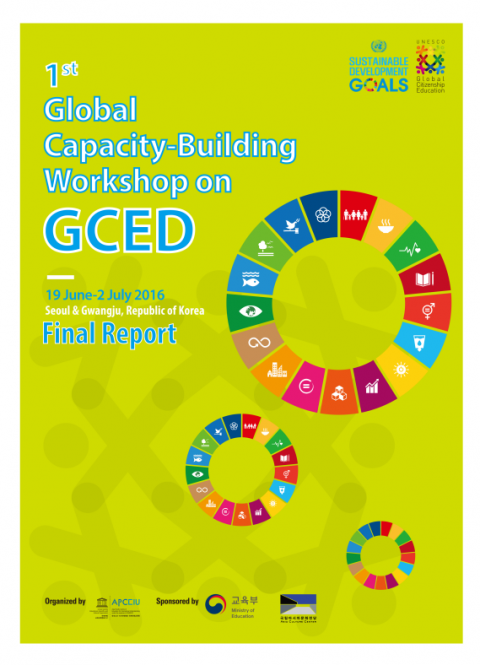 Final Report: 1st Global Capacity-Building Workshop on GCED Année de publication: 2016 Auteur institutionnel: APCEIU This report provides an overview of the activities carried out during the 1st Global Capacity-Building Workshop on GCED held in Seoul and Gwangju, Republic of Korea from 19 June - 2 July, 2016. APCEIU organized the 1st Global Capacity-Building Workshop on GCED in collaboration with UNESCO in order to contribute to achieving the Sustainable Development Goals(SDGs) target 4.7 by enhancing the capacity of teacher educators and trainers in implementing GCED. This intensive 2-week workshop provided the participating educators with the opportunities to better understand the concept and internalize the pedagogical principles of GCED while sharing their experiences and working on collaborative action plans. For more information, please contact APCEIU's Office of Education and Training at ent@unescoapceiu.org.
 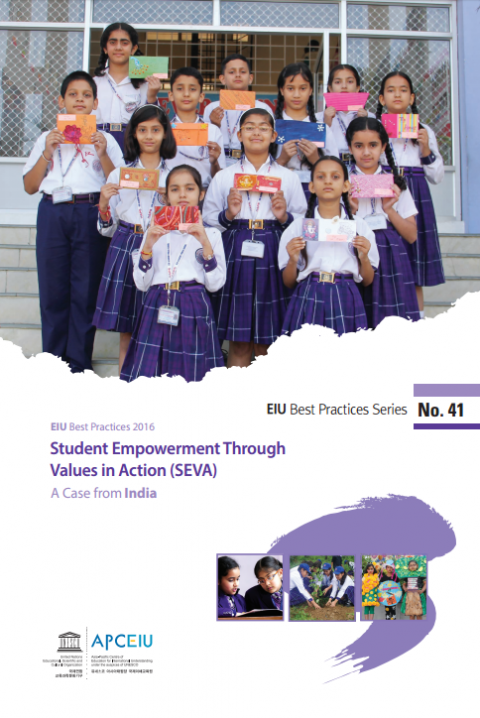 EIU Best Practices Series No. 41: Student Empowerment Through Values in Action (SEVA) Année de publication: 2016 Auteur institutionnel: APCEIU This monograph is one of APCEIU's EIU Best Practices Series, which aims to encourage educators, scholars, and activists to implement and share local initiatives on EIU. The Series No. 41 introduces a programme called “Student Empowerment through Values in Action (SEVA)" carried out by a school in India. The programme encouraged students to put the values of respect, responsibility, care, integrity, resilience and cyber-wellness in day to day actions. The programme has been successful in motivating the school staffs to enthusiastically participate in the programme as they witnessed the impact of the progarmme on the students. The programme sends out important messages to the school education system, where evaluation of success tends to be heavily based on academic performance.
 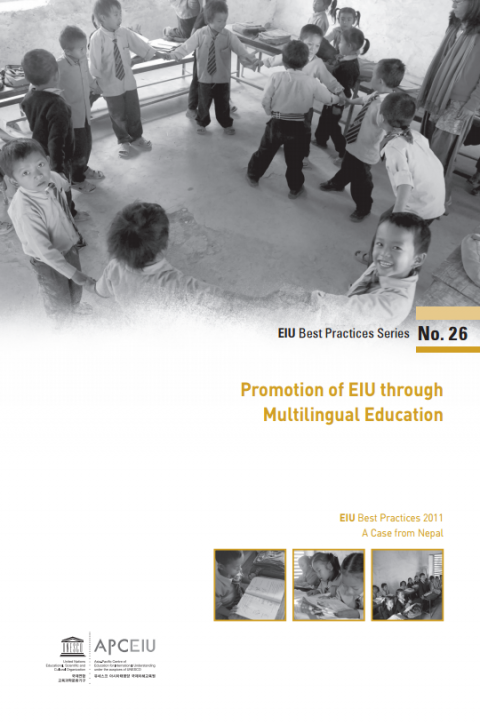 EIU Best Practices Series No. 26: Promotion of EIU through Multilingual Education Année de publication: 2011 Auteur: Narayan Prasad Subedi Auteur institutionnel: APCEIU This monograph is one of APCEIU's EIU Best Practices Series, which aims to encourage educators, scholars, and activists to implement and share local initiatives on EIU. The Series No.26 showcases a Multilingual Education Programme initiated by the Magar community in Nepal, that fosters EIU and multiculturalism. As there are over 200 local languages within Nepal, the MEP seeks to address the educational needs of non-Nepali speaking population. The program helps to enhance teacher capacity building, training manual development, and curriculum development, thereby allowing non-Nepali students to study in respective mother tongue.
 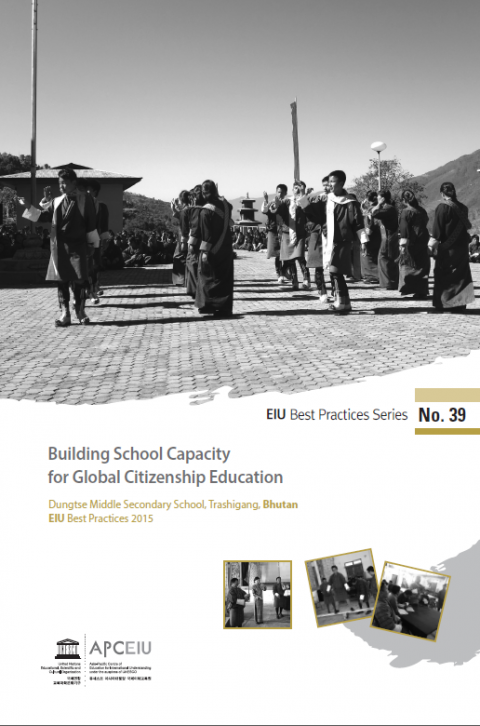 EIU Best Practices Series No.39: Building School Capacity for Global Citizenship Education: Dungtse Middle Secondary School, Trashigang, Bhutan Année de publication: 2015 Auteur institutionnel: APCEIU This monograph is one of APCEIU's EIU Best Practices Series, which aims to encourage educators, scholars, and activists to implement and share local initiatives on EIU. The Series No.39 introduces the Training of Trainers (TOT) program, a workshop for teachers to better incorporate GCED/EIU concepts into respective curriculum and school environment. Upon participating in the APCEIU training workshop, Mr. Yeshi Dorji from Dungtse Middle Secondary School in Bhutan sought to create a forum in which teachers and school officials can learn to incorporate GCED. Such exemplary initiative not only enhances capacity building of educators in the school, but also has potential to have larger impact in the local and regional communities.
 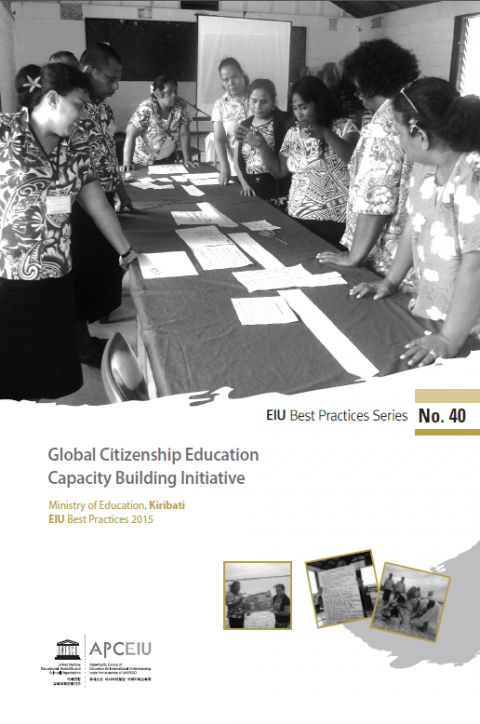 EIU Best Practices Series No.40: Global Citizenship Education Capacity Building Initiative: Misitry of Education, Kiribati Année de publication: 2015 Auteur institutionnel: APCEIU This monograph is one of APCEIU's EIU Best Practices Series, which aims to encourage educators, scholars, and activists to implement and share local initiatives on EIU. The Series No. 40 introduces a successful hosting of workshop on GCED in Kiribati. Considered the first of its kind in Kiribati, the workshop brought together education officers and teachers to learn about emerging concept of GCED and EIU and means for implementation. The exemplary workshop involving fieldtrips and seminars has created a wave of learning opportunities for key stakeholders at all levels, paving way to put GCED into practice.