
Ressources
Explorez une large gamme de ressources sur le GCED afin d’approfondir votre compréhension et de renforcer vos activités de recherche, de plaidoyer, d’enseignement et d’apprentissage.
2,668 résultats trouvés
 GCED Curriculum Development and Integration Project (Sri Lanka): 2021 Final Report Année de publication: 2021 Auteur institutionnel: National Institute of Education (Sri Lanka) | Centre Asie-Pacifique d'éducation pour la compréhension internationale (APCEIU) This resource is a compiled documentation of the final outcomes of the Sri Lankan National Institute of Education (NIE) and APCEIU’s joint partnership to develop the GCED curriculum, particularly for the secondary school level. The report includes the materials created and used to evaluate, monitor, and execute the GCED curriculum, as well as the documentation of the process of its creation. It is written in both English and Sinhalese. In the compilation, you may find:- Introduction to the project (ENG)- Annexure of evaluative materials (ENG, SNH)- GCED Framework (ENG)- GCED Learning ModulesGrade 6 English (ENG)Grade 6 Sound Test (SNH)Grade 8 (SNH)Grade 8 English World of Work (ENG)Grade 8 School Try Out (SNH)
  GCED Curriculum Development and Integration Project (Lebanon): 2021 Final Report Année de publication: 2021 Auteur institutionnel: Center for Educational Research and Development (CRDP) | Centre Asie-Pacifique d'éducation pour la compréhension internationale (APCEIU) This resource is a compiled documentation of the final outcomes of the Center for Educational Research and Development (CRDP), Lebanon and APCEIU’s joint partnership to develop the GCED curriculum across both primary and secondary school levels. The report includes the materials created and used to evaluate, monitor, and execute the GCED curriculum, as well as the documentation of the process of its creation. It is written in both English and Arabic.In the compilation, you may find:- Report on the Implementation of the Project Stages- Digital Activities for GCED Integration in the Civics and National Education Curriculum: Grade 1 - 12 (ARA)- Digital Activities for GCED Integration in the Civics and National Education Curriculum: Grade 1 - 12 (ENG)- Teacher’s Guide: Grade 1 - 12 (ARA)- Teacher’s Guide: Grade 1 - 12 (ENG)- Training of Trainers (TOT): TOT Materials (ENG; ARA)- The Project of Training the Trainers on Global Citizenship Education and Integrating it into the Pre-university Educational Curricula: Preamble (ENG)- Technical Cards (ENG; ARA)
  ACER-APCEIU 세계시민교육 모니터링 가이드: 교사, 학교 관리자, 교육행정가를 위한 안내서 Année de publication: 2025 Auteur: Rachel Parker | Amy Berry | Payal Goundar | Karena Menzie-Ballantyne Auteur institutionnel: 호주교육연구위원회 | 유네스코 아시아태평양 국제이해교육원 『ACER-APCEIU 세계시민교육 모니터링 가이드: 교사, 학교 관리자, 교육행정가를 위한 안내서』는 APCEIU와 ACER가 2022년부터 2024년까지 3년에 걸쳐 호주, 라오스, 필리핀, 한국의 파트너들과 함께 수행한 공동연구의 결과물인 『ACER-APCEIU Global Citizenship Education Monitoring Toolkit for Teachers, Schools and System Leaders』를 한국의 맥락에 맞게 번역한 국문판이다.이 가이드는 다양한 수준의 교육 이해관계자가 세계시민교육에서 자신의 위치를 진단하고 목표와 계획을 수립하며, 실행과 평가를 지속적으로 이어가도록 설계된 탐구 순환 모형을 제시하며, 이를 각자의 맥락에 맞게 실천할 수 있도록 구체적인 지침과 방법을 안내한다.이 가이드의 주요 활용자는 정책 입안자, 교육부 및 교육청 등 유관 기관의 교육행정가, 학교장과 학교감 등 교육 리더십을 가진 이들뿐 아니라 정규·비정규 교육 전반에서 세계시민교육을 실천하는 모든 교사를 포함한다.
 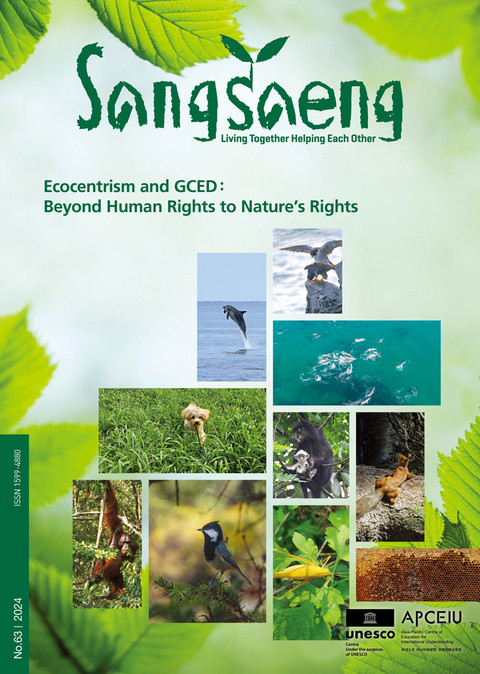 Ecocentrism and GCED : Beyond Human Rights to Nature’s Rights (SangSaeng; No.63, 2024) Année de publication: 2024 Auteur institutionnel: APCEIU In the context of Sustainable Development Goal (SDG) 4, global citizenship and sustainability are spotlighted through SDG Target 4.7, which underscores the importance of harmonising cultural and biological diversity.To address the urgent need for harmony between humanity and the nature, ecocentrism needs to be explored as a guiding principle for fostering ethical and sustainable coexistence.In this light, Issue 63 of SangSaeng delves into Ecocentrism—a perspective advocating for the ethical treatment of all beings and recognising their intrinsic value—alongside Global Citizenship Education (GCED). Contents 03 Editor's Note 04 Special Column- Creating Respectful, Valued Society — Strengthening Global Citizenship Education (GCED) to Combat Hate, Racism, and Discrimination Worldwide / Peter K. Ngure 08 FOCUS Ecocentrism and GCED: Beyond Human Rights to Nature’s Rights- Getting Over Ourselves — Ecocentrism: The Importance of Earth Jurisprudence, Compassionate Conservation, and Personal Rewilding / Marc Bekoff- Combating Decline of Nature’s Diversity — Global Citizenship Education for Geodiversity, Biodiversity Conservation / Eunhee Lee- Ecocentrism and Global Citizenship Education — Fostering Coexistence with Critically Endangered Primates through Citizen Science / Andie Ang- Dolphins Dream of Peace: Beyond Human Rights to Nature’s Rights / Interview with Seungmok Oh 23 Special Report- Small Actions, Global Ripples — How GCED is Revitalizing Peace / Micha Aime 26 Best Practices- What’s Good for the Community — GCED in Action Fosters Culture of Bulungi Bwansi in Uganda / Barbara Nakijoba- Sharing Emotional Sensibility in Education — Practicing Arts Opens up the Spirit of Global Citizenship / Seoyoung Bae - Teaching GCED through Liberation History — Working to Eradicate Entrenched Racism, Intolerance, Xenophobia / Charles Chikunda 36 GCED YOUTH NETWORK- How Youth Leaders Redefine Advocacy, Leading Global Change to Shape our Future — Deep Dive into South Asian Youth Declaration on GCED, Facilitation Techniques for Empowered Youth / Noora Elkenawi 39 Peace in My Memory- Pathway to Inner Peace — Journey is Interconnected with Relationships and Environment / Itseng Kwelagobe 42 Story Time- From Drops to Waves — Power of Poetry-telling in Times of Crisis / Kalpani Dambagolla & Alessia Marzano 45 Understanding the Asia Pacific Region- Central Asian Heart of Culture — Legacy of Horsemanship from Tradition to Modernity / Gulzhan Kabysheva 48 Letter- Raising a Global Citizen / Nelly Aluanga Omino 50 APCEIU in Action
 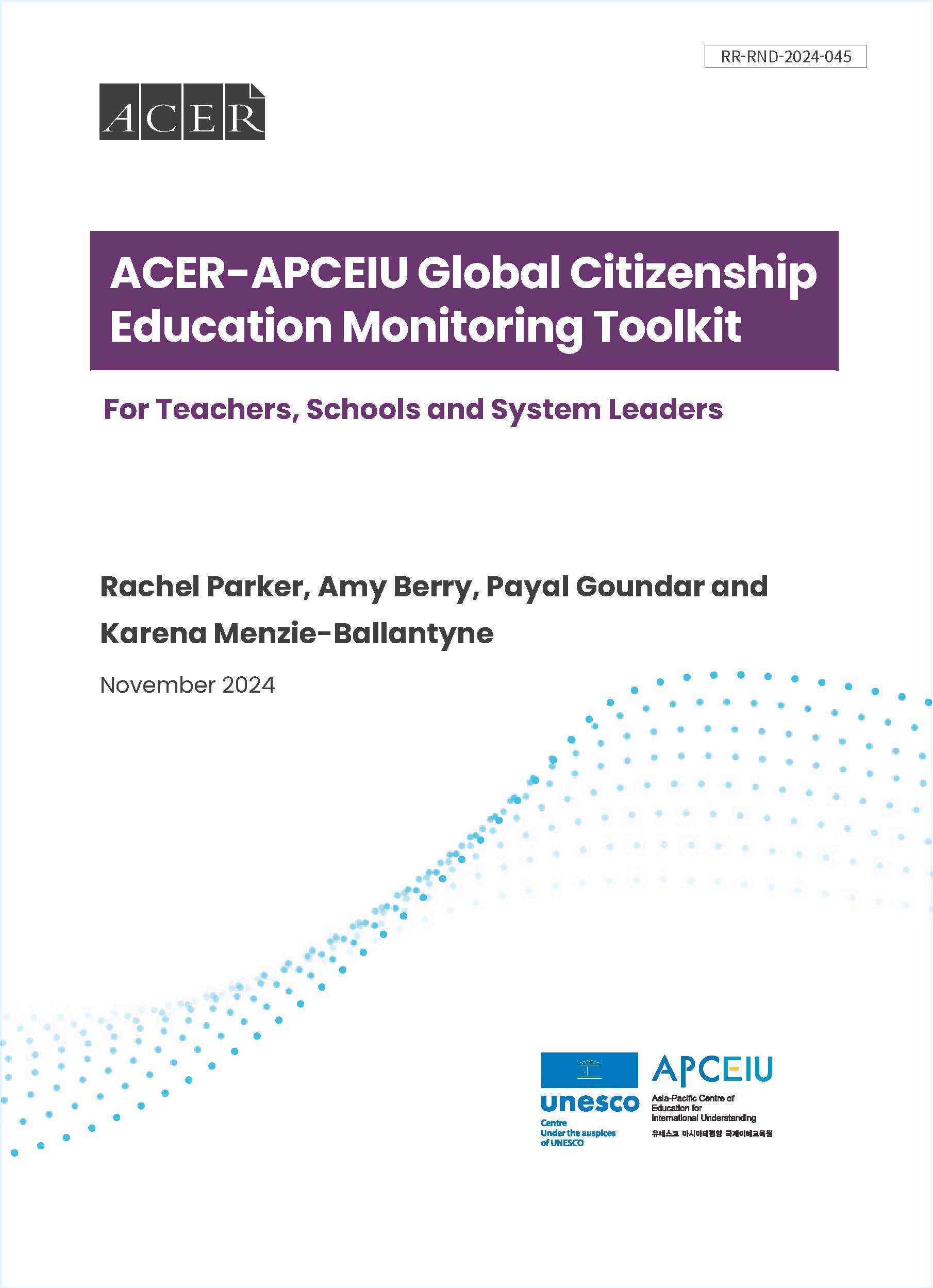 ACER-APCEIU Global Citizenship Education Monitoring Toolkit: For Teachers, Schools and System Leaders Année de publication: 2024 Auteur: Rachel Parker | Amy Berry | Payal Goundar | Karena Menzie-Ballantyne Auteur institutionnel: Australian Council for Educational Research (ACER) | APCEIU The APCEIU-ACER GCED Monitoring Toolkit was developed and informed by research conducted from 2022-2024 in collaboration with partners in Australia, Lao PDR, Philippines, and South Korea. The toolkit aims to assist education stakeholders to embed GCED within policy and practice in alignment with local, regional, and international frameworks. Target users of this toolkit include policy makers, education department and ministry personnel, leaders, and educators at all levels in both formal and non-formal education sectors.The toolkit explores effective GCED including how to conceptualise and define, plan, enact and monitor implementation, and how to measure success. By guiding educators and leaders to align their enactment and monitoring efforts to international guidance, research, theory and practice, this toolkit supports a robust and evidence-informed process for enacting GCED in ways that nurture learners as proactive and empowered global citizens.Phase I Report (Link): https://www.unescoapceiu.org/post/4995Phase II Report (Link): https://www.unescoapceiu.org/post/5184
 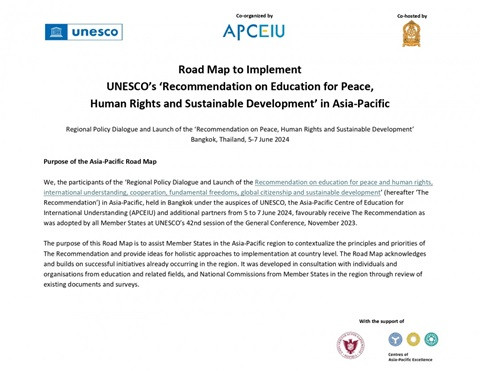 Road Map to Implement UNESCO’s ‘Recommendation on Education for Peace, Human Rights and Sustainable Development’ in Asia-Pacific Année de publication: 2024 Auteur institutionnel: UNESCO Bangkok | APCEIU The Road Map is a product of the Regional Policy Dialogue and the Launch of the Recommendation on Education for Peace, Human Rights, and Sustainable Development (hereafter referred to as the 2023 Recommendation), held in Bangkok in June 2024. This document aims to promote the regional implementation of the 2023 Recommendation and outlines the challenges and priorities within the Asia-Pacific educational landscape, making it a valuable resource for policymakers, researchers, and practitioners.
 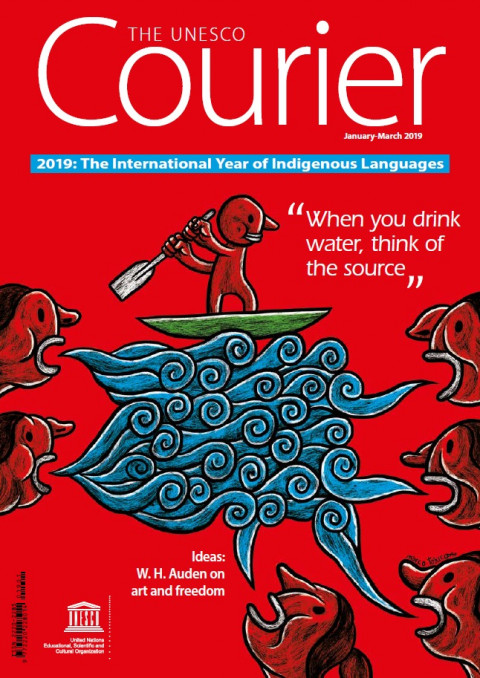 2019: The International Year of Indigenous Languages (The UNESCO Courier. January-March 2019) Année de publication: 2019 Auteur institutionnel: UNESCO With the designation of 2019 as the International Year of Indigenous Languages (IYIL2019), officially launched at UNESCO on 28 January, the international community reaffirms its commitment to supporting indigenous peoples in their efforts to preserve their knowledge and enjoy their rights. Since the adoption of the Declaration on the Rights of Indigenous Peoples (link is external) by the United Nations General Assembly on 13 September 2007, considerable progress has been made in this regard. Nevertheless, indigenous peoples still have a long way to go before they emerge from marginalization and overcome the many obstacles they face. One-third of the world’s people living in extreme poverty belong to indigenous communities, just as in a number of countries, legislation that promotes the rights of indigenous peoples remains incompatible with other laws that deal with issues such as agriculture, land, conservation, forestry, mining and other industries, according to Victoria Tauli-Corpuz (link is external), United Nations Special Rapporteur on the Rights of Indigenous Peoples. The Wide Angle section in this issue of the Courier is dedicated to these indigenous peoples. It takes its title from the Chinese proverb: “When you drink water, think of the source”, to remind us that indigenous knowledge, the source of all knowledge, deserve a prominent place in modernity. The issue also marks the celebration of International Mother Language Day (link is external), 21 February. 2019 : Année internationale des langues autochtones Année de publication: 2019 Auteur institutionnel: Organisation des Nations Unies pour l'éducation, la science et la culture (UNESCO) À une époque où la tension ne cesse de croître, où les droits de l'homme, la liberté d'expression, la paix et l'avenir de la planète semblent plus que jamais remis en question, le pouvoir de transformation véhiculé par l'éducation revêt une importance cruciale.Avec la désignation de 2019 comme Année internationale des langues autochtones(IYIL2019), lancée officiellement à l’UNESCO le 28 janvier, la communauté internationale réaffirme sa volonté de soutenir les peuples autochtones dans leurs efforts de préserver leurs savoirs et de jouir de leurs droits.Depuis l’adoption de la Déclaration sur les droits des peuples autochtones, par l’Assemblée générale des Nations Unies, le 13 septembre 2007, des avancées considérables ont été faites dans ce sens. Il n’en reste pas moins que les peuples autochtones ont encore un long chemin à parcourir avant de sortir de la marginalisation et de surmonter les nombreux obstacles auxquels ils doivent faire face. Un tiers des personnes qui vivent dans l’extrême pauvreté à travers le monde appartiennent à des communautés autochtones, de même que dans un bon nombre de pays, les législations en faveur des peuples autochtones demeurent incompatibles avec d’autres lois qui traitent notamment de l’agriculture, de la terre, de la conservation et des industries forestières ou minières, selon Victoria Tauli-Corpuz, Rapporteuse spéciale des Nations Unies sur les droits des peuples autochtones. Le dossier Grand angle de ce numéro du Courrier leur est consacré. Il emprunte son titre au proverbe chinois : « Quand tu bois de l’eau, pense à la source », pour rappeler que les savoirs autochtones, source de tous les savoirs, méritent une place prééminente dans la modernité. Il s’associe également à la célébration de la Journée internationale de la langue maternelle, le 21 février.
 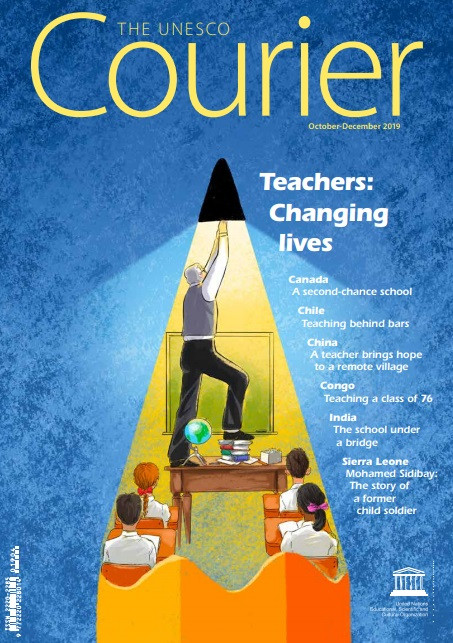 Teachers: changing lives (The UNESCO Courier no. 4, October-December 2019) Année de publication: 2019 Auteur institutionnel: UNESCO Certainly, everyone recognizes the key role teachers play. On a personal level, we can all name at least one teacher who made a difference – sometimes to such an extent that it redirected our whole lives. At the international level, the United Nations Sustainable Development Goals (SDGs), Goal 4 in particular, recognize the importance of teachers in the implementation of the Sustainable Development Agenda by 2030. Yet, the profession is being undermined. The development of cognitive neuroscience and the many applications of new technologies in the field of education are forcing the profession to adapt and reinvent itself. Ces profs qui changent le monde (Le Courrier de l'UNESCO 4, octobre-décembre 2019) Année de publication: 2019 Auteur institutionnel: Organisation des Nations Unies pour l'éducation, la science et la culture (UNESCO) Certes, tout le monde reconnaît le rôle clé que jouent les enseignants. À titre personnel, chacun peut citer le nom d’au moins un professeur qui a compté, parfois au point de réorienter une vie entière. Sur le plan international, les Objectifs de développement durable (ODD) des Nations Unies, en particulier l’Objectif no 4, reconnaissent l’importance des enseignants dans la mise en œuvre du Programme de développement durable à l’horizon 2030. Pourtant, la profession est mise à mal. Le développement des neurosciences cognitives, les multiples applications des nouvelles technologies dans le domaine de l’éducation obligent la profession à s’adapter, se réinventer.