
Ressources
Explorez une large gamme de ressources sur le GCED afin d’approfondir votre compréhension et de renforcer vos activités de recherche, de plaidoyer, d’enseignement et d’apprentissage.
2,781 résultats trouvés
 GCED Curriculum Development and Integration Project (Sri Lanka): 2021 Final Report Année de publication: 2021 Auteur institutionnel: National Institute of Education (Sri Lanka) | APCEIU This resource is a compiled documentation of the final outcomes of the Sri Lankan National Institute of Education (NIE) and APCEIU’s joint partnership to develop the GCED curriculum, particularly for the secondary school level. The report includes the materials created and used to evaluate, monitor, and execute the GCED curriculum, as well as the documentation of the process of its creation. It is written in both English and Sinhalese. In the compilation, you may find:- Introduction to the project (ENG)- Annexure of evaluative materials (ENG, SNH)- GCED Framework (ENG)- GCED Learning ModulesGrade 6 English (ENG)Grade 6 Sound Test (SNH)Grade 8 (SNH)Grade 8 English World of Work (ENG)Grade 8 School Try Out (SNH)
  GCED Curriculum Development and Integration Project (Lebanon): 2021 Final Report Année de publication: 2021 Auteur institutionnel: Center for Educational Research and Development (CRDP) | APCEIU This resource is a compiled documentation of the final outcomes of the Center for Educational Research and Development (CRDP), Lebanon and APCEIU’s joint partnership to develop the GCED curriculum across both primary and secondary school levels. The report includes the materials created and used to evaluate, monitor, and execute the GCED curriculum, as well as the documentation of the process of its creation. It is written in both English and Arabic.In the compilation, you may find:- Report on the Implementation of the Project Stages- Digital Activities for GCED Integration in the Civics and National Education Curriculum: Grade 1 - 12 (ARA)- Digital Activities for GCED Integration in the Civics and National Education Curriculum: Grade 1 - 12 (ENG)- Teacher’s Guide: Grade 1 - 12 (ARA)- Teacher’s Guide: Grade 1 - 12 (ENG)- Training of Trainers (TOT): TOT Materials (ENG; ARA)- The Project of Training the Trainers on Global Citizenship Education and Integrating it into the Pre-university Educational Curricula: Preamble (ENG)- Technical Cards (ENG; ARA)
  다문화가정대상국가와의 교육교류사업 후속활동 길라잡이 Année de publication: 2023 Auteur institutionnel: APCEIU The Asia-Pacific Teacher Exchange for Global Education(APTE) is a bilateral teacher exchange programme between the Republic of Korea and Asia-Pacific countries, hosted by the Ministry of Education of the Republic of Korea (MOE ROK) and implemented by the Asia-Pacific Centre of Education for International Understanding under the auspices of UNESCO (APCEIU), in collaboration with the Ministries of Education of the partner countries. Since 2012, the Office of International Teacher Exchange of APCEIU has been playing a pivotal role in implementing APTE. APCEIU prepared this book in the hope of spreading the fruits of teachers’ efforts and the seeds of peace in them, which were nurtured on the ground of APTE, to a broader world. <Contents>IntroductionI. Understanding follow-up activitiesII. Types of follow-up activities and model examples1. Types of follow-up activities2. Model examples of follow-up activities- [Real-Time Online Video Class] Starting online international education exchange- [Visiting / Invitational Program] An insight into international exchange programme- [Club-Oriented Inter-School Exchange] Follow-up exchange with invention club activity- [Inter-School Cooperative Agreement] Precious ties- [Participation In Various Support Programs] Heart of Korea, multicultural values: overcoming the limits of the classroomIII. Follow-up activity operation1. The nine-step preparation process for independent operation of educational exchange2. Procedures for independent operation of international exchangeIV. Annex1. Asia-Pacific Teacher Exchange for Global Education2. UNESCO APCEIU: Asia-Pacific Centre of Education for International Understanding under the auspices of UNESCO3. Reference programs for follow-up activities 다문화가정대상국가와의 교육교류사업 후속활동 길라잡이 Année de publication: 2023 Auteur institutionnel: 유네스코 아시아태평양 국제이해교육원 다문화가정대상국가와의 교육교류사업(APTE: Asia-Pacific Teacher Exchange for Global Education)은 대한민국 교육부가 주최하고 유네스코 아시아태평양 국제이해교육원이 주관하며, 교류 대상국 교육부가 현지 협력주체로서 함께하는 한국 아태지역 국가 양자 간 교육교류사업입니다. 아태교육원 국제교사교류실은 2012년부터 2022년 현재까지 10년간 APTE 사업 시행을 담당하고 있습니다. 지난 10년간 APTE 사업이라는 터전에서 선생님들께서 맺으신 열매와 그 속에 담긴 평화의 씨앗이 더 널리 퍼지길 기대하며 이 책자를 제작합니다. 목차:머리말I. 후속활동의 이해II. 후속활동 유형 및 우수 사례1. 후속활동 유형 소개2. 후속활동 우수 사례 - [온라인 실시간 화상수업 사례] 온라인 국제교육교류 시작하기 - [방문 및 초청 프로그램 운영 사례] 국제교류프로그램에 대한 고찰 - [동아리 중심 학교 간 교류 사례] 발명 동아리 활동과 함께한 후속교류사업 - [학교 간 협약 체결 사례] 소중한 인연들 - [각종 지원사업 참가 사례] 한마음, 다가치 교실의 경계를 넘다III. 후속활동 운영 방법1. 교육교류 자체 운영을 위한 9단계 준비 과정2. 국제교류 자체 운영의 절차IV. 붙임1. 다문화가정대상국가와의 교육교류사업 소개2. 유네스코아시아태평양국제이해교육원 소개3. 후속교류 시 참고 프로그램
 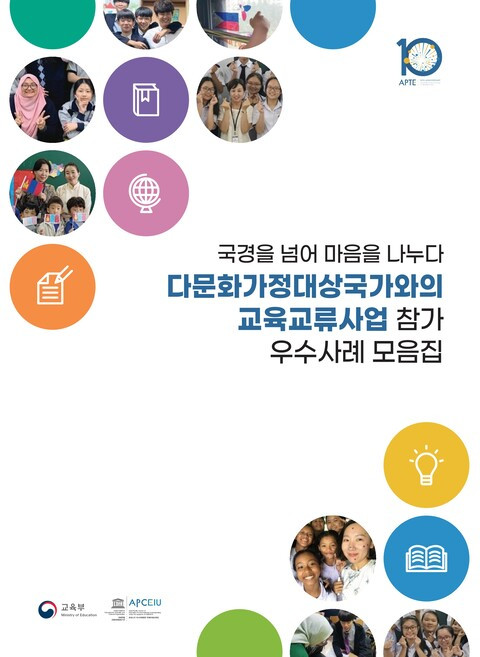 다문화가정대상국가와의 교육교류사업 참가 우수사례 모음집 Année de publication: 2023 Auteur institutionnel: APCEIU A carefully curated collection of best practices is presented as part of the 10th-anniversary celebrations of the Asia Pacific Teacher Exchange for Global Education (APTE). Over 30 teachers share their honest and vivid experiences, as well as outstanding follow-up activities. Each story aims to inspire teachers who are interested in the APTE Programme, and to serve as a valuable resource for future participants. 다문화가정대상국가와의 교육교류사업 참가 우수사례 모음집 Année de publication: 2023 Auteur institutionnel: 유네스코 아시아태평양 국제이해교육원 다문화가정 대상국가와의 교육교류사업의 10주년을 맞아 우수사례를 선별한 모음집을 선보인다. 국경을 넘어 마음을 나누는 교사들의 솔직하고 생생한 경험과 후속활동 사례가 수록되어 있다. 교사들의 생동감 있는 이야기가 향후 참가 교사들에게 긍정적인 영향과 소중한 자산이 되길 바란다.
  Asia-Pacific Teacher Exchange for Global Education 2022: Final Report Année de publication: 2022 Auteur institutionnel: APCEIU | Korea R. Ministry of Education The Asia-Pacific Teacher Exchange for Global Education (APTE), which has been in place since 2012, marks its 10th anniversary this year. APTE had been conducted according to the existing programme execution system and flow chart until 2019. However, the Office of International Teacher Exchange (ITE) focused on online exchange due to the pandemic crisis. This year’s APTE programme followed last year’s online formula and presented a new direction for utilization even post-pandemic. These efforts are expected to enhance global educational competencies for a more sustainable Global Citizenship Education. 다문화가정 대상국가와의 교육교류사업 2022년도 사업: 최종보고서 Année de publication: 2022 Auteur institutionnel: 유네스코 아시아태평양 국제이해교육원 | Korea R. Ministry of Education 2012년부터 시작되어 2022년에 11년 차를 맞이한 「다문화가정 대상국가와의 교육교류사업」 은, 2020년도 팬데믹으로 인해 물리적 교류가 불가능한 상황에서 비대면 온라인 교육교류의 형태로 진행되었다. 2022년도 교육교류 추진 실적 및 결과, 교육활동 결과물 등이 수록되어있다.
  2022 Youth Leaders’ Mentorship & Local GCED Projects: Activity Report Année de publication: 2022 Auteur institutionnel: APCEIU This report summarizes 15 GCED projects implemented in different parts of the world by the alumni of APCEIU’s Youth Leadership Workshop on GCED in 2022. Ranging from community advocacy for global citizenship to girls’ empowerment projects, 15 GCED initiatives have been taken by the team of 15 young leaders in their own communities in Asia, Europe, Africa, Latin America, and the Caribbean. APCEIU offers GCED training programmes targeting youth leaders around the globe to encourage them to achieve the SDGs through global citizenship and GCED. Since 2015, the Youth Leadership Workshop on GCED has been held every year in the Republic of Korea, inviting 50 young global leaders to take part in an intensive training programme where they share their actions, deepen their knowledge on global/local issues, enhance their motivation to take actions for a change, and establish the young leaders’ network on GCED. Since 2021, it has been shifted to a comprehensive training programme composed of online training workshops, mentorship, and local project implementation.
  Иcпользование живого наследия в учебном процессе в азиатскотихоокеанском регионе: комплект методических материалов Année de publication: 2022 Auteur institutionnel: UNESCO Bangkok | Азиатско-тихоокеанский центр по воспитанию в духе международного взаимопонимания (APCEIU) | International Information and Networking Centre for Intangible Cultural Heritage in the Asia-Pacific Region (ICHCAP) Использование концепций и практики живого наследия в учебном процессе может повысить качество образования, способствовать оживлению учебного процесса для учащихся и учителей и способствовать сохранению такого наследия для нынешнего и будущих поколений. Кроме того, как показала продолжающаяся пандемия COVID-19, живое наследие может играть важную роль в обеспечении благополучия и жизнеспособности человеческих сообществ. ЮНЕСКО призывает страны сохранять живое наследие посредством формального и неформального образования. С конца 2019 по начало 2022 года ЮНЕСКО совместно со своими партнёрами реализовала пилотный проект «Преподавание и обучение с использованием элементов живого наследия в школах» в шести странах Азиатско-Тихоокеанского региона — Камбодже, Казахстане, Кыргызстане, Непале, Южной Корее и Таиланде. Более 1900 учащихся из 21 школы получили возможность принять участие в этих инновационных занятиях. В ходе этого проекта 86 учителей, из которых более двух третей — женщины, разработали и опробовали 101 план уроков и мероприятий. Данный комплект методических материалов содержит пошаговое руководство и основные сведения, позволяющие понять важность и научиться интегрировать концепции и практику живого наследия в учебные и внеклассные мероприятия в школах. Кем бы вы ни были — сотрудником директивных органов, директором школы, учителем, учеником, родителем, практикующим носителем живого наследия — вам предстоит сыграть жизненно важную роль в этом процессе.