
Ressources
Explorez une large gamme de ressources sur le GCED afin d’approfondir votre compréhension et de renforcer vos activités de recherche, de plaidoyer, d’enseignement et d’apprentissage.
2,161 résultats trouvés
 Guidance on Integrating the Environment and Climate Change in Processes for United Nations Sustainable Development Cooperation Frameworks Année de publication: 2021 Auteur: Henrieta Martonakova Auteur institutionnel: Issue-based Coalition on Environment and Climate Change The guidance, which benefits from the diverse expertise of the 18 member organizations of the Coalition, looks at mainstreaming environmental and climate change considerations into the different stages of preparing the UNSDCF: The roadmap for a new cooperation frameworkThe common country analysisThe cooperation framework designThe cooperation framework implementationCooperation framework monitoring and evaluation The guidance looks deeper into mainstreaming the environment and climate change into a series of development priorities: human rights, including children’s rights and the rights of women; economic and trade development, including innovations, SMEs and decent work; food security and agriculture; infrastructure and sustainable use of resources, including energy, water and waste management; quality education; good health; good governance; and disaster reduction and conflict prevention.
  Educación Integral de la Sexualidad: Conceptos, Enfoques y Competencias Année de publication: 2014 Auteur institutionnel: UNESCO Santiago El objetivo de este documento es comprender que la sexualidad es parte integral de la vida de las personas (en sus diferentes etapas o edades, y en toda su diversidad), y que contribuye al desarrollo de su identidad y por lo tanto, a su desarrollo social. Se trata de capacidades más que de contenidos, las que deben desarrollarse en forma interdisciplinaria y de manera progresiva para que las personas actúen de forma responsable respecto a ellas mismas y con los demás. El documento explica que la educación de la sexualidad está íntimamente relacionada con la comprensión, la reflexión y el discernimiento, y fortalece las bases para el aprendizaje a lo largo de la vida, preparando a los jóvenes para la vida adulta. Es así que el enfoque se centra en alcanzar un desarrollo y bienestar humano sostenible.
  Greening Technical and Vocational Education and Training: A Practical Guide for Institutions Année de publication: 2017 Auteur institutionnel: UNESCO International Centre for Technical and Vocational Education and Training (UNEVOC) This Guide describes the macro need for TVET reform in conformity with the Sustainable Development Goals, the Global Action Programme (GAP) on Education for Sustainable Development (ESD), and other United Nations, UNESCO and national initiatives. The Guide also provides specific practical help for institutional greening transition teams to plan and carry out the changes that are deemed necessary. It is essential that all such greening undertakings have a clear vision, are known to all those concerned, follow a strategic plan, set targets and milestones, and include a monitoring/assessment tool. The concept of shared vision and team reformation combined with the support of senior leaders is evident throughout this Guide. A major goal is that greening will grow into an ongoing process which is eventually infused into the culture of each institution.
 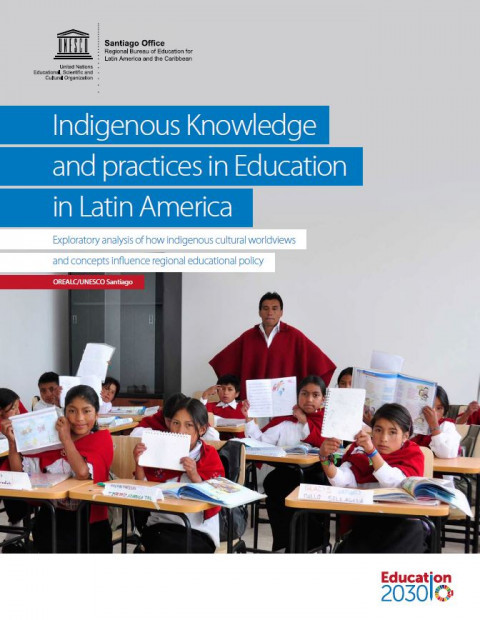 Indigenous Knowledge and practices in Education in Latin America: Exploratory Analysis of How Indigenous Cultural Worldviews and Concepts Influence Regional Educational Policy Année de publication: 2017 Auteur institutionnel: UNESCO Santiago This study presents a preliminary exploration of the approaches, processes and tools through which indigenous worldviews and concepts of knowledge and well-being can and have influenced education policies in Latin America. First, it addresses the principal theoretical approaches used in the area of indigenous knowledge and education policies, taking into account the persistence of an “epistemic otherness” and the need for a dialogue between the predominant approaches. Second, it addresses the normative framework and intercultural educational policies, emphasizing how and to what extent the countries in the region take indigenous knowledge into consideration and include it in their education policies and practices. Third, it presents a number of “relevant practices” in terms of dialogue with indigenous knowledge in education policies, taking into account the factors that favour the relevance of education to indigenous views and cultural practices, facilitating their replicability and sustainability. Furthermore, these practices respond to key criteria like recognizing learners as ‘carriers’ and producers of culture, valuing the use of schools as centres of social and cultural activities and favouring the inclusive learning of indigenous and non-indigenous students. Finally, the study unveils challenges for the advancement of the dialogue between indigenous knowledge and education policies, at the same time proposing key concepts to be approached in depth. Conocimiento Indígena y Políticas Educativas en América Latina: Análisis exploratorio de cómo las cosmovisiones y conceptos culturales indígenas de conocimiento inciden, y pueden incidir, en la política educativa en la región Année de publication: 2017 Auteur institutionnel: UNESCO Santiago El presente estudio explora la idea de una ‘alternativa epistémica’, construyendo desde el conocimiento y los valores que sustentan las prácticas sociales y educacionales indígenas de la región. En particular, explora cómo estos valores y formas de conocimiento han sido adoptados en las políticas educacionales de tres países de la región andina: Bolivia, Ecuador y Perú, que hace poco atravesaron reformas políticas y constitucionales con el fin de reconocer la composición de sus poblaciones multiculturales, multiétnicas y multilingüísticas. Esta publicación es una invitación a considerar el conocimiento indígena como una fuente legítima de inspiración para las políticas educacionales que puedan contribuir al bienestar de todos y a la sostenibilidad del planeta.
  Integrating education for sustainable development (ESD) in teacher education in South-East Asia: a guide for teacher educators Année de publication: 2018 Auteur institutionnel: UNESCO Bangkok This publication is a cumulative output of the project Sustainability Begins with Teachers in South-East Asia, implemented by UNESCO Bangkok, in cooperation with SEAMEO from 2017 to 2018, with the generous support of the Government of Japan. The initial content was developed together with the representatives of the universities and teacher education institutions who participated in the South-East Asia Sub-Regional Workshop on Education for Sustainable Development for Teacher Education Institutions, held from 5 to 9 June 2017 in Chiang Rai, Thailand. Content has since been enhanced through the sharing of knowledge and experiences gathered from a series of in-country workshops held in Cebu, Philippines; Luang Prabang, Lao PDR; Kampot, Cambodia; Bangkok, Thailand; and Yogyakarta, Indonesia. This culminated in a project review workshop in Bangkok from 24 to 26 April 2018 in which different in-country experiences were shared and comments on the guidebook collected. Twenty-six universities and teacher education institutions have taken part in the project process in total. This guidebook is a result of this collaborative journey.
  Learning-service and Citizenship Education Année de publication: 2011 Auteur: Josep M.ª Puig Rovira | Mònica Gijón Casares | Xus Martín García | Laura Rubio Serrano Auteur institutionnel: Universidad de Barcelona The aim of this article is to present the methodology of service learning as an especially significant contribution to citizenship education. Service learning is an activity that combines community service and curricular learning. It is an educational setup in which a circular link is formed between participation in services created to meet a community need and the learning of knowledge and values. The project presents an initiative for education in values and citizenship based on experience, participation and critique. Service learning is at the same time an excellent instrument for making education more inclusive and for helping students develop a set of basic skills that can only be acquired through a comprehensive, contextualized activity. Through service learning, students acquire a real, committed engagement with the search for the common good; this acquisition of commitment is a key formative mechanism in achieving a complete education for citizenship. The article begins by analyzing the different elements that make up citizenship education and the pedagogical means required for their acquisition. The concepts of ‘practice’ and ‘citizenship practice’ are the basis for proposing service learning as an ideal methodology for educating participative citizens who can contribute to the common good. The rest of the article is devoted to analyzing each of the constitutive aspects of service learning. This portion of the article begins by presenting a more-precise definition of ‘service learning’ and continues with an analysis of the components of service learning: social needs, the learning of contents and competences, community service, partnerships between institutions and the required networking. The article concludes by reviewing the different levels at which service learning has an impact and identifying and organizing the various personal acquisitions and institutional achievements that this type of educational activity provides. Aprendizaje-servicio y Educación para la Ciudadanía Année de publication: 2011 Auteur: Josep M.ª Puig Rovira | Mònica Gijón Casares | Xus Martín García | Laura Rubio Serrano Auteur institutionnel: Universidad de Barcelona El objetivo de este artículo es presentar la metodología del aprendizaje-servicio como una aportación especialmente relevante para la Educación para la Ciudadanía. El aprendizaje- servicio es una actividad que combina el servicio a la comunidad con el aprendizaje curricular. Es una propuesta educativa que vincula de una manera circular la participación en servicios pensados para satisfacer alguna necesidad de la comunidad y el aprendizaje de conocimientos y valores. Con ella, la educación en valores se pone en práctica de una manera participativa y crítica. Al mismo tiempo, también es un buen instrumento para hacer una educación más inclusiva y para desarrollar un conjunto de competencias básicas que solo pueden adquirirse a través de un trabajo global y contextualizado. Incorporar la intervención real y comprometida de los educandos en la búsqueda del bien común es un mecanismo formativo imprescindible para lograr una completa Educación para la Ciudadanía. Para lograr este objetivo, el escrito empieza analizando los distintos aprendizajes que supone la Educación para la Ciudadanía, así como los medios pedagógicos para alcanzarlos. Los conceptos de práctica y de práctica de ciudadanía permiten proponer el aprendizaje-servicio como una metodología idónea para lograr la formación de una ciudadanía participativa y capaz de contribuir al bien común. A continuación, se analizan los aspectos constitutivos del aprendizaje-servicio. Se presenta primero una aproximación más exacta a su definición y luego se desglosan sus componentes: las necesidades sociales, el aprendizaje de contenidos y competencias, el servicio a la comunidad, el partenariado entre instituciones y el trabajo en red que requiere. Al final del artículo se muestran los distintos niveles en los que impacta el aprendizaje-servicio, y se señalan y ordenan las distintas adquisiciones personales y logros institucionales que proporciona este tipo de actividad educativa. Integral Education of Sexuality: Concepts, Approaches and Competencies Année de publication: 2014 Auteur institutionnel: UNESCO Santiago The objective of this document is to understand that sexuality is an integral part of people's lives (in their different stages or ages, and in all their diversity), and that it contributes to the development of their identity and, therefore, to their development Social. It is about capacities rather than content, which must be developed in an interdisciplinary way and progressively so that people act responsibly towards themselves and with others. The document explains that the education of sexuality is closely related to understanding, reflection and discernment, and strengthens the bases for lifelong learning, preparing young people for adult life. Thus, the focus is on achieving sustainable human development and well-being.
  일상 사례로 비추어 본 지속가능발전 실천하는 생활 속 행동수칙 7 (지속가능발전 교육자료 2호) Année de publication: 2020 Auteur institutionnel: 지속가능발전포털 | 대한민국 환경부 지속가능발전목표를 위해 우리가 일상 생활 속에서 쉽게 실천할 수 있는 행동에는 어떤 것들이 있는지 7가지 행동수칙으로 정리하였다.행동수칙1. 교통, 2. 에너지 절약, 3. 물 아껴쓰기, 4. 음식물 쓰레기 줄이기, 5. 장바구니 이용하기, 6. 분리수거하기, 7. 나무 심기