
Ressources
Explorez une large gamme de ressources sur le GCED afin d’approfondir votre compréhension et de renforcer vos activités de recherche, de plaidoyer, d’enseignement et d’apprentissage.
3,446 résultats trouvés
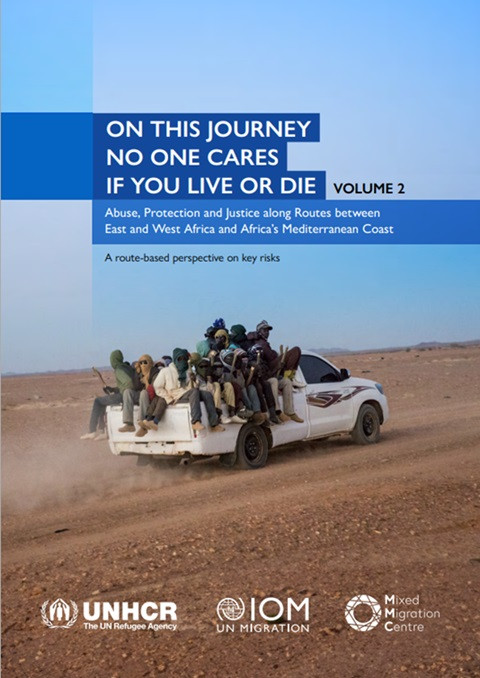 On This Journey No One Cares If You Live or Die, Volume 2: Abuse, Protection and Justice Along Routes Between East and West Africa and Africa's Mediterranean Coast Année de publication: 2024 Auteur institutionnel: International Organization for Migration (IOM) | Mixed Migration Centre | UN. Office of the United Nations High Commissioner for Refugees (UNHCR) In the complex landscape of migration, this second volume of the report, On This Journey, No One Cares if You Live or Die, emerges as a crucial body of work that sheds light on the stark realities faced by refugees and migrants traversing the perilous Central Mediterranean route all the way from East and Horn of Africa and West Africa to the North African coast of the Mediterranean and across the sea. Jointly published by IOM, MMC and UNHCR, this report delves into the protection risks faced by refugees and migrants during these journeys. It aims to inform increased and concrete routes-based protection responses to reduce the suffering associated with the desperate journeys refugees and migrants undertake, and to serve as a call to action in addressing the root causes of displacement and drivers of irregular migration through positive action on peace, climate change, governance, inequality and social cohesion, as well as the creation of safe migration pathways.
 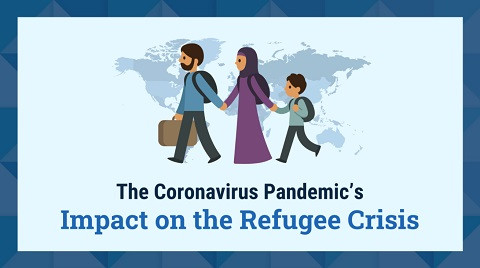 The Coronavirus Pandemic and the Refugee Crisis Année de publication: 2020 Auteur: Alice Corner Auteur institutionnel: Venngage Inc. One group of people most impacted by the Coronavirus Pandemic is the world’s population of refugees and displaced people. There are approximately 25 million refugees in the world, facing unique struggles in access to healthcare, government assistance, and sanitation. Venngage analyzed the data and created this collection of infographics to help paint a fuller picture of COVID-19’s impact on the refugee crisis. This resource includes clear infographics detailing how the conronavirus crisis and refugee crisis relate to each other globally
  문화다양성협약 국내 이행을 위한 논의: 유튜브에서 AI까지, 21세기 한국에서의 문화다양성 Année de publication: 2020 Auteur: 김재인 | 염신규 | 이광석 | 이동연 | 이상욱 | 홍성수 | 황승흠 Auteur institutionnel: 대한민국 문화체육관광부 | 한국문화예술위원회 | 유네스코한국위원회 「문화다양성협약 국내 이행을 위한 논의 - 유튜브에서 AI까지, 21세기 한국에서의 문화다양성」는 모두 세 차례에 걸쳐 진행된 전문가회의에서 각 분야 전문가들이 발표하고 토론한 내용을 담은 종합보고서입니다. 올해는 문화다양성협약의 이행과 관련된 이슈들 중 특히 디지털플랫폼의 급부상, 인공지능 기술의 급격한 발달에 초점을 두어 논의하는 한편, 우리들의 일상을 송두리째 바꿔놓은 코로나19가 낳은 불안과 공포, 이로 인한 적대감이 초래한 소외와 고립, 혐오와 갈등의 문제를 짚어보았습니다. 전문가회의에서 나온 전문가들의 진단과 논의가 앞으로 한국사회에서 문화다양성협약 이행 관련 의제를 주도하는 데 있어서 필요한 비전과 전략 수립에도 기여하기를 기대합니다.
  The Media and Its Role in Raising Security Awareness in Society Année de publication: 2018 Auteur: Abdul Basit Howaidi | Iman Drake Auteur institutionnel: Hamma Lakhdar Eloued University The aim of this study was to reveal the role of the media in the security awareness within the society. The media was one of the means of mass influence that played an important role in the life of human societies. The analytical descriptive method was used to suit the nature of the subject. A professor of the Faculty of Social Sciences and Humanity, which was randomly selected. The questionnaire was also used as an important tool for collecting data from the field. The study reached the following results: The media, the coverage, the nature of the programs presented, and the attempt to open channels of communication between the security institutions and the media have a great role in spreading and achieving security awareness within the community. الإعلام و دوره في التوعية الأمنية داخل المجتمع Année de publication: 2018 Auteur: Abdul Basit Howaidi | Iman Drake Auteur institutionnel: Hamma Lakhdar Eloued University هدفت هذه الدراسة إلى ال كشف عن "دور الإعلام في التوعية الأمنية داخل المجتمع"، و ذلك أن الإعلام وسيلة من وسائل التأثير الجماهيري التي لعبت دورا مهما في حياة المجتمعات الإنسانية ، تم توظيف المنهج الوصفي التحليلي و الذي يناسب طبيعة الموضوع، وقدرت عينة الدراسة ب66 أستاذا جامعيا من كلية العلوم الاجتماعية و الانسانية و التي تم اختيارها بطريقة عشوائية، كما تم الاعتماد على أداة الاستبيان كأداة مهمة لجمع البيانات من الميدان و قد توصلت الدراسة إلى النتائج التالية : ان للإعلام و طريقة التغطية و طبيعة البرامج المقدمة ومحاولة فتح قنوات الاتصال بين المؤسسات الأمنية و الإعلام له دور كبير في نشر و تحقيق التوعية الأمنية داخل المجتمع.
 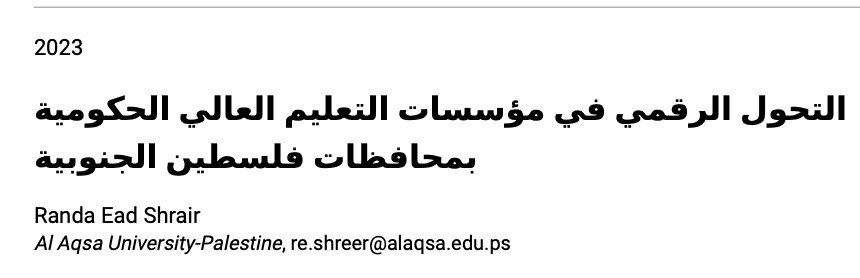 The Digital Transformation of Governmental Higher Education Institutions in the Southern Governorates of Palestine Année de publication: 2023 Auteur: Randa Ead Shrair The article aimed to identify the level of digital transformation in government higher education institutions in the Southern Governorates of Palestine from the point of view of its faculty members and to reveal whether there are statistically significant differences at the significance level (α ≤ 0.05). between the averages of the respondents' responses about the level of digital transformation in Government higher education institutions in the Southern Governorates of Palestine are attributed to the variables: (gender, years of service, academic degree, and specialization); by using the descriptive/surveying, a questionnaire was designed consisted of (30) items distributed on (4) axes. After verifying its validity and reliability, the questionnaire was applied to a stratified random sample of (123) male and female faculty members. The study concluded that the level of digital transformation in higher education institutions was “high" and there were no statistically significant differences between the averages of the respondents' responses about the level of digital transformation in those institutions due to the variables of the study . التحول الرقمي في مؤسسات التعليم العالي الحكومية بمحافظات فلسطين الجنوبية Année de publication: 2023 Auteur: Randa Ead Shrair هدفت الدراسة التعرف إلى مستوى التحول الرقمي في مؤسسات التعليم العالي الحكومية بمحافظات فلسطين الجنوبية من وجهة نظر أعضاء هيئاتها التدريسية، والكشف عما إذا كان هناك فروق ذات دلالة إحصائية عند مستوى الدلالة (0.05≥α)، بين متوسطات استجابات أفراد العينة حول مستوى التحول الرقمي في مؤسسات التعليم العالي الحكومية بمحافظات فلسطين الجنوبية تعزى لمتغيرات: (الجنس، سنوات الخدمة، والدرجة العلمية، والتخصص)، وباستخدام المنهج الوصفي/ المسحي، والرجوع للأدبيات السابقة، تم بناء استبانة تكونت من (30) فقرة موزعة على (4) مجالات، وبعد التأكد من صدقها وثباتها، تم تطبيقها على عينة عشوائية بسيطة مكونة من (123) عضو هيئة تدريس، وقد توصلت الدراسة ًإلى أن مستوى التحول الرقمي في مؤسسات التعليم العالي جاء "كبيرا"، ولم توجد فرق ذو دلالة إحصائية بين متوسطات استجابات أفراد العينة حول مستوى التحول الرقمي في تلك المؤسسات تعزى لمتغيرات الدراسة.
 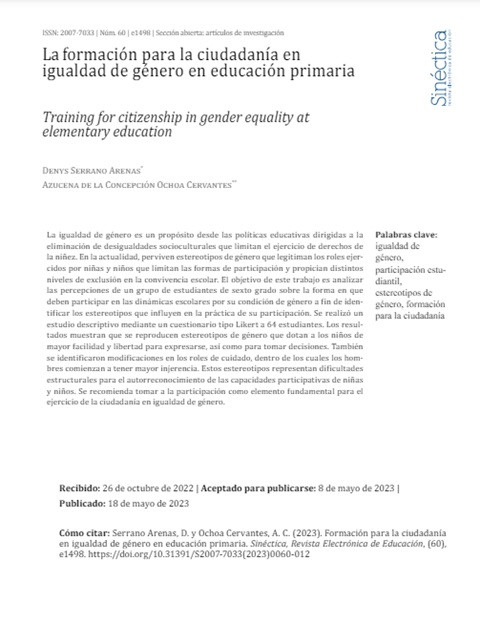 Training for Citizenship in Gender Equality at Elementary Education(Sinéctica, Revista electrónica de educación; no. 60) Année de publication: 2023 Auteur: Denys Serrano Arenas | Azucena de la Concepción Ochoa Cervantes Auteur institutionnel: Sinéctica, Revista Electrónica de Educación Gender equality is a purpose from educational policies aimed to eliminating sociocultu-ral inequalities that limit the exercise of children's rights. At present, gender stereotypes that legitimize the roles exercised by girls and boys that limit the forms of participation persist, promoting different levels of exclusion in school life. The objective of this work is to analyze the perceptions of a group of sixth grade students, about how they consider they should participate in school dynamics due to their gender condition, to detect tho-se stereotypes that influence the practice of their participation. A descriptive study was carried out using a Likert-type questionnaire to 64 students. The results show that gen-der stereotypes are reproduced that provide children with greater ease and freedom to express themselves, as well as to make decisions. Modifications in the care roles were also identified, within which, they begin to have greater interference. In parallel, it was found that these stereotypes represent structural difficulties for the self-recognition of the par-ticipatory capacities of girls. It is recommended to take participation as a fundamental element for the exercise of citizenship in gender equality. La formación para la ciudadanía en igualdad de género en educación primaria(Sinéctica, Revista electrónica de educación; núm. 60) Année de publication: 2023 Auteur: Denys Serrano Arenas | Azucena de la Concepción Ochoa Cervantes Auteur institutionnel: Sinéctica, Revista Electrónica de Educación La igualdad de género es un propósito desde las políticas educativas dirigidas a la eliminación de desigualdades socioculturales que limitan el ejercicio de derechos de la niñez. En la actualidad, perviven estereotipos de género que legitiman los roles ejercidos por niñas y niños que limitan las formas de participación y propician distintos niveles de exclusión en la convivencia escolar. El objetivo de este trabajo es analizar las percepciones de un grupo de estudiantes de sexto grado sobre la forma en que deben participar en las dinámicas escolares por su condición de género a fin de identificar los estereotipos que influyen en la práctica de su participación. Se realizó un estudio descriptivo mediante un cuestionario tipo Likert a 64 estudiantes. Los resultados muestran que se reproducen estereotipos de género que dotan a los niños de mayor facilidad y libertad para expresarse, así como para tomar decisiones. También se identificaron modificaciones en los roles de cuidado, dentro de los cuales los hombres comienzan a tener mayor injerencia. Estos estereotipos representan dificultades estructurales para el autorreconocimiento de las capacidades participativas de niñas y niños. Se recomienda tomar a la participación como elemento fundamental para el ejercicio de la ciudadanía en igualdad de género.
 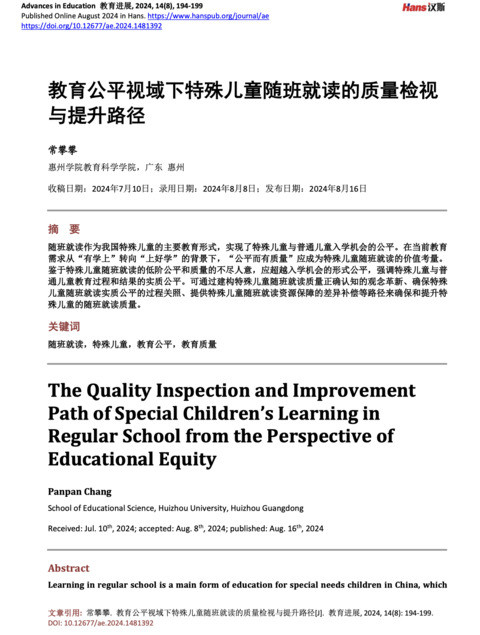 教育公平视域下特殊儿童随班就读的质量检视与提升路径 (教育进展 第14卷 第8期) Année de publication: 2024 Auteur: 常攀攀 Auteur institutionnel: 汉斯出版社 随班就读作为我国特殊儿童的主要教育形式,实现了特殊儿童与普通儿童入学机会的公平。在当前教育 需求从“有学上”转向“上好学”的背景下,“公平而有质量”应成为特殊儿童随班就读的价值考量。 鉴于特殊儿童随班就读的低阶公平和质量的不尽人意,应超越入学机会的形式公平,强调特殊儿童与普 通儿童教育过程和结果的实质公平。可通过建构特殊儿童随班就读质量正确认知的观念革新、确保特殊 儿童随班就读实质公平的过程关照、提供特殊儿童随班就读资源保障的差异补偿等路径来确保和提升特 殊儿童的随班就读质量。