
Ressources
Explorez une large gamme de ressources sur le GCED afin d’approfondir votre compréhension et de renforcer vos activités de recherche, de plaidoyer, d’enseignement et d’apprentissage.
2,781 résultats trouvés
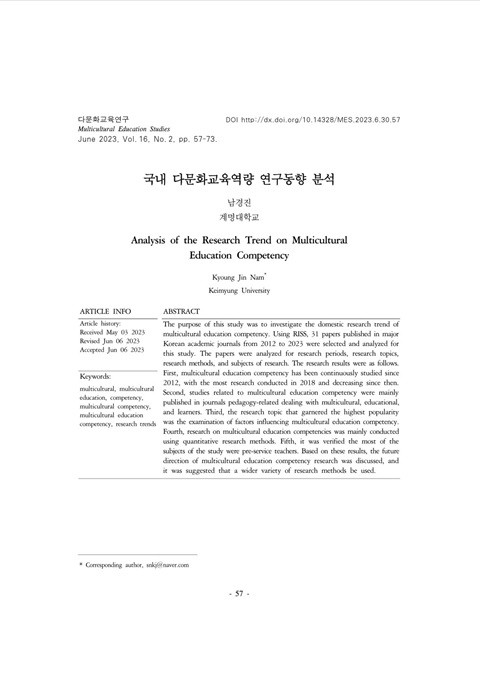 국내 다문화교육역량 연구동향 분석 (다문화교육연구; Vol. 16, No.2) Année de publication: 2023 Auteur: 남경진 Auteur institutionnel: 한국다문화교육학회 본 연구는 향후 다문화교육역량의 국내 연구동향을 살펴보기 위하여 2012년부터 2023년까지 한국연구재단의 등재지 및 등재후보지에 게재된 연구 중 다문화교육역량에 대한 31편의 논문을 선정하였다. 연도별 추이, 연구주제, 연구대상 등을 분석틀로 하여 연구동향 및 특징을 분석하였다. 연구결과는 다음과 같다. 첫째, 다문화교육역량 관련 연구는 2012년부터 지속적으로 연구되어왔으며 2018년 가장 많은 연구가 이루어졌으나 이후 다시 감소하였다. 둘째, 다문화교육역량 관련 연구들은 주로 다문화, 교육, 학습자를 다루는 교육학 관련 학술지에 주로 게재되고 있었다. 셋째, 다문화교육역량 관련 연구주제는 다문화교육역량의 영향에 대한 요인연구 유형이 가장 많았다. 넷째, 다문화교육역량의 연구는 주로 양적연구를 활용하여 이루어졌다. 다섯째, 다문화교육역량의 연구대상은 예비교사와 교사를 대상으로 하는 시도가 가장 많은 것으로 검증되었다. 이러한 결과를 토대로 다문화교육역량 연구의 향후 방향에 대해 논의하였으며 다양한 연구방법을 활용할 필요가 있다는 점을 시사하였다.
 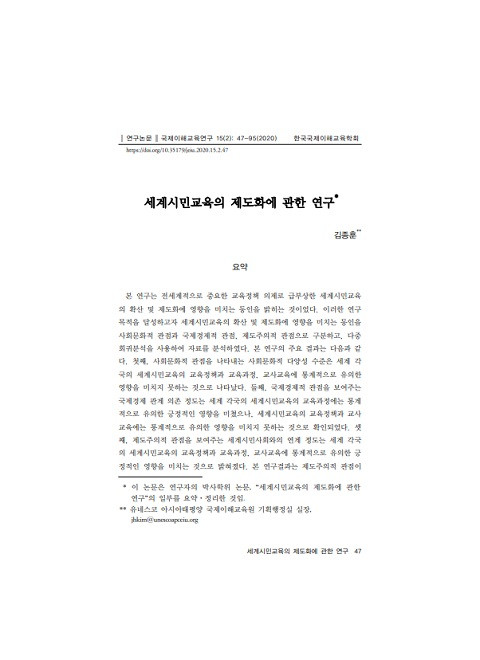 The Institutionalization of Global Citizenship Education as a Global Policy Agenda (Journal of Education for International Understanding; Vol. 15, No. 2) Année de publication: 2020 Auteur: Jonghun Kim Auteur institutionnel: Korean Society of Education for International Understanding (KOSEIU) The purpose of this study was to examine the driving forces that affect the global diffusion and institutionalization of Global Citizenship Education (GCED), which is rapidly emerging as an important global education agenda. In order to achieve the objective of this study, driving forces affecting the diffusion and institutionalization of GCED were categorized into three perspectives, namely, sociocultural perspective, international economic perspective and institutional perspective. The data were analyzed using multiple regression analysis. The main findings of this study are as follows. First, the degree of sociocultural diversity that represents sociocultural perspective did not have a statistically significant effect on education policies, curriculum and teacher education on GCED in each country. Second, the degree of dependence on international economic relations, which shows international economic perspective, had a positive statistically significant effect on the curriculum of GCED in countries around the world but it did not have a statistically significant effect on education policy and teacher education of GCED. Third, the degree of linkage to the global civil society that represents institutional perspective has a positive statistically significant effect on the GCED education policies, curricula and teacher education of different countries around the world. The results of this study show that institutional perspectives are more persuasive drivers of the spread and institutionalization of GCED in individual countries than from sociocultural perspective and international economic perspective. The result of this study shows that the adoption of policies for GCED is an institutional embodiment reflecting education norms and values at the global level embedded in an institutional environment of the world society rather than instrumental means that meet immediate and concrete socioeconomic needs and demands of individual countries. This study is of significance in that it has identified the driving forces for the diffusion and institutionalization of GCED through empirical analysis. 세계시민교육의 제도화에 관한 연구 (국제이해교육연구; Vol. 15, No. 2) Année de publication: 2020 Auteur: 김종훈 Auteur institutionnel: 한국국제이해교육학회 본 연구는 전세계적으로 중요한 교육정책 의제로 급부상한 세계시민교육의 확산 및 제도화에 영향을 미치는 동인을 밝히는 것이었다. 이러한 연구목적을 달성하고자 세계시민교육의 확산 및 제도화에 영향을 미치는 동인을 사회문화적 관점과 국제경제적 관점, 제도주의적 관점으로 구분하고, 다중회귀분석을 사용하여 자료를 분석하였다. 본 연구의 주요 결과는 다음과 같다. 첫째, 사회문화적 관점을 나타내는 사회문화적 다양성 수준은 세계 각국의 세계시민교육의 교육정책과 교육과정, 교사교육에 통계적으로 유의한 영향을 미치지 못하는 것으로 나타났다. 둘째, 국제경제적 관점을 보여주는 국제경제 관계 의존 정도는 세계 각국의 세계시민교육의 교육과정에는 통계적으로 유의한 긍정적인 영향을 미쳤으나, 세계시민교육의 교육정책과 교사교육에는 통계적으로 유의한 영향을 미치지 못하는 것으로 확인되었다. 셋째, 제도주의적 관점을 보여주는 세계시민사회와의 연계 정도는 세계 각국의 세계시민교육의 교육정책과 교육과정, 교사교육에 통계적으로 유의한 긍정적인 영향을 미치는 것으로 밝혀졌다. 본 연구결과는 제도주의적 관점이 사회문화적 관점과 국제경제적 관점보다 개별 국가의 세계시민교육의 확산 및 제도화의 동인으로서 보다 많은 설득력을 지니고 있음을 보여준다. 본 연구결과는 세계시민교육의 정책 도입과 추진이 개별 국가 내부의 특수한 사회문화적·경제적 필요와 요구를 충족시키는 기능적 산물이라기보다 세계사회의 제도적 환경 속에서 배태된 세계수준의 교육규범과 가치를 반영하는 제도적 구성물이라는 점을 시사하고 있다. 본 연구는 세계시민교육의 확산 및 제도화에 미치는 동인을 실증적 분석을 통해 규명했다는 점에서 의미가 있다.
 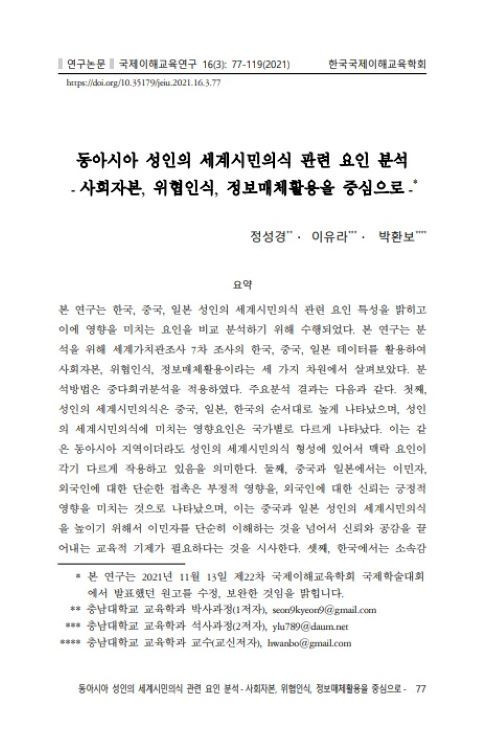 An Analysis of the Factors Affecting East-Asian Adults’ Global Citizenship: Social capital, Threat Recognition, Information Media Utilization (Journal of Education for International Understanding; vol.16, no.3) Année de publication: 2021 Auteur: Seongkyeong Jeong | Yura Lee | Hwanbo Park Auteur institutionnel: Korean Society of Education for International Understanding (KOSEIU) This paper puts an in-depth study on identifying the characteristics of factors related to global citizenship in adults from South Korea, China, and Japan and analyzing the elements affecting them. For this purpose, data from the 7th World Value Survey which was undertaken in South Korea, China, and Japan were used, and they were examined with three different perspectives of social capital, threat recognition, and information media utilization to get to know the influence of variables from various aspects. Multiple regression was applied for this and the results are as follows. Firstly, the global citizenship of adults was high in the order of China, Japan, and South Korea, and the factors influencing global citizenship depend on the country. This implies that contextual factors are acting differently in the formation of the global citizenship of adults even they are from the same East Asian region. Secondly, simple contact with immigrants and foreigners in China and Japan has negative effects while having a positive effect on trust in foreigners. This suggests that an educational mechanism is required to raise trust and empathy beyond understanding immigrants simply to foster global citizenship among Chinese and Japanese adults. Thirdly, depending on the hierarchy of the sense of belonging, the impact on global citizenship was different in South Korea. Educational activities and programs should be implemented to establish the sense of global citizenship of adults in South Korea. Fourthly, the treat perception of social safety and employment insecurity in South Korea and China did not have statistical significance to global citizenship. While the higher the social safety perception the heavier the employment insecurity, adults in Japan had higher global citizenship awareness. This implies that Japanese adults perceive the problems of immigration as a matter of national or social situation and structure. Finally, the utilization of information media in all countries revealed statistical significance, which means that attitude for immigrants would vary depending on which information medica is used from those three countries. 동아시아 성인의 세계시민의식 관련 요인 분석: 사회자본, 위협인식, 정보매체활용을 중심으로 (국제이해교육연구; vol.16, no.3) Année de publication: 2021 Auteur: 정성경 | 이유라 | 박환보 Auteur institutionnel: 한국국제이해교육학회 본 연구는 한국, 중국, 일본 성인의 세계시민의식 관련 요인 특성을 밝히고 이에 영향을 미치는 요인을 비교 분석하기 위해 수행되었다. 본 연구는 분석을 위해 세계가치관조사 7차 조사의 한국, 중국, 일본 데이터를 활용하여 사회자본, 위협인식, 정보매체활용이라는 세 가지 차원에서 살펴보았다. 분석방법은 중다회귀분석을 적용하였다. 주요분석 결과는 다음과 같다. 첫째, 성인의 세계시민의식은 중국, 일본, 한국의 순서대로 높게 나타났으며, 성인의 세계시민의식에 미치는 영향요인은 국가별로 다르게 나타났다. 이는 같은 동아시아 지역이더라도 성인의 세계시민의식 형성에 있어서 맥락 요인이 각기 다르게 작용하고 있음을 의미한다. 둘째, 중국과 일본에서는 이민자, 외국인에 대한 단순한 접촉은 부정적 영향을, 외국인에 대한 신뢰는 긍정적 영향을 미치는 것으로 나타났으며, 이는 중국과 일본 성인의 세계시민의식을 높이기 위해서 이민자를 단순히 이해하는 것을 넘어서 신뢰와 공감을 끌어내는 교육적 기제가 필요하다는 것을 시사한다. 셋째, 한국에서는 소속감의 위계에 따라 세계시민의식에 미치는 영향이 상이하였으며, 한국 성인의 세계시민의식을 향상하기 위해서는 세계 소속감을 교육 활동과 프로그램에 적극 활용할 필요가 있다. 넷째, 한국과 중국에서는 사회안전인식과 고용불안이라는 위협인식이 세계시민의식에 아무런 통계적 유의성을 보이지 않았으며, 일본에서는 사회안전인식이 높을수록 고용불안이 앉을수록 세계시민의식이 높았다. 이는 일본 성인은 이민자 수용의 문제를 국가나 사회적 상황과 구조의 문제로 인식하고 있음을 시사한다. 마지막으로 모든 국가에서 정보매체활용이 통계적 유의성을 보였으며, 이는 세 나라 모두 어떤 정보매체를 활용하느냐에 따라 이민자 태도가 달라질 수 있음을 의미한다.
 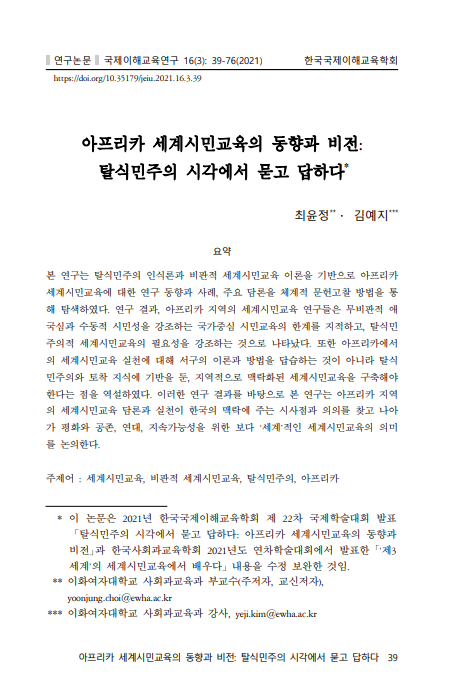 Discourses on Global Citizenship Education in Africa: Questioning and Answering from a Post-Colonial Perspective (Journal of Education for International Understanding; vol.16, no.3) Année de publication: 2021 Auteur: Yoonjung Choi | Yeji Kim Auteur institutionnel: Korean Society of Education for International Understanding (KOSEIU) Theoretically framed by post-colonialism and critical global citizenship education(GCED), this study explored major discourses on and practices of GCED in African countries through the use of a systematic review method. The findings demonstrated that studies related to GCED in African countries pointed out the limitations of state-centered civic education based on uncritical patriotism and passive citizenship, and further emphasize the importance of promoting more critical and reflective GCED. In addition, research emphasized the implementation of alternative and unique GCED education unique built on indigenous African knowledge and philosophy. This study provides significant insights into GCED in the context of South Korea and discusses the pursuit of globally oriented, sustainable GCED aiming for peace and solidarity around the world. 아프리카 세계시민교육의 동향과 비전: 탈식민주의 시각에서 묻고 답하다 (국제이해교육연구; vol.16, no.3) Année de publication: 2021 Auteur: 최윤정 | 김예지 Auteur institutionnel: 한국국제이해교육학회 본 연구는 탈식민주의 인식론과 비판적 세계시민교육 이론을 기반으로 아프리카 세계시민교육에 대한 연구 동향과 사례, 주요 담론을 체계적 문헌고찰 방법을 통해 탐색하였다. 연구 결과, 아프리카 지역의 세계시민교육 연구들은 무비판적 애국심과 수동적 시민성을 강조하는 국가중심 시민교육의 한계를 지적하고, 탈식민주의적 세계시민교육의 필요성을 강조하는 것으로 나타났다. 또한 아프리카에서의 세계시민교육 실천에 대해 서구의 이론과 방법을 답습하는 것이 아니라 탈식민주의와 토착 지식에 기반을 둔, 지역적으로 맥락화된 세계시민교육을 구축해야 한다는 점을 역설하였다. 이러한 연구 결과를 바탕으로 본 연구는 아프리카 지역의 세계시민교육 담론과 실천이 한국의 맥락에 주는 시사점과 의의를 찾고 나아가 평화와 공존, 연대, 지속가능성을 위한 보다 ‘세계’적인 세계시민교육의 의미를 논의한다.
 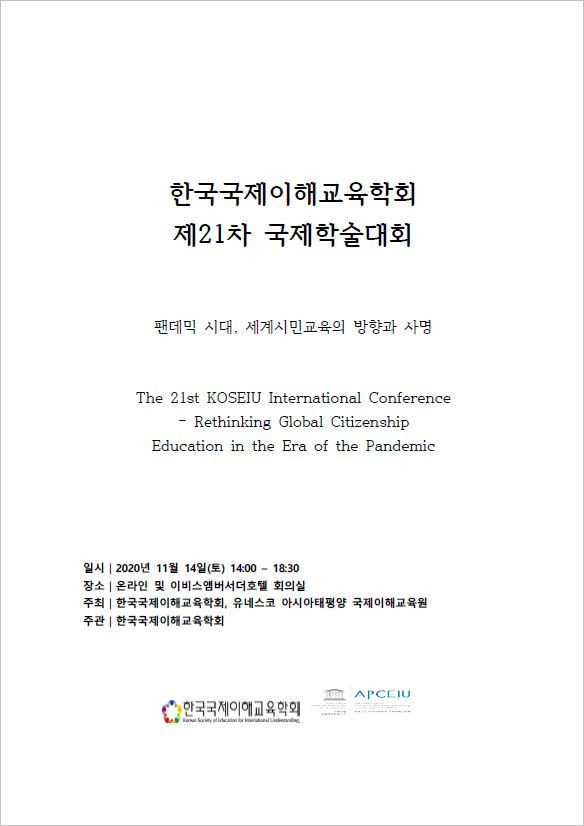 한국국제이해교육학회 제21차 국제학술대회: 팬데믹 시대, 세계시민교육의 방향과 사명 Année de publication: 2020 Auteur institutionnel: 한국국제이해교육학회 | 유네스코 아시아태평양 국제이해교육원 제21차 한국국제이해교육학회 학술대회 자료집으로 ‘팬데믹 시대, 세계시민교육의 방향과 사명’이라는 주제로 팬데믹으로 인한 상황이 더 정의롭고 평화로우며 지속가능한 세상을 만드는데 어떤 새로운 위기를 초래하는지를 점검하고, 그 가운데 교육이 담당해야 할 과제를 다각도로 검토하였다.
 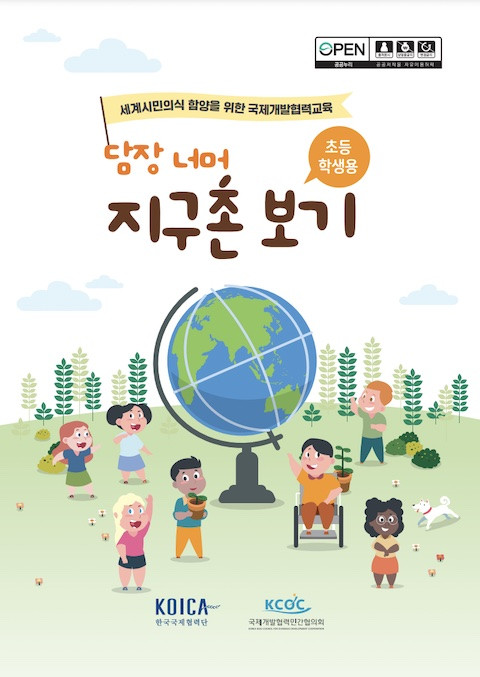 담장 너머 지구촌 보기: 세계시민의식 함양을 위한 국제개발협력교육; 초등학생용 Année de publication: 2021 Auteur: 이태주 | 김다원 | 김현주 Auteur institutionnel: 한국국제협력단 | 국제개발협력민간협의회 세계화, 문화다양성, 지속가능발전, 평화 등을 주제로 한 초등용 세계시민교육 교수학습자료이다.본 자료는 한국국제협력단과 국제개발협력민간협의회에서 2021년 작성하여 공공누리 제4유형으로 개방한 ‘담장 너머 지구촌 보기: 세계시민의식 함양을 위한 국제개발협력교육; 초등학생용’ 을 이용하였으며 국제개발협력민간협의회 홈페이지(http://www.ngokcoc.or.kr)에서 다운로드 하실 수 있습니다.
 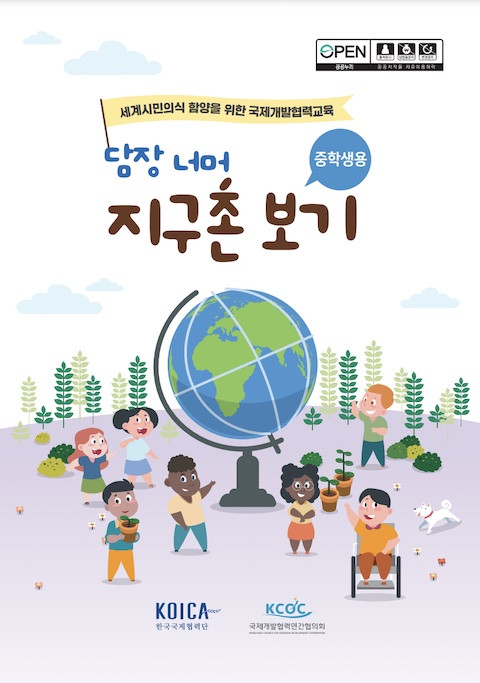 담장 너머 지구촌 보기: 세계시민의식 함양을 위한 국제개발협력교육; 중학생용 Année de publication: 2021 Auteur: 이태주 | 김다원 | 김현주 Auteur institutionnel: 한국국제협력단 | 국제개발협력민간협의회 세계화, 문화다양성, 지속가능발전, 평화 등을 주제로 한 중학생용 세계시민교육 교수학습자료로 다양한 모둠별 학습활동지를 담고 있다.본 자료는 한국국제협력단과 국제개발협력민간협의회에서 2021년 작성하여 공공누리 제4유형으로 개방한 ‘담장 너머 지구촌 보기: 세계시민의식 함양을 위한 국제개발협력교육; 중학생용’ 을 이용하였으며 국제개발협력민간협의회 홈페이지(http://www.ngokcoc.or.kr)에서 다운로드 하실 수 있습니다.