
Ressources
Explorez une large gamme de ressources sur le GCED afin d’approfondir votre compréhension et de renforcer vos activités de recherche, de plaidoyer, d’enseignement et d’apprentissage.
3,451 résultats trouvés
 Набор инструментов для молодежи по адвокации обучения для глобального гражданства (GCED) Année de publication: 2019 Auteur institutionnel: Азиатско-тихоокеанский центр по воспитанию в духе международного взаимопонимания (APCEIU) APCEIU опубликовал набор инструментов для молодежи по адвокации обучения для глобального гражданства для того, чтобы обеспечить молодежным лидерам руководство по адвокации ОГГ (GCED). Этот набор, предназначен для молодежных активистов, которые в настоящее время участвуют в программах ОГГ (GCED) по всему миру, предлагает обзор ОГГ и информационно-адвокационной деятельности, а также советы и инструменты для эффективной реализации информационно-адвокационной кампании по ОГГ в локальном и глобальном контексте. Кроме того, посредством обмена историй адвокации молодежи в различных областях этот набор также предоставляет примеры из реальной жизни, которые могут быть легко использованы молодежью, заинтересованной в адвокации ОГГ. <Содержание> Набор инструментов для молодежи по адвокации обучения для глобального гражданства (GCED)Глава 1 - Что такое образование для глобального гражданства (ОГГ)?Глава 2. Что такое адвокация ОГГ?Глава 3 - Молодежь как активный агент для ОГГГлава 4 - Обмен историй молодежной адвокацииГлава 5 - Молодежные инициативы по ОГГ
  Renewing Our Commitment through Revision of 1974 Recommendation (SangSaeng no.60, 2023) Année de publication: 2023 Auteur institutionnel: APCEIU After nearly 50 years, UNESCO is in the process of revising “the 1974 Recommendation”. The revision aims to ensure the sustained relevance of the Recommendation within the evolving global and educational landscape in the face of contemporary and future threats to peace, and notably included the concept of ‘global citizenship’. Recognising its profound significance, SangSaeng No. 60 focuses on the theme of “Renewing. Our Commitment through the Revision of the 1974 Recommendation” to delve into the intrinsic value and significance underpinning the revision of this normative instrument. Contents 03 Editor's Note 04 Special Column Peace Educators Reflect on Revision of 1974 Recommendation / Betty Reardon & Tony Jenkins Renewing Our Commitment to Build a Culture of Peace through Education / Toh Swee-Hin 12 FOCUS: Renewing Our Commitment through Revision of the 1974 Recommendation Highly Capable, Profoundly Human / Elisa Guerra Revisiting UNESCO 1974 Recommendation / Bert J. Tuga & Edward Shiener S. Landoy Creatively Innovative Thinking for 21st Century / Patrice Ssembirige Observations on Revision of 1974 Recommendation / Rilli Lappalainen 26 Special Report What You Need to Know about Revision of 1974 Recommendation / UNESCO and APCEIU 28 Best Practices Tell Me About My Planet / Elvira Sarsenova Crucial Strategy to Mainstream GCED in Education / Rebecca Rosario Bercasio 36 Story Time Bringing GCED to Life Through the Power of Social Impact Films / Virginia Pittaro 40 Understanding the Asia-Pacific Region Mosaic of Sri Lankan Cultural Life / Nirmal Ranjith Dewasiri 44 GCED YOUTH NETWORK Youth Addressing Pressing Social Issues / Umair Mushtaq & Anna Susarenco 48 Letter Butterfly Effect of Embracing Opportunities / Khalifa Affnan 50 APCEIU in Action
  Food Security and Peace (SangSaeng no.59, 2022) Année de publication: 2023 Auteur institutionnel: APCEIU The food security issue is vital in pursuing the United Nations’ Sustainable Development Goals, which specifically include a goal of zero hunger. Hunger is both a cause and a result of conflicts. In this perspective, SangSaeng No. 59 focuses on the issue of “food security and peace” in order to examine the impacts of food insecurity and food crises and to explore possible alternatives or solutions to prevent conflicts and secure peace. Contents 03 Editor’s Note 04 Special ColumnRepositioning Youth for Responsible Citizenship / Michael Boakye-Yiadom and Raymond Chegedua Tangonyire, SJ. 08 FOCUS: Food Security and Peace 08 Conflict of Securing Food – ‘Food Insecurity is in Effect Creating an Existential Threat to Human Existence’ / Gavin E L Hall 12 Prioritizing Food Justice – Thinking About Water/Food Nexus for Latin America / Mayari Castillo 16 Feeding the Planet’s Survival – Climate Crisis and Food Security are Paramount Issues for Students to Connect with Nature / Simon Klein 21 Best Practices 21 Archipelagos of Certainty and Inclusion – Identifying Diverse Strategies to Make Learning Effective for Disabled / Eduardo Esteban Perez Leon 25 Adventure Education in Youth Work – Using Rick to Connect People and Nature to Unlearn Unhealthy Behaviours / Tina Trdin 30 InterviewRoad to Peace and Hope in Times of Crisis – Lee Chul Soo’s Works on Peace and Living Beings / APCEIU 36 Story TimeMessage of a Warlus / Marisol Bock 40 Peace in My MemoryPeace at Home / Ivy Joshia 44 Understanding the Asia and the PacificRenaissance of Traditional Archery in Asia / Lee Seunghwan 48 LetterMaking History with the EIU Photo Class Programme / Fanny Amalia Surya Tantular 50 APCEIU in Action
  Transforming Education and Shaping Our Futures Together (SangSaeng no.58, 2022) Auteur institutionnel: APCEIU As humanity is facing unprecedented social, economic and environmental challenges, positive changes are necessary. And education plays a key role in adapting and responding to a changing world as it can be the most reliable tool to shape our future into a more inclusive, sustainable, and just world. In this context, SangSaeng No. 58 focuses on “Transforming Education and Shaping Our Futures Together” with the goal of exploring possible alternatives to educational systems and practices. Contents 03 Editor’s Note 04 Special ColumnTransformative Education for Learning to Live Together / Lim Hyun Mook 08 FOCUS: Transforming Education and Shaping Our Futures Together 08 Global Movement to Educate for Peace – Develop Hope by Focusing on an Educational Renaissance that’s Deliberate / Fernando M. Reimers 12 University as the Foundation of Education – Effective Education System Discovers Attributes that Help to Excel / Madhav Das Nalapat 15 Vision for a Feminist, Decolonized Education – Develop Two-accountability Education that Furthers Today’s Standard / Shamah Bulangis 19 Best Practices 19 Best of Both Worlds – Collaborative Approach to Transforming Education / Dailess Banda-Zulu and Sibylle Freiermuth 23 Leading Impactful Transformation in Local Community – Grassroots Level Educational Innovation that Inspires Future Action / IniOluwa Odekunle 26 Special Report 26 Asia-Pacific Education Ministers Call for Responsive Covid-19 Learning Recovery, Transformation of Education Systems – Highlights of the Second Asia-Pacific Regional Education Minister’s Conference (APREMC-II) / Jenelle Babb, Worapot Yodpet, Seek Ling Tan 29 Transforming Education: A Call to Action – Education Stakeholders Gather to Reimagine Education and Revitalize Commitments at the Transforming Education Pre-Summit / Transforming Education Summit Secretariat 32 Story TimeMy Role Model Teacher / Joseph Sandamira 34 Letter OneCambodian Approach Toward Educational Development for Better Future Connectedness, Readiness / Mok Sarom 36 Peace in My MemoryLost and Found Peace in War Times – Defining Secret Puzzle of Peace in War-torn Ukraine / Valeria Moroz 40 Understanding the Asia and the PacificBringing Living Heritage to Asia-Pacific Classrooms – Contextualizing School Activities with Living Heritage Supports Teachers, Improves Learning Outcomes, Safeguards Living Heritage / Duong Bich Hanh and Vanessa Achilles 44 GCED Youth Network Shapers for Today and Tomorrow’s Education – Youth Tackle Educational Topics to Further Develop, Improve, Transform / Diego Manrique 47 Letter TwoSupporting Global Citizenship Education in Kenya / Jane Nyaga 49 APCEIU in Action
  Addressing Hate Speech and Racial Discrimination through Education (SangSaeng no.57, 2021) Année de publication: 2023 Auteur institutionnel: APCEIU Today, humanity is faced with various multifaceted challenges such as climate change, increasing inequality, hate speech and racial discrimination. Moreover, the COVID-19 pandemic has crudely manifested those problems and further highlighted the acute need for concerted efforts to address them. In this context, SangSaeng No. 57 focuses on “Addressing Hate Speech and Racial Discrimination through Education” to provide readers with opportunities to reflect on these salient issues. Contents 03 Editor’s Note 04 Special ColumnFrom Hatred to Reconciliation - Learning from Rwanda / Freddy Mutanguha 08 FOCUS: Addressing Hate Speech and Racial Discrimination through Education08 Confronting Hate Speech - Thoughts, Challenges, Proposals from Educational Perspective / Gabriela Martini Armengol12 Missing Link in Global Citizenship Education – Taking into Account Identities, Alterities and Citizenships Hurt by Systemic and Chronic Racism / Gina Thesee16 Moving from Hate and Discrimination to Greater Humanity – Increasing Need for Empathy Education / Pat Dolan19 But What Can I Do? - Educational Responses to Hate Speech / Felisa Tibbitts 23 Best Practices23 Learning Democracy at Utoya - Young People’s Response to Hate and Extremism / Ingrid Aspelund26 Combatting Hate Speech – Experiences and Lessons from South Sudan / Marina Modi 29 Special Report29 Setting out Priorities for Addressing Hate Speech Through Educationt - Highlights of the Multi-Stakeholder Forum and Global Education Ministers Conference on Addressing Hate Speech through Education / UNESCO 32 Call for Global Action towards Transforming the World through Education - Highlights of the 5th UNESCO Forum on Transformative Education / APCEIU and UNESCO 35 Story TimeGrandfather’s Funeral / Sudipa Charkraverty 38 Peace in My MemoryPeace Turned into Pain / An anonymous contributor from Afghanistan 42 Understanding the Asia and the PacificMha Puja, Practicing Respect / Sharareh Bajracharya and Sanjeev Maharjan 45 Youth Network Youth Tackling Hate Speech and Racial Discrimination / GCED Youth Network Core Team 48 LetterReflections on Hate Speech and GCED / Sengpapah Holanouphab 50 APCEIU in Action
 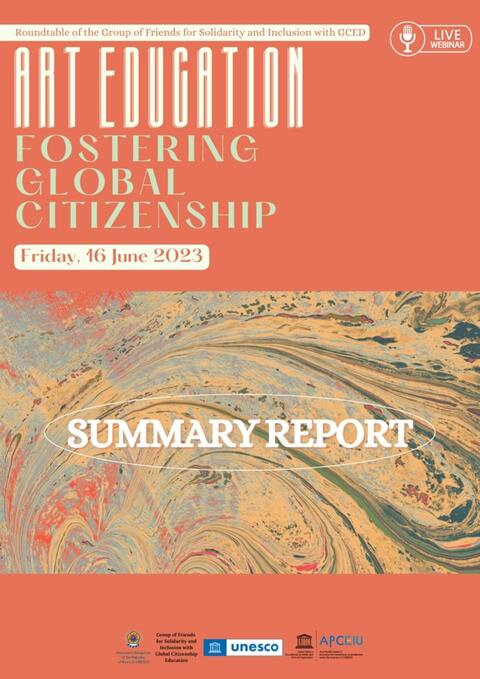 Roundtable of the Group of Friends for Solidarity and Inclusion with GCED: "Art Education Fostering Global Citizenship" Année de publication: 2023 Auteur: Hyunmook Lim Auteur institutionnel: APCEIU This report shares the overview of the Roundtable of the Group of Friends for Solidarity and Inclusion with GCED: “Art Education Fostering Global Citizenship”, held on Friday, 16 June 2023. The event was co-organized by the Permanent Delegation of the Republic of Korea to UNESCO and the Asia-Pacific Centre of Education for International Understanding (APCEIU) in partnership with the Group of Friends for Solidarity and Inclusion with GCED (Afghanistan, Armenia, Austria, Bangladesh, Canada, Colombia, Italy, Jordan, Kenya, Kuwait, Philippines, Republic of Korea, Saudi Arabia, Senegal, Serbia, Nigeria and Oman). This report shares the summary of the event, particularly the presentations on GCED activities through arts education by experts from Finland, Lebanon, the Republic of Korea and Nigeria to promote the values and initiatives of GCED through arts education.
  Why Contextualization is Critical for Global Citizenship Education Année de publication: 2019 Auteur: Waqar Shams Auteur institutionnel: APCEIU This video is an interview on "Why contextualization is Critical for Global Citizenship Education". It is also under UNESCO's APCEIU "Meet the Global Citizens" series.Do you want to know why Contextualization is Critical for GCED? Check out what Waqar has to say. This is a story of Waqar Shams from Pakistan.In this video you will learn why Contextualization is Critical for GCED and through it, learn to think globally but act locally.
  Global Citizenship Education: A Guide for Policymakers Année de publication: 2017 Auteur: Swee-Hin Toh | Gary Shaw | Danilo Padilla Auteur institutionnel: APCEIU In order to assist UNESCO Member States to integrate and strengthen Global Citizenship Education (GCED) in national education policies, strategies and plans to achieve SDG Target 4.7 effectively, the Asia-Pacific Centre of Education for International Understanding (APCEIU) has developed and published Global Citizenship Education: A Guide for Policymakers (hereafter referred to as the Guide).The Guide is mainly divided into two parts. Part 1 provides an overview of GCED, including the following three sections: the background to GCED; the rationale for GCED; and the concept of GCED. In Part 2, various selection strategies which allow each country to incorporate GCED into its current education system aligned with its own priorities and context, were divided and suggested into five major policy areas as follow: policy review and development; curriculum review and development; capacity building; knowledge creation; sharing and dissemination; and monitoring and assessment.The Guide was first published in English and Korean and additional translations will be available in the future in other languages, including French and Arabic to provide access to more readers worldwide. We hope that the Guide will provide an opportunity for policymakers and practitioners to share their experiences and insights. 세계시민교육 정책 개발을 위한 가이드 Année de publication: 2017 Auteur: Swee-Hin Toh | Gary Shaw | Danilo Padilla Auteur institutionnel: 유네스코 아시아태평양 국제이해교육원 유네스코 아시아태평양 국제이해교육원은 유네스코 회원국이 국가 교육정책에 세계시민교육을 반영하고 이를 통해 지속가능발전목표 4.7을 효과적으로 달성하는 것을 돕기 위해 『세계시민교육 정책 개발을 위한 가이드(Global Citizenship Education: A Guide for Policymakers)』를 개발ㆍ출간하였다.본 가이드는 크게 두 부분으로 나뉜다. 첫 번째 장에서는 세계시민교육의 배경과 논리, 그리고 개념을 차례로 살펴봄으로써 세계시민교육을 개괄하고자 하였다. 그리고 두 번째 장에서는 각국이 자신의 우선적 목표와 맥락에 맞게 세계시민교육을 현행 교육 시스템에 반영할 수 있도록 하는 다양한 선별적 전략들을 정책 검토ㆍ개발, 교육과정 검토ㆍ개발, 역량 강화, 지식의 창출ㆍ공유ㆍ확산, 모니터링 및 평가 등의 5가지 주요 정책 영역으로 나누어 제시하고자 하였다.본 가이드는 영어와 한국어로 우선 출간되었으며, 향후 전 세계의 더 많은 독자들에게 접근성을 제공하기 위하여 프랑스어와 아랍어를 포함한 다른 언어로도 추가 번역될 예정이다. 모쪼록 본 가이드가 정책입안자들과 실천가들에게 서로의 경험과 통찰을 나누는 계기를 제공할 수 있기를 바란다.
  [Video] Pedagogical Principles of GCED Année de publication: 2018 Auteur institutionnel: APCEIU Here we introduce a fast, fun, and friendly way of learning GCED.The series of bite-sized animation will take you on a journey to GCED in minutes!