
Ressources
Explorez une large gamme de ressources sur le GCED afin d’approfondir votre compréhension et de renforcer vos activités de recherche, de plaidoyer, d’enseignement et d’apprentissage.
1,407 résultats trouvés
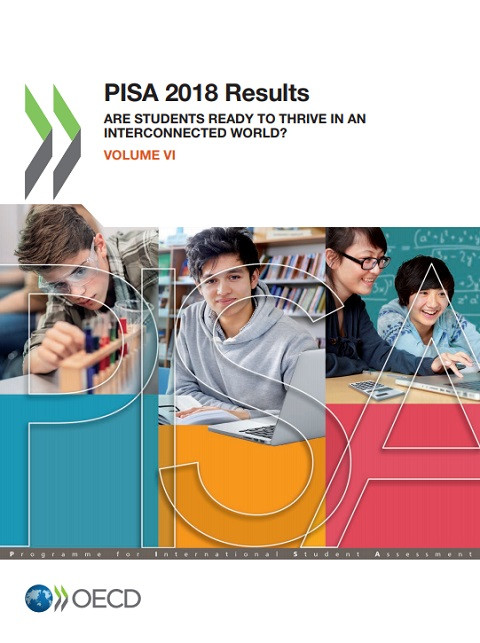 PISA 2018 Results (Volume VI): Are Students Ready to Thrive in an Interconnected World? Année de publication: 2020 Auteur institutionnel: Organisation for Economic Co-operation and Development (OECD) The OECD Programme for International Student Assessment (PISA) examines what students know in reading, mathematics and science, and what they can do with what they know. It provides the most comprehensive and rigorous international assessment of student learning outcomes to date. Results from PISA indicate the quality and equity of learning outcomes attained around the world, and allow educators and policy makers to learn from the policies and practices applied in other countries. This is one of six volumes that present the results of the PISA 2018 survey, the seventh round of the triennial assessment. Volume VI: Are Students Ready to Thrive in an Interconnected World? explores students’ ability to examine issues of local, global and cultural significance; understand and appreciate the perspectives and worldviews of others; engage in open, appropriate and effective interactions across cultures; and take action for collective well-being and sustainable development. The volume explores students’ outcomes on the cognitive test and corresponding questionnaire in addition to their experiences of global and intercultural learning at school and beyond.
 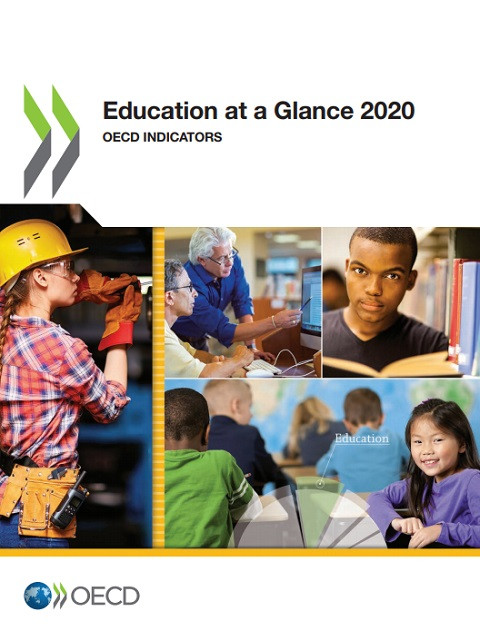 Education at a Glance 2020: OECD Indicators Année de publication: 2020 Auteur institutionnel: Organisation for Economic Co-operation and Development (OECD) Education at a Glance is the authoritative source for information on the state of education around the world. It provides data on the structure, finances and performance of education systems across OECD countries and a number of partner economies. More than 100 charts and tables in this publication – as well as links to much more available on the educational database – provide key information on the output of educational institutions; the impact of learning across countries; access, participation and progression in education; the financial resources invested in education; and teachers, the learning environment and the organisation of schools.The 2020 edition includes a focus on vocational education and training, investigating participation in vocational education and training at various levels of education, the labour market and social outcomes of vocational graduates as well as the human and financial resources invested in vocational institutions. Two new indicators on how vocational education and training systems differ around the world and on upper secondary completion rate complement this topic. A specific chapter is dedicated to the Sustainable Development Goal 4, and investigates the quality and participation in secondary education.
 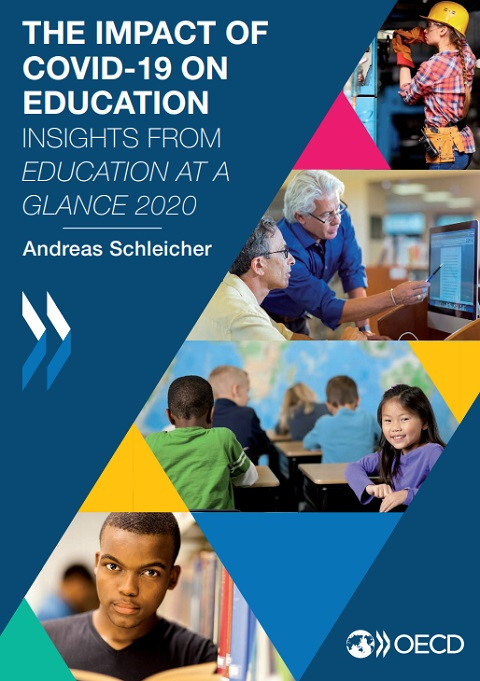 The Impact of COVID-19 on Education: Insights From Education at a Glance 2020 Année de publication: 2020 Auteur: Andreas Schleicher Auteur institutionnel: Organisation for Economic Co-operation and Development (OECD) OECD Director for Education and Skills Andreas Schleicher gives his insights and interpretations from the OECD’s Education at a Glance 2020 report – the go-to source for information on the state of education around the world. This brochure focuses on a selection of indicators from Education at a Glance, selected for their particular relevance in the current context. Their analysis enables the understanding of countries’ response and potential impact from the COVID-19 containment measures.
 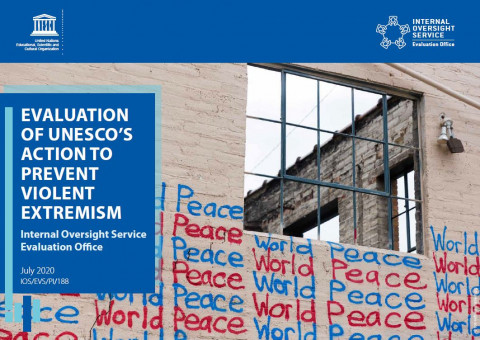 Evaluation of UNESCO’s Action to Prevent Violent Extremism Année de publication: 2020 Auteur institutionnel: UNESCO Internal Oversight Service (IOS) The purpose of this evaluation was twofold. To provide evidence, ideas and insights on how UNESCO’s efforts on PVE in the period from 2015-2018 have contributed to enhancing UNESCO’s action and position in the PVE sphere in light of the decisions of Member States. And to provide evidence and formulate lessons learned and good practices on the intersectoral approach with the aim of informing what works and what does not work in intersectoral cooperation.The evaluation found that UNESCO’s work on PVE was context specific and adjusted to respond to the needs of the countries and sub-regions where the work was being implemented.UNESCO’s work is aligned with the agency’s mandate and expertise and makes the most of its strong relationships with government bodies and civil society actors. UNESCO’s work on PVE has led to positive results around the quality, use and effectiveness of guidance documents, around capacity building of UNESCO partners and stakeholders, and around the provision of expertise and policy advice both at national and global level. Using an intersectoral approach led to an increase in information sharing and coordination. However, this was not always translated to intersectoral implementation or delivery of PVE initiatives.
 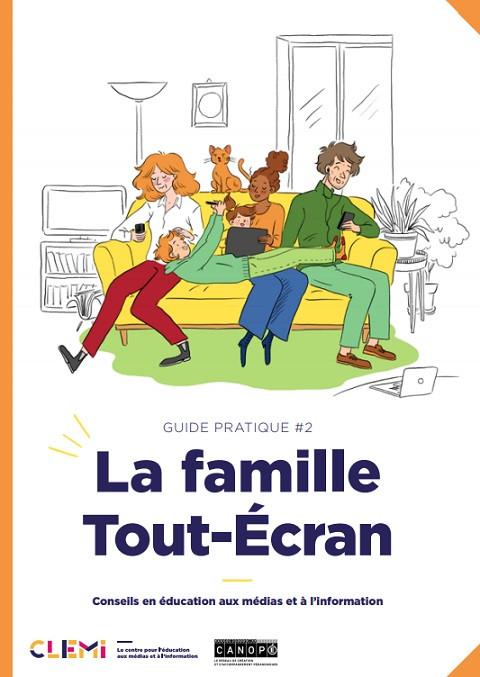 La famille Tout-Écran: Conseils en éducation aux médias et à l’information Année de publication: 2019 Auteur institutionnel: Centre pour l’éducation aux médias et à l’information (CLEMI) | Réseau Canopé L’Éducation aux Médias et à l'Information (EMI) devient une exigence républicaine au cœur du Parcours citoyen, un enjeu éducatif et sociétal incontournable dans un environnement où le numérique est omniprésent.Dans un monde globalisé et complexifié, la définition et la compréhension de la source de l’information constituent une priorité pour déjouer les tentatives de manipulation et de désinformation.Les enjeux sociétaux de l’EMI dépassent les murs de l’école et doivent mobiliser tous les acteurs pour renforcer le continuum entre temps scolaire et hors temps scolaire.Ce guide bénéficie de l’expertise des professionnels du CLEMI et de son réseau de pédagogues, de partenaires institutionnels, associatifs et médiatiques. Issu de cette mobilisation, cet ouvrage est le produit d’un groupe de travail dédié aux pratiques informationnelles des jeunes, composé de membres représentant du ministère de l’Éducation nationale et de la Jeunesse, du ministère de la Culture, France Télévisions, Radio France, le CSA, CNRS Images, Ceméa, la Ligue de l’enseignement, la CNAF, Jets d’encre et l’Icem-Pédagogie Freinet.
 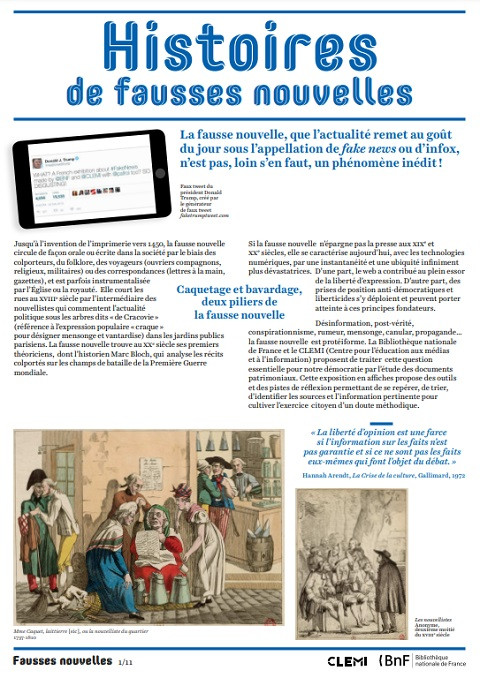 Histoires de fausses nouvelles Auteur institutionnel: Centre pour l’éducation aux médias et à l’information (CLEMI) | Bibliothèque nationale de France (BnF) Désinformation, mensonge, canular, propagande, la « fausse nouvelle » a été remise au goût du jour sous l’appellation de « fake news » puis de« infox ». Mais elle ne date pourtant pas d'hier. Le CLEMI s’est associé a Bibliothèque nationale de France pour traiter cette question essentielle pour notre démocratie par l’étude des documents patrimoniaux. Cette exposition pédagogique en affiches propose des outils et des pistes de réflexion permettant de se repérer, de trier, d’identifier les sources et l’information pertinente pour cultiver l’exercice citoyen d’un doute méthodique.
 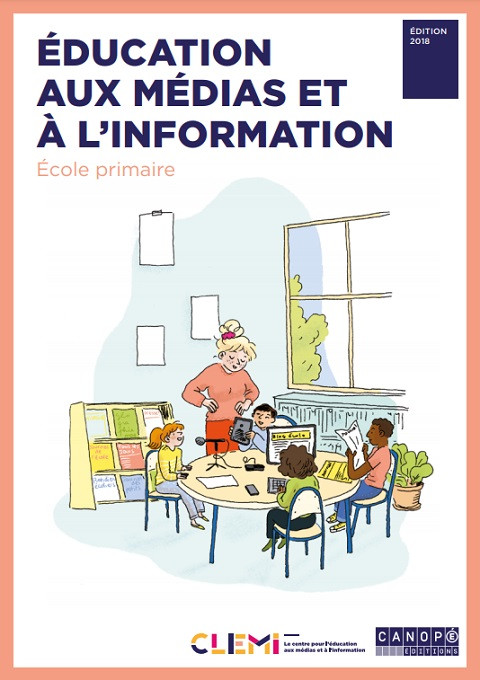 Éducation aux médias et à l’information: École primaire Année de publication: 2018 Auteur institutionnel: Centre pour l’éducation aux médias et à l’information (CLEMI) | Réseau Canopé Dans un monde complexe où l’information est surabondante, instantanée et en flux continu, l’éducation aux médias et à l’information (EMI) est devenue une priorité. À l’école primaire, elle peut s'intégrer à tous les enseignements. Son objectif est de favoriser la compréhension et un usage raisonné des médias, notamment numériques.Avec cette brochure, nous souhaitons encourager les professeurs des écoles à mettre en œuvre des activités en EMI, tout en répondant à leurs besoins spécifiques. Chaque fiche pédagogique propose des références aux programmes, un déroulement avec des activités concrètes, une durée indicative, des repères pour l’évaluation, des suggestions de traces écrites et des ressources. Ces fiches ont été validées et enrichies par un comité pédagogique, garant de la qualité et de la pertinence du contenu. Nous remercions les membres de ce comité pour leur implication active et leur engagement dans ce projet collectif.Cette brochure présente également une diversité de témoignages et d’entretiens qui démontrent que l’éducation aux médias et à l’information est une priorité éducative partagée. Apprendre à chercher, vérifier et publier l’information de manière responsable est essentiel au développement de l’esprit critique des élèves. Pensée comme outil de formation et support pour l’action, nous espérons vivement que cette brochure saura répondre efficacement aux besoins des enseignements.
 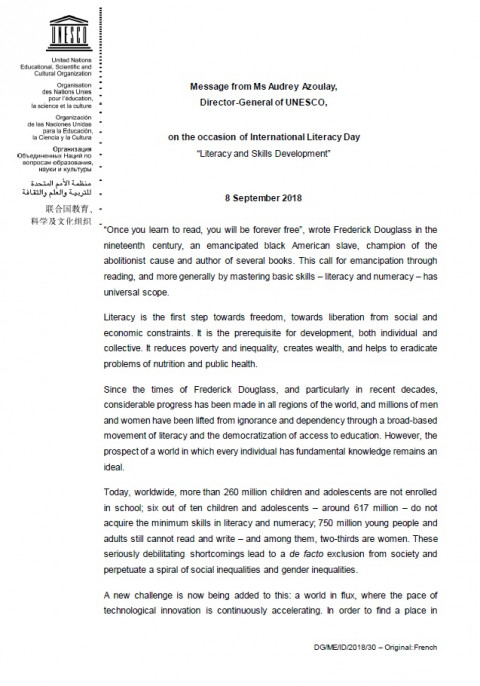 Message from Ms Audrey Azoulay, Director-General of UNESCO, on the occasion of International Literacy Day, 8 September 2018 Année de publication: 2018 Auteur institutionnel: UNESCO. Director-General, 2017-2025 (Azoulay, A.) This message was delivered by Audrey Azoulay, Director-General of UNESCO, on the occasion of the International Day of Literacy, on 8 September 2018. 联合国教科文组织总干事奥德蕾·阿祖莱 国际扫盲日致辞:扫盲与能力开发 Année de publication: 2018 Auteur institutionnel: UNESCO. Director-General, 2017-2025 (Azoulay, A.) 2018年9月8日,联合国教科文组织总干事奥德蕾·阿祖莱国际扫盲日致辞
 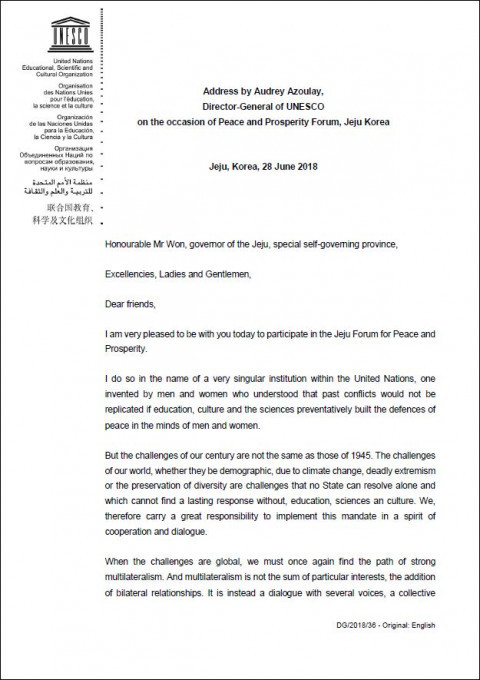 Address by Audrey Azoulay, Director-General of UNESCO, on the occasion of Peace and Prosperity Forum, Jeju Korea Année de publication: 2018 Auteur institutionnel: UNESCO. Director-General, 2017-2025 (Azoulay, A.) This address was delivered by Audrey Azoulay, Director-General of UNESCO, on the occasion of Peace and Prosperity Forum Jeju Korea; 28 June 2018.