
Ressources
Explorez une large gamme de ressources sur le GCED afin d’approfondir votre compréhension et de renforcer vos activités de recherche, de plaidoyer, d’enseignement et d’apprentissage.
2,657 résultats trouvés
 Feasibility study: establishment of an international centre for the promotion of human rights at the local and regional levels in Graz, Austria, under the auspices of UNESCO Année de publication: 2017 Auteur: Vandenhole, Wouter On 3 November 2016, the Government of the Republic of Austria requested (annexed to this report) the Director-General of UNESCO to initiate all necessary steps for the establishment of an International Centre for the Promotion of Human Rights at the Local and Regional Levels (hereafter: ‘the Centre’) in Graz (Styria, Austria) as a UNESCO Category 2 Centre, in application of the Integrated Comprehensive Strategy for Category 2 Institutes and Centres under the Auspices of UNESCO, adopted by the General Conference at its 37th session (res. 37 C/Resolution 93). This application stems from the long-standing commitment and efforts by the Government of the Republic of Austria, the Federal State of Styria and the City of Graz to further the implementation of human rights, both within the country and globally. The Centre will contribute, through research, capacity-building, information-sharing and international collaboration, to UNESCO programmes relating to Sustainable Development Goals 10, 11 and 16 of the 2030 Agenda for Sustainable Development, as well as to urban inclusion-related commitments of the New Urban Agenda. As regards the latter, the Centre is equally expected to feed into the work of the International Coalition of Inclusive and Sustainable Cities – ICCAR and its European Chapter, as well as into UNESCO urban initiatives and platforms. Feasibility study: establishment of an international centre for the promotion of human rights at the local and regional levels in Graz, Austria, under the auspices of UNESCO Année de publication: 2017 Auteur: Vandenhole, Wouter On 3 November 2016, the Government of the Republic of Austria requested (annexed to this report) the Director-General of UNESCO to initiate all necessary steps for the establishment of an International Centre for the Promotion of Human Rights at the Local and Regional Levels (hereafter: ‘the Centre’) in Graz (Styria, Austria) as a UNESCO Category 2 Centre, in application of the Integrated Comprehensive Strategy for Category 2 Institutes and Centres under the Auspices of UNESCO, adopted by the General Conference at its 37th session (res. 37 C/Resolution 93). This application stems from the long-standing commitment and efforts by the Government of the Republic of Austria, the Federal State of Styria and the City of Graz to further the implementation of human rights, both within the country and globally. The Centre will contribute, through research, capacity-building, information-sharing and international collaboration, to UNESCO programmes relating to Sustainable Development Goals 10, 11 and 16 of the 2030 Agenda for Sustainable Development, as well as to urban inclusion-related commitments of the New Urban Agenda. As regards the latter, the Centre is equally expected to feed into the work of the International Coalition of Inclusive and Sustainable Cities – ICCAR and its European Chapter, as well as into UNESCO urban initiatives and platforms. Feasibility study: establishment of an international centre for the promotion of human rights at the local and regional levels in Graz, Austria, under the auspices of UNESCO Année de publication: 2017 Auteur: Vandenhole, Wouter On 3 November 2016, the Government of the Republic of Austria requested (annexed to this report) the Director-General of UNESCO to initiate all necessary steps for the establishment of an International Centre for the Promotion of Human Rights at the Local and Regional Levels (hereafter: ‘the Centre’) in Graz (Styria, Austria) as a UNESCO Category 2 Centre, in application of the Integrated Comprehensive Strategy for Category 2 Institutes and Centres under the Auspices of UNESCO, adopted by the General Conference at its 37th session (res. 37 C/Resolution 93). This application stems from the long-standing commitment and efforts by the Government of the Republic of Austria, the Federal State of Styria and the City of Graz to further the implementation of human rights, both within the country and globally. The Centre will contribute, through research, capacity-building, information-sharing and international collaboration, to UNESCO programmes relating to Sustainable Development Goals 10, 11 and 16 of the 2030 Agenda for Sustainable Development, as well as to urban inclusion-related commitments of the New Urban Agenda. As regards the latter, the Centre is equally expected to feed into the work of the International Coalition of Inclusive and Sustainable Cities – ICCAR and its European Chapter, as well as into UNESCO urban initiatives and platforms.
 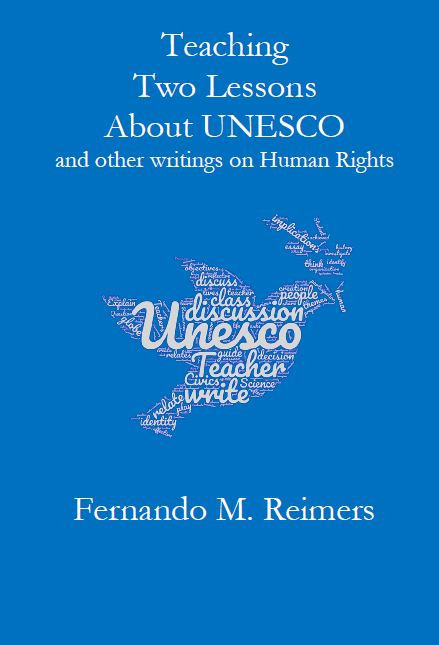 Teaching Two Lessons about UNESCO and Other Writings on Human Rights Année de publication: 2017 Auteur: Fernando Reimers This book presents two lessons for use in college or high school, to educate students on the mission and work of UNESCO as it relates to the advancement of Human Rights. It includes also a series of a short essays on Human Rights, the Right to Education, Teaching Human Rights and the role of Teachers and Universities in Teaching Human Rights which will be useful to educators interested in educating their students to advance the values of freedom and justice. For more information about this book, please visit the link below.URL: https://www.amazon.com/Teaching-Lessons-Unesco-writings-Rights/dp/1978367996#reader_1978367996 The lessons(Two Lessons About UNESCO) are designed to help high school and college students understand the mission of UNESCO, the reason the organization was created, the work it does, how it is structured and funded, and how its work relates to the Universal Declaration of Human Rights. The lessons can be taught at the High School or College level. They can be taught in a variety of courses including social studies, history, humanities, and can be integrated in courses in other disciplines. For more information, please visit the link below.URL: https://medium.com/@fernandomreimers/teaching-two-lessons-about-unesco-7531c5fe9395
  Collected: Educational Project about “Learning from Biographies” in General Sciences in Primary School Année de publication: 2006 Auteur: A. Becher Original Title: Eingesammelt: Ein Unterrichtsprojekt zum‚ “Lernen an Biographien” im Sachunterricht der Grundschule(In D. Pech, M. Rauterberg, & K. Stocklas, (Eds.). Möglichkeiten und Relevanz der Auseinandersetzung mit dem Holocaust im Sachunterricht der Grundschule, Supplement 3, pp. 17–34) The article presents a project aimed at developing suitable methods for Holocaust Education already in the German primary school. Based on Ido Abram’s three-step-program as well as Wolfgang Klafki’s critical didactics, the project has developed a biographical approach to create possibilities for identification among the students. This is tested in a 3rd grade class and is thereafter evaluated.The above abstract is taken from the International Holocaust Remembrance Alliance Education Research Project. Please also consult the full list of abstracts in 15 languages and the accompanying publication Research in Teaching and Learning about the Holocaust: A Dialogue Beyond Borders. Ed: IHRA, Monique Eckmann, Doyle Stevick, Jolanta Ambrosewicz-Jacobs, 2017, Metropol Verlag at www.holocaustremembrance.com/resources/publications.
  Construction of Citizenship: Experience of Implementing an Index of Citizen Participation in Latin America Année de publication: 2006 Auteur: Isidro Adúriz | Pablo Ava Auteur institutionnel: Universidad de Salamanca The aim of this paper is to establish the main conceptual and methodological lines in order to carry out an investigation about levels and forms of citizen participation. This paper is the result of the formation of a Citizen Participation Index in Latin America in its 2005 edition. It was promoted by the Inter-American Network for Democracy and implemented by the Economic and Social Research Foundation. Construcción de Ciudadanía: Experiencia de Implementación de un Índice de Participación Ciudadana en América Latina Année de publication: 2006 Auteur: Isidro Adúriz | Pablo Ava Auteur institutionnel: Universidad de Salamanca El objetivo del presente documento es establecer los principales lineamientos conceptuales y metodológicos para llevar a cabo una investigación que dé cuenta de los niveles y modalidades de participación ciudadana. El mismo está basado en la experiencia de la construcción del Índice de Participación Ciudadana en América Latina en su edición del año 2005 impulsado por la Red Interamericana para la Democracia e implementado por la Fundación de Investigaciones Económicas y Sociales.
  Anthropology of Citizenship? ... Ethnic. Under Construction from Latin America Année de publication: 2007 Auteur: Xochitl Leyva Solano The main argument of this article develops around the concept of citizenship which I will examine taking as a starting point contributions made in the fields of law studies, philosophy and anthropology. There have been considerable advances in the social sciences with the proposition and discussion of new composite concepts such as “multicultural citizenship”, “intercultural citizenship”, and “ethnic citizenship”. With “ethnic citizenship” in particular, scholars have been trying to respond to the history and nature of the demands, claims and struggles that indigenous organizations and communities, movements and their leaders have made in Latin America over the past three decades. ¿Who proposed this concept, and when, where and for what purposes was it developed? What are the advantages and limits of “ethnic citizenship”? Who is using this concept now and in what social and political contexts? This discussion leads me to ask whether it is possible to speak of an emerging, alternative Latin American model of interpretation. ¿Antropología de la Ciudadanía?... Étnica. En Construcción desde América Latina Année de publication: 2007 Auteur: Xochitl Leyva Solano En este artículo tomo como hilo conductor el concepto de ciudadanía haciéndolo cruzar desde los campos de interés propios del derecho y la filosofía hacia el de la antropología. Ello es posible hacerlo hoy gracias a que científicos sociales de varias latitudes han acuñado términos como “ciudadanía cultural”, “ciudadanía multicultural”, “ciudadanía intercultural” y “ciudadanía étnica”. Este último concepto ha sido acuñado atendiendo principalmente la historia y la naturaleza de las demandas, los reclamos y las luchas que han llevado a cabo, desde el último cuarto del siglo XX, las comunidades, líderes, organizaciones y movimientos indígenas de América Latina. ¿Quiénes lo acuñaron? ¿Cuándo, dónde y para qué? ¿Qué aportes y qué límites encontramos al usarlo? ¿Quiénes lo están utilizando y bajo qué contextos? Tomando como punto de partida dicho término ¿se podría hablar de la existencia de un modelo interpretativo alternativo, emergente y propiamente latinoamericano?
 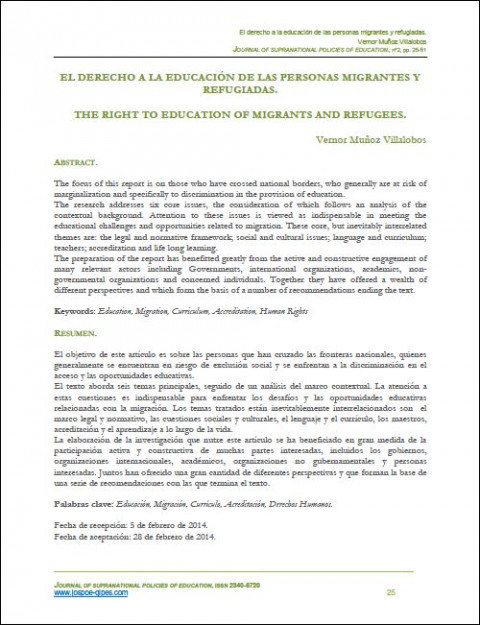 The Right to Education of Migrants and Refugees Année de publication: 2014 Auteur: Vernor Muñoz Villalobos The focus of this report is on those who have crossed national borders, who generally are at risk of marginalization and specifically to discrimination in the provision of education. The research addresses six core issues, the consideration of which follows an analysis of the contextual background. Attention to these issues is viewed as indispensable in meeting the educational challenges and opportunities related to migration. These core, but inevitably interrelated themes are: the legal and normative framework; social and cultural issues; language and curriculum; teachers; accreditation and lifelong learning. The preparation of the report has benefitted greatly from the active and constructive engagement of many relevant actors including Governments, international organizations, academics, non-governmental organizations and concerned individuals. Together they have offered a wealth of different perspectives and which form the basis of a number of recommendations ending the text.