
Ressources
Explorez une large gamme de ressources sur le GCED afin d’approfondir votre compréhension et de renforcer vos activités de recherche, de plaidoyer, d’enseignement et d’apprentissage.
1,180 résultats trouvés
 Strengthening Social and Emotional Learning in Hybrid Modes of Education: Building Support for Students, Teachers, Schools and Families; A UNESCO-IBE Discussion Paper Année de publication: 2024 Auteur institutionnel: UNESCO International Bureau of Education (IBE) The COVID-19 pandemic intensified existing educational disparities globally, prompting a reevaluation of school curricula to include Social and Emotional Learning (SEL). This shift recognized the holistic needs of learners, teachers, and families, emphasizing competencies beyond traditional knowledge acquisition. Despite SEL's increasing global recognition, it is often absent from formal curricula, prompting the UNESCO-IBE to address this gap. This Discussion Paper explores the crucial role of SEL in the broader transformation of global education, particularly in the post-COVID-19 era. It highlights six key topics, presenting diverse experiences in integrating SEL into education. Experts from various fields contribute insights, focusing on socio-emotional and hybrid learning advancements worldwide. The report aims to inspire global change-makers, advocating for robust policies aligned with UNESCO's Futures of Education framework. This call to action aligns with the UNESCO-IBE's HELA initiative, promoting flexible hybrid learning models for crisis response and sustainable educational strategies in line with the UN Transforming Education Summit's vision.
  Reflections and Countermeasures on Traditional Education in the Age of Artificial Intelligence: Taking ChatGPT as an Example (Advances in Education; Vol.13, No.5) Année de publication: 2023 Auteur: 罗蕾 | 张祖国 | 幸丽君 Since the turn of the century, the pace of scientific and technological advancement has been increasing rapidly, like a rolling wave gaining momentum. As a result, the topic of artificial intelli-gence and its potential applications has remained a hot topic in the field of education. The introduction of ChatGPT had an immediate and significant impact on the domestic education industry. Addressing how to manage this impact on teaching activities has become an urgent issue that requires prompt consideration and resolution. In light of the ongoing impact of artificial intelligence technology on traditional teaching methods, this article focuses on ChatGPT’s response as an intervention point, delving into a thorough analysis of the inherent strengths and weaknesses of traditional teaching modes, as well as the opportunities and challenges presented by intelligent teaching. Through our analysis of artificial intelligence, we aim to propose effective measures and explore new directions for the development of education in its influence. 人工智能时代传统教育反思与应对: 以ChatGPT为例 (教育进展; Vol.13, No.5) Année de publication: 2023 Auteur: 罗蕾 | 张祖国 | 幸丽君 新世纪以来,科学技术的进步犹如滚滚的浪潮不断加速前进,关于人工智能应用的讨论,在教育领域内一直是一个比较热点的话题,而ChatGPT推出,立即引起了国内教育行业的重大震荡。如何应对ChatGPT对教学活动造成的巨大冲击,成为当下急需思考、解决的问题。本文在人工智能技术持续影响传统教学模式的背景下,以ChatGPT对现有教学引发的反应为介入点,通过对传统教学模式固有利弊的审视,及智能化教学所带来的机遇与挑战进行深入的分析,尝试提出相关有效措施,力求探寻人工智能影响下教育发展新方向。
  أدوات التقييم الخاصة بتطبيق أداة تعليم المهارات الحياتية والمواطنة: قياس المهارات الحياتية بناءً على إطار العمل الإقليمي لتعليم المهارات الحياتية والمواطنة في منطقة الشرق الأوسط وشمال أفريقيا; امللخص التنفيذي Année de publication: 2021 Auteur institutionnel: UNICEF Middle East and North Africa "إن تعليم المهارات الحياتية مُهم للغاية لتمكين الأطفال والشباب من تحقيق النجاح في التعليم والعمل والأهداف الشخصية. ومع ذلك، قد أدرجت القليل من الأنظمة التعليمية المهارات الحياتية في نظامها التعليمي. ومن أسباب ذلك هو التحديات المتعلقة بنقص المعرفة الخاصة بكيفية قياس المهارات الحياتية وتقييمها. وبناءً على إطار العمل الإقليمي لتعليم المهارات الحياتية والمواطنة في الشرق الأوسط وشمال أفريقيا، فإن منظمة اليونيسف والبنك الدولي قد طورا أداة تعليم المهارات الحياتية والمواطنة لقياس المستوى الوطني لنتائج طلبة الصف السابع في ثماني مهارات حياتية بوصفه تقييم وطني واسع النطاق. يرجى أيضًا الاطلاع على منشور قياس المهارات الحياتية." LSCE Measurement Instrument: Measuring Life Skills in the Context of Life Skills and Citizenship Education in the Middle East and North Africal; Advocacy Brief Année de publication: 2021 Auteur institutionnel: UNICEF Middle East and North Africa Teaching and learning life skills is incredibly important for empowering children and young people to achieve success in education, employment, and personal goals. Nevertheless, few education systems have integrated life skills into their education systems. One of the reasons for this is challenges concerning the lack of knowledge as to how life skills can be measured, assessed, and evaluated. Building on the regional Life Skills and Citizenship Education (LSCE) framework in the Middle East and North Africa (MENA), UNICEF and The World Bank have developed this LSCE Measurement Instrument, to measure the national level of grade 7 students’ scores in eight life skills as national large-scale assessment.
  Mirages and Harsh Reality of Inclusive Education in Kyrgyzstan Année de publication: 2022 Auteur: Kalys Meymanbekova Auteur institutionnel: Central Asian Bureau for Analytical Reporting (CABAR) The purpose of the article is to analyze the current state of accessibility of inclusive education for persons with disabilities in Kyrgyzstan. Inclusive education is understood as an activity to increase diversity and develop a sense of belonging, based on the fact that each person is valuable and has the potential for development. Миражи и суровая реальность инклюзивного образования в Кыргызстане Année de publication: 2022 Auteur: Kalys Meymanbekova Auteur institutionnel: Central Asian Bureau for Analytical Reporting (CABAR) Целью статьи является анализ текущего положения доступности инклюзивного образования для ЛОВЗ Кыргызстана. Инклюзивное образование понимается как деятельность по расширению разнообразия и развитию чувства сопричастности, основанная на том, что каждый человек ценен, и у него есть потенциал развития.
 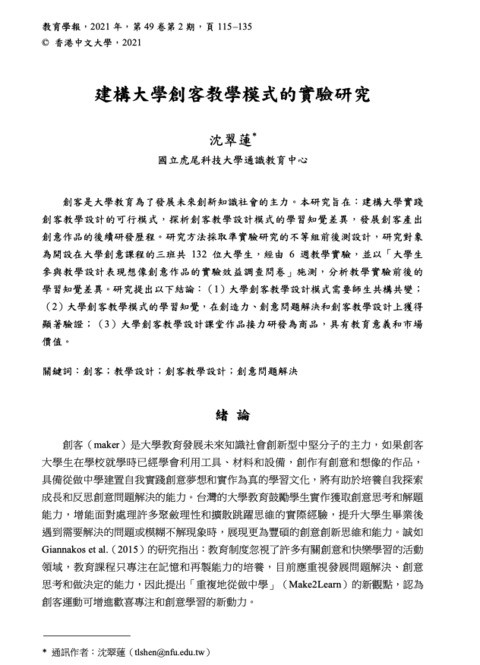 An Experimental Study of Constructing Maker Teaching Model (Educational Journal ; Vol.49, No.2) Année de publication: 2021 Auteur: 沈翠莲 Makers studying at university are the main powerful pioneers for developing innovative knowledge society. This research aimed to construct a feasible model of maker teaching, to explore the differences of learning perception of the maker instructional model, and to develop the subsequent process of product creation. Nonequivalent pretest-posttest designs of the quasi-experimental research was employed. Research participants included 132 college students from three classes of creativity-related courses, who participated a 6-week experiment. They were divided into the experimental group and two control groups. A questionnaire was employed to test their differences of learning perception. Results found that: (a) for the maker instructional model, CEO-I2M2E2-SF, a collaborative constructive relationship should be built between instructor and makers; (b) in terms of the performances of learning perception under the maker instructional model, significant differences were found in the dimensions of creativity, creative problem solving, and maker instructional design; (c) there were educational and marketing values in the subsequent process of product creation by makers. 建构大学创各教学模式的实验研究 (教育学报; Vol.49, No.2) Année de publication: 2021 Auteur: 沈翠莲 创客是大学教育为了发展未来创新知识社会的主力。本研究旨在:建构大学实践创客教学设计的可行模式,探析创客教学设计模式的学习知觉差异,发展创客产出创意作品的后续研发历程。研究方法采取准实验研究的不等组前后测设计,研究对象为开设在大学创意课程的三班共132位大学生,经由6周教学实验,并以「大学生参与教学设计表现想像创意作品的实验效益调查问卷」施测,分析教学实验前后的学习知觉差异。研究提出以下结论:(1)大学创客教学设计模式需要师生共构共变;(2)大学创客教学模式的学习知觉,在创造力、创意问题解决和创客教学设计上获得显着验证;(3)大学创客教学设计课堂作品接力研发为商品,具有教育意义和市场价值。
 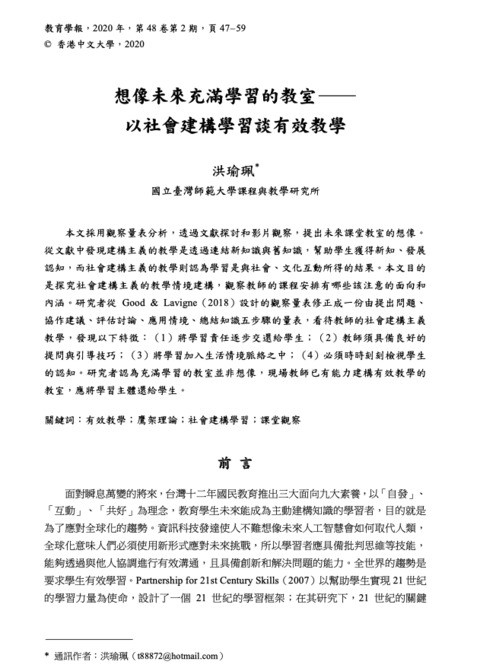 Imagining the Classroom Full of Learning in the Future: Effective Teaching With Social Constructive Learning (Educational Journal ; Vol.48, No.2) Année de publication: 2020 Auteur: 洪瑜佩 This article used an observation scale, together with literature exploration and film observation, to imagine the future classroom. From literature review, it was found that constructivist teaching helps students acquire new knowledge and develop cognition through connecting new and old knowledge. Teaching with the social constructivism approach regards learning as the result of interaction with society and culture. This article aimed to explore the social constructivist teaching context, as well as to observe which aspects and connotations teachers should pay attention to in curriculum arrangement. The researcher amended the observation scale designed by Good & Lavigne (2018) with five steps: (a) raising questions;(b) collaboration and suggestions; (c) assessment and discussions; (d) application to scenarios; and (e) summarizing knowledge. Teachers’ teaching was observed and assessed based on the five steps. The following results were found: (a) students should have the responsibilities of learning;(b) teachers must have good questioning and guidance skills; (c) teachers need to incorporate learning into real-life situations; (d) students’ cognition must be reviewed and monitored frequently. The researcher believes that a classroom full of learning is not imaginary. Teachers already have the ability to construct effective classrooms and should treat students as the learning agent.