
Ressources
Explorez une large gamme de ressources sur le GCED afin d’approfondir votre compréhension et de renforcer vos activités de recherche, de plaidoyer, d’enseignement et d’apprentissage.
1,443 résultats trouvés
 Pan-African forum: sources and resources for a culture of peace Année de publication: 2013 Auteur institutionnel: African Union The Pan-African Forum “ Sources and resources for a culture of peace” was held in Luanda, Angola, from 26 to 28 March 2013, and was jointly organized by UNESCO, the African Union and the Government of Angola, under the High Patronage of H. E. Mr José Eduardo dos Santos, President of the Republic of Angola. This forum was the result of a close cooperation between UNESCO and the African Union, one of their main objectives being building peace in Africa, through the promotion of a culture of peace based on the intrinsic values of African societies. The Republic of Angola Government, through its President of the Republic H. E. Mr José Eduardo dos Santos, resolutely engaged in this process with major financial and technical support for the organization of the Forum in the Angolan capital city. As indicated in the Action Plan adopted by the participants in plenary (Annex I), recommendations made during the Forum are directed at all components of African society : political leaders, national and regional institutions, civil society, community associations, youth movements and women’s organizations, religious and traditional leaders, entrepreneurs and leaders from the private sector, etc. The implementation of the Action Plan will be continuously monitored by the two institutions that jointly organized the Luanda Forum, the African Union and UNESCO. Representatives from the 55 African countries participating in the Forum will both contribute to the proposal for action by bringing their national experience and take the lead in the follow‐up of the recommendations made at country level. In order to ensure this follow‐up it will be important to link together the participants by the creation of an African Network for the Promotion of a Culture of Peace and Non‐violence. The representatives of African countries will play the role of focal points of the awareness campaign at the national level. Finally, the agenda of the Forum includes a plan to hold a roundtable on the establishment of a multi-stakeholder partnership for action. Organized with the participation of regional institutions, public and private economic actors as well as representatives of Governments and Civil Society, this session will be the occasion to launch a continental and lasting Movement for the promotion of a culture of peace. For this round table and for the Campaign, the stakeholders can now witness the action as their Foundation / Company / Institution / Organization leads to help in building the defence of peace in the minds of men and women and ensure that peace is a reality: "Make Peace Happen". Forum panafricain: sources et ressources pour une culture de paix Année de publication: 2013 Auteur institutionnel: African Union Le Forum «Sources et ressources pour une culture de paix » panafricaines a eu lieu à Luanda, en Angola, du 26 au 28 Mars 2013, et a été organisée conjointement par l'UNESCO, l'Union africaine et le Gouvernement de l'Angola, sous le Haut Patronage de SEM José Eduardo dos Santos, Président de la République d'Angola. Ce forum a été le résultat d'une étroite collaboration entre l'UNESCO et l'Union africaine, l'un de leurs principaux objectifs étant consolidation de la paix en Afrique, à travers la promotion d'une culture de la paix fondée sur les valeurs intrinsèques des sociétés africaines. Le gouvernement de la République d'Angola, à travers son Président de la République H. E. M. José Eduardo dos Santos, résolument engagé dans ce processus avec le soutien financier et technique majeur pour l'organisation du Forum dans la capitale angolaise. Comme indiqué dans le Plan d'action adopté par les participants en séance plénière (annexe I), les recommandations formulées lors du Forum visent à toutes les composantes de la société africaine: les dirigeants politiques, les institutions nationales et régionales, la société civile, les associations communautaires, les mouvements de jeunesse et les organisations de femmes , les chefs religieux et traditionnels, les entrepreneurs et les dirigeants du secteur privé, etc. la mise en œuvre du plan d'action seront surveillés en permanence par les deux institutions qui ont organisé conjointement le Forum Luanda, l'Union africaine et l'UNESCO. Les représentants des 55 pays africains participant au Forum seront tous deux contribuer à la proposition d'action en apportant leur expérience nationale et prendre les devants dans le suivi des recommandations formulées au niveau des pays. Afin d'assurer ce suivi, il sera important de relier entre eux les participants par la création d'un Réseau africain pour la promotion d'une culture de la paix et de la non-violence. Les représentants des pays africains vont jouer le rôle des points focaux de la campagne de sensibilisation au niveau national. Enfin, l'ordre du jour du Forum comprend un plan pour tenir une table ronde sur la mise en place d'un partenariat multipartite pour l'action. Organisé avec la participation des institutions régionales, publiques et acteurs économiques privés ainsi que des représentants des gouvernements et de la société civile, cette session sera l'occasion de lancer un mouvement continental et durable pour la promotion d'une culture de la paix. Pour cette table ronde et de la campagne, les parties prenantes peuvent maintenant témoigner de l'action que leur / Société / Institution / Organisation Fondation mène pour aider à la construction de la défense de la paix dans l'esprit des hommes et des femmes et de veiller à ce que la paix est une réalité: « Agissons pour la paix ». Programa Mundial para Educação em Direitos Humanos: segunda fase, plano de ação Année de publication: 2012 Auteur institutionnel: UN Office of the High Commissioner for Human Rights According to Human Rights Council resolution 12/4, the second phase of the World Programme (2010–2014) will focus “on human rights education for higher education and on human rights training programmes for teachers and educators, civil servants, law enforcement officials and military personnel at all levels” and “Member States should also continue the implementation of human rights education in primary and secondary school systems”. The plan of action focuses on human rights education in two broadly defined sectors, i.e. higher education and training for civil servants, law enforcement officials and the military. Programme mondial en faveur de l'Éducation aux droits de l'Homme: deuxième phase, plan d'action Année de publication: 2012 Auteur institutionnel: UN Office of the High Commissioner for Human Rights According to Human Rights Council resolution 12/4, the second phase of the World Programme (2010–2014) will focus “on human rights education for higher education and on human rights training programmes for teachers and educators, civil servants, law enforcement officials and military personnel at all levels” and “Member States should also continue the implementation of human rights education in primary and secondary school systems”. The plan of action focuses on human rights education in two broadly defined sectors, i.e. higher education and training for civil servants, law enforcement officials and the military.
  World programme for human rights education: second phase; plan of action Année de publication: 2012 Auteur institutionnel: UN Office of the High Commissioner for Human Rights According to Human Rights Council resolution 12/4, the second phase of the World Programme (2010–2014) will focus “on human rights education for higher education and on human rights training programmes for teachers and educators, civil servants, law enforcement officials and military personnel at all levels” and “Member States should also continue the implementation of human rights education in primary and secondary school systems”. The plan of action focuses on human rights education in two broadly defined sectors, i.e. higher education and training for civil servants, law enforcement officials and the military. Enseigner le respect pour tous: activité 2: cartographie des matériels et pratiques existants, en coopération avec les universités et les centres de recherche, rapport final Année de publication: 2013 Auteur: Peter G. Kirchschlaeger | Stefanie Rinaldi | Franziska Brugger | Tanja Mitrovic Auteur institutionnel: University of Teacher Education (Switzerland). Centre of Human Rights Education The constant rise of racism, xenophobia and intolerance despite the renewed commitments made by the international community is giving the United Nations Educational, Scientific and Cultural Organisation (UNESCO) a reason to consider education as key to strengthen the foundations of tolerance, reducing discrimination and violence and learning to live together. It is required to cultivate respect for all people regardless of colour, gender, descent or national, ethnic or religious identity. The project “teaching respect for all” aims at reducing intolerance, violence and discrimination trough education. The project is founded on the universal values and common core principles promoted by UNESCO, even though UNESCO is aware, that the countries differ from one another in dealing with issues related to anti-racism and tolerance in education according to each country’s history and culture. Teaching respect for all: activity 2: mapping of existing materials and practices in cooperation with universities and research centres; final report Année de publication: 2013 Auteur: Peter G. Kirchschlaeger | Stefanie Rinaldi | Franziska Brugger | Tanja Mitrovic Auteur institutionnel: University of Teacher Education (Switzerland). Centre of Human Rights Education The constant rise of racism, xenophobia and intolerance despite the renewed commitments made by the international community is giving the United Nations Educational, Scientific and Cultural Organisation (UNESCO) a reason to consider education as key to strengthen the foundations of tolerance, reducing discrimination and violence and learning to live together. It is required to cultivate respect for all people regardless of colour, gender, descent or national, ethnic or religious identity. The project “teaching respect for all” aims at reducing intolerance, violence and discrimination trough education. The project is founded on the universal values and common core principles promoted by UNESCO, even though UNESCO is aware, that the countries differ from one another in dealing with issues related to anti-racism and tolerance in education according to each country’s history and culture.
 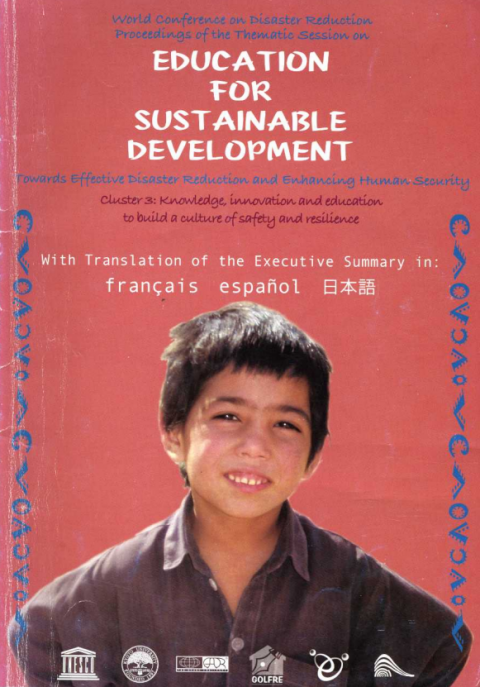 Proceedings of the thematic session on education for sustainable development: towards effective disaster reduction and enhancing human security; cluster 3: knowledge, innovation and education to build a culture of safety and resilience Année de publication: 2005 Auteur: Rajib Shaw | Badaoui Rouhban Auteur institutionnel: Kyoto University. Graduate School of Global Environmental Studies | Global Alliance for Disaster Reduction | Global Open Learning Forum on Risk Education | Disaster Reduction Alliance | International Institute of Earthquake Engineering and Seismology Ten years ago, the city of Kobe and its adjoining areas in Hyogo prefecture of Japan were hit by a strong earthquake, leaving behind a trail of death and destruction. This earthquake was a turning point in disaster reduction initiatives in Japan, resulting in two prominent changes: 1) a blending of technological and social issues in the field of research and application, and 2) an enhanced participation of civil society in disaster reduction Initiatives. Since Japan had long been one of the most developed countries in the field of earthquake engineering, the tragedy in Kobe posed a daunting question: 'how to fill the gap between knowledge and practice?' This question is not only for Japan, but is pertinent to many other countries. With the advancement of technology, the knowledge base is growing, and it is now time to tackle this question in order to save lives and properties from natural disasters. The World Conference on Disaster Reduction (WCDR), at the 10th anniversary of the Kobe earthquake, is therefore of special significance, providing an excellent platform to share experiences, expertise, and lessons from different parts of the world. The year 2005 is also the beginning of the United Nations Decade of Education for Sustainable Development (DESD: 2005-2014) which is led by UNESCO. Compte rendu de la session thématique sur l'éducation pour le développement durable: vers une réduction efficace des catastrophes et le renforcement de la sécurité humaine; groupe 3: la connaissance, l'innovation et l'éducation pour instaurer une culture de la sécurité et de résilience Année de publication: 2005 Auteur: Rajib Shaw | Badaoui Rouhban Auteur institutionnel: Kyoto University. Graduate School of Global Environmental Studies | Global Alliance for Disaster Reduction | Global Open Learning Forum on Risk Education | Disaster Reduction Alliance | International Institute of Earthquake Engineering and Seismology Il y a dix ans, la ville de Kobe et ses zones adjacentes dans la préfecture de Hyogo du Japon ont été touchés par un fort tremblement de terre, laissant derrière lui une traînée de mort et de destruction. Ce tremblement de terre a été un point tournant dans les initiatives de prévention des catastrophes au Japon, ce qui entraîne deux changements importants: 1) un mélange de questions technologiques et sociales dans le domaine de la recherche et de l'application, et 2) une participation accrue de la société civile dans les initiatives de prévention des catastrophes. Depuis que le Japon a longtemps été l'un des pays les plus développés dans le domaine de l'ingénierie des tremblements de terre, la tragédie de Kobe a posé une question de taille:? Comment combler le fossé entre les connaissances et la pratique ' Cette question est non seulement pour le Japon, mais est pertinent pour de nombreux autres pays. Avec l'avancement de la technologie, la base de connaissances est en croissance, et il est maintenant temps d'aborder cette question dans le but de sauver des vies et des propriétés des catastrophes naturelles. La Conférence mondiale sur la prévention des catastrophes (CMPC), au 10e anniversaire du tremblement de terre de Kobe, est donc d'une importance particulière, en fournissant une excellente plateforme pour partager des expériences, des compétences et des leçons de différentes parties du monde. L'année 2005 est aussi le début de la Décennie des Nations Unies pour l'éducation pour le développement durable (DEDD: 2005-2014) qui est dirigé par l'UNESCO.
  The Comprehensive Learning Diagnosis: Chile’s approach to assess socio-emotional learning in schools Année de publication: 2023 Auteur: José Weinstein | Juan Bravo Auteur institutionnel: Center for Universal Education at Brookings Education in Chile has important challenges of quality, equity, and social integration. For decades, policies tried to respond to these concerns with a high-stakes accountability institutional framework, which has not had success. The underlying vision of educational quality was limited. The assessment system in place privileged cognitive and academic dimensions of educational results. Socio-emotional learning had been neglected or considered secondary, without an infrastructure of assessment tools that allowed teachers and principals to diagnosis students’ situations and monitor their progress. The COVID-19 crisis was an opportunity for change: Students’ socioemotional needs were a main concern for schools and society, and the regular accountability system based on standardized tests was interrupted. Subsequently, the Comprehensive Learning Diagnosis (DIA) was launched by the Education Quality Agency. The DIA is a voluntary assessment tool made available to all Chilean schools. The DIA promotes the comprehensive development of students, providing timely information and guidance to internally monitor students’ learning in the academic and socio-emotional domains at several points during the school year. Specifically, with respect to socio-emotional learning, three areas were considered: personal, community, and citizenship. In each of these areas, a set of socioemotional skills were defined, operationalized, and became possible to monitor by school communities. The DIA also collects students’ opinions of school management practices regarding socio-emotional skills. The DIA has received a wide acceptance in school communities. Despite being voluntary, an ample majority of schools decided to participate. The information collected from the DIA allows for practical use by principals and teachers. Moreover, the DIA provides the opportunity for students to inform school management. The new Chilean government has decided to strengthen DIA as an important component in a four-year national plan for reactivating academic and socio-emotional learning in schools. The previous high-stakes accountability system, which involved external assessments, has been suspended and is under discussion. The DIA experience has shown that critical social and educational situations can provide fertile ground to motivate deep and rapid transformation, if an educational actor (in this case the Education Quality Agency) is capable of enacting a pertinent, timely, and practical response to school needs. The DIA is not only an example of productive uses of students´ assessment by schools, but also a demonstration that it is possible to build an institutional arrangement among local, intermediate, and national levels of school systems, where a vertical hierarchy is changed by a collaborative relationship based on local agency, mutual trust, and differentiated technical contributions.