
Ressources
Explorez une large gamme de ressources sur le GCED afin d’approfondir votre compréhension et de renforcer vos activités de recherche, de plaidoyer, d’enseignement et d’apprentissage.
2,161 résultats trouvés
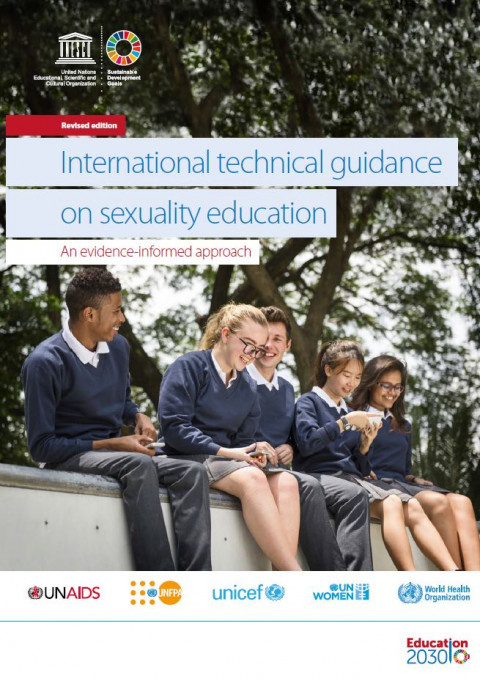 International Technical Guidance on Sexuality Education: An Evidence-Informed Approach Année de publication: 2018 Auteur institutionnel: Joint United Nations Programme on HIV/AIDS (UNAIDS) | United Nations Population Fund (UNFPA) | United Nations Children's Fund (UNICEF) | United Nations Entity for Gender Equality and the Empowerment of Women (UN Women) | World Health Organization (WHO) The UN International technical guidance on sexuality education was first published in 2009 as an evidence-informed approach for schools, teachers and health educators.Recognizing the dynamic shifts in the field of sexuality education that have occurred since then, an expanded group of UN co-publishing partners has reviewed and updated the content to respond appropriately to the contemporary needs of young learners, and to provide support for education systems and practitioners seeking to address those needs. The International technical guidance on sexuality education (revised edition) provides sound technical advice on the characteristics of effective comprehensive sexuality education (CSE) programmes; a recommended set of topics and learning objectives that should be covered in comprehensive sexuality education; and, recommendations for planning, delivering and monitoring effective CSE programmes. This revised edition of the Guidance reaffirms the position of sexuality education within a framework of human rights and gender equality, and promotes structured learning about sex and relationships in a manner that is positive, affirming, and centred on the best interests of the young person. It is based on a review of the latest evidence and lessons-learned from implementing CSE programmes across the globe. The revised Guidance reflects the contribution of sexuality education to the realization of multiple Sustainable Development Goals, notably Goal 3 on good health and well-being for all, Goal 4 on quality education for all, and Goal 5 to achieve gender equality.
  Participatory Planning to Achieve Structural Change with Equality: Citizen Participation Strategies in Multi-scale Planning Processes Année de publication: 2015 Auteur: Alicia Williner | Andrea Sanhueza | Carlos Sandoval Auteur institutionnel: United Nations (UN) This manual that ILPES places at the disposal of public officials and non-governmental agents working in the community, has the purpose of sharing a brief theoretical reflection on the current socio-political context through which this manual becomes important; and a set of methodological instruments that will bring the user closer to the social practice of a citizen participation process in the construction of a public management instrument. The manual is divided into two chapters: The first conceptualizes participatory multiscale planning, while also briefly introducing three topics of great importance to be incorporated into any participatory planning process and construction of public management instruments: the perspective of gender, the use of Convention 169 and Principle 10. The second chapter systematizes a set of methodological instruments that describe the stages of a citizen participation strategy to incorporate the multiscale public management instruments. The manual closes with two annexes, the last of which incorporates a set of tools that can be used in the stages of the construction of a citizen participation strategy. La Planificación Participativa para Lograr un Cambio Estructural Con igualdad: Las Estrategias de Participación Ciudadana en los Procesos de Planificación Multiescalar Année de publication: 2015 Auteur: Alicia Williner | Andrea Sanhueza | Carlos Sandoval Auteur institutionnel: United Nations (UN) Este manual que ILPES coloca a disposición de funcionarios públicos y agentes no gubernamentales que trabajan en la comunidad, tiene el propósito de compartir una breve reflexión teórica sobre el contexto socio-político actual por el cual este manual cobra importancia; y un conjunto de instrumentos metodológicos que acercarán al usuario a la práctica social de un proceso de participación ciudadana en la construcción de un instrumento de gestión pública. El manual se estructura en dos capítulos: El primero de ellos conceptualiza la planificación multiescalar participativa, a la vez que realiza una breve introducción a tres temas de suma relevancia a incorporar en todo proceso de planificación participativa y construcción de instrumentos de gestión pública: la perspectiva de género, el uso del Convenio 169 y del Principio 10. El segundo capítulo sistematiza un conjunto de instrumentos metodológicos que describen las etapas de una estrategia de participación ciudadana para incorporar a los instrumentos de gestión pública multiescalar. El manual cierra con dos anexos, el último de los cuales incorpora un conjunto de herramientas que podrán ser utilizadas en las etapas de la construcción de una estrategia de participación ciudadana.
  The Teacher as a Promoter of the Pedagogy of Coexistence for Education for Peace Année de publication: 2014 Auteur: María Elena López Serrano | Rosa María Medrano Domínguez | Patricia Villar López Auteur institutionnel: Universidad Católica Silva Henríquez Recognizing the diversity in the aulic space allows to create spaces of harmonious coexistence that promote and accept interculturality, for this the teacher becomes the nodal axis to propitiate the conditions that allow the students to recognize themselves as equal beings capable of developing their capacities to the maximum academic and personal. To achieve this goal it is essential that the teacher recognizes himself and others, in such a way that generates spaces in which students identify as social beings able to interact with their peers, the educational community and their environment. What has been described here supports the proposal of the pedagogy of coexistence in the aulic space as a promoter of education for peace that contributes to the reduction of the violence experienced in society. The proposal is based on a documentary research on the pedagogy of coexistence linked to diversity and interculturality to promote education for peace. The proposal recognizes the teacher as the axis that drives education for peace through fostering harmonious environments in the classroom. It is not possible to speak of harmonic coexistence without considering the teacher's awareness of his role as a social educator, which promotes through Pedagogy of Coexistence an intercultural education that attends to diversity and that favors education for peace and contributes to the decrease of cultural violence. El docente como promotor de la pedagogía de la convivencia para la educación por la paz Année de publication: 2014 Auteur: María Elena López Serrano | Rosa María Medrano Domínguez | Patricia Villar López Auteur institutionnel: Universidad Católica Silva Henríquez Reconocer la diversidad en el espacio áulico permite propiciar espacios de convivencia armónica que promuevan y acepten la interculturalidad, por ello el docente se convierte en el eje nodal para propiciar las condiciones que permitan a los estudiantes reconocerse como seres iguales capaces de desarrollar al máximo sus capacidades académicas y personales. Para conseguir este objetivo es fundamental que el docente se reconozca en sí mismo y en los demás, de tal forma que genere espacios en el que los alumnos se identifiquen como seres sociales capaces de interactuar con sus pares, con la comunidad educativa y su entorno. Lo hasta aquí descrito sustenta la propuesta de la pedagogía de la convivencia en el espacio áulico como promotor de la educación para la paz que contribuya a la disminución de la violencia que se vivencia en la sociedad. La propuesta se sustenta en una investigación documental respecto a la pedagogía de la convivencia vinculada con la diversidad e interculturalidad para promover la educación por la paz.La propuesta reconoce al docente como el eje que impulsa la educación por la paz a través de propiciar ambientes armónicos en el aula. No es posible hablar de Convivencia armónica sin considerar la conciencia del docente respecto a su rol como educador social, que promueve a través de la Pedagogía de la Convivencia una educación intercultural que atienda a la diversidad y que favorezca la educación para la paz y contribuya a la disminución de la violencia cultural.
  Teaching Two Lessons about UNESCO and Other Writings on Human Rights Année de publication: 2017 Auteur: Fernando Reimers This book presents two lessons for use in college or high school, to educate students on the mission and work of UNESCO as it relates to the advancement of Human Rights. It includes also a series of a short essays on Human Rights, the Right to Education, Teaching Human Rights and the role of Teachers and Universities in Teaching Human Rights which will be useful to educators interested in educating their students to advance the values of freedom and justice. For more information about this book, please visit the link below.URL: https://www.amazon.com/Teaching-Lessons-Unesco-writings-Rights/dp/1978367996#reader_1978367996 The lessons(Two Lessons About UNESCO) are designed to help high school and college students understand the mission of UNESCO, the reason the organization was created, the work it does, how it is structured and funded, and how its work relates to the Universal Declaration of Human Rights. The lessons can be taught at the High School or College level. They can be taught in a variety of courses including social studies, history, humanities, and can be integrated in courses in other disciplines. For more information, please visit the link below.URL: https://medium.com/@fernandomreimers/teaching-two-lessons-about-unesco-7531c5fe9395
 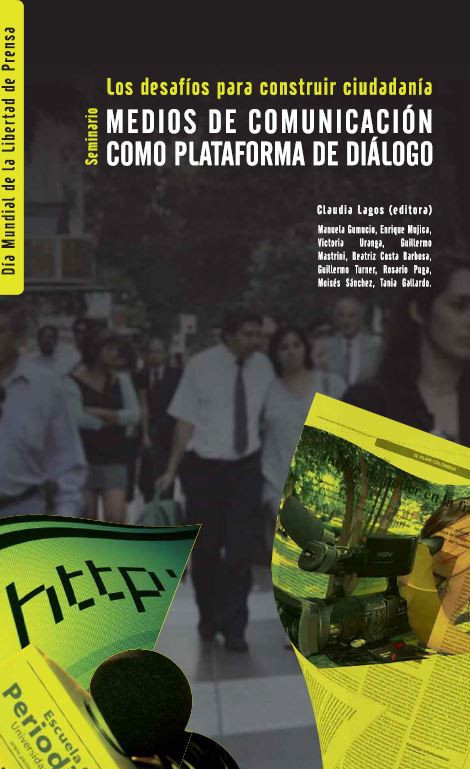 The Challenges to Build Citizenship: Media as a Platform for Dialogue Année de publication: 2010 Auteur: Claudia Lagos Auteur institutionnel: Universidad de Chile The OREALC / UNESCO Santiago and the UNESCO National Commission, the Regional Delegation for Cooperation in the Southern Cone and Brazil, the French Embassy in Chile, the Freedom of Expression Program of the Institute of Communication and Image of the University of Chile and the UNESCO Chair "Media and citizen participation" of the Universidad Diego Portales, commemorated the World Day for Press Freedom 2009 with the seminar "The challenges to build citizenship. Media as a platform for dialogue ", held on May 5, 2009 at the Central House of the University of Chile. The meeting, with national and international guests, made it possible to reflect on and discuss the main issues -although not the only ones- that are currently in the hands of issues related to the promotion of pluralism and diversity; the challenges for journalism and the media in a context of high technological renewal and economic crisis; the lines of work in the matter for the design and execution of public policies, and research in communication. This publication collects the presentations of the speakers during the Seminar, as well as leaves testimony of the commitments assumed by the presidential candidates that we hope will become an agenda not only for the 2010-2014 administration, but also for the political sectors that represent each one of those who signed the document. Seminario Los Desafíos para Construir Ciudadanía: Medios de Comunicación como Plataforma de Diálogo Année de publication: 2010 Auteur: Claudia Lagos Auteur institutionnel: Universidad de Chile La OREALC/UNESCO Santiago y la Comisión Nacional UNESCO, la Delegación Regional de Cooperación para el Cono Sur y Brasil, de la Embajada de Francia en Chile, el Programa de Libertad de Expresión del Instituto de la Comunicación e Imagen de la Universidad de Chile y la Cátedra UNESCO “Medios de comunicación y participación ciudadana” de la Universidad Diego Portales, conmemoraron el Día Mundial por la Libertad de Prensa 2009 con el seminario “Los desafíos para construir ciudadanía. Medios de comunicación como plataforma de diálogo”, realizado el 5 de mayo de 2009 en la Casa Central de la Universidad de Chile. El encuentro, con invitados nacionales e internacionales, permitió reflexionar y discutir sobre los principales -aunque no los únicos- problemas que hoy están en carpeta en cuestiones referidas al fomento del pluralismo y la diversidad; los desafíos para el periodismo y los medios en un contexto de alta renovación tecnológica y crisis económica; las líneas de trabajo en la materia para el diseño y ejecución de políticas públicas, y la investigación en comunicación. Esta publicación recoge las presentaciones de los expositores durante el Seminario, así como también deja testimonio de los compromisos asumidos por los candidatos presidenciales que esperamos se transforme en una agenda no sólo para la administración 2010-2014, sino que también para los sectores políticos que representa cada uno de quienes suscribieron el documento.
 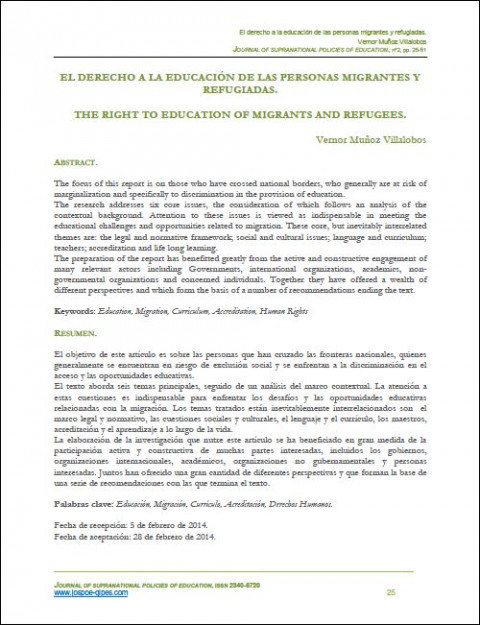 The Right to Education of Migrants and Refugees Année de publication: 2014 Auteur: Vernor Muñoz Villalobos The focus of this report is on those who have crossed national borders, who generally are at risk of marginalization and specifically to discrimination in the provision of education. The research addresses six core issues, the consideration of which follows an analysis of the contextual background. Attention to these issues is viewed as indispensable in meeting the educational challenges and opportunities related to migration. These core, but inevitably interrelated themes are: the legal and normative framework; social and cultural issues; language and curriculum; teachers; accreditation and lifelong learning. The preparation of the report has benefitted greatly from the active and constructive engagement of many relevant actors including Governments, international organizations, academics, non-governmental organizations and concerned individuals. Together they have offered a wealth of different perspectives and which form the basis of a number of recommendations ending the text. El Derecho a la Educación de las Personas Migrantes y Refugiadas Année de publication: 2014 Auteur: Vernor Muñoz Villalobos El objetivo de este artículo es sobre las personas que han cruzado las fronteras nacionales, quienes generalmente se encuentran en riesgo de exclusión social y se enfrentan a la discriminación en el acceso y las oportunidades educativas. El texto aborda seis temas principales, seguido de un análisis del marco contextual. La atención a estas cuestiones es indispensable para enfrentar los desafíos y las oportunidades educativas relacionadas con la migración. Los temas tratados están inevitablemente interrelacionados son el marco legal y normativo, las cuestiones sociales y culturales, el lenguaje y el currículo, los maestros, acreditación y el aprendizaje a lo largo de la vida. La elaboración de la investigación que nutre este artículo se ha beneficiado en gran medida de la participación activa y constructiva de muchas partes interesadas, incluidos los gobiernos, organizaciones internacionales, académicos, organizaciones no gubernamentales y personas interesadas. Juntos han ofrecido una gran cantidad de diferentes perspectivas y que forman la base de una serie de recomendaciones con las que termina el texto.