
Ressources
Explorez une large gamme de ressources sur le GCED afin d’approfondir votre compréhension et de renforcer vos activités de recherche, de plaidoyer, d’enseignement et d’apprentissage.
3,790 résultats trouvés
 Reaching the Youth: countering the Terrorist Narrative Année de publication: 2012 Auteur: Thomas Koruth Samuel This monograph studies the issue of the dynamics of youth and terrorism, paying close attention to the methods used by terrorists to entice the youth, the message or the narrative of the terrorists, and the possible counter-narrative that could be subsequently developed. Reaching the Youth: countering the Terrorist Narrative Année de publication: 2012 Auteur: Thomas Koruth Samuel Cette monographie étudie la dynamique entre la jeunesse et le terrorisme en accordant une attention particulière aux méthodes utilisées par les terroristes pour attirer les jeunes, leurs messages ou discours, et le contre-récit éventuel qui pourrait être développé par la suite.
 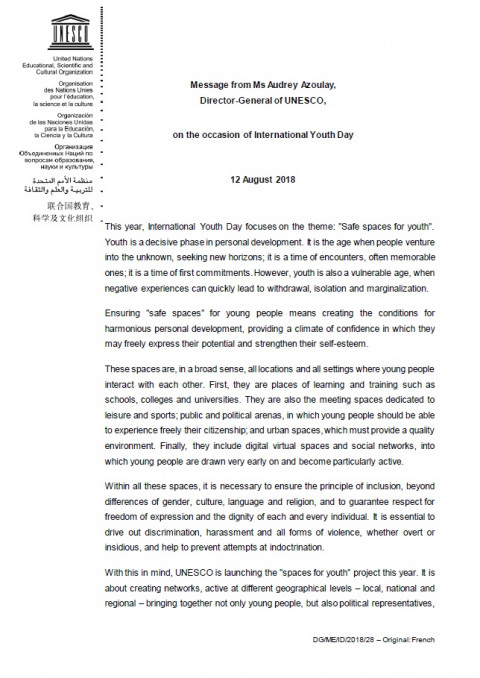 Message from Ms Audrey Azoulay, Director-General of UNESCO, on the occasion of International Youth Day, 12 August 2018 Année de publication: 2018 Auteur institutionnel: UNESCO. Director-General, 2017-2025 (Azoulay, A.) This message was delivered by Audrey Azoulay, Director-General of UNESCO, on the occasion of the International Youth Day, 12 August 2018. 联合国教科文组织总干事奥德蕾·阿祖莱女士 国际青年日致辞 Année de publication: 2018 Auteur institutionnel: UNESCO. Director-General, 2017-2025 (Azoulay, A.) 2018年8月12日,联合国教科文组织总干事奥德蕾·阿祖莱女士国际青年日致辞
  Switzerland and the Holocaust: teaching contested history This study is about a history textbook which introduces the new transnational master‐narrative of Holocaust memory into the classrooms of the German‐speaking part of Switzerland. The script of the book entails a replacement of the formerly dominant view of Switzerland as a neutral nation resisting evil in favour of an image that aligns Switzerland with other nations that accept the Holocaust as part of their national history, and combine their efforts to prevent such crimes in the future. However, this process cannot be seen as hegemonic or total since it is fragmented at various levels. On the level of state power, there is no uniform vision of the nation’s history. Therefore, the book needed to accommodate its critics to a certain extent. Furthermore, there are institutional rules of history education that restrict a direct transmission of knowledge and promote teaching youths to develop their own views. And then there are the teachers, who have their part in shaping history. (By the publisher) Naming and misnaming the nation. Ambivalence and national belonging in German textbook representations of the Holocaust At a time when the power of schools and both state and federal education authorities to guide young people’s sense of belonging is being challenged by multilingualism, by the claims of supra- and subnational regions and minorities, by memories of national catastrophes and crimes, and by out-of-school educational media, this collection of essays provides an apposite exploration of the ways in which shared narratives continue to be transmitted and learned. Its authors, whose work emerged from a series of conferences organized by the French National Institute for Pedagogical Research in Lyon, Barcelona and Paris in 2010, demonstrate not only ways in which multiple disciplines (including history, literature, social and language studies) address young people’s sense of attachment, but also how challenges to educational policy are reflected in school textbooks and curricula in Algeria, Bulgaria, Catalonia, France, Galicia, Germany, Quebec, Senegal and the USA. These studies about the role of education in relation to largely tenacious but shifting national identities should appeal to specialists of education, nationalism studies, history and political science. (By the author) A ‘Curtain of Ignorance’: An Analysis of Holocaust Portrayal in Textbooks from 1943 through 1959 If textbooks are supposed to be an honest and impartial portrayal of historical events, they should remain the same over time. However, when examining one event across different editions of the same textbook, it becomes apparent that this is not the case. This study seeks to examine how the beginnings of the Cold War may have influenced how the Holocaust was discussed during the 1940s and 1950s. Results indicate that as Germany transformed from an enemy to be defeated into an ally needed to stop the advance of Communism, discussion of the Holocaust became more muted. While the beginnings of the Cold War may not be the only factor in this phenomenon, the results of this study indicate a methodological process in which textbooks could be used to create critical and historical thinking in today's classroom. (By the author) Die Darstellung des Faschismus und Nationalsozialismus in deutschen, österreichischen und italienischen Schulbüchern Textbooks are often held to be official representations of history. Contrary to many other products of historical culture, they are subject to state control and approval. Yet, especially against this background, the question remains which historical theories and which history didactical concepts are being offered for students’ processing of this period in secondary school level I. How are the dictatorships evaluated and which possibilities are the students offered to deal with the didactically prepared material? Recent Italian, Austrian, and German history textbooks are analysed to see how Italian Fascism and German National Socialism are narratively conceptualized and to what extent students are offered the chance to make an independent evaluation of this recent history. The study tries above all to build a bridge to the contemporary debate about competences in the didactics of history and civics, related to the domain-specific competences students should acquire during their time in school. This is particularly interesting with respect to the two dictatorships, as it comes to determine to what extent the processing of the two dictatorships, in the sense of the acquisition of a reflective and (self-)reflexive historical consciousness, something which today is considered by the majority to be the goal of history education, is at the centre for these three democracies (By the publisher)
 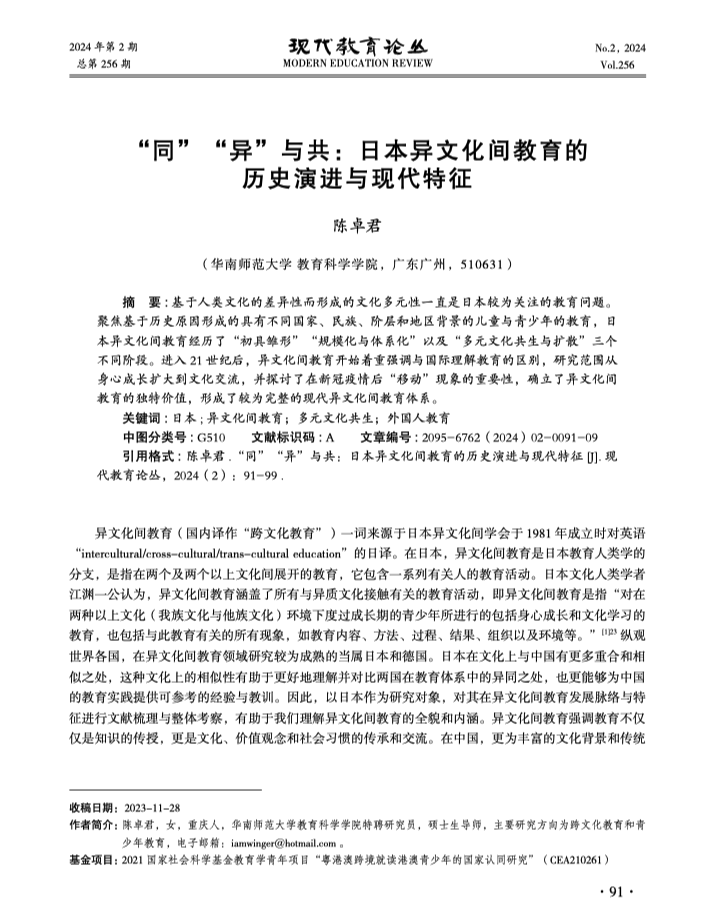 “同”“异”与共:日本异文化间教育的历史演进与现代特征 (现代教育论丛 第256期) Année de publication: 2024 Auteur: 陈卓君 基于人类文化的差异性而形成的文化多元性一直是日本较为关注的教育问题。 聚焦基于历史原因形成的具有不同国家、民族、阶层和地区背景的儿童与青少年的教育,日 本异文化间教育经历了“初具雏形”“规模化与体系化”以及“多元文化共生与扩散”三个 不同阶段。进入 21 世纪后,异文化间教育开始着重强调与国际理解教育的区别,研究范围从 身心成长扩大到文化交流,并探讨了在新冠疫情后“移动”现象的重要性,确立了异文化间 教育的独特价值,形成了较为完整的现代异文化间教育体系。
 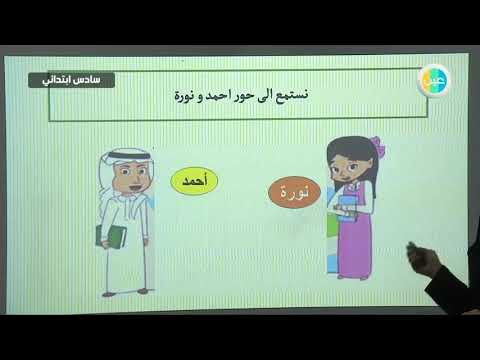 iEN Social Studies and Citizenship Lessons: Personality Enhancement Program - Sixth Primary Année de publication: 2020 Auteur: Fawzia Alghamdi Auteur institutionnel: iEN National Education Portal The teacher explains a sixth grade lesson on character development and enhancement. The lesson for students of the Kingdom of Saudi Arabia in a social studies course. With the Coronavirus pandemic, lessons explaining across platforms have emerged.