
Ressources
Explorez une large gamme de ressources sur le GCED afin d’approfondir votre compréhension et de renforcer vos activités de recherche, de plaidoyer, d’enseignement et d’apprentissage.
3,790 résultats trouvés
 Reimagining Life Skills and Citizenship Education in the Middle East and North Africa: A Four-Dimensional and Systems Approach to 21st Century Skills; Conceptual and Programmatic Framework Année de publication: 2017 Auteur institutionnel: UNICEF Middle East and North Africa The situation of learning in MENA calls for a holistic, lifelong and rights-based vision of education that maximizes the potential of all children and youth in the region and better equips them to create meaning out of knowledge and to face the transitions from childhood to adulthood, from education to work, and from unreflective development to responsible and active citizenship. This is what drives the MENA Life Skills and Citizenship Education (LSCE) Initiative, kicked off in 2015 with the aim of supporting the countries of the region – conceptually, programmatically and technically – to improve learning and to better invest such learning in individual, social and economic development.The LSCE Conceptual and Programmatic Framework (CPF) puts forth a roadmap to guide policies, strategies and programmes on life skills and citizenship education supporting the region-wide efforts to provide children and youth with opportunities to learn, transition from childhood to adulthood, move from school to work settings, and become responsible and active citizens of their communities.A set of twelve core life skills for MENA has been identified using the four-dimensional learning model: ‘Learning to Know’ (Cognitive Dimension), ‘Learning to Do’ (Instrumental Dimension), ‘Learning to Be’ (Individual Dimension), and ‘Learning to Live Together’ (Social Dimension). The twelve core life skills are life-long, and they build on evidence that underlines the importance of skills acquisition from an early age. Furthermore, the twelve core life skills are acquired and sustained through all forms of learning in a systems approach that recognizes multiple pathways of learning, formal, non-formal and informal. Réimaginer l’éducation aux compétences de vie et à la citoyenneté au Moyen-Orient et en Afrique du Nord : Une approche à quatre dimensions et systémique des compétences pour le XXIe siècle ; Cadre programmatique et conceptuel Année de publication: 2017 Auteur institutionnel: UNICEF Middle East and North Africa L’Initiative pour l’éducation aux compétences de vie et à la citoyenneté de la région MENA (LSCE) représente un effort de collaboration étatique et régional en faveur de la réalisation de l’objectif de développement durable (ODD) 4 – Assurer l’accès de tous à une éducation de qualité, sur un pied d’égalité, et promouvoir les possibilités d’apprentissage tout au long de la vie. Elle cherche à reformuler la compréhension traditionnelle de l’éducation aux compétences de vie et à la citoyenneté dans la région, tout en rappelant les questions fondamentales au sujet du but et du rôle de l’éducation dans le développement sociétal qui sont pertinentes dans le contexte actuel.L’Initiative LSCE se concentre sur trois défis interdépendants :Une société du savoir inaccessible, résultat de la mauvaise qualité de l’éducation, du bas niveau des résultats scolaires et d’une équité et inclusion limitées.Une croissance économique en déclin, résultat d’un manque d’aptitudes à l’employabilité, du haut taux de chômage chez les jeunes, de l’inégalité des sexes face à l’accès au marché du travail, du manque de création d’emplois, et d’un environnement économique faible.Une faible cohésion sociale, résultat de l’escalade de la violence et de la radicalisation tout autant que d’un faible engagement civique.
  IIEP-UNESCO 12th Medium-Term Strategy: 2026–2029 Année de publication: 2026 Auteur institutionnel: UNESCO International Institute for Educational Planning (IIEP) The 2026-2029 Medium-Term Strategy of the UNESCO International Institute for Educational Planning provides a vision for transforming educational planning into tangible results for education systems across the globe. Building on more than 60 years of experience, the Strategy puts the focus not only on policy and plan design, but on collective and agile implementation.
  Global Learning in Subject Teaching: Framework and Toolkit Année de publication: 2020 Auteur institutionnel: Center for Citizenship Education (CCE) | Global Issues, Global Subjects (GIGS) The brochure 'Global Learning in Subject Teaching: Framework and Toolkit' has been developed as a proposal for teachers, educators and educational institutions on how to reach pupils with Global Learning. In its practical part, the brochure provides the reader with a toolkit of 20 ready-to-use lesson plans for subject lessons where the subject curriculum topics are linked with global issues such as migration, climate change and gender equality.
  Media Literacy in the Library: A Guide for Library Practitioners Année de publication: 2020 Auteur institutionnel: American Library Association (ALA) | Institute of Museum and Library Services As information providers and hubs for lifelong learning, libraries have always been resources for helping communities develop media literacy skills. Now, in the midst of a global pandemic, and in an age when we increasingly rely on digital media for information and communication, these critical thinking skills are more important than ever. The American Library Association (ALA), working with talented thought leaders across the library and media literacy sectors, has created Media Literacy in the Library: A Guide for Library Practitioners to help library workers prepare for day-to-day interactions like the imagined reference desk one above.In this guide, we offer resources and ideas to plan programs and activities to teach media literacy skills to adults and also to integrate these skills into programming you already offer at your library. This guide has been created for out-of-school adult audiences, who library workers will generally meet in a public library context.
 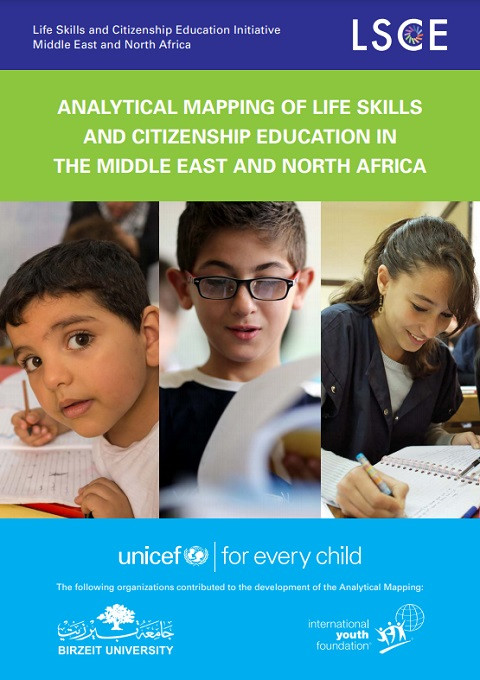 Analytical Mapping of Life Skills and Citizenship Education in the Middle East and North Africa Année de publication: 2017 Auteur institutionnel: UNICEF Middle East and North Africa The Analytical Mapping of the Life Skills and Citizenship Education in MENA, published in October 2017, provides a multi-stakeholder view of the status of life skills and citizenship education in MENA and the corresponding vision for the region. It does not evaluate existing interventions, nor is it meant to generate an exhaustive list of all existing life skills programmes in MENA. It rather aims to provide an analytical overview of Life Skills and Citizenship Education (LSCE) related intervention in the region. Through analyzation, it also attempts to highlight general challenges encountered in the programming of LSCE, as well as focus on opportunities for LSCE in MENA national education systems.
  Research on Citizen Participation in the Construction of Service-Oriented Government—Taking Yilong County as an Example Année de publication: 2020 Auteur: Luo Jian Using a particular county as an exmple, this paper analyses the role of civic participation in transforming local government into service-oriented government, and provides suggestions for improvement. 服务型政府建设中公民参与问题研究——以仪陇县为例 Année de publication: 2020 Auteur: Luo Jian 本文以中国某县为案例,讨论中国地方政府转型过程中公民参与的作用以及存在问题,并提出了相应对策,尤其是需要加强公民参与教育。
  The Idea and Innovation of Digitized Public Participation Année de publication: 2016 Auteur: Ji Yuanyuan This paper analyses the existing problems of public participation in public affairs through digitial tools and provides suggestions for improvement. 数字化公众参与的理念与创新 Année de publication: 2016 Auteur: Ji Yuanyuan 本文分析了当前中国民众通过数字方式参与政务的现状,探讨了现存为题,并为民主型政府转型提出了相关改善建议。