
Ressources
Explorez une large gamme de ressources sur le GCED afin d’approfondir votre compréhension et de renforcer vos activités de recherche, de plaidoyer, d’enseignement et d’apprentissage.
3,446 résultats trouvés
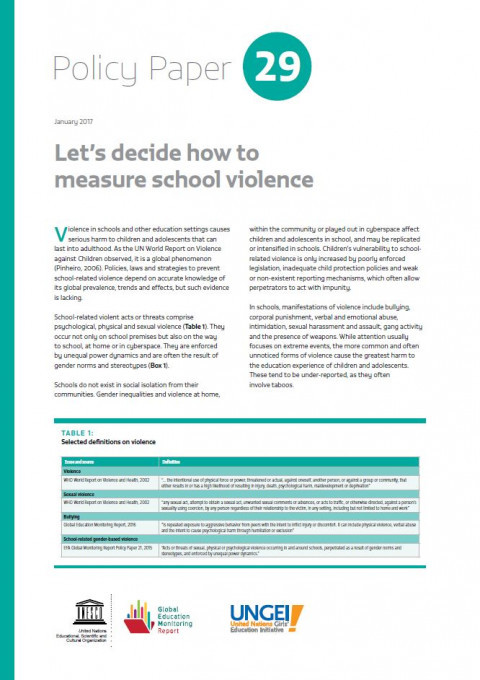 Let's Decide How to Measure School Violence (Policy Paper 29) Année de publication: 2017 Auteur institutionnel: UNESCO Violence in schools and other education settings causes serious harm to children and adolescents that can last into adulthood. As the UN World Report on Violence against Children observed, it is a global phenomenon (Pinheiro, 2006). Policies, laws and strategies to prevent school-related violence depend on accurate knowledge of its global prevalence, trends and effects, but such evidence is lacking.In schools, manifestations of violence include bullying, corporal punishment, verbal and emotional abuse, intimidation, sexual harassment and assault, gang activity and the presence of weapons. While attention usually focuses on extreme events, the more common and often unnoticed forms of violence cause the greatest harm to the education experience of children and adolescents. These tend to be under-reported, as they often involve taboos.To collect data on aspects of violence in schools, large-scale, multi-country school-based surveys are increasingly used; some countries also have well-established monitoring mechanisms. Overall, however, consistent evidence on the global prevalence and trends of school-related violence is lacking. To ensure reliable data is gathered, action is needed to bridge differences between the various monitoring methods. This paper, launched to coincide with the International Symposium on School Violence and Bullying: From Evidence to Action, in Seoul, Republic of Korea (January 17–19, 2017), aims to inform the current debate and propose options for the future.
  Agree to Differ Année de publication: 2015 Auteur institutionnel: UNESCO Dialogue on the basis of respect, tolerance, human rights and dignity has never been so important. This is the spirit of the International Decade for the Rapprochement of Cultures (2013-2022). The International Decade originates in the United Nations General Assembly Resolution 67/104 adopted in December 2012, co-sponsored by Kazakhstan and designating UNESCO as lead agency. This drew on a Resolution of the UNESCO General Conference and the experience of the 2010 International Year for the Rapprochement of Cultures which UNESCO led forward with activities across the world.The objective of the International Decade is to promote mutual understanding and respect for diversity, rights and equal dignity between peoples, through intercultural dialogue and concrete initiatives. This is essential for all societies today, undergoing deep transformation. The surge of conflict, acts of violence, extremism and intolerance pose a threat to peace, undermining the unity of humanity and calling on us all to redouble our efforts to advance a culture of peace, through dialogue, the safeguarding of cultural heritage, and the promotion of global citizenship education.The International Decade for the Rapprochement of Cultures embodies a commitment to explore new articulations between cultural diversity and universal values. The rapprochement of cultures calls for a commitment to the principles of human dignity and solidarity as the corner stones of living together within and between societies, making the most of all sources of diversity.This publication bears testimony to the urgency of addressing contemporary challenges through intercultural and interreligious dialogue in order to deepen understanding and cooperation for peace. Through concrete examples, including experiences at the community level from across the world, the publication showcases why cultural diversity, intercultural dialogue and responsive democratic governance are vital for the enhancement of mutual understanding, the growth of tolerance, and the building of bridges of mutual respect and dignity.
 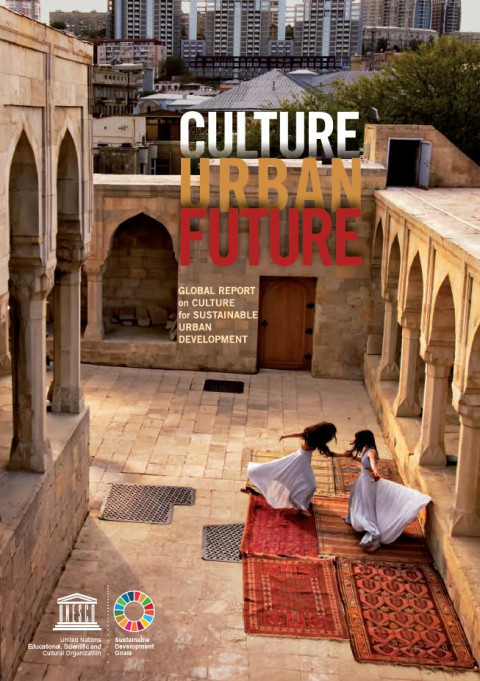 Culture: Urban Future; Global Report on Culture for Sustainable Urban Development Année de publication: 2016 Auteur institutionnel: UNESCO As the cornerstone of society, culture must lie at the heart of sustainable policies and strategies. Yet, despite its vital importance, key questions such as: ‘How has culture influenced urban development across the world?’ and ‘How can culture make a difference to our urban future?’ have often remained unexplored.This report, the first of its kind, explores the role of culture for sustainable urban development. It is intended as a policy framework document to support governments in the implementation of the 2030 Agenda for Sustainable Urban Development and the New Urban Agenda.In search of a common thread between the past and the future, the report examines the contribution of culture to urban sustainability from two analytical angles: a global survey implemented with nine regional partners across the world; and key thematic insights. The report thus analyses the situation, trends, threats and existing opportunities in different regional contexts, and presents a global picture of urban heritage safeguarding, conservation and management, as well as the promotion of cultural and creative industries, as resources for sustainable urban development. The report also includes a set of maps and a section on UNESCO’s strategic networks reflecting the Organization’s various fields of competence.Building on the findings of this global research and thematic reflection, the report presents new guidelines and recommendations, rooted in culture, to ensure that the cities of tomorrow are safe, inclusive, resilient and sustainable.
 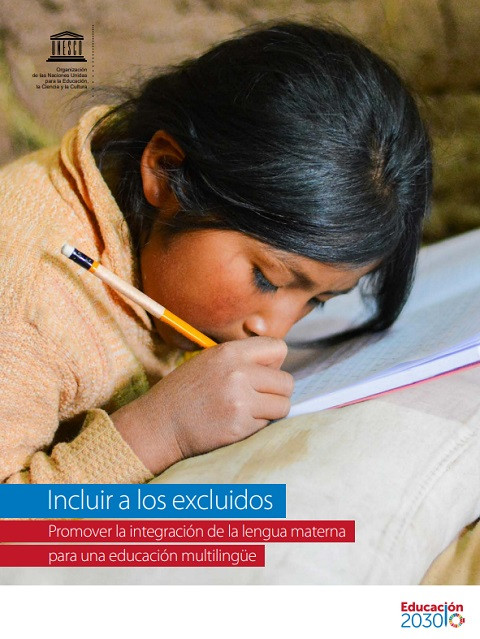 Including the Excluded: Promoting the Integration of the Mother Tongue for a Multilingual Education Année de publication: 2020 Auteur institutionnel: UNESCO This publication presents the advantages of including the mother tongue and promoting multilingual education, as well as guidelines for achieving it. Incluir a los excluidos: Promover la integración de la lengua materna para una educación multilingüe Année de publication: 2020 Auteur institutionnel: Organización de las Naciones Unidas para la Educación, la Ciencia y la Cultura (UNESCO) Esta publicación presenta las ventajas de incluir la lengua materna y promover una educación multilingue, así como orientaciones para lograrlo.
  Education for 'global citizenship': a framework for discussion Année de publication: 2013 Auteur: Sobhi Tawil Auteur institutionnel: Organisation des Nations Unies pour l'éducation, la science et la culture (UNESCO) La notion de ‘citoyenneté mondiale’ a récemment pris de l'importance dans le discours du développement international avec la Première Initiative Éducation Modiale adoptée récemment du Secrétaire Général de l’ONU(2012). Parmi les trois domaines prioritaires énoncés dans cette initiative mondiale, la troisième vise à ‘favorsier citoyenneté mondiale'. L'éducation doit assumer pleinement son rôle central en aidant les gens à forger plus justes, des sociétés pacifiques, tolérantes et inclusives. Il faut donner aux gens la compréhension, les compétences et les valeurs dont ils ont besoin de coopérer pour résoudre les défis interdépendants du 21ème siècle. La notion de ‘citoyenneté mondiale’, cependant, reste très large, sinon contestée, et par conséquent difficile à appliquer dans l'éducation. Il y a deux raisons possibles pour cela. Tout d'abord, il est difficile de savoir si la notion même de ‘citoyenneté mondiale’ est une métaphore, une contradiction dans les termes, ou un oxymore (Davies, 2006). Qu'est-ce que la ‘citoyenneté mondiale’ implique peut-être à la fois d'un point de vue juridique, ainsi que de celle de l'identité collective, le sentiment d'appartenance et l'engagement civique? Deuxièmement, lorsqu'il est appliqué à l'éducation, la notion de ‘citoyenneté mondiale’ implique un certain degré de confusion. Est-ce que 'éducation à la citoyenneté mondiale’(ou ‘éducation pour la citoyenneté mondiale’) est seulement une expression d'un objectif fondamental des systèmes éducatifs? Est-ce qu'il se réfère également à un large domaine de l'enseignement et l'apprentissage? Si oui, quels sont les contours de ce domaine? Comment est-elle liée à d'autres domaines qui se recoupent souvent de l'apprentissage associés à la socialisation civique et politique?
  Reflexiones Sobre el Progreso, el Desarrollo Sostenible y la Ciudadanía Mundial Année de publication: 2013 Auteur: Georges Haddad Auteur institutionnel: Organización de las Naciones Unidas para la Educación, la Ciencia y la Cultura (UNESCO) Los argumentos desarrollados en esta breve ponencia ponen de manifiesto que el desarrollo sostenible, el progreso y la ciudadanía mundial sólidamente arraigados en la Sociedad del Conocimiento contribuyen indudablemente a construir este Nuevo Humanismo promovido por la Directora General de la UNESCO, y que todos coincidimos en considerar esencial para la riqueza y la prosperidad de la Humanidad, en un entorno común grato, pacífico y cordial.
  Education pour le développement durable: bonnes pratiques en matière de biodiversité Année de publication: 2012 Auteur institutionnel: Organisation des Nations Unies pour l'éducation, la science et la culture (UNESCO) To support the growing interest in biodiversity issues and ESD, UNESCO is publishing this volume containing 24 examples of programmes addressing biodiversity in ESD settings and practices. These good practices and shared experiences, which were provided by a range of different stakeholders, are concrete examples of successful implementation of ESD in different fields and sectors, from the political to the school level, and including formal, non-formal and informal learning situations. Education for sustainable development; good practices in addressing biodiversity Année de publication: 2012 Auteur institutionnel: UNESCO To support the growing interest in biodiversity issues and ESD, UNESCO is publishing this volume containing 24 examples of programmes addressing biodiversity in ESD settings and practices. These good practices and shared experiences, which were provided by a range of different stakeholders, are concrete examples of successful implementation of ESD in different fields and sectors, from the political to the school level, and including formal, non-formal and informal learning situations.
  Fighting racism and discrimination: identifying and sharing good practices in the International Coalition of Cities Année de publication: 2012 Auteur institutionnel: UNESCO Since the establishment of the International Coalition, UNESCO has headed the regional scientific committees. In this role, UNESCO receives reports from cities in fulfilment of formal or informal requirements of their membership. These reports showcase the efforts of cities showcase the efforts of cities in addressing the Ten Point Plan of commitments for their respective region. UNESCO undertakes its efforts based on the information provided by the city in its report. First, it provides feedback to the cities on their efforts. The report identifies promising practices and highlights areas where additional work can be undertaken. Second, the reports from cities provide information that can be used for a variety of purposes including the publication of this report of good practices in anti-discrimination. The contents of this report reflect the information shared by Member Cities and as current Member Cities become increasingly active and new ones join the Coalition, the collection of good practices will undoubtedly expand.The purpose of this good practices report is two-fold. First, it draws together a collection of good practices in anti-discrimination of Member Cities so that they can inspire and inform the policies and practices of other cities. Second, the report uses major themes related to the different roles and domains of cities to inform and indeed, encourage critical reflection on anti-discrimination work in these areas. Several key objectives underlie the report:• Reflect on the different roles and capacities of cities and provide a framework to understand and assess their policies and practices;• Present, in one publication, examples of a wide variety of good practices; Provide a useful resource on anti-discrimination for stakeholders including city staff and representatives, community organisations, researchers, as well as interested individuals and groups; • Contribute to the successful networking of cities underway through the coalition;• Highlight the fact that even if there are challenges to engaging in anti-discrimination work, and that city representatives may feel limited, there are multiple actions that they can undertake.