
Ressources
Explorez une large gamme de ressources sur le GCED afin d’approfondir votre compréhension et de renforcer vos activités de recherche, de plaidoyer, d’enseignement et d’apprentissage.
884 résultats trouvés
 Radicalization in Central Asia: Have We Managed to Avoid It? Année de publication: 2020 Auteur: Milan Lazovic Auteur institutionnel: Russian International Affairs Council Central Asia is a very multifaceted, multi-ethnic, multi-confessional region, where many cultures, national traditions and ways of life intersect, united by a common factor - religious. The authors of the chapter on the role of religion in Central Asia in the book "Religion, Conflict, and Stability in the Former Soviet Union", prepared by the analytical center "RAND Corporation", touched upon a very important, significant and influential topic on the region. Experts note that, despite the success of Central Asia's attempts to avoid large-scale radicalization, there is a risk of its expansion today. Радикализация в Центральной Азии: удалось ли избежать? Année de publication: 2020 Auteur: Milan Lazovic Auteur institutionnel: Russian International Affairs Council Центральная Азия представляет собой весьма многогранный, полиэтнический, многоконфессиональный регион, где пересекаются множество культур, национальных традиций и укладов, объединенных общим фактором — религиозным. Авторы главы о роли религии в Центральной Азии в книге «Religion, Conflict, and Stability in the Former Soviet Union», подготовленной аналитическим центром «RAND Corporation», затронули весьма важную, значимую и имеющую широкое влияние на регион, тему. Специалисты отмечают, что, несмотря на успех попыток Центральной Азии избежать масштабной радикализации, риск ее расширения в наши дни существует.
  Strategies to End School-Related Gender-Based Violence: The Experience of Education Unions in Africa Année de publication: 2019 Auteur: Rex Fyles Auteur institutionnel: Education International (EI) | United Nations Girls' Education Initiative (UNGEI) | Gender at Work This document draws on the experience of nine EI member organisations in seven African countries committed to combatting SRGBV in their contexts. It presents the wide range of actions and strategies education unions can initiate to confront the challenges SRGBV poses to their students, members, organisations and societies. This collection of union experiences is intended to inform and inspire education unions and their members to test their own approaches to eliminating SRGBV. The document will also inform other stakeholders in the education sector interested in learning more about the unique strengths and specific roles education unions can play as partners in collective efforts to end SRGBV.The document is divided into two parts. The first section focuses on actions these unions have taken internally to adapt decision- making structures, update policies and deploy resources to empower their members to act. The second section looks at how education unions have reached out to other stakeholders – legislators, ministries, civil society organisations, traditional leaders, parents, media and learners – to pursue coordinated strategies for change. Estrategias para poner fin a la violencia de género en el ámbito escolar: La experiencia de los sindicatos de la educación en África Année de publication: 2019 Auteur: Rex Fyles Auteur institutionnel: Education International (EI) | United Nations Girls' Education Initiative (UNGEI) | Gender at Work Este documento se basa en la experiencia de nueve organizaciones afiliadas de la IE en siete países africanos comprometidos a combatir la VGAE en sus contextos. Presenta una amplia gama de acciones y estrategias que los sindicatos pueden iniciar para afrontar los desafíos que plantea la VGAE a sus estudiantes, miembros, organizaciones y sociedades. El propósito de esta colección de experiencias sindicales es informar e inspirar a los sindicatos de la educación y sus miembros para que pongan a prueba sus propias iniciativas para eliminar la VGAE. El documento también informará a otros grupos, del sector educación, interesados en aprender más sobre las fortalezas únicas y el papel específico que los sindicatos de la educación pueden desempeñar como socios en los esfuerzos colectivos para acabar con la VGAE.El documento está dividido en dos partes. La primera sección se enfoca en acciones que estos sindicatos han emprendido internamente para adaptar las estructuras de toma de decisiones, actualizar las políticas y desplegar recursos para empoderar a los y las miembros para actuar. La segunda sección da una mirada a cómo los sindicatos de la educación han llegado a otros grupos de interés – legisladores, ministerios, organizaciones de la sociedad civil, líderes tradicionales, padres, medios de comunicación y estudiantes – para desarrollar estrategias coordinadas hacia el cambio. Stratégies pour éradiquer la violence fondée sur le genre en milieu scolaire : L’éxperience des syndicats de l’éducation en afrique Année de publication: 2019 Auteur: Rex Fyles Auteur institutionnel: Education International (EI) | United Nations Girls' Education Initiative (UNGEI) | Gender at Work Le présent document puise dans l’expérience de neuf organisations membres de l’IE dans sept pays africains engagés dans la lutte contre la VGMS dans leur contexte particulier. Il présente la large gamme d’actions et de stratégies que peuvent mettre en œuvre les syndicats de l’enseignement pour relever le défi que la VGMS pose à leurs membres et à leurs élèves, à leurs organisations et à leurs sociétés. Ce recueil d’expériences syndicales est destiné à informer et à encourager les syndicats de l’enseignement et leurs membres à tester leurs propres démarches pour éliminer la VGMS. Il éclairera également les autres acteurs de l’enseignement qui souhaitent en savoir davantage sur les forces uniques et les rôles spécifiques que peuvent jouer les syndicats de l’enseignement dans les efforts collectifs pour mettre fin à la VGMS.Ce document est organisé en deux parties. La première section examine les mesures prises par ces syndicats à l’interne pour adapter leurs structures décisionnelles, mettre à jour leurs politiques et déployer les ressources nécessaires pour permettre à leurs membres d’agir. La seconde section étudie la façon dont les syndicats de l’enseignement ont amorcé le dialogue avec d’autres parties prenantes (législateurs, ministères, organisations de la société civile, responsables traditionnels, parents, médias et élèves) pour mettre en œuvre des stratégies de changement coordonnées.
 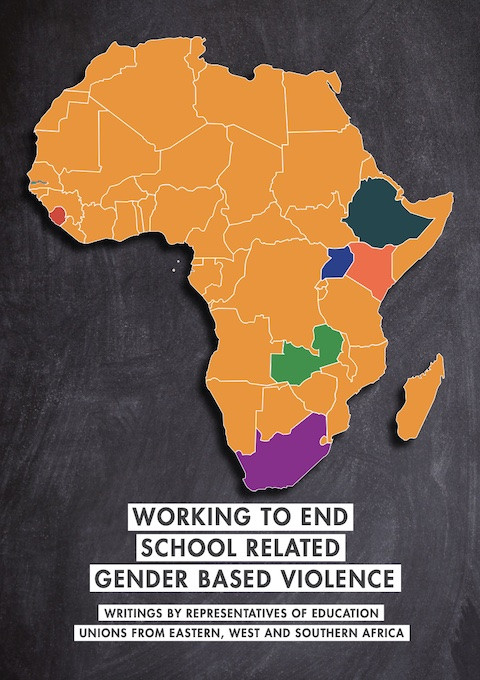 Working to End School Related Gender Based Violence: Writings by Representatives of Education Unions From Eastern, West and Southern Africa Année de publication: 2019 Auteur: Shamim Meer Auteur institutionnel: Gender at Work | Labour Research Service (LRS) | Global Affairs Canada (GAC) | United Nations Girls' Education Initiative (UNGEI) | Education International (EI) School Related Gender Based Violence (SRGBV) is violence that undermines the bodily integrity, human rights, and gender equality of all those involved in the school but primarily that of the school child.In 2016, 7 teacher unions i.e. SADTU and NAPTOSA from South Africa, BETUZ and ZNUT from Zambia, UNATU from Uganda, ETA from Ethiopia and KNUT from Kenya and in 2018, SLTU from Sierra Leone, GTU from the Gambia and the staff from the Ghana-based Education International Regional Africa Office - actively engaged in a Gender at Work - Gender Action Learning Process (GAL).The main aim of this specific GAL process was to create a participatory EI pilot program in Southern, East and West Africa focusing on individual teachers’ and teacher unions’ capacity to address SRGBV. With the support of Gender at Work facilitators, participants strengthened their understanding of gender inequality and gender based violence in the context of the school. Throughout the GAL Process participants spoke from their hearts, sharing inspirational stories of change.
  Sexual Violence and the News Media: Issues, Challenges and Guidelines for Journalists in India Année de publication: 2021 Auteur: Chindu Sreedharan | Einar Thorsen Auteur institutionnel: UNESCO New Delhi This report presents the findings of a multilingual national study on the news reporting of sexual violence in India. Drawing on a content analysis of 10 newspapers covering six languages, and semi-structured interviews with 257 journalists working across 14 languages, it provides comparative insights into the routines journalists follow and the challenges they face when they cover sexual violence.The report evidences how news outlets tend to disproportionately publish unusual cases, such as those involving extreme brutality; focus on rape in urban areas; and rely heavily on police sources. Journalists rarely undertake in-depth inquiries into the cases they cover. The challenges they face include safety issues while newsgathering, difficulties in accessing key sources, and distress from the requirements of their assignments. Overall, nearly 20% of our respondents experienced psychological challenges while reporting on sexual violence, and 55% of women journalists reported workplace sexual harassment or violence.Based on the evidence, the report presents seven national and 10 organisational recommendations. It concludes by offering guidelines that individual journalists and media houses can adapt to suit their news routines.
 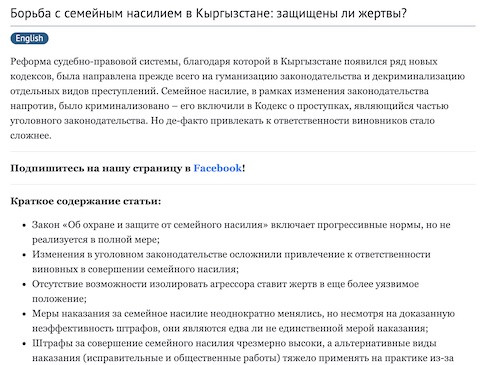 Curbing Domestic Violence in Kyrgyzstan: Are Victims Protected? Année de publication: 2020 Auteur: Anna Zubenko Auteur institutionnel: Central Asian Bureau for Analytical Reporting (CABAR) | Institute for War and Peace Reporting (IWPR) In this article, the author analyzes some of the results of the reforms of the judicial and legal system, thanks to which a number of new codes appeared in Kyrgyzstan, was aimed primarily at the humanization of legislation and decriminalization of certain types of crimes. On the contrary, domestic violence was criminalized as part of the legislative amendments - it was included in the Misdemeanor Code, which is part of the criminal law. However, according to the author, it has become more difficult to prosecute the perpetrators de facto.
  Gender Equality and Empowerment of Women and Girls in the UK: Meeting the Challenge of the Sustainable Development Goals Année de publication: 2016 Auteur: Holly Dustin | Helen Mott | Nicola Waterworth | Gillian Cowell | Janet Veitch Auteur institutionnel: British Council This research provides the first stocktake of gender equality in the UK from the perspective of the UN’s Sustainable Development Goals (SDGs), the 17 goals adopted by world leaders in 2015 in order to end poverty, protect the planet and ensure prosperity for all.It focuses on the UK’s successes towards achieving gender equality, as well as gaps and priorities for further action in five key areas: participation, power and leadership; education; economy; justice and violence against women and girls and culture (including arts, sports and technology). There are many examples of good practice from the UK, such as strong legislation, data gathering and structures. However, the research also concludes that women and girls continue to lag behind men and boys on key rights, opportunities and well-being, with men over-represented in almost all positions of power and decision-making. It also explores the impact of international linkages and collaboration to determine whether as the UK’s cultural relations organisation, there is a role for the British Council in this.
  Transformative Education: Bridging Education for Change Année de publication: 2021 Auteur: Jana Arbeiter | Maja Bučar Auteur institutionnel: Bridge 47 This publication suggests that improvements in the areas of coordination, cooperation, awareness raising and capability development are needed, as outlined in the recommendations below. Policies and strategies at national, regional and global level should adopt overarching visions for transformative education in the form of overarching strategies for SDG Target 4.7. Mechanisms for coordination and collaboration between the different components of SDG Target 4.7 should be established at national, regional and global levels. Awareness of the role of transformative education and SDG Target 4.7 in contributing to more just and sustainable futures should be raised jointly between the different components of SDG Target 4.7. Opportunities for capacity building and upskilling of practitioners and learners linked to transformative education should be enabled and created at national, regional and global levels.