
Ressources
Explorez une large gamme de ressources sur le GCED afin d’approfondir votre compréhension et de renforcer vos activités de recherche, de plaidoyer, d’enseignement et d’apprentissage.
3,446 résultats trouvés
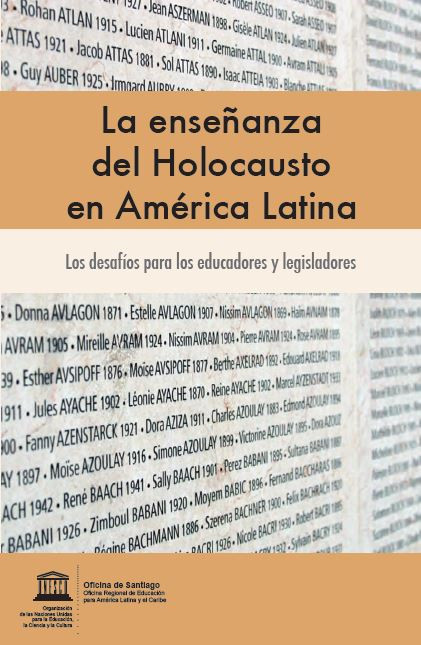 The Teaching of the Holocaust in Latin America the Challenges for Educators and Legislators Année de publication: 2017 Auteur: María Celeste Adamoli | Emmanuel Kahan, Pablo Luzuriaga | Ministerio de Educación Auteur institutionnel: UNESCO Santiago This book provides an overview of opportunities that may arise from educating about the Holocaust in diverse cultural contexts and educational situations, with a special focus on Latin American countries. We can actually be away from the places where the genocide against the Jewish people was perpetrated, but Latin America is still taking charge of its own past of violence and crimes against humanity. With this publication, Latin American educators will have at their fingertips an updated account of the most outstanding topics that are discussed on pedagogy and policy making. You can also explore how, even today in Europe, education about the Holocaust shapes a culture of memory. On the other hand, you can see how in other places the memory of the Holocaust can be a starting point to relate to other difficult pasts. UNESCO is convinced that the prevention of genocide begins at school. In a world where mass violence is possible, this publication will show the importance of teaching young people about the Holocaust and about other genocides in history. It is a condition to prevent similar crimes from happening in the future. La Enseñanza del Holocausto en América Latina: los desafíos para los educadores y legisladores Année de publication: 2017 Auteur: María Celeste Adamoli | Emmanuel Kahan, Pablo Luzuriaga | Ministerio de Educación Auteur institutionnel: UNESCO Santiago Este libro proporciona un panorama de oportunidades que pueden surgir de educar sobre el Holocausto en diversos contextos culturales y situaciones educativas, con un foco especial en los países latinoamericanos. Podemos en realidad estar lejos de los lugares donde el genocidio contra el pueblo judío fue perpetrado, pero también América Latina está todavía haciéndose cargo de su propio pasado de violencia y crímenes contra la humanidad. Con esta publicación, los educadores latinoamericanos van a tener al alcance de la mano un recuento actualizado de los temas más destacados que se discuten sobre pedagogía y construcción de políticas. También podrán explorar cómo, todavía hoy en Europa, la educación sobre el Holocausto da forma a una cultura de la memoria. Por otra parte, pueden ver cómo en otros lugares la memoria del Holocausto puede ser un punto de partida para relacionarse con otros pasados difíciles. La UNESCO está convencida de que la prevención del genocidio comienza en la escuela. En un mundo en donde la violencia masiva es posible, esta publicación mostrará lo importante de enseñar a los jóvenes sobre el Holocausto y sobre otros genocidios en la historia. Es una condición para prevenir que crímenes similares sucedan en el futuro.
  Religion and Belief Issues in the Countries of Central Asia (Kyrgyzstan, Kazakhstan, Uzbekistan, Tajikistan) and Russia in the Media; April 2016 - April 2017 Année de publication: 2017 Auteur: Evgeny Zavyalov Auteur institutionnel: Open Position (Kyrgyzstan) This publication is a review of news on religion and belief issues that appeared in the media from April 2016 to April 2017, in Central Asia (Kyrgyzstan, Kazakhstan, Uzbekistan, Tajikistan) and Russia. The materials included in the publication were distributed monthly on a newsletter including members of religious communities and experts working on issues of religion and belief. Вопросы религии и убеждений в странах Центральной Азии (Кыргызстан, Казахстан, Узбекистан, Таджикистан) и России в материалах СМИ. Апрель 2016 г. - апрель 2017 г. Année de publication: 2017 Auteur: Evgeny Zavyalov Auteur institutionnel: Open Position (Kyrgyzstan) Настоящее издание представляет собой обзор новостей по вопросам религии и убеждений, вышедших в СМИ в период с апреля 2016 по апрель 2017 года, по странам Центральной Азии (Кыргызстан, Казахстан, Узбекистан, Таджикистан) и России. Вошедшие в публикацию материалы ежемесячно рассылались по рассылке, включающей членов религиозных общин и экспертов, занимающихся вопросами религии и убеждений.
  The UNESCO and the Culture of Peace Année de publication: 2008 Auteur: Ahmed Al-Azri Auteur institutionnel: Oman National Commission for Education, Culture and Science The author presents the projects undertaken by the Sultanate of Oman to spread the culture of peace in its educational institutions. The author links this movement with what UNESCO aims to spread the culture of peace around the world. اليونسكو وثقافة السلام Année de publication: 2008 Auteur: Ahmed Al-Azri Auteur institutionnel: Oman National Commission for Education, Culture and Science يعرض الكاتب المشاريع التي تقوم بها سلطنة عمان لنشر ثقافة السلام في مؤسساتها التعليمية. ويربط الكاتب هذا الحراك مع ما ترمي إليه اليونسكو في نشر ثقافة السلام حول العالم.
 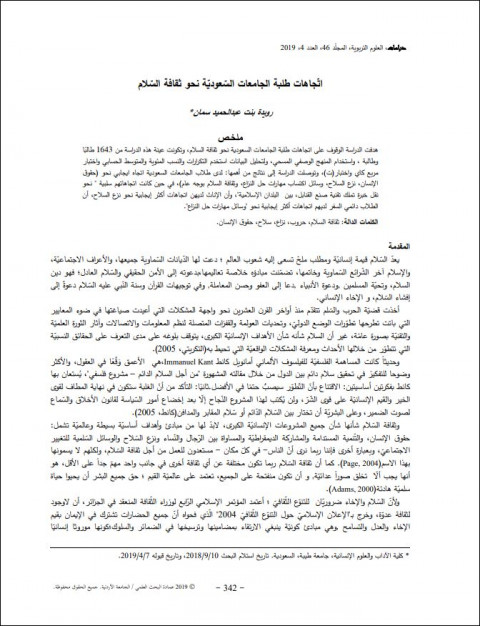 Saudi University Students’ Attitude Towards a Culture of Peace Année de publication: 2019 Auteur: Rowaidah Abdulhameed Saman Auteur institutionnel: University of Jordan The aim of this study is to identify the attitudes of Saudi Universities’ students towards peace culture. The descriptive surveying approach was used on a sample of 1643 students. The frequency, percentages, arithmetic mean, Kay-box test, and T-test were used in the analysis. The results showed that Saudi students have a positive attitude towards (human rights, disarmament, conflict resolution skills, peace culture) while their attitudes were negative towards transferring bomb-making experience to Islamic countries. Also, females had more positive attitudes towards disarmament than male students. اتّجاهات طلبة الجامعات السّعوديّة نحو ثقافة السّلام Année de publication: 2019 Auteur: Rowaidah Abdulhameed Saman Auteur institutionnel: University of Jordan هدفت الدراسة الوقوف على اتجاهات طلبة الجامعات السعودية نحو ثقافة السلام، وتكونت عينة هذه الدراسة من 1643 طالبا وطالبة، واستخدام المنهج الوصفي المسحي، ولتحليل البيانات استخدم التكرارات والنسب المئوية والمتوسط الحسابي واختبار مربع كاي واختبار (ت)، وتوصلت الدراسة إلى نتائج من أهمها: لدى طلاب الجامعات السعودية اتجاه إيجابي نحو (حقوق الإنسان، نزع السلاح، وسائل اكتساب مهارات حل النزاع، وثقافة السلام بوجه عام)، في حين كانت اتجاهاتهم سلبية "نحو نقل خبرة تملك تقنية صنع القنابل، بين البلدان الإسلامية"، وأن الإناث لديهن اتجاهات أكثر إيجابية نحو نزع السلاح، أن الطلاب دائمي السفر لديهم اتجاهات أكثر إيجابية نحو "وسائل مهارات حل النزاع".
  The Role of Education Towards Enhancing the Peaceful Coexistence Culture and Devoting the Citizenship Values of Postmodern Society Année de publication: 2019 Auteur: Lilia Bensouilah Auteur institutionnel: Research & Development of Human Resources Center REMAH This study aims to examine the role of education in creation the peaceful coexistence culture, promote opportunities for cosmopolitan openness to the other, preserve mutual respect and legitimize culture of difference, tolerance and pluralism of religions, beliefs and ideologies away from all manifestations of intolerance, hatred and destructive conflicts that violate human rights. دور التعليم في تعزيز ثقافة التعايش السلمي وتكريس قيم المواطنة في سياق مجتمع ما بعد الحداثة Année de publication: 2019 Auteur: Lilia Bensouilah Auteur institutionnel: Research & Development of Human Resources Center REMAH تركز الورقة على تحليل دور التعليم وبحث المجهودات العالمية والمساعي الدولية في سياق مجتمعي لما بعد الحداثة نحو تعزيز ثقافة التعايش السلمي وتكريس قيم المواطنة بما يتوافق مع المنظور الحقوقي الإنساني، وما ينبثق عنه من احترام وتقبل لتعددية واختلاف المذاهب والأديان والأيديول وجيات والثقافات بعيدا عن كل مظاهر التعصب الفكري المذهبي والعرقي والذي يمكن أن يهيأ بيئة محفزة لنشوب النزاعات المسلحة والصراعات المدمرة المنتهكة الكيان الحقوقي للبشرية قاطبة.