
Ressources
Explorez une large gamme de ressources sur le GCED afin d’approfondir votre compréhension et de renforcer vos activités de recherche, de plaidoyer, d’enseignement et d’apprentissage.
3,446 résultats trouvés
 Intolerance and Its Relationship to Extremism and Violence Année de publication: 2017 Auteur: Jad Al-Karim Al-Jabaei | Aladdin Zaatari | Karim Abu Halawa Auteur institutionnel: Damascus Center for Research and Studies This document is a set of research papers discussing intolerance and its relationship to extremism and violence. In this production, the researchers tried to shed light on one of the issues facing societies, which is intolerance. التعصب وعلاقته بالتطرف والعنف Année de publication: 2017 Auteur: Jad Al-Karim Al-Jabaei | Aladdin Zaatari | Karim Abu Halawa Auteur institutionnel: Damascus Center for Research and Studies مجموعة من الأوراق البحثية تناقش التعصب وعلاقته بالتطرف والعنف. حاول الباحثون في هذا الانتاج تسليط الضوء على واحد من القضايا التي تواجه المجتمعات وهو التعصب.
  Manuscript Heritage of Uzbekistan and Its Current State Année de publication: 2021 Auteur: Asror Abdukhakimov The study of the cultural and educational heritage of past centuries, developed by the entire history of mankind, is one of the main tasks in the construction of a new society and its culture, because only accurate knowledge of culture and science created by the entire development of mankind, and their processing can build a progressive culture. Of particular importance in this is the study of medieval written sources, which are one of the main sources of information about the historical past of people. Рукописное наследие Узбекистана и его современное состояние Année de publication: 2021 Auteur: Asror Abdukhakimov Изучение культурно-просветительского наследия прошлых веков, выработанного всей историей человечества, является одной из основных задач в постройке нового общества и его культуры, ибо только точным знанием культуры и науки, созданной всем развитием человечества, только их переработкой можно строить прогрессивную культуру. Особое значение в этом имеет исследование средневековых письменных источников, которые являются одним из основных источников сведений об историческом прошлом народов.
  Backtalk: The Participatory Film and Its Residency in the Space of Cultural Violence and Creative Education towards a Conceptual Understanding of Peace Année de publication: 2017 Auteur: Ruchika Gurung Auteur institutionnel: Mahatma Gandhi Institute of Education for Peace and Sustainable Development (MGIEP) Cultural violence is defined as the beliefs, attitudes and values that justify structural and direct violence (Galtung 1990). It dulls us into seeing exploitation and repression as normal or in not actively witnessing it, and the media plays a vital role in its dissemination. Media and in particular film studies occupies a space through which notions of culture, ideology, peace and violence are negotiated.While the observational approach to film is well established in education, participatory filmmaking as an educational tool is what this paper addresses, with reference to concepts of cultural violence and peace education.This paper uses Brantmeier’s (2011) five stage model, that encourages social and cultural change towards a future that is nonviolent, sustainable and renewable, and Bery’s (2003) conceptualisation of empowerment to propose that participatory film functions as a transformative creative process and challenges notions of identity and culture while helping learners describe the world around them (Zembylas & Bekerman 2013).Through analysing existing cases in the field of participatory video (Schwab-Cartas & Mitchell 2014), the author argue that participatory film functions as a tool for creative education practices that promotes a more hands-on approach to raising awareness about cultural violence and engaging with identity formation, and as a creative tool for knowledge creation and dissemination.
 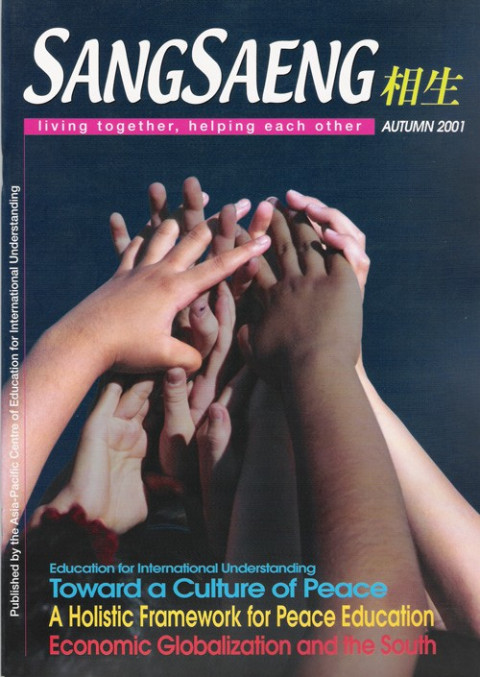 Education for international understanding: toward a culture of peace (SangSaeng vol1. autumn 2001) Année de publication: 2001 Auteur: Swee-Hin Toh Auteur institutionnel: APCEIU Over the past several decades of political, economic, social and cultural changes and developments throughout the world, the idea of education for international understanding (EIU) has evolved through the work of innumerable educators, researchers, institutions and organizations. Initially, the focus in school and tertiary programs tended to emphasize the need to increase the level of knowledge about other nations, societies and cultures as a key means to promote better, more “peaceful” international (economic and political) and intercultural relations. Especially in universities of the “North,” area studies of different regions and countries expanded and found their way into school-based curricula. In part, EIU was deemed important and helpful in the development of human resources needed to implement foreign aid programs. It was also a response to the increased internationalization of campuses due to the growing numbers of foreign/overseas students. By the 60s, however, a variety of social and political forces and movements were beginning to impact on this earlier focus of EIU. First, it was no longer viewed only in terms of understanding the relations between “nations” or “societies” across political and economic boundaries. EIU would need also to look closely at local and internal issues, and at problems of one’s own society that might significantly influence the direction and nature of international relations. Furthermore, conceptual perspectives on EIU began to reflect a spectrum of frameworks of understanding and analysis, from “conservative” and “liberal” to more “critical” paradigms. Underpinning the critical approaches was a questioning of the power inequities characterizing the international order of nation-states, and the need to overcome such gaps if the original vision of “world peace” was to be fulfilled. Third, the evolving theory and practice of EIU took on a host of societal, international and increasingly global issues deemed urgent at all levels of life. Education for international understanding: toward a culture of peace (SangSaeng vol1. autumn 2001) Année de publication: 2001 Auteur: Swee-Hin Toh Auteur institutionnel: Centre Asie-Pacifique d'éducation pour la compréhension internationale (APCEIU) Au cours des dernières décennies, des changements et des évolutions politiques, économiques, sociaux et culturels à travers le monde, l'idée de l'éducation pour la compréhension internationale (ECI) a évolué grâce au travail des éducateurs innombrables, chercheurs, institutions et organisations. Dans un premier temps, l'aCECnt dans les programmes scolaires et tertiaires ont tendance à mettre l'aCECnt sur la nécessité d'accroître le niveau des connaissances sur les autres nations, les sociétés et les cultures comme un moyen essentiel de promouvoir une meilleure, les relations internationales (économiques et politiques) et interculturelles plus «pacifiques». Surtout dans les universités du "Nord", les études régionales des différentes régions et pays développés et ont trouvé leur chemin dans les programmes scolaires. En partie, ECI a été jugé important et utile dans le développement des ressources humaines nécessaires à la mise en œuvre de programmes d'aide extérieure. Il a également été une réponse à l'internationalisation accrue du campus en raison du nombre croissant d'étudiants étrangers / outre-mer. Par les années 60, cependant, une variété de forces et de mouvements sociaux et politiques commençaient à avoir un impact sur cette orientation antérieure de ECI. Tout d'abord, il a été plus considéré seulement en termes de compréhension des relations entre les «nations» ou «sociétés» à travers les frontières politiques et économiques. ECI aurait également besoin d'examiner de près les enjeux locaux et internes, et les problèmes de sa propre société qui pourraient influencer de manière significative la direction et la nature des relations internationales. En outre, les perspectives conceptuelles sur ECI ont commencé à refléter un éventail de cadres de compréhension et d'analyse, des paradigmes «conservateurs» et «libérales» à plus «critiques». À la base des approches critiques était une remise en cause des inégalités de pouvoir qui caractérisent l'ordre international des États-nations, et la nécessité de surmonter ces lacunes si la vision originale de la «paix mondiale» devait être rempli. Troisièmement, la théorie et la pratique de ECI évolution ont pris sur une foule de questions sociétales, internationales et de plus en plus globales jugées urgentes à tous les niveaux de la vie.
  Education for international understanding: a river flowing from the mountains (SangSaeng vol5. autumn 2002) Année de publication: 2002 Auteur: Swee-Hin Toh Auteur institutionnel: APCEIU EIU (Education for International Understanding) is a concept that has diverse sources and tributaries, much like a river that begins in the mountains and flows to the sea or ocean, enriched by innumerable ideas, perspectives and practices along its journey. However, unlike a river in one community or nation, this is a river that flows across the world encompassing the breadth and depth of civilizations, peoples and mother Earth. Although by designation EIU appears to have a “modern genealogy,” it is vital to recognize and to search for its roots in the ancient wisdoms of all civilizations, especially through the values and principles of well-being, dignity and good or virtuous relationships between and among all peoples, communities and societies. EIU has been catalyzed and developed by multiple individuals, organizations, agencies and movements, including educators, researchers, national/multilateral organizations (e.g. UN agencies), NGOs, people’s organizations (POs) and other civil society movements and advocates. EIU is simultaneously practiced in all modes of education (formal, non-formal and informal), but a challenge is to attain synergy across all the modes for optimal outcomes and sustainability. Education pour la compréhension internationale: une rivière qui coule des montagnes (SangSaeng vol 5. automne 2002) Année de publication: 2002 Auteur: Swee-Hin Toh Auteur institutionnel: Centre Asie-Pacifique d'éducation pour la compréhension internationale (APCEIU) ECI (éducation pour la compréhension internationale) est un concept qui a diverses sources et affluents, un peu comme une rivière qui commence dans les montagnes et se jette à la mer ou de l'océan, enrichi par des idées innombrables, les perspectives et les pratiques le long de son voyage. Cependant, contrairement à une rivière dans une communauté ou d'une nation, cela est une rivière qui coule à travers le monde englobant la largeur et la profondeur des civilisations, les peuples et la Terre mère. Bien que par la désignation ECI semble avoir une «généalogie moderne», il est essentiel de reconnaître et de rechercher ses racines dans les anciennes sagesses de toutes les civilisations, en particulier à travers les valeurs et les principes du bien-être, la dignité et de bons ou vertueux relations entre et parmi tous les peuples, les communautés et les sociétés. ECI a été catalysée et développé par des individus multiples, les organisations, les organismes et les mouvements, y compris les éducateurs, les chercheurs, les organisations nationales / multilatérales (par exemple les agences de l'ONU), les ONG, les Organisations Populaires (OPs) et les autres mouvements de la société civile et les défenseurs. ECI est simultanément pratiqué dans tous les modes de l'éducation (formelle, non formelle et informelle), mais un défi est d'atteindre une synergie entre tous les modes pour des résultats optimaux et la durabilité.
  Global citizenship education: goals and challenges in the new millennium Année de publication: 2013 Auteur: Soonyong Pak Auteur institutionnel: APCEIU The research report examines what issues are at stake in delivering global citizenship education, a new emerging education initiative. Revisiting the conceptual and operational framework of global citizenship education, readers can have a broad picture on the current status of global citizenship education and a way forward towards effective implementation of it.