
Ressources
Explorez une large gamme de ressources sur le GCED afin d’approfondir votre compréhension et de renforcer vos activités de recherche, de plaidoyer, d’enseignement et d’apprentissage.
3,446 résultats trouvés
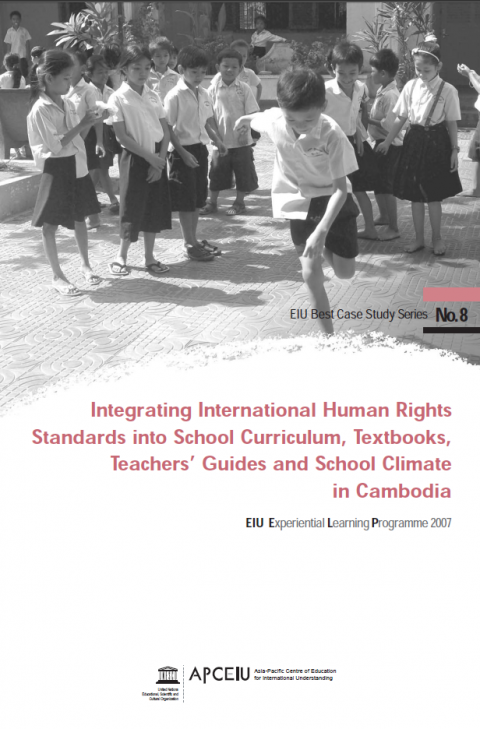 EIU Best Practice Series No.8: Integrating international human rights standards into school curriculum, textbooks, teachers' guides and school climate in Cambodia Année de publication: 2007 Auteur: Seungmi Lee | Hyewon Jung Auteur institutionnel: APCEIU It goes without saying that the aftermath of the war brings various challenges such as poverty, displacement, disability, destroyed culture, etc. and it is of critical importance that it should be well-remedied to preclude its recurrence. In this regard, value education and human rights education are considered crucial and to my mind, so is the educational role that religion can play. Although religions have harmonized the impaired society, but generally they have not been appreciated by their ignorant disciples or followers. Thus, value education is considered to be able to play a crucial role. It is in this context that human rihts education is gaining currency in Cambodia in recent years and has been implemented gradually. Préliminaire d'inventaire L'intégration des normes internationales des droits de l'homme dans les programmes scolaires, les manuels, les guides de l'enseignant et le climat scolaire au Cambodge (ECI no. 8) Année de publication: 2007 Auteur: Seungmi Lee | Hyewon Jung Auteur institutionnel: Centre Asie-Pacifique d'éducation pour la compréhension internationale (APCEIU) Il va sans dire que le lendemain de la guerre apporte de nombreux défis tels que la pauvreté, le déplacement, le handicap, la culture détruite, etc., et il est d'une importance cruciale qu'il devrait être bien remédié à empêcher qu'elle ne se reproduise. À cet égard, l'éducation de la valeur et l'éducation aux droits de l'homme sont considérés comme cruciaux et à mon avis, est donc le rôle éducatif que la religion peut jouer. Bien que les religions ont harmonisé la société avec facultés affaiblies, mais généralement ils ne sont pas appréciés par leurs disciples ou adeptes ignorants. Ainsi, l'éducation de valeur est considérée pour être en mesure de jouer un rôle crucial. Il est dans ce contexte que l'éducation rihts humaines gagne la monnaie au Cambodge ces dernières années et a été mis en œuvre progressivement.
  EIU Best Practice Series No. 5: Peace and human rights education through education for sustainable development: lessons from four case studies in the Philippines Année de publication: 2007 Auteur institutionnel: APCEIU The four case studies showed that EIU through peace and human rights education in the context of education for sustainable development can build a critical mass of Filipinos who will reject wars and promote social security. Education can play a role to direct the children, youth, and adults toward peace building and better understanding of cultural differences. It should also be noted that when institutions adopt a peace culture, establishing local and international organizations and putting up resources for various peace-building initiatives become possible. Educational intervention can effect changes in the minds of men and build a lasting and substantive foundation for peace based on justice and respect for human rights. La paix et les droits de l'éducation par l'éducation pour le développement durable: les leçons de quatre études de cas aux Philippines (Meilleure série ECI de cas d'étude no. 5) Année de publication: 2007 Auteur institutionnel: Centre Asie-Pacifique d'éducation pour la compréhension internationale (APCEIU) Les quatre études de cas ont montré que ECI par l'éducation de la paix et les droits de l'homme dans le contexte de l'éducation pour le développement durable peut constituer une masse critique de Philippins qui rejettent les guerres et promouvoir la sécurité sociale. L'éducation peut jouer un rôle pour diriger les enfants, les jeunes et les adultes vers la construction de la paix et une meilleure compréhension des différences culturelles. Il convient également de noter que lorsque les institutions adoptent une culture de la paix, la création d'organisations locales et internationales et de mettre en place des ressources pour diverses initiatives de consolidation de la paix deviennent possibles. L'intervention éducative peut effectuer des changements dans l'esprit des hommes et de construire une base durable et de fond pour la paix fondée sur la justice et le respect des droits de l'homme. EIU Best Practice Series No. 5: Peace and human rights education through education for sustainable development: lessons from four case studies in the Philippines Année de publication: 2007 Auteur institutionnel: 유네스코 아시아태평양 국제이해교육원 The four case studies showed that EIU through peace and human rights education in the context of education for sustainable development can build a critical mass of Filipinos who will reject wars and promote social security. Education can play a role to direct the children, youth, and adults toward peace building and better understanding of cultural differences. It should also be noted that when institutions adopt a peace culture, establishing local and international organizations and putting up resources for various peace-building initiatives become possible. Educational intervention can effect changes in the minds of men and build a lasting and substantive foundation for peace based on justice and respect for human rights.
  A Study on the Monitoring Framework of GCED in South Korea Année de publication: 2020 Auteur: Hwanbo Park | Daehoon Jho | Kyunghee Park | Jeongmin Eom Auteur institutionnel: APCEIU The purpose of this study is to establish a feasible monitoring system for the implementation of Global Citizenship Education (GCED) in South Korea that can both align itself with the global indicator (SDG 4.7.1) and reflect the domestic context and feasibility. The study further builds upon previous studies carried out by the Asia-Pacific Centre of Education for International Understanding (APCEIU). Particularly, it aims to refine and validate the GCED indicator system for domestic monitoring as proposed in the previous studies, which are also in line with SDG 4.7.1, the global indicator to monitor the mainstreaming of GCED/ESD.To this end, the study involved a Delphi survey and expert consultation to build the refined list and classification of GCED related thematic areas and keywords contextualized in Korea, and aligned these with global indicators so that it could establish a set of sub-indicators for the South Korean context. Then, it pilot-tested the sub-indicators by codifying and statistically analyzing key policy documents and the curricula of Teacher Education Institutes (TEIs) to validate the sub-indicators and to examine the extent to which GCED is mainstreamed in the given domains of the Korean context. Case analyses with focused interviews for some TEI curricula were also added to enrich the study. Lastly, the study draws key implications and proposes some recommendations for the establishment of a feasible and sustainable GCED monitoring system in South Korea. Considering the importance of national input in initiating the SDG agenda, the research concluded with a proposal on how to manage the global citizenship indicators in South Korea. 2020 세계시민교육 국내 모니터링 체제 구축 연구 Année de publication: 2020 Auteur: 박환보 | 조대훈 | 박경희 | 엄정민 Auteur institutionnel: 유네스코 아시아태평양 국제이해교육원 유네스코 아태교육원은 세계시민교육의 국내 모니터링을 체계화하기 위한 노력의 일환으로 “2020 세계시민교육 국내 모니터링 체제 구축 연구”를 실시, 결과물을 보고서로 발간하였다. 본 연구는 지속가능발전목표 글로벌 지표(4.7.1)에 부합하면서 국내 맥락과 실효성이 반영된 세계시민교육 이행 모니터링 체제 구축 방안을 모색하는데 목적이 있다.이를 위하여 첫째, 아태교육원의 선행 연구에서 제안한 세계시민교육 지표체계를 델파이 조사 및 전문가 협의를 통해 정교화하고 타당도를 높였으며, 둘째, 고도화된 하위지표 체계를 적용하여 국내 교육정책 및 교사교육 분야에 있어 세계시민교육 주류화 정도를 문헌연구, 통계자료 분석 등을 통하여 시범적으로 분석하였고, 이와 함께, 정책 및 교원양성교육의 사례도 제시하고 있다. 마지막으로 이러한 연구 결과를 토대로 국내 세계시민교육 모니터링 체제 구축 방안에 대한 시사점을 도출하였으며, 특히 SDGs에서 강조하는 국가별 자율적 이행을 고려하여, 한국에서 어떻게 세계시민교육 지표를 관리할 것인지에 대해 제언하였다.
 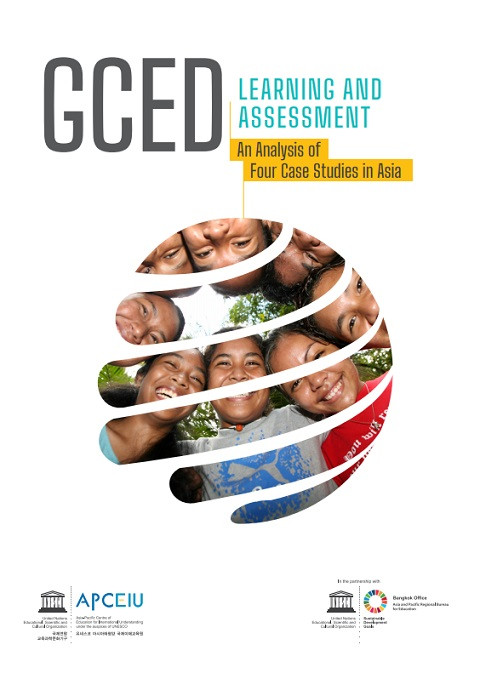 GCED Learning and Assessment: An Analysis of Four Case Studies in Asia Année de publication: 2020 Auteur institutionnel: APCEIU | UNESCO Bangkok “GCED Learning and Assessment: An Analysis of Four Case Studies in Asia” is a result report of research jointly led by UNESCO Asia-Pacific Regional Bureau for Education, the Asia-Pacific Centre of Education for International Understanding (APCEIU) and the Asia-Pacific Regional GCED Network. The report encompasses four case studies of GCED Learning in the region and its assessment. Four leading researchers in the field of GCED, Satya Bushan from the National Council of Educational Research and Training (NCERT), India; Sayaka Matsukura of Ageo Oishi Junior High School, Japan; Dawon Kim from Gwangju National University of Education, Republic of Korea; and Le Anh Vinh from the Vietnam National Institute of Educational Science (VNIES), Viet Nam, contributed to this research. Through presenting and sharing the cases of India, Japan, Republic of Korea and Viet Nam, the publication is expected to shed light on the assessment on how GCED is implemented in the region and further inspire and encourage the GCED practitioners on the ground to take another step forward to reflect GCED in their respective educational systems. <List of Contents>ForewordAcknowledgementsAcronymsExecutive summaryChapter 1: IntroductionChapter 2: Schoollevel approaches at integrating GCEDChapter 3: Assessment of GCED learning Chapter 4: Reflections on GCED learning assessment Chapter 5: Conclusions and recommendations References
  세계시민교육 국내 이행현황 연구보고서: 유·초중등학교 교육과정을 중심으로 Année de publication: 2018 Auteur institutionnel: 유네스코 아시아태평양 국제이해교육원 “세계시민교육 국내 이행현황 연구보고서 - 유·초중등학교 교육과정을 중심으로”가 발간되었다. 본 연구보고서는 세계시민교육의 실행과 성과에 대한 국가 수준의 모니터링 및 평가 연구가 희소하다는 문제의식에 기초하여 작성된 결과물이다. 특히, 국내 17개 시·도교육청 산하 유치원, 초·중·고등학교 교육과정 활동에서 세계시민의 개념이 어떻게 반영 및 실행되고 있는지를 살펴보기 위하여 탐색적 연구를 설계하고 관련 자료 조사를 실시하는데 주안점을 두었다. 또한 연구조사 결과를 토대로 동 보고서는 향후 세계시민교육이 교육현장에서 보다 명확하게 이행되고 확산될 수 있도록 하는 정책적 제언도 담고 있다.
  SDG 4.7: 세계시민교육 지표수립을 위한 기초연구 Année de publication: 2018 Auteur institutionnel: 유네스코 아시아태평양 국제이해교육원 “SDG 4.7 세계시민교육 지표수립을 위한 기초연구 보고서”가 발간되었다. 본 연구보고서는 국제적으로 합의된 글로벌 지표의 부재로 현재까지 정의가 완료되지 않은 지속가능발전목표 (SDG) 4.7 지표 개발을 위한 기초 연구이다. 즉, 동 보고서는 세계시민교육 및 SDG 4.7 지표에 관한 기존의 국내·외 연구결과를 종합적으로 검토하여 글로벌 지표에 관한 주요 논의를 정리하고, 국내 지표 개발을 위한 함의를 도출하는 데에 목적을 두고 있다. 이를 위하여 유네스코 통계원 (UIS)의 최신 SDG 4.7.1 메타데이터 연구와 국내·외 연구결과에 기초하여 국내에서 활용할 수 있는 정보와 데이터를 검토하고 있다.