
Ressources
Explorez une large gamme de ressources sur le GCED afin d’approfondir votre compréhension et de renforcer vos activités de recherche, de plaidoyer, d’enseignement et d’apprentissage.
2,776 résultats trouvés
 Teacher Policy Development Guide Année de publication: 2019 Auteur institutionnel: UNESCO | International Task Force on Teachers for Education 2030 Countries will need to have a broad perspective on teacher issues in order to meet Sustainable Development Goal 4 and address the provisions on Teachers in the Incheon Declaration with the Framework for Action of Education 2030. A system to orient the elaboration and/or review of national teacher policies will be a useful tool. The International Teacher Task Force builds on its comparative advantage as a global multiple-stakeholder alliance joining hands to address the global teacher challenges, to offer the present Teacher Policy Development Guide.Users will find relevant definitions of concepts, description of the different dimensions of teacher issues and how they correlate, and suggestions of phases in the process of developing a national teacher policy. Of utmost importance is the involvement of all stakeholders, especially the teachers, in the process.
 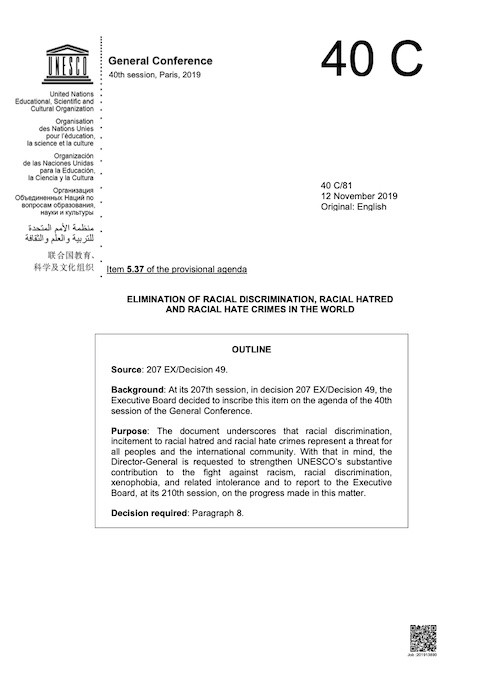 Ликвидация расовой дискриминации, расовой ненависти и преступлений на почве расовой ненависти во всем мире (Генеральная конференция; 40-я сессия) Année de publication: 2019 Auteur institutionnel: Организация Объединенных Наций по вопросам образования, науки и культуры (UNESCO) На своей 207-й сессии Исполнительный совет в решении 207 EX/49 постановил включить данный пункт в повестку дня 40-й сессии Генеральной конференции. В настоящем документе отмечается, что расовая дис- криминация, подстрекательство к расовой ненависти и преступления на почве расовой ненависти представляют собой угрозу для всех народов и международного сообщества. С учетом этого Генераль- ному директору предлагается укрепить содержательный вклад ЮНЕСКО в борьбу с расизмом, расовой дискриминацией, ксенофо- бией и связанной с ними нетерпимостью и представить Исполнитель- ному совету на его 210-й сессии доклад о достигнутых в данной обла- сти результатах. 消除世界上的种族歧视、种族仇恨和种族仇恨犯罪 Année de publication: 2019 Auteur institutionnel: 联合国教科文组织 (UNESCO) 本文件强调,种族歧视、煽动种族仇恨和种族仇恨犯罪对各国人民和国际社会构成威胁。考虑到这一点,兹要求总干事加大教科文组织对打击种族主义、种族歧视、仇外心理及相关不容忍行为的实质性贡献,并向执行局第二一〇届会议报告在这一事项上取得的进展。
  Making the Case For Inclusive Quality Physical Education Policy Development: A Policy Brief Année de publication: 2021 Auteur: Nancy McLennan Auteur institutionnel: UNESCO This evidence-based policy brief presents the benefits of investing in inclusive quality physical education (QPE) policy development. Content draws directly on findings from in-country interventions which demonstrate the value of inter-sectoral partnerships in QPE policy development and the delivery of low cost/high impact QPE programming which stands to accelerate post-COVID recovery efforts. A series of practical recommendations are included for public and private stakeholders in the sport-education ecosystem, alongside resources to support the implementation of recommendations. En defensa de un desarrollo inclusivo de políticas de educación física de calidad: Informe de políticas Année de publication: 2021 Auteur: Nancy McLennan Auteur institutionnel: Organización de las Naciones Unidas para la Educación, la Ciencia y la Cultura (UNESCO) Este informe presenta los beneficios de la inversión en el desarrollo de políticas inclusivas de educación física de calidad (EFC). Su contenido se funda directamente en evidencias observadas durante intervenciones en países que demuestran la importancia de las asociaciones intersectoriales en el desarrollo de políticas de EFC y en la ejecución de programas de EFC de bajo costo y alto impacto que ayudarán a agilizar los esfuerzos de recuperación tras la COVID. Se incluye una serie de recomendaciones para socios de los sectores público y privado en el ecosistema deportivo – educativo, así como también recursos para apoyar la aplicación de las recomendaciones. S’engager en faveur de l’élaboration inclusive de politiques d’éducation physique de qualité: Note de politique Année de publication: 2021 Auteur: Nancy McLennan Auteur institutionnel: Organisation des Nations Unies pour l'éducation, la science et la culture (UNESCO) Cette note de politique, fondée sur des faits, présente les avantages à investir dans l’élaboration inclusive de politiques d’Éducation Physique de Qualité (EPQ). Le contenu s’inspire directement des résultats issus d’interventions menées dans quatre pays, qui démontrent l’intérêt des partenariats intersectoriels dans le développement des politiques d’EPQ et de la mise en œuvre de programmes d’EPQ à faible coût/à fort impact qui devraient accélérer les efforts de rétablissement post-COVID. Cette note contient une sélection de recommandations pratiques à destination des acteurs publics et privés de l’écosystème sport-éducation, ainsi que des ressources pour soutenir la mise en œuvre de ces recommandations. القضاء على التمييز العنصري والكراهية العنصرية والجرائم الناجمة عن الكراهية العنصرية في العالم Année de publication: 2019 Auteur institutionnel: منظمة الأمم المتحدة للتربية والعلم والثقافة (UNESCO) تؤكد الوثيقة أنأشكالالتمييز العنصري والتحريض على الكراهية العنصرية والجرائم الناجمة عن الكراهية العنصرية تمثلًﺗﻬديدالكلالشعوب واﻟﻤﺠتمع الدوليبرمتهطلب ُ. ومن هذا المنطلق، يمن المديرة العامة تعزيز مساهمة اليونسكو الجوهرية في مكافحة العنصرية والتمييز العنصريوكراهية الأجانبان دور ّوما يتعلق ﺑﻬا من تعصب، وموافاة اﻟﻤﺠلس التنفيذي، إبته العاشرة بعد المائتين، بمعلوماتعن التقدم المحرز في هذا الصدد. Elimination of Racial Discrimination, Racial Hatred and Racial Hate Crimes In the World (General Conference; 40th session) Année de publication: 2019 Auteur institutionnel: UNESCO At its 207th session, in decision 207 EX/Decision 49, the Executive Board decided to inscribe this item on the agenda of the 40th session of the General Conference. The document underscores that racial discrimination, incitement to racial hatred and racial hate crimes represent a threat for all peoples and the international community. With that in mind, the Director-General is requested to strengthen UNESCO’s substantive contribution to the fight against racism, racial discrimination, xenophobia, and related intolerance and to report to the Executive Board, at its 210th session, on the progress made in this matter. Eliminación de la discriminación racial, el odio racial y los crímenes de odio racial en el mundo (Conferencia general; 40a reunión) Année de publication: 2019 Auteur institutionnel: Organización de las Naciones Unidas para la Educación, la Ciencia y la Cultura (UNESCO) En su decisión 207 EX/49, adoptada en su 207a reunión, el Consejo Ejecutivo decidió incluir este punto en el orden del día de la 40a reunión de la Conferencia General. El presente documento pone de relieve que la discriminación racial, la incitación al odio racial y los crímenes de odio racial constituyen una amenaza para todos los pueblos y para la comunidad internacional. Teniendo esto presente, se pide a la Directora General que refuerce la contribución sustantiva de la UNESCO a la lucha contra el racismo, la discriminación racial, la xenofobia y las formas conexas de intolerancia, y que informe al Consejo Ejecutivo, en su 210a reunión, sobre los progresos realizados al respecto.
 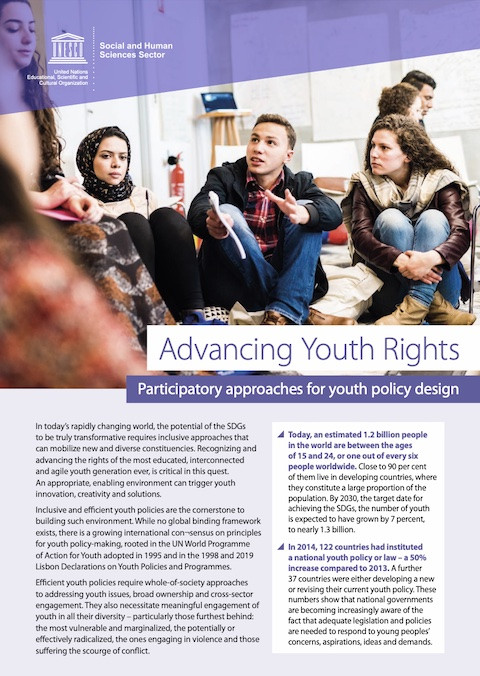 Advancing Youth Rights: Participatory Approaches for Youth Policy Design Année de publication: 2019 Auteur institutionnel: UNESCO Inclusive and efficient youth policies are the cornerstone to building such environment. While no global binding framework exists, there is a growing international con¬sensus on principles for youth policy-making, rooted in the UN World Programme of Action for Youth adopted in 1995 and in the 1998 and 2019 Lisbon Declarations on Youth Policies and Programmes. Efficient youth policies require whole-of-society approaches to addressing youth issues, broad ownership and cross-sector engagement. They also necessitate meaningful engagement of youth in all their diversity – particularly those furthest behind: the most vulnerable and marginalized, the potentially or effectively radicalized, the ones engaging in violence and those suffering the scourge of conflict.