
Ressources
Explorez une large gamme de ressources sur le GCED afin d’approfondir votre compréhension et de renforcer vos activités de recherche, de plaidoyer, d’enseignement et d’apprentissage.
3,446 résultats trouvés
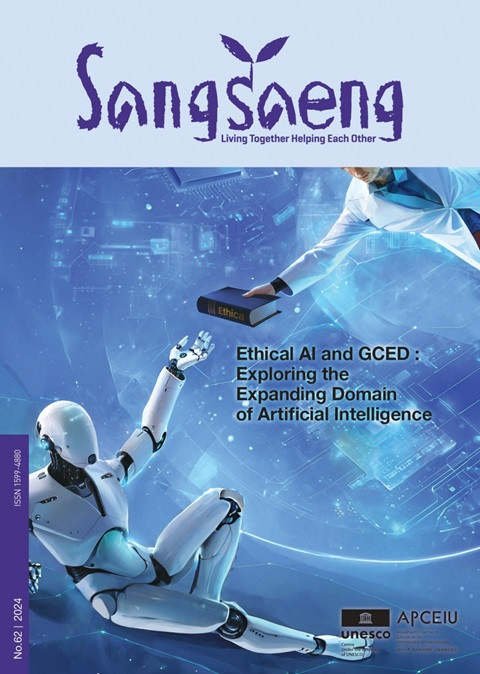 Ethical AI and GCED: Exploring the Expanding Domain of Artificial Intelligence (SangSaeng; No. 62, 2024) Année de publication: 2024 Auteur institutionnel: APCEIU The 62nd issue of SangSaeng has been published with the theme of “Ethical AI and GCED: Exploring the Expanding Domain of Artificial Intelligence.” AI has never been as pervasive and influential as it is in today’s rapidly changing world. Despite the convenience and cutting-edge technology AI has offered us, it has the potential to pose a threat to humanity. This is where ethics for AI should come forward. In this regard, this issue will lead readers to the alarming side of AI as well as its future developments, focusing on the importance of GCED and AI ethics in tackling any potential problems. Contents03 Editor's Note 04 Special ColumnEmbracing Change to Cultivate Success — Integrating Global Citizenship Education into Tertiary Education / Dendev Badarch 08 FOCUS: Ethical AI and GCED: Exploring the Expanding Domain of Artificial IntelligenceRole of Ethics in the Era of AI — Protecting and Guiding AI Processes for Humanity to Flourish / Emma Ruttkamp-BloemPaying Attention to AI Ethics — An Avenue for a New Competitive Edge in Business / Myoungshin KimDriving Innovative Education — Balancing Future Possibilities and Ethical Concerns: How GCED Can be Used to Address AI Issues / Angelique Southern 20 Special ReportEmpowering a Climate Generation — From Classrooms to Climate Frontlines: The Transformative Role of Education highlighted at COP28 / Djian Sadadou 22 Best PracticesNavigating an AI Future — Ethical AI and the Importance of Critical Thought / Hannah GrantGLACE Brings the World to a City — Empowering Youth as Global Citizens: Lessons from Navotas City’s Project GLAC / Marco D. MedurandaLowering Eco-Anxiety — Teaching Climate Change Through Media and Information Literacy / Laetitia Legrand 33 GCED YOUTH NETWORK New Wave of Youth Advocacy — Role of AI in Youth Advocacy and its Ethical Implications to Global Citizenship / Oshan M. Gunathilake and Diego Manrique 36 Understanding the Asia Pacific RegionDiscovering Auroville — Where Boundaries Fade, Nature Thrives, and Global Minds Unite / Akanksha Arya 39 Peace in My MemoryHappiness without Violence — Mindanao Peace ForumCelebrates Building a Culture of Peace / Ludivina Borja-DekitPeace Scholar Passes Away Amidst Turbulent Times / Kwang-Hyun KIM 45 Story TimeThe Right Footing — My Life Has Purpose Thanks to Football / Hajar Abulfazl 48 LetterShared Challenges of Global Citizens / Natsuki Nagata 50 APCEIU in Action
  2025 세계시민교육 국내 모니터링 체제 구축 연구 Année de publication: 2025 Auteur: 박환보 | 박경희 | 길혜지 | 강지영 | 김종훈 | 지선미 Auteur institutionnel: 유네스코 아시아태평양 국제이해교육원 유네스코 아시아태평양 국제이해교육원(APCEIU)은 한국의 맥락에서 지속가능발전목표(SDG) 4.7의 이행 현황을 파악하고자 2018년부터 세계시민교육 국내 모니터링 연구를 수행해왔다. 매년 정책, 교육과정, 교사교육, 학습자 평가 등 교육체계 전반을 대상으로 연구를 실시하며 국내 이행 현황을 분석하고, 이를 토대로 데이터 기반의 정책 환류를 도모해왔다. 2025년 연구는 이러한 연속적 노력의 일환으로, 국가·지역·학교 수준에서 세계시민교육이 어떻게 추진·실천되고 있는지를 종합적으로 검토하고자 실시되었다.본 연구는 세 가지 영역을 중심으로 이루어졌다. 첫째, 시·도교육청의 세계시민교육 관련 정책 및 사업 운영 현황을 분석하였다. 둘째, 2022 개정 초등학교 교육과정 내 세계시민교육 반영 양상을 과목별·영역별로 검토하였다. 셋째, 교사의 세계시민교육 실천 사례를 학습자 평가 측면에서 분석하였다. 이를 토대로 향후 국내 세계시민교육 모니터링을 위한 정책적 시사점도 제시하였다.이번 연구는 정책 적용 단계에서부터 현장 수업 과정에 이르기까지 국가 교육체계 전반에서 세계시민교육 이행 현황을 종합적으로 분석하였다는 점에서 의의를 지닌다. 연구 결과는 향후 세계시민교육 국내 모니터링 체제의 고도화와 SDG 4.7 글로벌 모니터링, 그리고 Post-2030 글로벌 교육 의제 논의에 참고 자료로 활용될 수 있을 것이다.
  Envisioning the Future of Assessment in Transformative Education: A Synthesis Report of the Expert Meeting on Evaluation and Assessment for Transformative Education: Towards and Beyond 2030 Année de publication: 2025 Auteur: Esther Care Auteur institutionnel: APCEIU Transformative education calls for learning that nurtures not only knowledge, but also the values, attitudes, and behaviours essential for inclusive, just, and sustainable societies. Recent global discussions, including UNESCO’s Reimagining Our Futures Together: A New Social Contract for Education and the Recommendation on Education for Peace and Human Rights, International Understanding, Cooperation, Fundamental Freedoms, Global Citizenship and Sustainable Development, emphasise learning that fosters critical thinking, empathy, cooperation, and action-oriented engagement. Within this vision, assessment needs to evolve from primarily measuring achievement to supporting a process of learning that actively enables and evidences learners’ reflection, growth, and empowerment. Traditional approaches, which prioritise standardisation and summative outcomes, are insufficient for capturing the complex competencies at the heart of transformative education, such as socio-emotional development, critical reflection, ethical reasoning, and responsible action. These limitations raise fundamental questions about not only how transformative learning outcomes can be assessed across diverse systems and contexts, but also what purposes assessment should serve.To examine these issues, APCEIU convened the Expert Meeting on Evaluation and Assessment for Transformative Education: Towards and Beyond 2030, held in Seoul, Republic of Korea, on 2–3 July 2025. The meeting brought together global experts, researchers, and policymakers to discuss current challenges, share emerging practices, and consider strategic directions for reimagining assessment in support of transformative education.Building on these rich discussions, this report synthesises the key reflections and forward-looking perspectives shared during the meeting. Part I presents analytical insights and strategic considerations for advancing assessment in transformative education, while Part II documents the meeting proceedings, including presentations and collaborative discussions.
 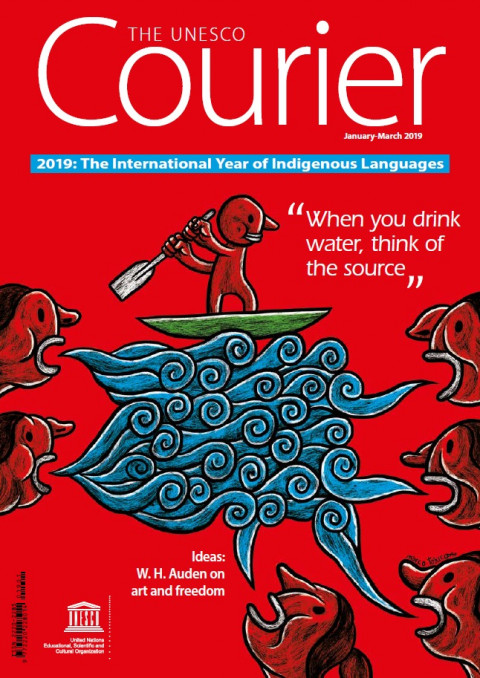 2019: The International Year of Indigenous Languages (The UNESCO Courier. January-March 2019) Année de publication: 2019 Auteur institutionnel: UNESCO With the designation of 2019 as the International Year of Indigenous Languages (IYIL2019), officially launched at UNESCO on 28 January, the international community reaffirms its commitment to supporting indigenous peoples in their efforts to preserve their knowledge and enjoy their rights. Since the adoption of the Declaration on the Rights of Indigenous Peoples (link is external) by the United Nations General Assembly on 13 September 2007, considerable progress has been made in this regard. Nevertheless, indigenous peoples still have a long way to go before they emerge from marginalization and overcome the many obstacles they face. One-third of the world’s people living in extreme poverty belong to indigenous communities, just as in a number of countries, legislation that promotes the rights of indigenous peoples remains incompatible with other laws that deal with issues such as agriculture, land, conservation, forestry, mining and other industries, according to Victoria Tauli-Corpuz (link is external), United Nations Special Rapporteur on the Rights of Indigenous Peoples. The Wide Angle section in this issue of the Courier is dedicated to these indigenous peoples. It takes its title from the Chinese proverb: “When you drink water, think of the source”, to remind us that indigenous knowledge, the source of all knowledge, deserve a prominent place in modernity. The issue also marks the celebration of International Mother Language Day (link is external), 21 February. 2019 : Année internationale des langues autochtones Année de publication: 2019 Auteur institutionnel: Organisation des Nations Unies pour l'éducation, la science et la culture (UNESCO) À une époque où la tension ne cesse de croître, où les droits de l'homme, la liberté d'expression, la paix et l'avenir de la planète semblent plus que jamais remis en question, le pouvoir de transformation véhiculé par l'éducation revêt une importance cruciale.Avec la désignation de 2019 comme Année internationale des langues autochtones(IYIL2019), lancée officiellement à l’UNESCO le 28 janvier, la communauté internationale réaffirme sa volonté de soutenir les peuples autochtones dans leurs efforts de préserver leurs savoirs et de jouir de leurs droits.Depuis l’adoption de la Déclaration sur les droits des peuples autochtones, par l’Assemblée générale des Nations Unies, le 13 septembre 2007, des avancées considérables ont été faites dans ce sens. Il n’en reste pas moins que les peuples autochtones ont encore un long chemin à parcourir avant de sortir de la marginalisation et de surmonter les nombreux obstacles auxquels ils doivent faire face. Un tiers des personnes qui vivent dans l’extrême pauvreté à travers le monde appartiennent à des communautés autochtones, de même que dans un bon nombre de pays, les législations en faveur des peuples autochtones demeurent incompatibles avec d’autres lois qui traitent notamment de l’agriculture, de la terre, de la conservation et des industries forestières ou minières, selon Victoria Tauli-Corpuz, Rapporteuse spéciale des Nations Unies sur les droits des peuples autochtones. Le dossier Grand angle de ce numéro du Courrier leur est consacré. Il emprunte son titre au proverbe chinois : « Quand tu bois de l’eau, pense à la source », pour rappeler que les savoirs autochtones, source de tous les savoirs, méritent une place prééminente dans la modernité. Il s’associe également à la célébration de la Journée internationale de la langue maternelle, le 21 février.
  Inclusive Education for Persons with Disabilities - Are We Making Progress? Année de publication: 2019 Auteur institutionnel: UNESCO | Leonard Cheshire (UK) The paper ‘Inclusive education for persons with disabilities – Are we making progress?’ has been developed as a background paper for the UNESCO International Forum on inclusion and equity in education – Every learner matters, being held in Cali, Colombia from 11-13 September 2019. The Forum is being organised in commemoration of the 25th anniversary of the passing of the Salamanca Statement and Framework for Action. The paper will explore the global progress towards inclusive education, the successes achieved and learnings observed specifically in countries of the global South. In these countries the concerns of universal access to and retention in education is still a concern for many governments, but large-scale exclusion of children with disabilities (an estimated 32 million or 1 out of 3 are out of school) remains the order of the day and is not always high on government agendas. Educación inclusiva para personas con discapacidades - ¿estamos logrando avances? Année de publication: 2019 Auteur institutionnel: Organización de las Naciones Unidas para la Educación, la Ciencia y la Cultura (UNESCO) | Leonard Cheshire (UK) El informe «Educación inclusiva para personas con discapacidades: ¿estamos logrando avances?» ha sido elaborado como documento de referencia para el Foro Internacional sobre Inclusión y Equidad en la Educación UNESCO «Todas y todos los estudiantes cuentan», que se celebrará en Cali (Colombia) del 11 al 13 de septiembre de 2019. El Foro ha sido organizado para conmemorar el 25 aniversario de la aprobación de la Declaración de Salamanca y Marco de Acción sobre Necesidades Educativas Especiales. En este informe se explora el avance mundial hacia la educación inclusiva, los éxitos logrados y las conclusiones observadas específicamente en países del hemisferio sur, donde los problemas en torno al acceso universal a la educación y la continuidad en ella siguen siendo motivo de preocupación para numerosos gobiernos y donde la exclusión a gran escala de niños con discapacidad (se estima que unos 32 millones de niños no están escolarizados, lo que supone 1 de cada 3) sigue estando a la orden del día y no siempre es una prioridad en los programas gubernamentales.
  The IIEP letter: news and analysis on educational planning and management, vol. 35, no. 1 Année de publication: 2019 Auteur institutionnel: UNESCO This issue is dedicated to addressing the challenges and opportunities for quality secondary education for all. It addresses the necessary structural and curricular changes secondary education must undergo in order to address long histories of segregation and inequality. Experiences from Latin America illustrate some key takeaways on how to match commitment with meaningful change.
  Her education, our future: snapshots of UNESCO's work Année de publication: 2019 Auteur institutionnel: UNESCO This collection provides snapshots of some of UNESCO’s efforts to empower women and girls through education. It highlights core areas of work undertaken, as profiled on the next page. The aim is to give the reader a flavour of what it is that UNESCO, including its 53 field offices and specialized institutes, is doing to transform her education and our future.
 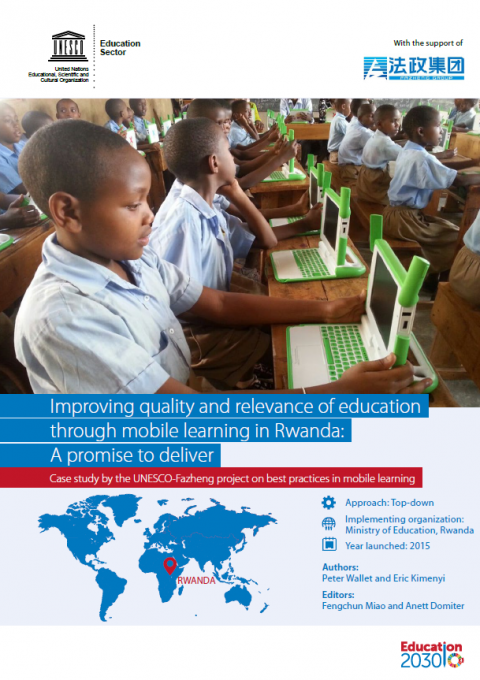 Improving quality and relevance of education through mobile learning in Rwanda: a promise to deliver: case study by the UNESCO-Fazheng project on best practices in mobile learning Année de publication: 2019 Auteur: Wallet, Peter | Kimenyi, Eric | Miao, Fengchun | Domiter, Anett Auteur institutionnel: UNESCO Rwanda’s education sector is evolving through the adoption of information and communication technology (ICT ). Whereas the focus was previously on the extensive deployment of laptop devices, it is shifting towards advancing adaptive child-centred learning and the use of ICT augmented environments to enrich teaching and learning. In developing countries, however, an orientation frequently remains to select strategies which have previously shown to be successful in developed contexts without taking into account the full range of elements required for effective implementation including a comprehensive assessment of the financial implications required to ensure longer term sustainability. This case study aims to showcase Rwanda’s customised approach to the integration of ICT in classrooms adapted to meet the particular needs of the Rwandan education system. The SMARTRwanda Master Plan lays out a vision to transform Rwanda’s economy by leveraging the use of ICT. Aligned to SMART Rwanda, the Ministry of Education (MINEDUC) is implementing the SMARTClassroominitiative under its ICT in Education Master Plan to reach all schools by 2020. Although there have been several challenges encountered during the various phases of implementation, more than half of all schools across the country are now equipped with ICT devices and many teachers have undergone various capacity-building initiatives to make better use of ICT in teaching and learning. More work is required in order to develop a fully functioning ICT in education ecosystem in Rwanda; nevertheless, this case study demonstrates progress made thus far and describes the various system stakeholders, their roles, responsibilities and contributions to date to improve access, quality and relevance of education through ICT adoption.