
Ressources
Explorez une large gamme de ressources sur le GCED afin d’approfondir votre compréhension et de renforcer vos activités de recherche, de plaidoyer, d’enseignement et d’apprentissage.
1,402 résultats trouvés
 Proposition de programme thématique sur l'éducation relative à l'eau dans le cadre de la décennie des Nations Unies pour L'Education au Service du Développement Durable (DEDD, 2005-2014) Année de publication: 2006 Auteur institutionnel: International Hydrological Programme (IHP) Water education is a very important component of UNESCO’s overall effort in water, including within the International Hydrological Programme. The UNESCO Executive Board has called for a UNESCO-wide strategy for water education at all levels. This document reviews the evolution of water education within UNESCO, and draws attention to the Draft Action Plan for the UN Decade on Education for Sustainable Development (DESD), which includes 12 Thematic Programmes one of which would be devoted to “Education for Sustainable Water Management”. The IHP would be expected to play an important role in such a UNESCO-wide effort for water education.
 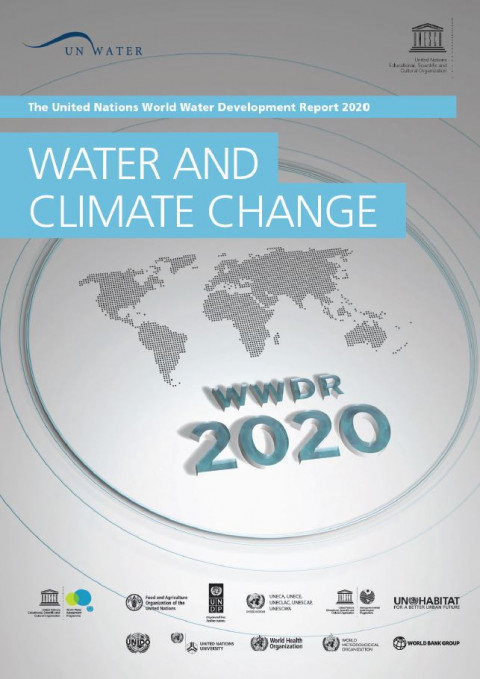 The United Nations World Water Development Report 2020: Water and Climate Change Année de publication: 2020 Auteur institutionnel: UNESCO World Water Assessment Programme (WWAP) The 2020 edition of the UN World Water Development Report addresses the critical linkages between water and climate change in the context of sustainable development. It also serves as a guide for concrete actions to address these challenges. It outlines actions, supported by examples from across the world, in three areas: first, enabling people to adapt to the impacts of climate change; second, improving the resilience of livelihoods; and, third, reducing the drivers of climate change. Critically, measures to improve the efficiency of water use in agriculture is inextricably linked to multiple SDGs. These include those related to zero hunger (SDG 2), availability and access to water (SDG 6), climate action (SDG 13), and promoting the sustainable use of ecosystem services (SDG 15).The Report concludes that reducing both the impacts and drivers of climate change will require substantial changes in the way we use and reuse the Earth’s limited water resources. The experience and expertise needed to achieve this goal are brought together in the Report through UN-Water’s Members and Partners. It will support policy makers in tackling the challenges of climate change by harnessing the wide-ranging opportunities that improved water management offers for adaptation, mitigation and resilience in a rapidly changing world. Rapport mondial des Nations Unies sur la mise en valeur des ressources en eau 2020: l'eau et les changements climatiques Année de publication: 2020 Auteur institutionnel: UNESCO World Water Assessment Programme (WWAP) L’édition 2020 du Rapport mondial sur la mise en valeur des ressources en eau montre les liens essentiels entre l’eau et les changements climatiques dans le cadre du développement durable. Le rapport sert également de guide pour prendre des mesures concrètes et relever ces défis. Il présente des actions, illustrées par des exemples provenant du monde entier, liées à trois domaines : premièrement, permettre aux personnes de s’adapter aux effets des changements climatiques ; deuxièmement, renforcer la résilience des moyens de subsistance ; enfin, réduire les moteurs des changements climatiques. Les mesures visant à accroître l’efficacité de l’utilisation de l’eau dans le domaine agricole – tout en garantissant l’accès à l’eau de groupes vulnérables tels que les petits exploitants agricoles – sont incontestablement liées à de multiples ODD. Il s’agit de ceux liés à l’objectif zéro faim (ODD 2), à la disponibilité et l’accès à l’eau (ODD 6), à l’action climatique (ODD 13) et à la promotion de l’utilisation durable des services écosystémiques (ODD 15).Le rapport conclut sur le fait que réduire tant les effets que les facteurs des changements climatiques exigera des transformations importantes dans la manière dont nous utilisons et réutilisons les ressources en eau limitées de la planète. L’expérience et l’expertise nécessaires pour atteindre cet objectif sont rassemblées dans ce rapport par les membres et partenaires d’ONU-Eau. Il contribuera à aider les dirigeants à lutter contre les difficultés liées aux changements climatiques en saisissant les vastes opportunités qu’offrent l’amélioration de la gestion de l’eau pour l’adaptation, la mitigation et la résilience dans un monde en rapide évolution.
 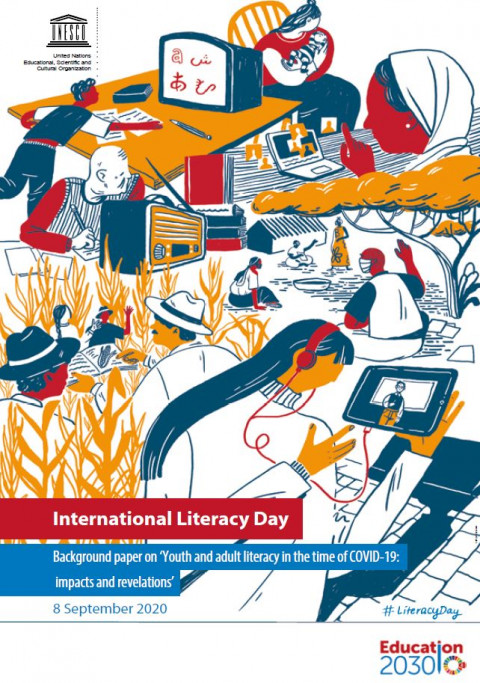 International Literacy Day: Background Paper on 'Youth and Adult Literacy in the Time of COVID-19; Impacts and Revelations' Année de publication: 2020 Auteur institutionnel: UNESCO Specially prepared on the occasion of International Literacy Day 2020, this background paper illustrates the impact of the COVID-19 crisis on youth and adult literacy, based on the limited information that is currently available. It provides five regional snapshots and identifies preliminary lessons learned thus far, while aiming to inspire continued reflection and subsequent action. It also makes the case for the ongoing importance of advancing youth and adult literacy, a priority that was already neglected even before the pandemic but which deserves all our attention. ILD 2020 thus seeks to trigger reimaginations of literacy teaching and learning in the COVID-19 crisis and beyond, with a particular focus on the role of educators. To live together: shaping new attitudes to peace through education Année de publication: 1997 Auteur: Daniel S. Halpérin Auteur institutionnel: UNESCO International Bureau of Education (IBE) The ‘To live together’ initiative was born at a meeting in February 1996 with Professor Emeritus Antoine Cuendet, a pediatric surgeon, former Dean of the Faculty of Medicine at Geneva University, and chairman of the Geneva Foundation to Protect Health in War (hereafter the Geneva Foundation). His foundation was in a process of trying to better define its scope of action within the large theme of ‘health and war’, and to identify areas of research that would deserve priority support. We agreed that, at a time when politicians had entered an era of peacemaking in the Middle-East, the situation might be suitable for Palestinians and Israelis to venture into joint research projects. In particular, a potentially fruitful project could be to examine the effects of long term, protracted conflicts-such as the Israeli-Palestinian one-on the mental and social health of children. Little was known about how much of their anxiety, psychosomatic complaints, agressivity, behavioural disorders or school failures may be linked with direct or indirect consequences of the conflict. What were the interventions or instruments that may counterbalance, or even correct such problems? Was there any kind of an educational programme, for instance, that might be demonstrated to be efficacious in counteracting those putative effects of the conflict; and that might prove of value in actually accelerating the healing of the traumatisms, while simultaneously strengthening the construction of peace? Pour vivre ensemble: l'élaboration de nouvelles attitudes à la paix par l'éducation Année de publication: 1997 Auteur: Daniel S. Halpérin Auteur institutionnel: UNESCO International Bureau of Education (IBE) L'initiative «Pour vivre ensemble» est né lors d'une réunion en Février 1996 avec le professeur Emeritus Antoine Cuendet, un chirurgien pédiatrique, ancien doyen de la Faculté de médecine de l'Université de Genève et président de la Fondation de Genève pour la protection de la santé dans la guerre (ci-après Fondation de Genève). Sa fondation était en train d'essayer de mieux définir son champ d'action au sein du grand thème de «la santé et de la guerre», et d'identifier les domaines de recherche qui mériterait un soutien prioritaire. Nous avons convenu que, à un moment où les politiciens étaient entrés dans une ère de rétablissement de la paix au Moyen-Orient, la situation pourrait être appropriée pour les Palestiniens et les Israéliens à se lancer dans des projets de recherche conjoints. En particulier, un projet potentiellement fructueux pourrait consister à examiner les effets de long terme, les conflits prolongés, tels que celui sur la santé israélo-palestinien mental et social des enfants. On ne savait pas combien de leur anxiété, troubles psychosomatiques, agressivité, troubles du comportement ou des échecs scolaires peuvent être liés avec des conséquences directes ou indirectes du conflit. Quelles ont été les interventions ou les instruments qui peuvent contrebalancer, voire corriger ces problèmes? Y avait-il tout type d'un programme d'éducation, par exemple, qui pourrait être démontré pour être efficace dans la lutte contre les effets putatifs du conflit; et qui pourrait se révéler utile pour accélérer effectivement la guérison des traumatismes, tout en renforçant simultanément la construction de la paix? Inter-agency peace education programme: skills for constructive living; overview of the programme Année de publication: 2005 Auteur: Antonella Verdiani Auteur institutionnel: UN. Office of the United Nations High Commissioner for Refugees (UNHCR) | Inter-agency Network for Education in Emergencies (INEE) This manual is one of the components of the “Inter-Agency Peace Education Programme”. The programme is designed for education managers of ministries dealing with both formal and non-formal education and for agencies which implement education activities on behalf of the government. The implementation structure is based on the experience acquired over the eight years the programme has been in use, from 1998 to 2005. The programme has been evaluated by external experts and the new revised materials (2005) incorporate both the suggestions made in the evaluation and the feedback from the specialists who implemented it in the field. Programme Interinstitution d'éducation pour la paix: compétences pour la vie constructive; aperçu du programme Année de publication: 2005 Auteur: Antonella Verdiani Auteur institutionnel: UN. Office of the United Nations High Commissioner for Refugees (UNHCR) | Inter-agency Network for Education in Emergencies (INEE) Ce manuel est l'une des composantes du «Programme Interinstitution d'éducation pour la paix». Le programme est conçu pour les gestionnaires de l'éducation des ministères chargés de l'éducation formelle et non-formelle et pour les organismes qui mettent en œuvre des activités d'éducation au nom du gouvernement. La structure de mise en œuvre est basée sur l'expérience acquise au cours des huit années, le programme a été utilisé, de 1998 à 2005. Le programme a été évalué par des experts externes et les nouveaux matériaux révisés (2005) intègrent à la fois les suggestions formulées dans l'évaluation et les réactions des spécialistes qui œuvre dans le domaine. Discours de M. Koïchiro Matsuura, Directeur général de l'UNESCO, à l'occasion de la Cérémonie de Remise du Prix UNESCO de l'Éducation pour la Paix 2008, UNESCO, 18 Septembre 2008 Année de publication: 2008 Auteur institutionnel: UNESCO. Director-General, 1999-2009 (Matsuura, K.) This is an address by Address by Mr Koïchiro Matsuura, Director-General of UNESCO, on the occasion of the Award Ceremony for the UNESCO Prize for Peace Education 2008.
 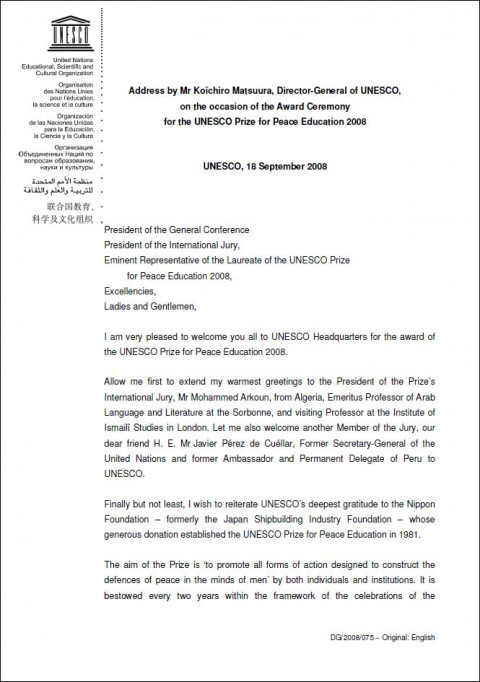 Address by Mr Koïchiro Matsuura, Director-General of UNESCO, on the occasion of the Award Ceremony for the UNESCO Prize for Peace Education 2008; UNESCO, 18 September 2008 Année de publication: 2008 Auteur institutionnel: UNESCO. Director-General, 1999-2009 (Matsuura, K.) This is an address by Address by Mr Koïchiro Matsuura, Director-General of UNESCO, on the occasion of the Award Ceremony for the UNESCO Prize for Peace Education 2008.