
Ressources
Explorez une large gamme de ressources sur le GCED afin d’approfondir votre compréhension et de renforcer vos activités de recherche, de plaidoyer, d’enseignement et d’apprentissage.
1,443 résultats trouvés
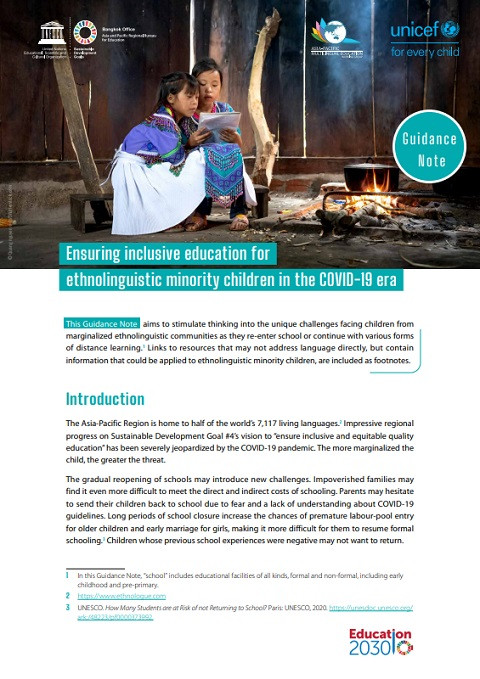 Ensuring Inclusive Education for Ethnolinguistic Minority Children in the COVID-19 Era: Guidance Note Année de publication: 2021 Auteur institutionnel: UNESCO Bangkok This Guidance Note aims to stimulate thinking into the unique challenges facing children from marginalized ethnolinguistic communities as they re-enter school or continue with various forms of distance learning. Links to resources that may not address language directly, but contain information that could be applied to ethnolinguistic minority children, are included as footnotes.
  Media Literacy at Your Library: Learning and Prototyping Report Année de publication: 2018 Auteur institutionnel: American Library Association (ALA) Media Literacy at Your Library was a project of the American Library Association (ALA) in collaboration with the Center for News Literacy at Stony Brook University (CNL), supported by the John S. and James L. Knight Foundation, the Democracy Fund, and the Rita Allen Foundation as part of the Knight Prototype Fund.Through this project, ALA sought to address a critical need in the field for adult media literacy education, with a focus on news literacy. The goal of the prototype project was to develop media literacy training and complementary resources designed to prepare public library professionals to educate their adult patrons to be informed media consumers.Following a one-day training led by CNL, teams from five public libraries took on the challenges of creating innovative media literacy programs serving their distinct communities. With the goal of making the CNL news literacy curriculum more broadly accessible to the library field, the teams also offered feedback on a series of online trainings based on the in-person training they attended. These five library teams guided and informed ALA and CNL’s understanding and development of prototype resources over the course of the project.
  Consultation Paper on AI Regulation: Emerging Approaches Across the World Année de publication: 2024 Auteur: Juan David Gutiérrez Auteur institutionnel: UNESCO Since 2016, over thirty countries have passed laws explicitly mentioning AI, and in 2024, the discussion about AI bills in legislative bodies has increased globally. This policy brief aims to inform legislators about the different regulatory approaches to artificial intelligence (AI) being considered worldwide by legislative bodies. The brief explains nine emerging regulatory approaches, each illustrated with specific cases worldwide. The order in which the nine AI regulatory approaches are presented is deliberately structured to guide readers from less interventionist, light-touch regulatory measures to more coercive, demanding approaches. These regulatory approaches are not mutually exclusive and AI bills often combine two or more approaches:1. Principles-Based Approach2. Standards-Based Approach3. Agile and Experimentalist Approach4. Facilitating and Enabling Approach5. Adapting Existing Laws Approach6. Access to Information and Transparency Mandates Approach7. Risk-Based Approach8. Rights-Based Approach9. Liability Approach The policy brief suggests parliamentarians how they can address three key questions before adopting AI regulations:1. Why regulate? Determine whether regulation is needed to address public problems, fundamental and collective rights, or desirable futures.2. When to regulate? Reach a consensus on why regulation is needed, map available regulatory instruments, compare them with other policy instruments, and assess the feasibility of adopting the former.3. How to regulate? Identify a combination of AI regulatory approaches that are tailored to specific contexts.
  Teaching approaches that help to build resilience to extremism among young people Année de publication: 2011 Auteur institutionnel: United Kingdom. Department of Education This is a summary for decision-makers – policy- makers, school leaders, teachers and other practitioners, such as youth and community workers – of the key ingredients of evidence-based teaching approaches and interventions that are effective in building resilience to extremism among young people. It also details support factors in schools and other education settings that maximize the benefits and impact of such interventions. Teaching approaches that help to build resilience to extremism among young people Année de publication: 2011 Auteur institutionnel: United Kingdom. Department of Education Il s’agit d’un résumé des éléments clés des approches et interventions éducatives qui se sont avérées efficaces pour développer et renforcer la résilience des jeunes à l’extrémisme, destiné aux décideurs politiques ou non, chefs d’établissement scolaire, enseignants et autres acteurs du domaine éducatif, comme les jeunes et les animateurs socio-culturels. Le livre détaille également le soutien à apporter aux écoles et autres environnements éducatifs pour maximiser les bénéfices et l’impact de ces interventions.
  Quality Adult Education Benchmarks for Indigeneous Education Année de publication: 2011 Auteur: Sandra L. Morrison | Timote Vaioleti Auteur institutionnel: Asia South Pacific Association for Basic and Adult Education (ASPBAE) In November 2010, in Indonesia, Asia South Pacific Association for Basic and Adult Education(ASPBAE) brought together a number of educators from across its region to discuss benchmarking quality adult education for indigenous peoples. Educators came from across the ASPBAE region including the Philippines, India, Nepal, New Zealand, Australia, Thailand, Indonesia and Uzbekistan to share experiences and to build a collective understanding of what constitutes a good quality adult education program for indigenous peoples. Discussions were informed by a broader ASPBAE Quality Adult Education Framework, which had its origins in discussions held in 2009. The Core of the Framework is grounded on ASPBAE’s commitment to education as a right, adult education for transformation, and adult and basic education as integral and inter‐connected components of the vision of lifelong learning (Guevara, 2010). Other frameworks promoted by ASPBAE for education to be empowering, pro‐poor, gender just and sustainable were also important considerations. The 2010 gathering served as a nodal point to discuss the ASPBAE framework more deeply and to reaffirm or create a set of benchmarks for indigenous education which can be validated through a subsequent national and regional consultation process.
 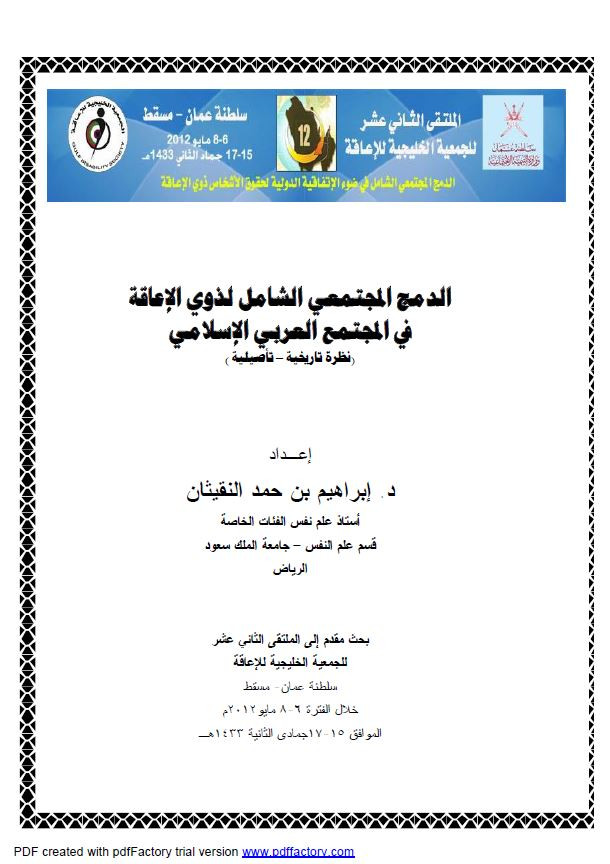 Comprehensive Societal Integration of People with Disabilities in the Arab and Islamic Society (A Historical-original View) Année de publication: 2012 Auteur: Ibrahim Alnuqythan Auteur institutionnel: Gulf Society for Diability The file is a research paper that discusses the comprehensive integration of persons with disabilities in the Arab and Islamic world. The paper seeks to answer the following questions:- Did the disabled in the Arab-Islamic civilization have a comprehensive integration into society?What are the examples of this integration in the Arab-Islamic civilization?The paper discussed and touched on live models that show the reality of inclusion of persons with disabilities in society. الدمج المجتمعي الشامل لذوي الإعاقة في المجتمع العربي الإسلامي (نظرة تاريخية-تأصيلية) Année de publication: 2012 Auteur: Ibrahim Alnuqythan Auteur institutionnel: Gulf Society for Diability الملف عبارة عن ورقة بحثية تناقش الدمج الشامل للمعوقين في الوطن العربي والإسلامي. وتسعى الورقة للإجابة عن الأسئلة التالية:- هل كان للمعوقين في الحضارة العربية الإسلامية دمج شامل في المجتمع؟- ما النماذج على هذا الدمج في الحضارة العربية الإسلامية؟ولقد ناقشت الورقة وتطرقت لنماذج حية تظهر واقع ادماج المعوقين في المجتمع. Russian regions for sustainable development: education and culture of peoples in Russian Federation; proceedings of the international conference Année de publication: 2010 Auteur: Ilona Graf | Natalia Dulepova | Nikolai Lyakhov | Vera Markova | Vladimir Sobyanin | Victoria Shatrova Auteur institutionnel: Novosibirsk State University The publication gives careful consideration to RF regional efforts to contribute undertaking a survey of educational contents and methods promoting cultural diversity, including traditional modes of transmission, in Siberia as a vast territory involving three greatest regions of Russian Federation. The mainstream of this recognition and accommodation of Siberian cultural diversity – efforts to create opportunities and facilities for culture-specific learning in each region, adapting teaching methods to the requirements of the everyday life of learners with the support of educational policymakers, educational professionals at all levels and local communities. The goal of publication is contributing to raising the awareness of Siberian population in recognizing the cultural dimension as a central pillar of the UNESCO decade «Education for Sustainable Development» (2005-2014). The publication is aimed at teachers, ethnologists, sociologists, linguists, philosophers, those researching the education and culture of peoples in Russia, government specialists, representatives of national-cultural communities of indigenous peoples and ethnic minorities. Régions russes pour le développement durable: l'éducation et la culture des peuples de la Fédération de Russie; Actes de la Conférence internationale Année de publication: 2010 Auteur: Ilona Graf | Natalia Dulepova | Nikolai Lyakhov | Vera Markova | Vladimir Sobyanin | Victoria Shatrova Auteur institutionnel: Novosibirsk State University La publication donne une attention particulière aux efforts régionaux RF pour contribuer d'entreprendre une enquête sur les contenus et les méthodes pédagogiques favorisant la diversité culturelle, y compris les modes traditionnels de transmission, en Sibérie comme un vaste territoire impliquant trois plus grandes régions de la Fédération de Russie. Le courant dominant de cette reconnaissance et d'hébergement de Sibérie diversité culturelle - des efforts pour créer des opportunités et des installations pour spécifiques à la culture d'apprentissage dans chaque région, en adaptant les méthodes d'enseignement aux exigences de la vie quotidienne des apprenants avec le soutien des décideurs éducatifs, professionnels de l'éducation du tout les niveaux et les communautés locales. Le but de la publication contribue à la sensibilisation de la population sibérienne dans la reconnaissance de la dimension culturelle comme un pilier central de l'UNESCO décennie «Education pour le développement durable» (2005-2014). La publication est destinée aux enseignants, ethnologues, sociologues, linguistes, philosophes, ces recherches sur l'éducation et la culture des peuples en Russie, les spécialistes du gouvernement, des représentants des communautés culturelles nationales des peuples autochtones et des minorités ethniques.