
Ressources
Explorez une large gamme de ressources sur le GCED afin d’approfondir votre compréhension et de renforcer vos activités de recherche, de plaidoyer, d’enseignement et d’apprentissage.
3,224 résultats trouvés
 Programme de Citoyenneté Mondiale dans l'enseignement supérieur: la politique et la pratique en évolution et un futur programme de recherche; actes d'un colloque tenu les 9-10 Décembre 2013 à Hong Kong Année de publication: 2013 Auteur institutionnel: Bath Spa University | General Education Centre (Hong Kong) | Polytechnic University Ce symposium était une excroissance du Conseil de la recherche économique et sociale du Royaume-Uni (en. ESRC) financé Projet international de réseautage. Une collaboration entre les universitaires au Royaume-Uni / Europe, Amérique du Nord, et en Asie, ce projet répond au fait qu'il ya un intérêt croissant pour comprendre comment les universités peuvent éduquer les élèves à devenir des citoyens plus engagés et ouverts sur le monde. La prémisse est que l'enseignement supérieur doit contribuer au bien public par la formation des citoyens plus globales avec la conscience culturelle, un fort sentiment de responsabilité et les compétences civiques de participer à une économie mondiale fondée sur le savoir. Le rapport suivant documente les actes du colloque, résume les présentations et fournit des informations clés tirées des présentations. Commentaires formulés par les individus sont paraphrasés et / ou synthétisés.
 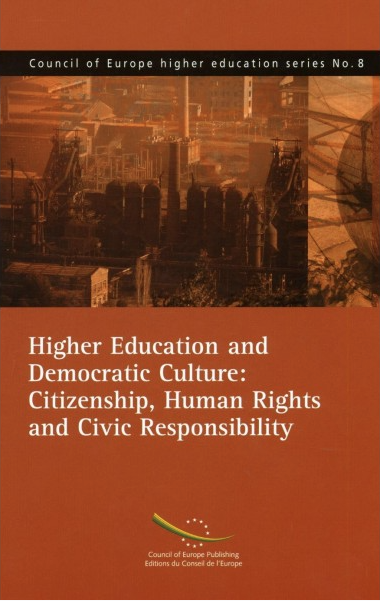 Higher Education and Democratic Culture: Citizenship, Human Rights and Civic Responsibility (Council of Europe Higher Education Series No.8) Année de publication: 2008 Auteur: Josef Huber | Ira Harkavy Auteur institutionnel: Council of Europe This book on the responsibility of higher education for a democratic culture is the 8th volume in the Council of Europe's Higher Education series. It is the direct result of a Higher Education Forum held in June 2006 on the responsibility of higher education for citizenship, human rights and sustainability. This forum was a part of the Council of Europe's long-standing commitment to work in the area of education for democratic citizenship and human rights. It complements earlier work on the public responsibility for higher education and research which led to a recommendation of the Committee of Minister to the member states of the Council of Europe in 2007. If our aim is to work for sustainable democratic societies, the responsibility of public authorities for a high-quality higher education system must go hand in hand with the responsibility of higher education institutions towards the advancement of society.
 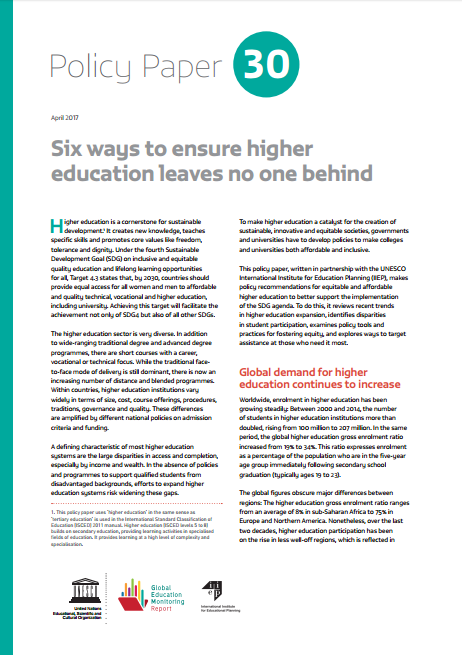 Six ways to ensure higher education leaves no one behind Année de publication: 2017 Auteur institutionnel: UNESCO International Institute for Educational Planning (IIEP) This policy paper, written in partnership with the UNESCO International Institute for Education Planning (IIEP), makes policy recommendations for equitable and affordable higher education to better support the implementation of the SDG agenda. To do this, it reviews recent trends in higher education expansion, identifies disparities in student participation, examines policy tools and practices for fostering equity, and explores ways to target assistance at those who need it most. Six façons de garantir que l'enseignement supérieur ne laisse personne sur le carreau Année de publication: 2017 Auteur institutionnel: UNESCO International Institute for Educational Planning (IIEP) This policy paper, written in partnership with the UNESCO International Institute for Education Planning (IIEP), makes policy recommendations for equitable and affordable higher education to better support the implementation of the SDG agenda. To do this, it reviews recent trends in higher education expansion, identifies disparities in student participation, examines policy tools and practices for fostering equity, and explores ways to target assistance at those who need it most. Seis maneras de asegurar que la educación superior no deje a nadie atrás Année de publication: 2017 Auteur institutionnel: UNESCO International Institute for Educational Planning (IIEP) This policy paper, written in partnership with the UNESCO International Institute for Education Planning (IIEP), makes policy recommendations for equitable and affordable higher education to better support the implementation of the SDG agenda. To do this, it reviews recent trends in higher education expansion, identifies disparities in student participation, examines policy tools and practices for fostering equity, and explores ways to target assistance at those who need it most.
 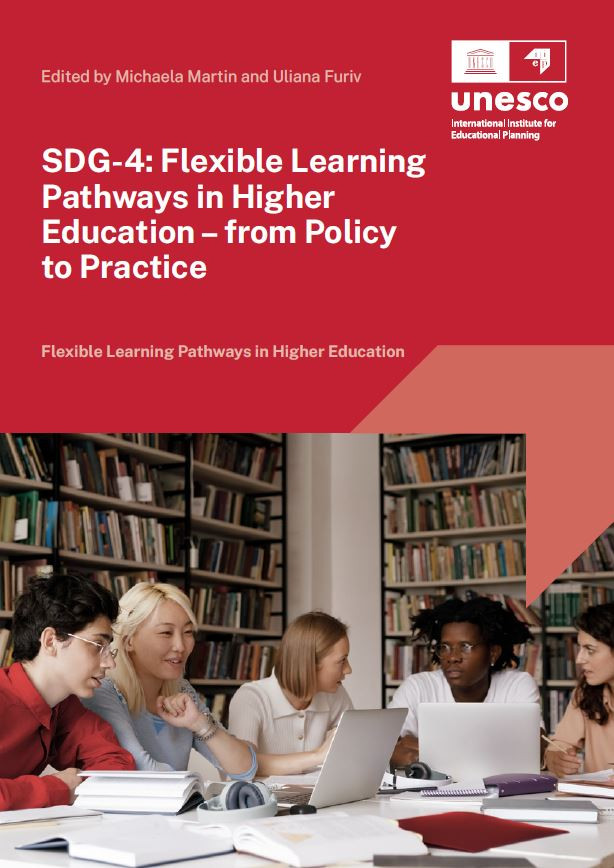 SDG-4: Flexible Learning Pathways in Higher Education – from Policy to Practice: An International Comparative Analysis Année de publication: 2022 Auteur: Michaela Martin | Uliana Furiv Auteur institutionnel: UNESCO International Institute for Educational Planning (IIEP) Higher education systems across the world are currently faced with a massive influx of learners with more diverse needs. They are expected to respond to this growing diversity through a more flexible learning offer and pathways that allow all learners, including those from disadvantaged groups, to access, progress through, and complete, higher education.To enhance knowledge on how to provide increased flexibility in higher education, IIEP–UNESCO undertook an international research project on SDG-4: Planning for Flexible Learning Pathways (FLPs) in Higher Education. The project included a stocktaking of policies, instruments, and practices, an international survey among UNESCO Member States, and eight in-depth country studies on Chile, Finland, India, Jamaica, Malaysia, Morocco, South Africa, and the UK.This book presents the findings from the research, including a cross-country analysis of available FLP policies and practices, and how they enhance equitable higher education systems. It also presents a series of country experiences with innovative approaches to alternative entry, flexible progression, and governance systems in support of FLPs. Discours de Mme Irina Bokova, Directrice générale de l'UNESCO, à l'occasion de l'ouverture de laconférenceinternationale sur l'enseignement supérieur pour le développement durable: Au-delà de l'enseignement supérieur 2014 Année de publication: 2014 Auteur institutionnel: UNESCO. Director-General, 2009-2017 (Bokova, I.G.) Cette adresse a été faite par Irina Bokova, Directrice générale de l'UNESCO, à l'occasion de l'ouverture de la conférence internationale sur l'enseignement supérieur pour le développement durable: Au-delà de l'enseignement supérieur 2014. Address by Irina Bokova, Director-General of UNESCO, on the occasion of the Opening of the International Conference on Higher Education for Sustainable Development: Higher Education Beyond 2014; Nagoya University, Aichi, Japan, 9 November 2014 Année de publication: 2014 Auteur institutionnel: UNESCO. Director-General, 2009-2017 (Bokova, I.G.) This address had been made by Irina Bokova, Director-General of UNESCO, on the occasion of the opening of the International Conference on Higher Education for Sustainable Development: Higher Education Beyond 2014.
 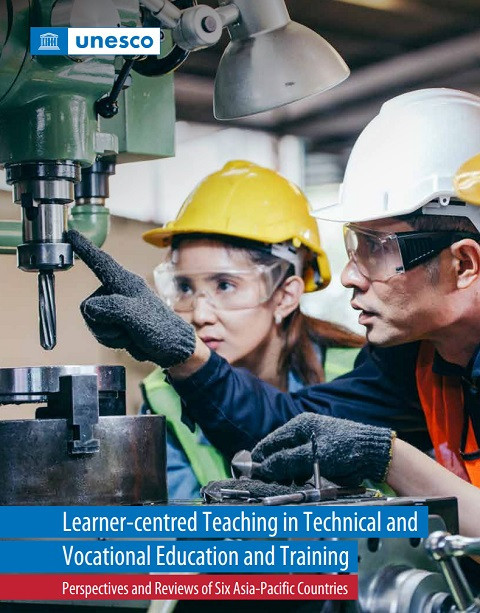 Learner-Centred Teaching in Technical and Vocational Education and Training: Perspectives and Reviews of Six Asia-Pacific Countries Année de publication: 2023 Auteur institutionnel: UNESCO Bangkok Learner-centred Teaching in Technical and Vocational Education and Training: Perspectives and Reviews of Six Asia-Pacific Countries A learner-centred approach to teaching in Technical and Vocational Education and Training (TVET) is based on learner engagement, autonomy and outcome-based activities to support professional development. This report analyses the status of learner-centred TVET teaching in six selected countries across Asia and the Pacific, including China, Republic of Korea, Samoa, Sri Lanka, Thailand, and Uzbekistan. The countries were selected because of their geographic diversity, access to national experts, and potential around learner-centred TVET.The first part of the study is a review of the theoretical background on the learner-centred approach and TVET teaching with an international scope. A total of 25 indicators were used to assess three components of TVET teaching in the region. The analysis includes 17 examples corresponding to the selected indicators. The findings showcase lessons learned and recommendations for countries to self-assess their TVET teaching strategies. These examples will help to inform future projects and capacity building in each sub-region of Asia-Pacific.As a result, seven proposals are identified and discussed to promote the development of learner-centred TVET teaching in the region. These proposals include: 1) supporting national reform of the pedagogy based on the results of pilot projects; 2) increasing two-way communication between students and teachers; 3) producing learning materials adapted to learner-centred methods; 4) using technology in the learning process; 5) implementing competency-based learning to support the learner-centred pedagogy; 6) integrating transversal and core skills; and 7) developing teachers’ capacities by employing a learner-centred approach. These proposals (on reform, teaching method, use of materials, etc.) also address gender dimensions throughout the planning, implementation and review process. Conclusions from the study provide lessons learned as well as proposals for further research and implementation of learner-centred TVET teaching in Asia-Pacific.
  Учёт показателей достижения ЦУР 4: доклад о ходе достижения национальных контрольных показателей; в фокусе внимания — учителя Année de publication: 2024 Auteur institutionnel: Global Education Monitoring Report Team | UNESCO Institute for Statistics (UIS) В настоящем издании представлена вторая оценка прогресса в достижении странами контрольных показателей, или национальных плановых ориентиров, установленных ими в отношении восьми показателей достижения ЦУР 4 в качестве вклада в реализацию глобальных целей. В этой оценке, охватывающей период с 2015 года, анализируется вероятность достижения каждой из стран национального контрольного показателя на 2025 год или (если контрольный показатель не был установлен) значения, которого они могли бы достичь в случае, если бы темпы их прогресса в истекший период (2000–2015 годы) были на уровне 25 % наиболее быстро прогрессирующих стран.В докладе об учете показателей достижения ЦУР 4 за 2024 год отмечено, что по большинству показателей темпы прогресса в достижении национальных целевых ориентиров отстают от плановых. Более того, по двум аспектам – гендерный дисбаланс (в пользу девочек) по показателю завершения полной средней школы и государственные расходы на образование в процентной доле от общего объема государственных расходов – в странах был зафиксирован регресс.Напротив, ускорился прогресс в достижении нового, восьмого показателя ЦУР 4 (доступ школ к интернету), который был добавлен с учетом приоритетного внимания, уделенного в ходе Саммита по трансформации образования 2022 года проблематике внедрения цифровых технологий. Треть стран установила в 2023 году национальные плановые ориентиры по этому показателю, в связи с чем в настоящем издании был впервые рассмотрен прогресс в этом вопросе.Наряду с этим относительно быстрыми темпами растет процентная доля учителей, имеющих минимально требуемый уровень квалификации. Этому показателю в настоящей публикации также было уделено повышенное внимание. В докладе представлены новые данные о национальных стратегиях в отношении минимальных уровней квалификации для доступа к учительской профессии, а также о правилах и стандартах, касающихся обязательного непрерывного повышения квалификации и обучения учителей навыкам применения новых технологий в сфере образования.